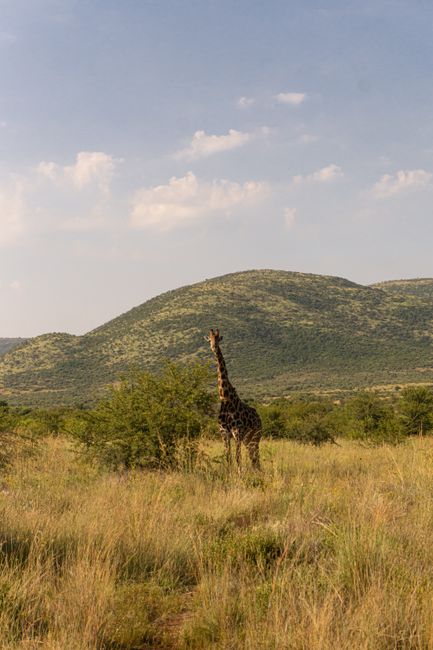
Pilanesberg National Park is the easiest Big Five safari from Johannesburg and Pretoria: a malaria-free game reserve of about 550 km² (210 square miles), roughly 2.5 hours’ drive from the city, set inside the eroded crater of an ancient volcano. The Pilanesberg Complex, a rare alkaline ring structure well over a billion years old, rises from the flat bushveld of the North West province as a circle of rocky hills around a central lake, Mankwe Dam, giving the park a scenery quite unlike Kruger’s plains. Created in 1979 on former farmland, it was restocked with thousands of animals in “Operation Genesis,” one of the largest game translocations ever attempted, and today is home to lion, leopard, elephant, buffalo and both white and black rhino, as well as cheetahs, wild dogs, hippos, giraffes, zebras, many antelope and more than 350 bird species. The park is run by North West Parks, a provincial agency. You can drive yourself on tarred and gravel roads, join guided game drives from the gates and lodges, or stay at one of the resorts inside the park, and the Sun City resort with its water park and golf courses is right next door. The climate is warm and summer-rainfall: summer (November to March) is hot with afternoon storms; winter (May to August) is dry, sunny and cool, with cold mornings.
Right now in Pilanesberg National Park (Mankwe Dam)
- Wed15–28°C59–83°FClear
- Thu14–28°C58–82°FClear
- Fri16–30°C61–87°FClear
Top tours in Pilanesberg National Park
See all tours for Pilanesberg National Park →
From local operators, with prices and reviews; you check availability and book on Viator, our partner. We may earn a commission at no extra cost to you. How we earn money
Pilanesberg at a glance
- Best months: May to September for game viewing, with dry, thin bush and animals at the water; April and October are also good. Summer is green, hot and stormy, with baby animals and birds.
- Time needed: a long day trip from Johannesburg is possible; one or two nights in or near the park are much better.
- Getting there: about 170–190 km (105–120 miles) from Johannesburg and 150 km (95 miles) from Pretoria, two to 2.5 hours by car. Pilanesberg International Airport (NTY) near Sun City has limited flights.
- Costs (as of October 2026): published gate tariffs list about R748 (about US$45) per foreign adult per day, plus R168 per vehicle; check with North West Parks.
- Before you go: visas, money and safety basics are covered in our South Africa travel guide.
Entry fees, gates and park rules
Conservation fees
Pilanesberg charges a daily entry (conservation) fee per person plus a vehicle fee, paid at the gate by card. The rates below, valid from 1 December 2025, are as published by tourism sites linked to the park; we could not read North West Parks’ own tariff page, so check before you go.
| Visitor category (from 1 Dec 2025) | Per person, per day | About US dollars |
|---|---|---|
| — | — | — |
| Foreign nationals, adult | R748 | $45 |
| SADC nationals, adult / child | R385 / R275 | $23 / $17 |
| South African citizens, adult | R168 | $10 |
| South African children (5–12) and pensioners | R84 | $5 |
| Vehicle (sedan, SUV or pickup) | R168 | $10 |
The SANParks Wild Card does not cover Pilanesberg, which is a provincial park.
Gate times
Gates open around dawn and close around dusk, changing with the season: approximately 05:30 to 19:00 from November to February, 06:00 to 18:30 in March, April, September and October, and 06:30 to 18:00 from May to August. Times can change, so confirm on arrival, and be out of the park, or inside your resort’s fence, before closing.
Gates
There are four main public gates: Manyane in the east (nearest from Johannesburg and Pretoria via Mogwase), Bakgatla in the north, and Bakubung and Kwa Maritane in the south near Sun City. A fifth gate serves the private Black Rhino reserve in the west.
Park rules
Stay in your vehicle except at designated hides, picnic sites and the Pilanesberg Centre; don’t feed animals; keep to the speed limits (generally 40 km/h or 25 mph) and marked roads; don’t drive off-road; and give elephants plenty of space.
Pilanesberg areas and who each one suits
Mankwe Dam and the center
The large lake at the heart of the crater attracts hippos, crocodiles, waterbirds and animals coming to drink, and the Mankwe hide lets you watch from a walkway at the water’s edge. Nearby, the Pilanesberg Centre, a restored 1930s magistrate’s court, has a restaurant, viewing deck and curio shop, and is a natural midday stop.
The eastern side: Manyane
The Manyane gate area is the most convenient entry from Johannesburg and Pretoria, with a resort and campsite just outside the gate, and good game-viewing loops toward the center.
The north: Bakgatla
Rocky hills, open valleys and the Bakgatla resort under the crater rim; quieter roads and good chances of rhino, elephant and giraffe.
The south: Bakubung, Kwa Maritane and Sun City
The southern gates are next to Sun City and have several lodges with their own hides and game drives. Good if you want to combine safari and resort, or if you’re traveling with children.
Top things to see in Pilanesberg
Self-drive game viewing
Around 200 km (125 miles) of roads cross the crater, many of them gravel but suitable for ordinary cars in dry weather. Popular areas include the roads around Mankwe Dam, the open plains in the center, and the valleys near Bakgatla. The best times are the first hours after the gates open and the late afternoon. Ask at the gate about recent sightings and check the boards at the Pilanesberg Centre.
Guided game drives
Licensed operators at the gates and lodges run morning, afternoon and night drives in open safari vehicles. Night drives are the only way to be in the park after dark and give a chance of seeing hyenas, leopards and nocturnal animals. Guided drives are also the best option if you’d rather not drive yourself.
Hides
Several hides at waterholes and dams, including Mankwe and Ruighoek, let you leave your car and sit quietly watching animals and birds come to drink. Hides are perfect for photographers and birders.
The volcanic landscape
The concentric rings of hills, dolerite and syenite outcrops and the crater rim make Pilanesberg one of the world’s best-preserved alkaline ring complexes. Geology signs along some roads explain how the crater formed.
Hot-air balloon safaris
Early-morning balloon flights over the crater, weather permitting, give a bird’s-eye view of the volcanic rings and animals below, followed by breakfast.
Operation Genesis and rhino conservation
Before 1979, the crater was farmland, and much of its wildlife had long disappeared. When the park was proclaimed, the old farms and fences were removed, alien plants cleared, and thousands of animals of many species brought in from other reserves, including elephants, rhinos and, later, lions and wild dogs, in what was called Operation Genesis. The Bakgatla and other communities who live around the crater are part of the park’s story, and several gates and camps carry their names. Today Pilanesberg is an important refuge for rhinos, and, as in all South African parks, rangers don’t share rhino locations, so please don’t post their position on social media.
Pilanesberg with children
Pilanesberg is one of the best parks in South Africa for families: it is malaria-free, close to Johannesburg, small enough that you reach good game-viewing areas quickly, and next to Sun City’s pools and water park. Many lodges and resorts welcome children, and some offer junior ranger activities. Note that age limits often apply on guided game drives in open vehicles, usually around six years, so self-driving can be easier with toddlers.
Other things to do near Pilanesberg
- Sun City: the Valley of Waves water park, the Lost City’s Palace, casinos, golf at the Gary Player Country Club, and the Sun City zipline.
- Guided bush walks: with armed rangers from some lodges.
- Elephant-back and animal interactions: you’ll see such activities offered nearby; many conservation organizations discourage riding or touching wild animals.
- Cultural visits: to communities around the park with local guides.
- Birding: more than 350 species recorded, including raptors and waterbirds at Mankwe Dam.
Food and drink
The Pilanesberg Centre inside the park has a restaurant and deck with views, and the resorts at Manyane, Bakgatla and the southern lodges have restaurants and braai areas. Sun City has many restaurants. There are few shops inside the park, so stock up in Mogwase, Rustenburg or at Sun City before you go, and carry water and snacks for long drives.
Day trips and nearby
Sun City
The resort is right next to the southern gates, with water parks, pools, golf, restaurants and entertainment, a popular combination with a safari for families.
Madikwe Game Reserve
About three hours northwest on the Botswana border, Madikwe is another malaria-free Big Five reserve, with exclusive private lodges and no day visitors.
The Magaliesberg and Hartbeespoort
On the way from Johannesburg or Pretoria, the Magaliesberg mountains and Hartbeespoort Dam have a cableway, markets, hot-air ballooning and country restaurants.
Johannesburg and Pretoria
Many visitors do Pilanesberg as an overnight trip from Johannesburg or Pretoria. For a longer safari, continue to Kruger National Park, a malaria-area park in the northeast.
Nearby destinations
- Pretoria122 km
- Johannesburg141 km
Getting there and getting around
By road
From Johannesburg, the usual route is the N4 toll road west via Hartbeespoort, then north via Rustenburg or the R556 to the southern gates, or via Mogwase to Manyane, about two to 2.5 hours. From Pretoria, it’s about two hours via the N4. The roads are tarred all the way to the gates. Leave early to make the most of the morning game viewing, and avoid driving back after dark.
Tours and transfers
Day tours and overnight safari packages run from Johannesburg and Pretoria hotels, usually with game drives in open vehicles. Transfers from OR Tambo airport and Sun City shuttle services are also available.
Flying
Pilanesberg International Airport (NTY) near Sun City has limited scheduled and charter flights; most visitors drive from Johannesburg.
When to go and how long to stay
Pilanesberg has a warm, summer-rainfall climate. Summer (November to March) is hot, around 29–30 °C (84–87 °F), with afternoon thunderstorms, lush green bush and newborn animals. Autumn (April and May) is warm, clear and drying out. Winter (June to August) is dry, sunny and pleasant by day, around 21 °C (70 °F), with cold mornings near freezing, ideal for game viewing. Spring (September and October) heats up before the rains.
| Month | Average high | Average low | Rain | Rain days |
|---|---|---|---|---|
| Jan | 30 °C (87 °F) | 18 °C (64 °F) | 108 mm (4.3 in) | 12 |
| Feb | 30 °C (86 °F) | 17 °C (63 °F) | 85 mm (3.3 in) | 9 |
| Mar | 29 °C (83 °F) | 15 °C (60 °F) | 69 mm (2.7 in) | 9 |
| Apr | 26 °C (80 °F) | 12 °C (53 °F) | 32 mm (1.3 in) | 6 |
| May | 24 °C (75 °F) | 7 °C (45 °F) | 13 mm (0.5 in) | 2 |
| Jun | 21 °C (70 °F) | 4 °C (38 °F) | 6 mm (0.2 in) | 2 |
| Jul | 21 °C (70 °F) | 3 °C (38 °F) | 2 mm (0.1 in) | 0 |
| Aug | 24 °C (75 °F) | 6 °C (42 °F) | 4 mm (0.2 in) | 1 |
| Sep | 28 °C (82 °F) | 10 °C (51 °F) | 14 mm (0.6 in) | 2 |
| Oct | 29 °C (84 °F) | 14 °C (57 °F) | 56 mm (2.2 in) | 8 |
| Nov | 30 °C (85 °F) | 16 °C (60 °F) | 69 mm (2.7 in) | 10 |
| Dec | 30 °C (86 °F) | 17 °C (62 °F) | 94 mm (3.7 in) | 12 |
| Year | 27 °C (80 °F) | 12 °C (53 °F) | 552 mm (22 in) | 72 |
Figures are the South African Weather Service’s 1981–2010 normals for Rustenburg, about 40 km (25 miles) southeast of the park, the nearest station in the WMO’s World Weather Information Service. Inside the crater, early mornings are often a little colder.
How long to stay: 1, 2 and 3 days
- One day: leave Johannesburg at dawn, enter at Manyane, drive to Mankwe Dam and the Pilanesberg Centre, and exit before the gates close.
- Two days: stay one night inside the park and add a night drive or sunrise drive.
- Three days: add a balloon flight and a day at Sun City, or continue to Madikwe.
Where to stay in Pilanesberg
- Resorts and camps inside the park: chalets, tents and campsites at Bakgatla and other camps, with restaurants and pools.
- Manyane: a resort and campsite just outside the eastern gate.
- Lodges inside the park: private lodges near the southern and western gates, with game drives and meals included.
- Sun City: large resort hotels next to the southern gates.
Book ahead for school holidays and long weekends.
Typical costs in Pilanesberg
| Item (as of October 2026) | Rand | About US dollars |
|---|---|---|
| — | — | — |
| Entry, foreign adult, per day (published tariff) | R748 | $45 |
| Vehicle entry, per day (published tariff) | R168 | $10 |
| Guided game drive, 2.5–3 hours | about R600–900 | about $36–54 |
| Hot-air balloon safari | about R5,000–6,500 | about $300–390 |
| Chalet or safari tent for two, per night | about R1,500–3,000 | about $90–180 |
| Private lodge, per person per night, all-inclusive | about R4,000–12,000 | about $240–720 |
Entry fees are as published from 1 December 2025 and flagged for checking with North West Parks; other prices are typical ranges. Conversions use about R16.60 to US$1.
Safety in Pilanesberg
- Malaria: Pilanesberg is malaria-free, which makes it a popular choice for families with young children and travelers who want to avoid antimalarial tablets.
- Wildlife: stay inside your vehicle except at designated areas, keep windows up near lions and elephants, and never get between an elephant and its calf. Walk only with armed guides.
- Gate times: plan your route so you reach a gate or your camp before closing; the crater roads are slow.
- Weather: summer storms can make gravel roads slippery; drive carefully and avoid low-water crossings in heavy rain. Winter mornings are cold in open vehicles.
- Driving to the park: avoid driving after dark on rural roads, watch for pedestrians, livestock and potholes, and keep valuables out of sight.
- Emergencies: contact your camp or the gate staff; for national services call 10111 (police) or 10177 (ambulance), or 112 from a mobile.
Practical tips for Pilanesberg
- Arrive early: the best sightings are in the first hours after the gates open.
- Fuel: fill up in Mogwase, Rustenburg or Sun City before entering.
- Map: buy a park map at the gate; mobile coverage is patchy in the valleys.
- Power: national load-shedding has been suspended; resorts have backup power.
What to pack for Pilanesberg
Bring binoculars, a camera with a zoom lens, neutral-colored clothes, a warm fleece, hat and gloves for winter mornings and night drives, a sun hat, sunglasses and SPF 50 sunscreen, plenty of water, snacks, and a field guide or app for mammals and birds. Pilanesberg is malaria-free, but insect repellent is still useful in summer. See our rain jackets guide for the summer storm season.
Pilanesberg National Park travel FAQ
Is Pilanesberg malaria-free?
Yes. Pilanesberg is in a malaria-free area, which makes it popular with families and short-stay visitors from Johannesburg.
How far is Pilanesberg from Johannesburg?
About 170–190 km (105–120 miles), around two to 2.5 hours by car.
Can you see the Big Five in Pilanesberg?
Yes. Lion, leopard, elephant, buffalo and rhino live in the park; leopards are the hardest to spot.
How much is the entry fee for Pilanesberg?
Published tariffs from 1 December 2025 list R748 per foreign adult per day plus R168 per vehicle; South Africans pay R168. Check current rates with North West Parks.
What are Pilanesberg’s gate times?
Roughly 05:30 to 19:00 from November to February, 06:00 to 18:30 in spring and autumn, and 06:30 to 18:00 from May to August.
Can I drive myself in Pilanesberg?
Yes. Ordinary cars can use the tarred and most gravel roads in dry weather. Stay in your vehicle and keep to the speed limits.
Does the Wild Card cover Pilanesberg?
No. Pilanesberg is run by North West Parks, not SANParks, so the SANParks Wild Card doesn’t apply.
Is Pilanesberg a good day trip from Johannesburg?
It’s possible if you leave very early, but one night in or near the park makes the trip far more relaxed and rewarding.
What is the best time to visit Pilanesberg?
May to September, the dry season, for game viewing; summer is green and good for birds but hot and stormy.
How is Pilanesberg different from Kruger?
Pilanesberg is much smaller, malaria-free and close to Johannesburg, set in a volcanic crater; Kruger is vast, wilder and in a malaria area.
Plan your trip
Partner links: TravelerCenter may earn a commission if you book, at no extra cost to you.
Sources · last reviewed 5 October 2026
Researched and last reviewed on 5 October 2026. Entry fees and gate times are from published tariffs on tourism sites linked to the park (valid from 1 December 2025), because North West Parks’ own tariff page could not be read; they are flagged for checking. Load-shedding status: Eskom; exchange rate: the European Central Bank; climate: the South African Weather Service’s 1981–2010 normals for Rustenburg via the World Meteorological Organization’s World Weather Information Service. The park’s size, geology, history, gates, roads, wildlife, activities, distances and typical prices are general references and flagged for checking. For entry rules and money, see our South Africa travel guide.
Data: Weather: MET Norway (CC BY 4.0) · Rates: ECB · Costs: World Bank ICP and price levels · Wikidata (CC0)