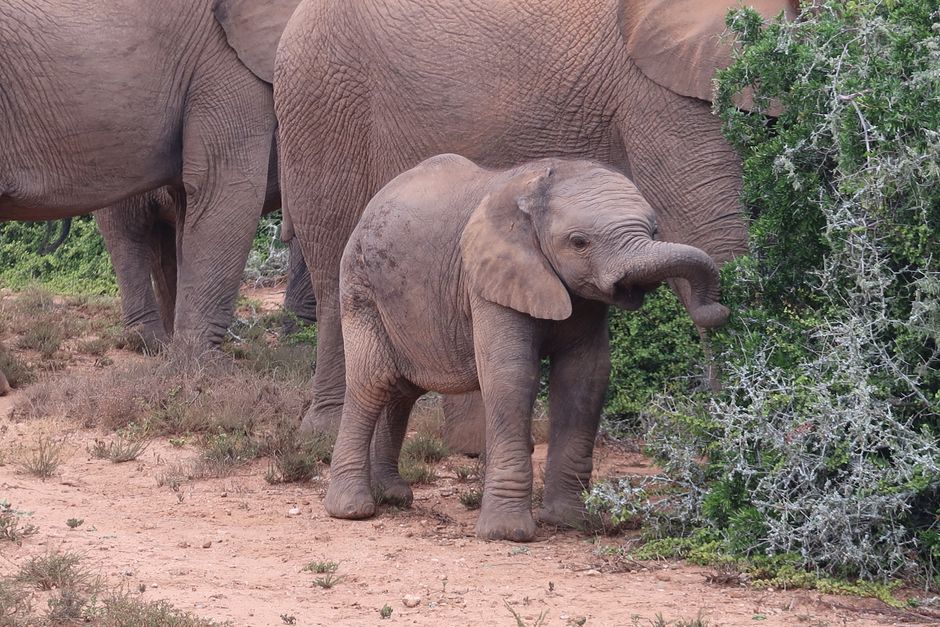
Addo Elephant National Park is the best place in South Africa to see elephants up close, and one of the easiest safaris to fit into a trip along the southern coast. Created in 1931 to protect the last 11 elephants surviving in the Eastern Cape’s dense spekboom thicket, it now protects several hundred elephants, and has grown into one of the largest national parks run by South African National Parks (SANParks), stretching from the semi-desert Karoo plains near Darlington Dam through the Zuurberg mountains and the thicket of the Sundays River valley to the giant coastal dunes of Woody Cape and the islands of Algoa Bay. Besides elephants, the park is home to lions, buffalo, black rhino, leopards, spotted hyenas, zebras, kudu and many other antelope, warthogs, and the rare flightless dung beetle, found in few places outside Addo. With a marine section that includes southern right whales and great white sharks, SANParks promotes it as a home of the “Big Seven.” Best of all for many visitors, Addo is malaria-free and only about an hour’s drive from Gqeberha (Port Elizabeth), so it combines easily with the Garden Route. The climate is mild, with rain spread through the year; summer (December to February) is hot inland, and winter (June to August) is mild by day with cool nights.
Right now in Addo Elephant National Park (Addo Main Camp)
- Wed9–19°C48–65°FPartly cloudy
- Thu10–27°C50–80°FClear
- Fri11–23°C51–73°FPartly cloudy
Top tours in Addo Elephant National Park
See all tours for Addo Elephant National Park →
From local operators, with prices and reviews; you check availability and book on Viator, our partner. We may earn a commission at no extra cost to you. How we earn money
Addo at a glance
- Best months: all year. March to May and September to November are mild and pleasant; in the drier winter months (June to August) animals gather at waterholes. Summer is hot in the thicket, so drive early and late.
- Time needed: a full day from Gqeberha; two or three nights to explore the main game area, Darlington or the coast at a relaxed pace.
- Getting there: about 70 km (43 miles) north of Gqeberha to the main gate, roughly an hour; the southern Matyholweni Gate near Colchester is about 45 minutes away.
- Costs: the daily conservation fee is R492 (about US$30) per international adult until 31 October 2026, rising to R565 (about US$34) from 1 November 2026.
- Before you go: visas, money and the SANParks Wild Card are covered in our South Africa travel guide.
Conservation fees, gate times and park rules
Daily conservation fees
Every visitor pays a daily conservation fee per person. The figures below are SANParks’ fees for 1 November 2026 to 31 October 2027; until 31 October 2026, international visitors pay R492 per adult and R246 per child.
| Visitor category (2026/27 tariff) | Adult (12+), per day | Child (2–11), per day |
|---|---|---|
| — | — | — |
| South African citizens and residents | R115 | R57 |
| SADC nationals | R242 | R121 |
| International visitors | R565 (about US$34) | R283 (about US$17) |
The SANParks Wild Card covers Addo; the International All Parks Cluster costs R4,680 for one person for a year. A 1% community fund levy is added to accommodation and activity bookings.
Gate times
According to SANParks, the Main Entrance Gate and the southern Matyholweni Gate are open from 07:00 to 19:00 throughout the year. Be out of the park or inside your camp before closing time. Hand in the completed gate registration and indemnity form with your passport when you enter.
Park rules
- Stay in your vehicle except at designated picnic sites, hides and lookouts, such as the fenced Jack’s Picnic Site.
- Don’t feed animals.
- Give dung beetles right of way: don’t drive over dung on the roads, where the flightless beetles roll their dung balls.
- Don’t bring citrus fruit into the park; elephants are attracted to its smell.
- Keep to the speed limits and the marked roads; drive slowly, as elephants often step out of the thicket onto the road.
- Respect elephants: keep a distance of at least several car lengths, never drive between a mother and calf, and back away calmly if an elephant approaches.
Addo regions and who each one suits
The Main Camp game area
Most visitors spend their time in the original elephant area around Main Camp, with a network of tarred and gravel roads, waterholes such as Hapoor and Rooidam, and the best density of elephants. Main Camp has a restaurant, shop, swimming pool, an underground hide at its floodlit waterhole, and chalets, cottages and campsites. Ideal for first visits and day trips.
Colchester and Matyholweni
The southern part of the park, entered through Matyholweni Gate near the village of Colchester, has a small rest camp and joins the main game area. It’s the closest entry point from Gqeberha and the N2.
Darlington and the Karoo
North of the Zuurberg, the Darlington Dam area has open Karoo plains, mountain views and a remote lodge; game is more spread out, but it is quiet and beautiful.
The Zuurberg mountains
The rugged Zuurberg section has hiking trails and horse trails through mountain fynbos and forest, with views over the Sundays River valley.
Woody Cape and the Alexandria dunefield
On the coast east of the Sundays River mouth, Woody Cape protects the Alexandria coastal dunefield, the largest active coastal dune system in the southern hemisphere, and coastal forest. The two-day Alexandria Hiking Trail crosses forest, dunes and beach.
The marine section
In Algoa Bay, the park includes Bird Island, home to a huge Cape gannet colony, and the waters around St Croix Island; licensed boat operators from Gqeberha run trips into the bay.
Top things to see in Addo
Elephants at the waterholes
Addo’s elephants are relaxed around cars, and family herds often gather at the waterholes in the main game area, especially at midday in hot weather. Hapoor waterhole is named after a famously bad-tempered bull from the park’s early years. Spending an hour quietly at a waterhole is often the best sighting of the day.
Guided game drives
SANParks guides run sunrise, morning, midday, afternoon, sunset and night drives in open vehicles from Main Camp; in the 2024/25 tariff a guided drive cost R476 per adult and R238 per child (6–11). Night drives give a chance of seeing nocturnal animals such as aardvarks, porcupines and bat-eared foxes, and lions on the hunt. Book at reception or in advance.
The underground hide at Main Camp
A tunnel leads from Main Camp to an underground hide at eye level with the floodlit waterhole, where you can watch elephants, buffalo and other animals drinking, day and night.
Jack’s Picnic Site and the lookouts
Fenced Jack’s Picnic Site, in the middle of the game area, has braai places and toilets. Lookout points and the Zuurkop viewpoint give wide views over the thicket.
Horse riding and walks
Guided horse trails in the Zuurberg and guided walks with armed rangers are offered at some times of year; check with the park.
Other things to do in Addo
- Birding: more than 400 species across the park’s many habitats.
- Sundays River canoeing: on the river near Colchester.
- Sandboarding: on the dunes at the Sundays River mouth near Colchester.
- Citrus farms: the Sundays River Valley is one of South Africa’s major citrus areas; buy fruit outside the park and eat it before you enter.
- Private reserves: malaria-free private reserves such as Schotia, Shamwari, Kariega and Amakhala are within about an hour.
Food and drink
Main Camp has a restaurant and a shop selling groceries, braai packs, firewood and drinks, and most chalets and campsites have kitchens or braai facilities. Outside the park, the village of Addo and Colchester have restaurants, farm stalls and guesthouses with meals. Remember to leave citrus fruit outside the park.
Saving Addo’s elephants
By the early 20th century, hunting and farming had pushed the Eastern Cape’s elephants to the brink; in 1919 a hunter was employed to clear them from the area, and only a handful survived in the dense bush. When the park was proclaimed in 1931, just 11 remained. For years, park staff fed them oranges to keep them inside, which is why citrus is now banned, and an elephant-proof fence, built in 1954, finally kept them safe. Since then the herd has grown steadily, and the park has expanded to protect the whole range of Eastern Cape habitats.
Day trips and nearby
Gqeberha
Gqeberha has beaches, Algoa Bay boat trips and museums, about an hour away.
Jeffreys Bay
About 1.5 hours west, Jeffreys Bay is a world-famous surf town. See our surfing guide.
The Garden Route
Tsitsikamma and the Garden Route begin about 2.5 hours west; many travelers visit Addo at the start or end of a Garden Route road trip.
Mountain Zebra National Park and the Karoo
About three hours north, Mountain Zebra National Park near Cradock protects Cape mountain zebras and has cheetah tracking, and the Karoo town of Graaff-Reinet is near the Valley of Desolation.
Nearby destinations
- Gqeberha59 km
Getting there and getting around
By road
From Gqeberha, take the N2 east and the R335 north through the town of Addo to the Main Entrance Gate, about 70 km (43 miles) and an hour’s drive; or follow the N2 to Colchester for Matyholweni Gate, about 45 minutes. Roads to the gates are tarred. From the Garden Route, Addo is about 2.5 hours from Storms River.
Flying
The nearest airport is Chief Dawid Stuurman International (PLZ) in Gqeberha, with flights from Johannesburg, Cape Town and Durban and car rental desks.
Inside the park
Ordinary cars can drive the main game area’s tarred and gravel roads; some roads in the Darlington and Zuurberg sections and some loops after heavy rain need a higher-clearance vehicle. Guided drives and tours from Gqeberha are alternatives if you don’t want to drive.
When to go and how long to stay
Addo has a mild climate with rain possible in any month. Summer (December to February) is hot inland, often above 30 °C (86 °F) in the thicket, with occasional thunderstorms. Autumn (March to May) is warm and pleasant. Winter (June to August) is mild by day, around 20 °C (68 °F), with cool to cold nights; animals gather at waterholes in dry spells. Spring (September to November) brings flowers and newborn animals.
| Month | Average high | Average low | Rain | Rain days (≥1 mm) |
|---|---|---|---|---|
| Jan | 26 °C (78 °F) | 17 °C (63 °F) | 33 mm (1.3 in) | 5 |
| Feb | 26 °C (79 °F) | 18 °C (64 °F) | 39 mm (1.5 in) | 5 |
| Mar | 25 °C (77 °F) | 16 °C (61 °F) | 46 mm (1.8 in) | 6 |
| Apr | 23 °C (74 °F) | 14 °C (56 °F) | 48 mm (1.9 in) | 6 |
| May | 22 °C (72 °F) | 11 °C (52 °F) | 47 mm (1.8 in) | 5 |
| Jun | 21 °C (69 °F) | 8 °C (47 °F) | 52 mm (2.0 in) | 5 |
| Jul | 20 °C (68 °F) | 8 °C (46 °F) | 51 mm (2.0 in) | 6 |
| Aug | 20 °C (68 °F) | 9 °C (48 °F) | 72 mm (2.8 in) | 7 |
| Sep | 20 °C (69 °F) | 11 °C (51 °F) | 47 mm (1.9 in) | 7 |
| Oct | 21 °C (71 °F) | 13 °C (55 °F) | 56 mm (2.2 in) | 6 |
| Nov | 23 °C (73 °F) | 14 °C (58 °F) | 57 mm (2.2 in) | 7 |
| Dec | 24 °C (76 °F) | 16 °C (61 °F) | 42 mm (1.7 in) | 6 |
| Year | 23 °C (73 °F) | 13 °C (55 °F) | 592 mm (23 in) | 71 |
Figures are the South African Weather Service’s 1991–2020 normals for Port Elizabeth (Gqeberha) airport, about 50–70 km (31–43 miles) south of the main game area, as published by the World Meteorological Organization; there is no Addo station in the WMO set. Inland, in the park, summer days are usually hotter and winter nights colder than on the coast.
How long to stay: 1, 2 and 3 days
- One day: enter at Matyholweni at 07:00, drive the main game loops and waterholes, lunch at Main Camp or Jack’s Picnic Site, and exit by 19:00.
- Two days: stay at Main Camp and add a sunset or night drive and the underground hide.
- Three days: add the Zuurberg or Woody Cape, or a night at a private reserve.
Where to stay in Addo
- Main Camp: chalets, cottages, safari tents and campsites, with a restaurant, shop and pool.
- Matyholweni: a small rest camp near the southern gate.
- Spekboom, Narina and Nyathi camps: smaller camps and tented options inside the park.
- Concession lodges: luxury lodges inside the park, with guided drives and meals.
- Addo village and Colchester: guesthouses, citrus-farm stays and lodges just outside the gates.
Book SANParks accommodation early for school holidays and long weekends.
Typical costs in Addo
| Item | Rand | About US dollars |
|---|---|---|
| — | — | — |
| Conservation fee, international adult, per day (to 31 Oct 2026 / from 1 Nov 2026) | R492 / R565 | $30 / $34 |
| Conservation fee, international child, per day (to 31 Oct 2026 / from 1 Nov 2026) | R246 / R283 | $15 / $17 |
| SANParks guided game drive, adult (2024/25) | R476 | $29 |
| Wild Card, International All Parks Cluster, one person (2026) | R4,680 | $282 |
| Main Camp chalet for two, per night | about R1,500–2,800 | about $90–170 |
| Day tour from Gqeberha | about R1,500–2,500 | about $90–150 |
Conservation fees, the guided drive and the Wild Card are official SANParks figures (fees change every November); accommodation and tours are typical ranges. Conversions use about R16.60 to US$1.
Safety in Addo
- Malaria: Addo is malaria-free, as is the whole Eastern Cape coast, making it popular with families and those who want to avoid antimalarial tablets.
- Elephants: they are calm but powerful. Keep your distance, switch off loud music, and never get out of your car near them; if an elephant blocks the road, wait patiently or reverse away slowly.
- Lions and buffalo: both roam the main game area; stay in your vehicle outside fenced areas.
- Heat: summer temperatures in the thicket can be high; carry water and avoid long walks at midday.
- Driving outside the park: avoid driving at night on rural roads, watch for animals and pedestrians, and keep valuables out of sight.
- Water and power: national load-shedding has been suspended; nearby Gqeberha had water supply interruptions in late September 2026, so check notices if you are staying in the metro.
- Emergencies: contact park reception; for national services call 10111 (police) or 10177 (ambulance), or 112 from a mobile.
Practical tips for Addo
- Arrive at opening: the cooler early hours are best for game viewing, especially in summer.
- Map and sightings: buy a park map at reception and check the sightings board.
- Cards: SANParks gates and camps take cards.
- Fuel: fill up in Addo village or Colchester; check whether fuel is available in the park.
What to pack for Addo
Bring binoculars, a camera with a zoom lens, neutral-colored clothes, a hat, sunglasses and SPF 50 sunscreen, a warm layer for early mornings and night drives, plenty of water and snacks (no citrus), and a field guide to mammals and birds. Walking shoes are useful for Woody Cape and the Zuurberg. See our hiking shoes guide.
Addo Elephant National Park travel FAQ
Is Addo Elephant National Park malaria-free?
Yes. Addo and the whole Eastern Cape coast are malaria-free.
How much is the Addo entrance fee?
The daily conservation fee is R492 per international adult and R246 per child until 31 October 2026, rising to R565 and R283 from 1 November 2026, when SANParks’ new tariff starts.
What are Addo’s gate times?
The Main Entrance Gate and Matyholweni Gate are open from 07:00 to 19:00, according to SANParks.
How far is Addo from Gqeberha (Port Elizabeth)?
About 70 km (43 miles) to the main gate, roughly an hour’s drive; Matyholweni Gate is about 45 minutes away.
Can you see the Big Five in Addo?
Elephant, lion, buffalo and black rhino are present, and leopards too, though they are rarely seen. SANParks also counts southern right whales and great white sharks in the marine section for the “Big Seven.”
Why can’t I bring citrus fruit into Addo?
Elephants are strongly attracted to the smell of citrus; the early park rangers fed them oranges, and the rule keeps elephants from approaching cars.
Can I drive myself in Addo?
Yes. Ordinary cars can use the main game area’s roads; stay in your vehicle, give elephants space and don’t drive over dung.
How many days do you need in Addo?
A full day gives good elephant sightings; one or two nights add night drives, the underground hide and more of the park.
Does the Wild Card cover Addo?
Yes. Addo is a SANParks park, so the Wild Card covers its conservation fees.
Is Addo or Kruger better?
They’re different. Kruger is far larger and wilder but in a malaria area; Addo is smaller, malaria-free, excellent for elephants and easy to combine with the Garden Route.
Plan your trip
Partner links: TravelerCenter may earn a commission if you book, at no extra cost to you.
Sources · last reviewed 6 October 2026
Researched and last reviewed on 6 October 2026. Conservation fees (2025/26 and 2026/27), guided drive prices (2024/25), gate times, the gate registration form, community levy and Wild Card prices come from South African National Parks (SANParks); Gqeberha’s water interruptions from the Nelson Mandela Bay Municipality; load-shedding status from Eskom; the exchange rate from the European Central Bank; climate from the South African Weather Service’s 1991–2020 normals for Port Elizabeth (Gqeberha) airport via the World Meteorological Organization. The park’s history and size, elephant numbers, the citrus rule, sections, camps, wildlife, distances and typical prices are general references and flagged for checking. For entry rules and money, see our South Africa travel guide.
Data: Weather: MET Norway (CC BY 4.0) · Sea temperature: NOAA CoastWatch · Rates: ECB · Costs: World Bank ICP and price levels · Wikidata (CC0)