Short answer: Florida is America’s beach and theme-park state: more than a thousand miles of coastline, the world’s busiest collection of theme parks around Orlando, the Everglades, the island chain of the Keys and warm weather nearly all year. Start with Orlando for the parks, Miami and Miami Beach for the city and the Atlantic, and drive down to Key West or across to the Gulf beaches. One week covers one or two areas; ten days to two weeks lets you combine the parks, a coast and the Keys.
Florida is the third most populous US state, with about 23.5 million people according to the US Census Bureau’s 2025 estimates, and one of the most visited places in the world: the state’s tourism office, VISIT FLORIDA, estimates that the state welcomed 143.3 million visitors in 2025, a record. It is a long, flat peninsula between the Atlantic Ocean and the Gulf, plus the Panhandle, which stretches west along the Gulf toward Alabama. The south is subtropical, with mangroves, coral reefs and palm trees; the north is closer to the Deep South, with oak trees hung with Spanish moss and cooler winters. For entry rules, ESTA, money and tipping, see our United States travel guide.
Where to go in Florida
Most visitors base themselves in one of four areas: Central Florida around Orlando; South Florida from Miami to Palm Beach, with the Everglades and the Keys; the Gulf Coast from Tampa Bay to Naples; and the Panhandle’s white-sand beaches in the far north-west. Orlando sits in the middle, about an hour from both coasts, so it combines easily with a beach stay.
Orlando and Central Florida
Orlando is the theme-park capital of the world. Walt Disney World has four theme parks (Magic Kingdom, EPCOT, Hollywood Studios and Animal Kingdom), two water parks and Disney Springs; Universal Orlando has Universal Studios, Islands of Adventure, the Volcano Bay water park and Epic Universe, which opened in May 2025; and SeaWorld and LEGOLAND are nearby. Beyond the parks, Winter Park has the Morse Museum’s Tiffany glass and a boat tour on its chain of lakes, and the clear freshwater springs north of the city, such as Blue Spring and Wekiwa Springs, are lovely for a swim or a paddle. The Kennedy Space Center Visitor Complex is about an hour east, on the Space Coast. Our Orlando travel guide has tickets, parking and getting around.
Miami, Miami Beach and Fort Lauderdale
Miami is Florida’s most international city, with a strong Latin American and Caribbean character. Have a Cuban coffee on Calle Ocho in Little Havana, see the street art of Wynwood, tour the Italian-style Vizcaya Museum and Gardens on Biscayne Bay, and visit the art museums of the downtown waterfront. Across the bay, Miami Beach has the pastel Art Deco hotels of Ocean Drive, wide sandy beaches and lively nightlife in South Beach. Thirty miles north, Fort Lauderdale is a laid-back beach city of canals and yachts, with Port Everglades, one of the busiest cruise ports in the world.
The Everglades
West of Miami, Everglades National Park protects the largest subtropical wilderness in the United States: a slow-moving “river of grass” with alligators, wading birds, manatees and mangrove islands. The park has several entrances that do not connect inside the park: Shark Valley, on the Tamiami Trail, with its tram tour and observation tower; the main road from Homestead to Flamingo, with the boardwalks of the Anhinga Trail; and the Gulf Coast entrance at Everglades City, where a new Marjory Stoneman Douglas Visitor Center opened in 2026, for boat tours among the Ten Thousand Islands.
The Florida Keys and Key West
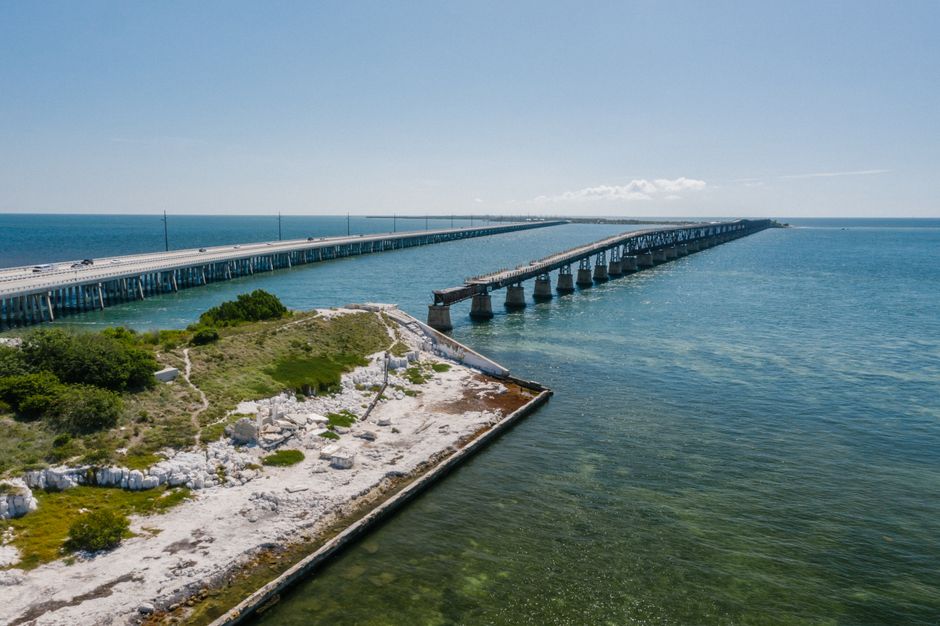
The Florida Keys are a chain of coral islands linked by the Overseas Highway, which runs 113 miles and crosses 42 bridges from Key Largo to Key West, including the Seven Mile Bridge, according to the Florida Keys tourism council. Key Largo has John Pennekamp Coral Reef State Park, the first undersea park in the United States; Islamorada is known for sport fishing; and Bahia Honda has some of the best beaches in the Keys. At the end of the road, Key West is a colorful, easygoing town of wooden houses, bars and sunset celebrations at Mallory Square, with the Ernest Hemingway Home and boats and seaplanes to Dry Tortugas National Park, about 70 miles further west.
Tampa Bay and the Gulf Coast
The Gulf Coast has calmer water, softer sand and famous sunsets. Tampa has the Riverwalk, the historic Cuban cigar district of Ybor City and Busch Gardens. Across the bay, St. Petersburg is known for its waterfront museums, including the Salvador Dalí Museum, and Fort De Soto Park, while Clearwater Beach has fine white sand and the Clearwater Marine Aquarium. Further south, Sarasota has the Ringling museums and Siesta Key’s powdery beach, and Naples is an elegant town of shopping streets, golf and quiet beaches, close to the western edge of the Everglades.
The Panhandle and the Emerald Coast
In the far north-west, the Panhandle’s beaches have sugar-white quartz sand and clear, emerald-green water. Destin is a fishing town and family beach resort, with the shallow sandbar of Crab Island and the small planned towns of Scenic Highway 30A nearby. Panama City Beach has a long, lively beachfront and St. Andrews State Park, with a shuttle boat to undeveloped Shell Island. Winters are cooler here than in South Florida, and most of the Panhandle west of the Apalachicola River is on Central Time, an hour behind the rest of the state.
St. Augustine and the Atlantic coast
Founded by the Spanish in 1565, St. Augustine is the oldest continuously occupied European-founded city in the continental United States, with narrow streets, a 17th-century stone fort, the Castillo de San Marcos, and a lighthouse you can climb. South along the Atlantic, Daytona Beach is the home of the Daytona International Speedway and one of the few beaches in Florida where you can drive on the sand, and the Space Coast around Cape Canaveral is the place to watch a rocket launch.
Top things to do in Florida
Spend a few days at the theme parks
Orlando’s parks are big enough to fill a week. Tickets are date-based and prices change with demand: as of October 2026, a one-day Walt Disney World ticket starts at $119 for one park, Universal Orlando one-park tickets start at $124.99 plus tax for Universal Studios or Islands of Adventure and $139.99 plus tax for Epic Universe, and SeaWorld single-day tickets start at $59.99. Parking at Disney’s theme parks costs $35 a day. Buy tickets on the parks’ official websites, choose quieter weeks in January, February, September and early December if you can, and arrive at opening time to ride the most popular attractions before the lines build up.
Go to the beach
Florida’s beaches are its greatest free attraction. The Atlantic side, from Miami Beach to Daytona, has more surf and long, straight strands; the Gulf side, from Naples to Clearwater, has calmer, warmer water and sunsets over the sea; and the Panhandle has the whitest sand of all. Look out for the colored flags at guarded beaches: double red means the water is closed to the public, and red means high surf or strong currents. On the Gulf Coast, Florida’s wildlife agency, FWC, publishes current red tide status, and the state’s Healthy Beaches program posts water-quality results for each beach.
See alligators and wading birds in the Everglades
As of October 2026, entry to Everglades National Park costs $35 per private vehicle for seven days, and visitors aged 16 and over who are not US residents pay an additional $100 per person unless they hold an America the Beautiful annual pass ($250 for non-residents), according to the National Park Service. At Shark Valley, the two-hour tram tour costs $34 for adults; book ahead from late December to April, when the park is busiest. The dry season, from about December to April, is the best time to see wildlife, as animals gather at the remaining water.
Snorkel and dive the coral reef
Florida has the only living coral barrier reef in the continental United States, running along the Keys, protected as the Florida Keys National Marine Sanctuary. Snorkel and glass-bottom boat trips leave from John Pennekamp in Key Largo and from Marathon, Big Pine Key and Key West. Do not stand on or touch coral, and display a dive flag when you snorkel from your own boat. From Key West, a day trip to Dry Tortugas National Park, by ferry or seaplane, combines snorkeling with the huge brick Fort Jefferson; the park entrance fee is $15 per person aged 16 and over, and is included in the ferry ticket.
Watch a rocket launch
The Space Coast is one of the busiest launch sites in the world. At the Kennedy Space Center Visitor Complex, about 50 miles east of Orlando, you can see the Space Shuttle Atlantis and a Saturn V moon rocket; as of October 2026, a one-day adult ticket costs $77, and parking is $15. Launch schedules change often, so check the visitor complex’s launch calendar shortly before your trip; beaches and parks around Titusville and Cocoa Beach are popular free viewing spots.
Swim in the springs and meet the manatees
Florida has hundreds of freshwater springs, with clear water that stays around 72 °F all year. Many are in the state’s 175 state parks and trails, which are open from 8 a.m. until sundown every day of the year, according to Florida State Parks. In winter, manatees gather in the warm springs, and Blue Spring, near Orlando, and Crystal River, on the Gulf Coast north of Tampa, are the best places to see them. Paddling, tubing and swimming are popular in summer.
Explore history, art and museums
Florida has more history and culture than its beach image suggests. In St. Augustine, the Castillo de San Marcos costs $15 for adults (children 15 and under free). In Sarasota, the Ringling’s art museum, circus museum and Venetian-style mansion cost $30 for adults, and the art museum and gardens are free on Mondays. In St. Petersburg, the Dalí Museum holds a major collection of Salvador Dalí’s work ($32 for adults). In Key West, you can tour Hemingway’s house and meet its six-toed cats ($19 for adults).
When to go to Florida
Most of Florida has a humid subtropical climate, and the Keys and the far south are tropical. There are really two seasons: a warm, sunny dry season from about November to April, and a hot, humid wet season from May to October, when short, heavy afternoon thunderstorms are an almost daily event. The Atlantic hurricane season officially runs from 1 June to 30 November, with most activity between mid-August and mid-October, according to NOAA’s National Hurricane Center. The Panhandle is noticeably cooler in winter, with average highs of 63–66 °F (17–19 °C) in Destin, when the sea is too cold for most swimmers. The figures below are 1991–2020 NOAA averages.
| Season | Miami: average high / low | Orlando: average high / low | What it’s like | Good for |
|---|---|---|---|---|
| Winter (Dec–Feb) | 76–78 °F (25–26 °C) / 61–64 °F (16–18 °C) | 72–75 °F (22–24 °C) / 50–53 °F (10–12 °C) | Warm, sunny and dry in the south; mild with chilly mornings in Central and North Florida | Beaches in the south, Everglades, the Keys, theme parks without the heat; peak prices |
| Spring (Mar–May) | 81–87 °F (27–30 °C) / 66–73 °F (19–23 °C) | 79–88 °F (26–31 °C) / 56–66 °F (13–19 °C) | Warm, sunny and mostly dry until the rains start in May | Beaches everywhere, springs, festivals; busy at spring break |
| Summer (Jun–Aug) | 89–91 °F (32–33 °C) / 76–78 °F (25 °C) | 91–92 °F (33 °C) / 72–74 °F (22–23 °C) | Hot and humid, with near-daily afternoon thunderstorms | Water parks, warm sea, snorkeling, Panhandle beaches; lower hotel rates in the south |
| Autumn (Sep–Nov) | 89 °F falling to 81 °F (32 to 27 °C) / 77 °F falling to 68 °F (25 to 20 °C) | 90 °F falling to 78 °F (32 to 26 °C) / 72 °F falling to 58 °F (22 to 15 °C) | Hot, wet and the peak of hurricane season early on; pleasant and dry by November | Fewer crowds, deals, Halloween events, stone crab season from mid-October |
Best overall: November to April for South Florida, the Keys and the Everglades, and March to May or late October to November for Orlando, when it is warm but not too hot. For the Panhandle beaches: April to October. For the lowest prices: late August to early December, except Thanksgiving week. Expect crowds and high prices at Christmas, New Year and during spring break in March and April.
Getting there and getting around
Airports
Orlando International (MCO) and Miami International (MIA) are the main gateways, with flights from across the Americas and Europe; Fort Lauderdale, Tampa, West Palm Beach, Fort Myers (for Naples and Sanibel), Sarasota, Jacksonville, Key West and Destin–Fort Walton Beach have busy airports of their own. At Miami, the free MIA Mover links the terminal with Metrorail, Tri-Rail and the rental car center. Orlando’s Terminal C sits next to the airport’s train station, with Brightline trains to South Florida.
Trains: Brightline, SunRail and Amtrak
Brightline, a privately run intercity train, links Orlando International Airport with Miami, with stations in West Palm Beach, Boca Raton, Fort Lauderdale and Aventura. Fares vary by date and class, so book on Brightline’s official website or app. In the Miami area, the Tri-Rail commuter train runs between Miami and West Palm Beach; around Orlando, SunRail serves 17 stations, but runs on weekdays only. Amtrak’s Silver Meteor runs between New York and Miami, the Floridian between Chicago and Miami via Washington, Orlando and Tampa, and the Auto Train carries you and your car nonstop from Lorton, Virginia, near Washington, D.C., to Sanford, near Orlando. There is no train to the Keys, the Gulf beaches south of Tampa or the Panhandle.
Driving and tolls
Outside Miami, a car is the most practical way to see Florida: the beaches, springs, Everglades and Keys are spread out and poorly served by public transport. Interstate 95 runs down the Atlantic coast, I-75 down the Gulf side and across the Everglades on Alligator Alley, and I-4 links Tampa and Orlando with Daytona Beach. Many highways, including Florida’s Turnpike, are toll roads, and tolls are cashless: you pay with a SunPass or a compatible transponder such as E-ZPass, or by a bill sent to the car’s owner. Toll-by-plate is not available for rental cars, so check your rental company’s toll program, or add the rental car’s plate to your own SunPass account. Allow plenty of time for the Overseas Highway to Key West: it is mostly two lanes, and traffic can be slow on weekends.
Food and drink in Florida
Florida food mixes Southern cooking, Caribbean and Latin American flavors and the catch of the day. Seafood is the star: try a grouper sandwich at a dockside shack, Gulf shrimp, smoked fish dip with crackers, and conch fritters in the Keys. The most prized local delicacy is stone crab claws, served cold with mustard sauce; the harvest season runs from 15 October to 1 May, according to Florida’s Fish and Wildlife Conservation Commission, so they are a fall-to-spring treat. Key lime pie, made with small, tart Key limes, is the official state pie, and Key West bakeries argue over who makes the best.
In Miami, Cuban food is everywhere: a strong cafecito at a walk-up window, a pressed Cuban sandwich of roast pork, ham, Swiss cheese and pickles, and croquetas and pastelitos at bakeries. Tampa claims its own version of the Cuban sandwich, with salami, in Ybor City. Florida’s citrus groves mean fresh orange juice, and farm stands sell strawberries in late winter. Further north, you find Southern classics such as fried chicken, grits and boiled peanuts. Craft breweries are found in every city, and rum bars and tiki bars suit the climate. Vegetarian options are easy to find in Miami, Orlando and Tampa, though seafood dominates in smaller beach towns.
Plan your trip
Tell our AI trip planner how many days you have and what you enjoy, and it will build a Florida itinerary from our guides, for example Orlando’s parks plus a few days on the Gulf Coast, or Miami, the Everglades and a drive down the Keys. Check the forecast and monthly averages for each stop with our Destination weather tool, and use the packing list: light clothes, reef-safe sunscreen, a hat, insect repellent and a small umbrella for the afternoon storms are useful in every season.
Frequently asked questions
What is the best time to visit Florida?
November to April is the best time for South Florida, the Keys and the Everglades, with warm, dry and sunny weather. For Orlando, March to May and late October to November are warm but less hot than summer. The Panhandle beaches are best from April to October.
When is hurricane season in Florida?
The Atlantic hurricane season runs from 1 June to 30 November, with most activity from mid-August to mid-October, according to NOAA’s National Hurricane Center. Flexible bookings make planning easier in this period.
How many days do you need in Florida?
One week is enough for four or five days at the Orlando parks plus a couple of days at the beach, or for Miami, the Everglades and the Keys. With ten days to two weeks, you can combine the parks, a coast and a drive to Key West.
Can you take the train from Orlando to Miami?
Yes. Brightline trains run from Orlando International Airport to downtown Miami, stopping at West Palm Beach, Boca Raton, Fort Lauderdale and Aventura. Fares vary by date and class; book on Brightline’s official website or app.
How much does it cost to visit the Everglades?
As of October 2026, entry to Everglades National Park costs $35 per private vehicle for seven days, or $20 per person on foot or by bike. Non-US residents aged 16 and over pay an additional $100 each, unless they hold an America the Beautiful annual pass. Tours, such as the Shark Valley tram, cost extra.