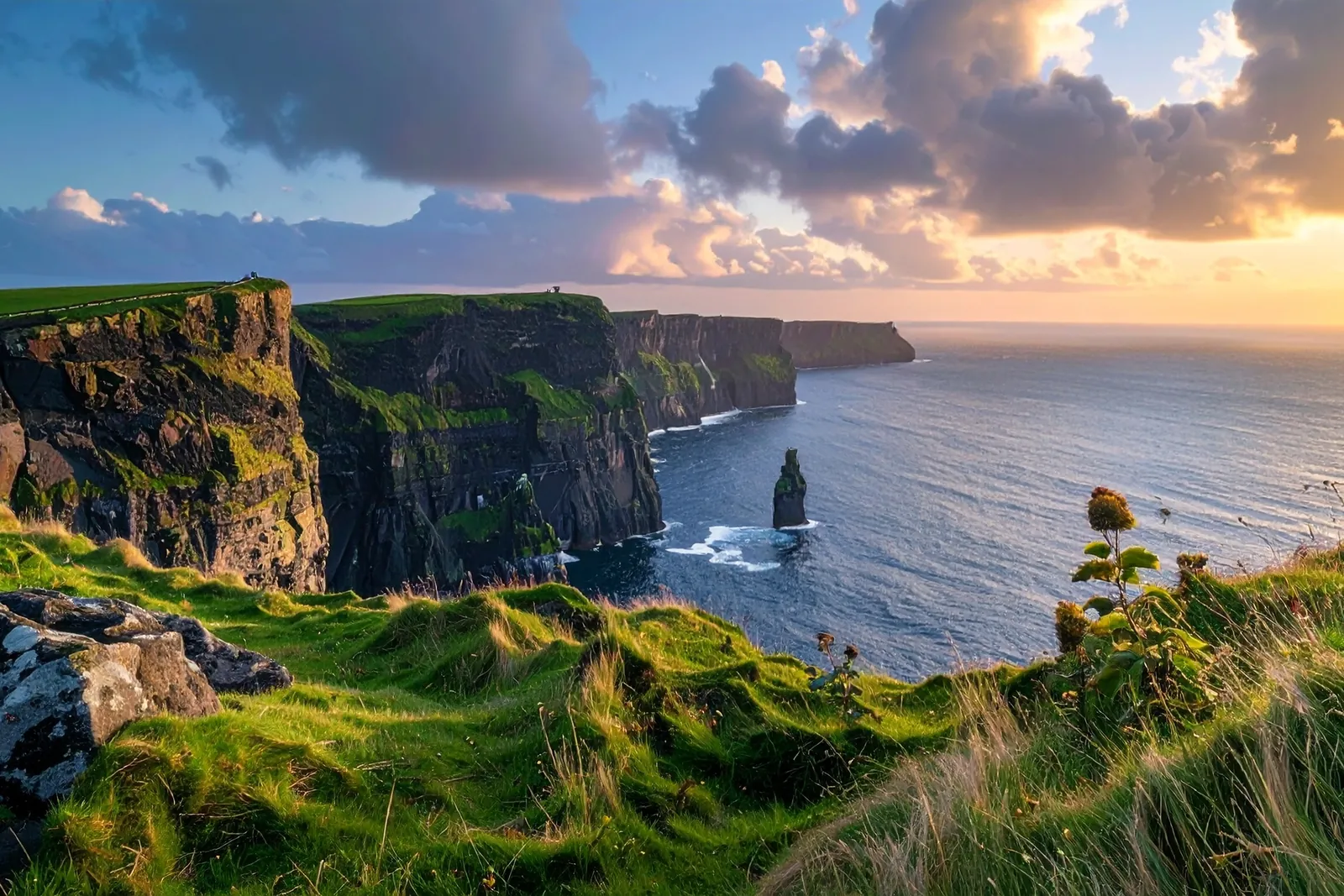
Short answer: the best time to visit Ireland is May, June and September. These months have long days, some of the driest and sunniest weather of the year and fewer crowds than high summer. July and August are the warmest and liveliest months, but also the busiest and most expensive, while winter is mild, cheap and wet, better for Dublin and cozy pubs than for the coast.
This page goes through Ireland’s weather, daylight, crowds, prices, festivals and public holidays month by month and region by region, as of October 2026. It covers the Republic of Ireland; for the north, see our Belfast guide. For where to go, transport and entry rules, start with our Ireland travel guide, then plan your days with our AI trip planner.
Best time to visit Ireland at a glance
| Goal | Best months | Why |
|---|---|---|
| Best all-round weather | May, June, September | Long days, the most sunshine and fewer rainy days |
| Warmest weather | July–August | Highs around 19–20 °C (66–68 °F) |
| Fewest crowds | November–February (outside Christmas) | Quiet roads and sights; shorter opening hours |
| Lowest prices | November–March (outside St Patrick’s week) | Low season for hotels and car hire |
| Hiking | April–June, September | Drier ground, long light, mild temperatures |
| Wildflowers and puffins | May–June | The Burren in bloom; puffins on the Cliffs of Moher |
| Skellig Michael | Mid-May–September | The only months boats land |
| Surfing | September–November | Bigger Atlantic swells and the warmest sea |
| Festivals | March, July–August, October | St Patrick’s Day, summer festivals, Cork Jazz and Halloween |
Ireland weather month by month
Weather month by month
The table shows average daily highs and lows and monthly rain for Ireland, from Met Éireann’s official 1991–2020 averages. Ireland’s climate is mild and damp all year: at Dublin Airport, highs run from about 8 °C (46 °F) in January to 19.5 °C (67 °F) in July, and the airport gets about 770 mm (30 in) of rain a year, spread over some 137 days. The west is wetter: Shannon Airport, in County Clare, gets about 1,020 mm (40 in) on 169 days, and the Kerry coast more again. Expect showers in any month, often with sunny spells in between.
Ireland month by month
January
Mild but dark and damp: Dublin averages highs of 8 °C (46 °F) and under two hours of sunshine a day, and the west is wetter and windier. It is the cheapest month for hotels and car hire, and Dublin‘s museums, pubs and theaters carry on as usual. Many seasonal attractions on the west coast are closed.
February
Similar to January, with slightly more daylight and a little less rain in Dublin (about 52 mm, or 2 in). St Brigid’s Day is a public holiday, on Monday 1 February in 2027, making a long weekend. Prices stay low, and it is a good month for a city break.
March
Days lengthen fast and spring flowers appear, with highs around 10–11 °C (50–52 °F). The big event is St Patrick’s Festival in Dublin, from 13 to 17 March 2027, with the national parade on Wednesday 17 March; Dublin hotels fill and prices jump that week, so book months ahead. Easter falls early in 2027, with Easter Monday on 29 March, and clocks go forward on the last Sunday of March.
April
Often one of the drier months, with Shannon’s rain falling to about 62 mm (2.5 in) and more than five hours of sunshine a day. Lambs are in the fields, seasonal attractions reopen and prices are still moderate. It can be chilly, around 12–13 °C (54–56 °F), so bring layers.
May
One of the best months. Dublin averages more than six hours of sunshine a day, the sunniest of the year, and highs of about 15–16 °C (59–61 °F). The Burren’s wildflowers bloom, puffins nest on the Cliffs of Moher, and boats start landing on Skellig Michael from about mid-May. The May bank holiday (3 May 2027) brings a busy long weekend.
June
The longest days, with light until about 22:00 late in the month, and highs around 18 °C (64 °F). Crowds build but are lighter than in July, and Dublin has its fewest rainy days of the year (about 10). Bloomsday on 16 June fills Dublin with Edwardian costumes, and there is a bank holiday on 7 June 2027.
July
The warmest month, with highs of about 19.5 °C (67 °F) in Dublin and Shannon, and the start of peak season. Irish schools are out, the Ring of Kerry, Dingle and the Cliffs of Moher are busy, and hotels in Dublin, Galway and Kerry are at their most expensive. The Galway International Arts Festival is usually in July.
August
Just as warm as July, a little wetter (Dublin’s rain rises to about 73 mm, or 2.9 in), and just as busy. It is the month of the Puck Fair in Killorglin (10–12 August every year), the Rose of Tralee and the All-Ireland finals at Croke Park. The August bank holiday is on 2 August 2027. Book cars and rooms well ahead.
September
Excellent: still mild at about 17 °C (63 °F), the sea is at its warmest, and crowds thin out once schools go back at the end of August. Festivals continue, including the Lisdoonvarna matchmaking festival in Clare and the Galway oyster festival. Skellig landings and some island ferries end at the end of the month.
October
Cooler (about 14 °C, 57 °F) and wetter, with Atlantic storms becoming more likely, but autumn colors in Killarney and low prices. Events in 2026 include the Wexford Festival Opera (15–31 October), the Guinness Cork Jazz Festival in Cork (22–26 October), the Dublin Marathon (25 October) and Halloween, which grew out of the Irish festival of Samhain. The October bank holiday is Monday 26 October 2026 and Monday 25 October 2027.
November
The wettest month at Dublin Airport (about 83 mm, or 3.3 in) and dark by about 16:30. It is quiet and cheap, good for city breaks, museums and long evenings in the pub. Christmas markets and lights open in Dublin, Galway and Cork from mid- or late November.
December
The darkest month, with under two hours of sunshine a day and dark soon after 16:00, but festive: markets, lights and the Christmas Day sea swim at the Forty Foot in Sandycove. Almost everything closes on Christmas Day, and transport is limited on 25 and 26 December. Prices rise again around Christmas and New Year.
Best time to visit by region
Dublin and the east
Dublin is the driest part of the country and works in any month. May, June and September are best for walking the city and the coast at Howth; winter suits museums, theaters and pubs. Avoid St Patrick’s week unless you have come for the party, and check for big concert and rugby weekends.
Galway and the Cliffs of Moher
Galway is liveliest in July, with its arts festival and races, but most enjoyable in May, June and September. The Cliffs of Moher are best early or late in the day; come in May or June for puffins and the Burren’s flowers.
Connemara
Connemara is wild and wet, so pick the drier spring months, April to June, or September for hiking Diamond Hill and driving the Sky Road. In winter some guesthouses and restaurants close.
Killarney and the Ring of Kerry
Killarney and the Ring of Kerry are busiest in July and August, when tour coaches fill the road. May, June and September give you long days and space; October adds autumn colors in the national park. Boats to the Skelligs run only from about mid-May to the end of September.
The Dingle Peninsula
Dingle is best from May to September, when the Slea Head Drive, boat trips and music pubs are all going. In winter it is very quiet, the Conor Pass can be closed by weather, and some restaurants shut.
Cork and the south
Cork is a good city stop in any season, with its jazz festival over the October bank holiday weekend. West Cork’s coast and islands are best from May to September.
Best time for road trips on the Wild Atlantic Way, hiking, surfing and festivals
Road trips on the Wild Atlantic Way
May, June and September: long days, open attractions and quieter roads. In July and August, start early to stay ahead of the coaches.
Hiking
April to June and September for Carrauntoohil, Croagh Patrick, the Wicklow Way and the Kerry Way. Midges can bother you on still summer evenings in the west, and cloud can close in on any summit in any month.
Surfing
Surf schools run from spring to autumn at Lahinch, Bundoran, Strandhill and Inch. September to November brings bigger swells and the warmest water, though it rarely tops 16 °C (61 °F), so wear a thick wetsuit.
Festivals and traditional music
Music is in the pubs every night of the year. For festivals, come for St Patrick’s week in March, the summer festivals of July and August, or the October bank holiday weekend in Cork.
Seasons to plan around
- Atlantic storms: mainly from October to March, gales can close coastal paths and cancel ferries and boat trips. Keep a spare day on island trips and check Met Éireann’s forecasts.
- Short winter days: around December it is dark soon after 16:00, so plan drives in daylight on narrow country roads.
- Seasonal closures: some west-coast guesthouses, restaurants, island ferries and the Skellig boats stop running from the end of September or October until spring.
- Bank holiday weekends: hotels, ferries and coastal towns fill with Irish visitors. Coming up: 26 October 2026; 1 February, 29 March, 3 May, 7 June, 2 August and 25 October 2027.
- St Patrick’s week and Christmas: the most expensive weeks in Dublin; almost everything closes on Christmas Day.
How long to stay
Five days covers Dublin and a quick trip west to Galway and the Cliffs of Moher. A week lets you do the classic loop of Dublin, Galway, Clare and Kerry, and ten days to two weeks adds Dingle, Cork, Connemara, Donegal or Belfast. In winter, plan fewer, shorter drives because of the daylight. Our Ireland travel guide has sample 5-, 7-, 10- and 14-day itineraries.
Best time to visit Ireland: FAQ
What is the best month to visit Ireland?
May or September. May is the sunniest month, with long days and wildflowers; September has the warmest sea, mild weather and thinner crowds. June is just as good but a little busier.
What is the cheapest time to visit Ireland?
November to March, apart from Christmas, New Year and St Patrick’s week. January and February are usually the cheapest months for hotels and car hire.
What is the rainiest month in Ireland?
In Dublin, November (about 83 mm, or 3.3 in); in the west, December and January, with about 104–115 mm (4.1–4.5 in) at Shannon Airport. Rain falls in every month, but April to June are usually the driest.
Is March a good time to visit Ireland?
Yes for St Patrick’s Day (17 March 2027) and quiet spring sightseeing, but expect cool, changeable weather around 10 °C (50 °F) and high Dublin prices during the festival week.
Is it worth visiting Ireland in winter?
Yes, for Dublin, Galway and Cork, pubs, music and low prices. Days are short and wet, and some coastal attractions close, so it is less suited to a west-coast road trip.
When does it get dark in Ireland in summer?
Around the longest day in late June, it stays light until about 22:00, which gives you long evenings for walks and drives.
Sources · last reviewed 4 Oct 2026
Researched and last reviewed by TravelerCenter on 8 October 2026. Temperatures, rain, rainy days and sunshine come from Met Éireann’s official 1991–2020 station averages for Dublin Airport and Shannon Airport; festival dates from the organizers (St Patrick’s Festival, Wexford Festival Opera) and Cork’s official tourism site; public holidays are calculated from Ireland’s statutory rules. Skellig landing season, daylight times and the timing of summer festivals are general references or come from operators and press reports. Check with organizers and operators before you travel.
Also: Met Éireann normals 1991–2020, Dublin Airport (climate)
Data: Natural Earth (PUBLIC DOMAIN) · © OpenStreetMap contributors (ODBL) · Wikidata (CC0)