Short answer: For a first trip, the top places to visit in the Dominican Republic are the beaches of Punta Cana and Bávaro, Santo Domingo’s Colonial Zone, Saona Island in Cotubanamá National Park, the green Samaná Peninsula with its winter whales, and La Romana with Casa de Campo and Altos de Chavón. Round out the list with Puerto Plata, the surf and kite beaches of Cabarete and Sosúa, the islets and caves of Los Haitises, the mountain town of Jarabacoa, and the remote beach of Bahía de las Águilas in the far southwest.
The list is ordered the way we would recommend places to a first-time visitor, classics first. The country is warm all year, so the real planning question is rain: the south and east are driest from December to April, while the north coast has a different pattern, and the Atlantic hurricane season runs from June 1 to November 30.
1. Punta Cana and Bávaro
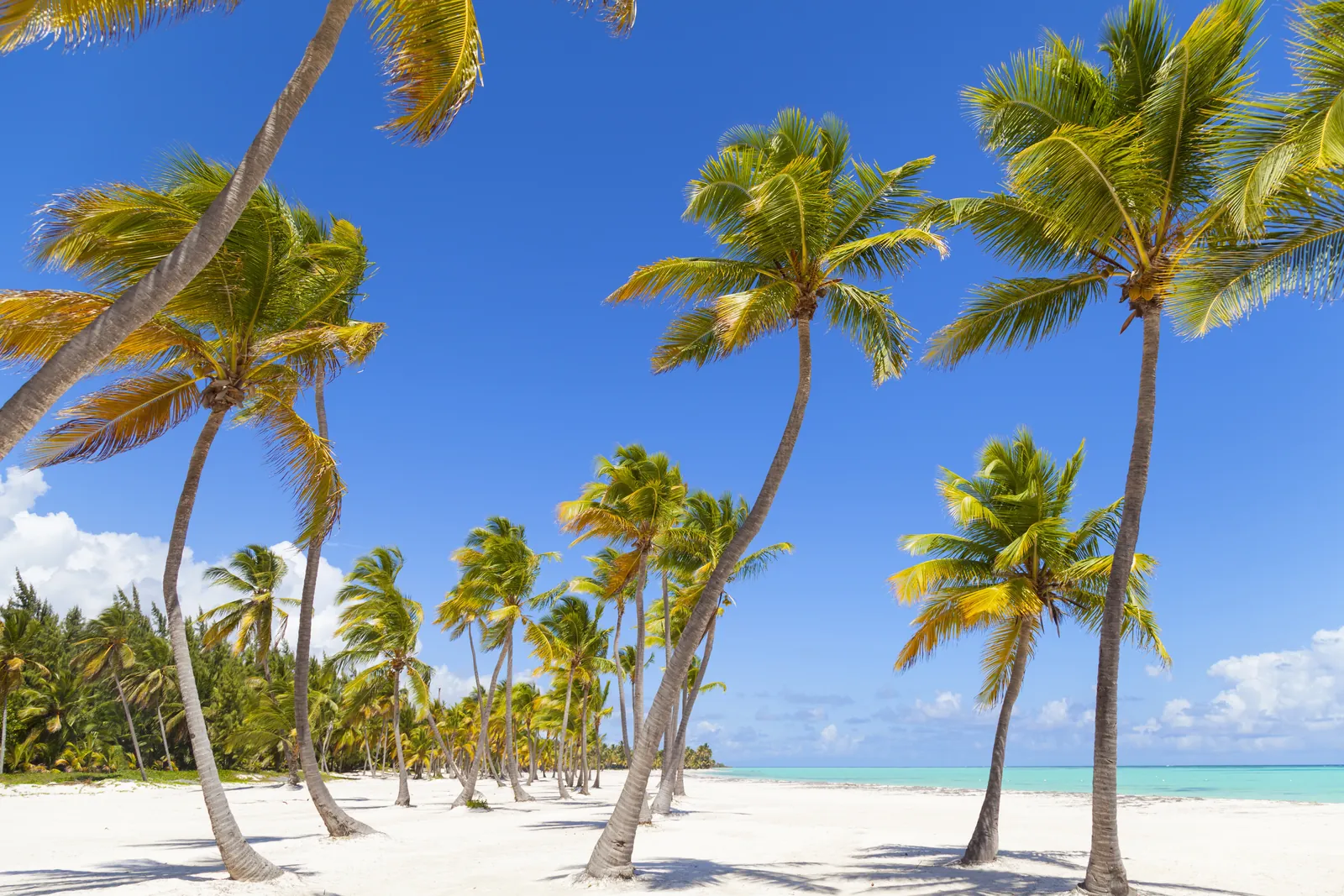
Why it made the list: the eastern tip of the island is the Dominican Republic’s best-known beach destination, a nearly continuous run of palm-lined Atlantic sand from Cap Cana through Punta Cana and Bávaro to Macao and Uvero Alto, with turquoise water inside the reef and most of the country’s big all-inclusive resorts.
Best time to go: December to April. At the Punta Cana weather station, March is the driest month of the year, with about 50 mm (2 in) of rain on average, and the wettest months are May and September to November.
Don’t miss: a catamaran snorkeling trip along the Bávaro reef, and a swim in Hoyo Azul, the blue sinkhole at Cap Cana. Surfers head to Macao.
Getting there and how long: Punta Cana International Airport (PUJ) is the country’s busiest, with direct flights from dozens of US, Canadian and European cities, and most resorts are 15 to 45 minutes away. Stay four or five nights.
Practical note: sargassum seaweed is most likely on these east-facing beaches from about April to September, and 2026 has been one of the heaviest years on record. Ask your resort about recent conditions if you travel in those months. See our Punta Cana travel guide.
2. Santo Domingo and the Colonial Zone
Why it made the list: the capital’s Colonial Zone (Zona Colonial), a UNESCO World Heritage Site, holds the oldest cathedral in the Americas, the Ozama Fortress, described by the official tourism site as the oldest European military building in the New World, and Calle Las Damas, the first paved street in the Americas.
Best time to go: December to April. February and March are the driest months in the capital, with under 60 mm (2.4 in) of rain each on average; August and September are the wettest.
Don’t miss: a slow walk from the cathedral down Calle Las Damas to the Ozama Fortress and the Alcázar de Colón on Plaza de España, then sunset on the seafront Malecón.
Getting there and how long: Las Américas International Airport (SDQ) is about 30 km (19 miles) east of the Colonial Zone, and cruise ships dock at the Don Diego and Sans Souci terminals, about half a mile from the center. Give it two or three days.
Practical note: cover shoulders and knees inside the cathedral and other churches, and wear good shoes for the narrow, cobbled sidewalks. See our Santo Domingo travel guide.
3. Saona Island and Cotubanamá National Park
Why it made the list: Saona is the postcard island of the Dominican Republic: long white beaches and palms inside Cotubanamá National Park (also called Parque Nacional del Este), whose Saona beaches the official tourism site calls the country’s most important turtle-nesting site. It is one of the most popular day trips in the country.
Best time to go: December to April, the dry season on the south and east coasts, when seas are usually calm.
Don’t miss: the stop at the shallow natural pool on the way out, where boats anchor in knee-deep water over the sand, and lunch on one of Saona’s beaches. Divers and snorkelers should add Catalina Island, also in the park, for its reefs and underwater walls.
Getting there and how long: most boats leave from the fishing village of Bayahibe, near La Romana; resorts in Punta Cana sell the same trip with a road transfer. It is a full day.
Practical note: book with a licensed operator that carries life jackets, and expect trips to be postponed when the navy closes ports to small craft in rough weather. See the Saona and Catalina day trips in our La Romana travel guide.
4. The Samaná Peninsula
Why it made the list: Samaná is the country’s green, mountainous northeast corner, with wild beaches, waterfalls and small hotels rather than mega-resorts. From January to March, humpback whales gather in Samaná Bay to breed and give birth, the highlight of the Dominican year.
Best time to go: mid-January to March for whales; the 2026 whale-watching season ran from January 15 to March 31. February is also the peninsula’s driest month, although Samaná is the wettest of the main regions, with about 2,170 mm (85 in) of rain a year.
Don’t miss: a whale-watching boat trip from Samaná town in season, and Playa Rincón near Las Galeras, which the official tourism site calls one of the country’s most beautiful beaches. The El Limón waterfall can be reached on horseback or on foot.
Getting there and how long: fly into Samaná El Catey International Airport (AZS), or drive about two and a half to three hours from Santo Domingo. Stay three to five days, based in Las Terrenas or Las Galeras.
Practical note: whale watching is run by boats with environmental permits under rules set by the government, so book with a permitted operator. See our Samaná travel guide.
5. La Romana, Casa de Campo and Altos de Chavón
Why it made the list: La Romana is home to Casa de Campo, a 7,000-acre resort with three Pete Dye golf courses, including the famous Teeth of the Dog, and to Altos de Chavón, a stone village in Mediterranean style above the Chavón River, with an amphitheater, galleries and shops. It is a quieter, more polished alternative to Punta Cana, and the closest base for Bayahibe.
Best time to go: December to April, when the southeast coast is dry and breezy.
Don’t miss: sunset over the Chavón River from Altos de Chavón, and a snorkeling or diving trip to Catalina Island.
Getting there and how long: La Romana’s small international airport (LRM) has seasonal flights from the US and Canada; otherwise, drive about one and a half to two hours from Santo Domingo’s airport. Stay three or four nights.
Practical note: Altos de Chavón sits inside Casa de Campo, so check the entry arrangements for non-guests before you go. See our La Romana travel guide.
6. Puerto Plata
Why it made the list: the main city of the north coast mixes a historic center with colorful wooden houses, the 16th-century Fortaleza San Felipe (now a museum overlooking the Atlantic), an amber museum and a long Malecón, with the beach resorts of Playa Dorada next door.
Best time to go: spring and summer. The north coast’s rain pattern is the opposite of the south’s: at Puerto Plata airport, June is the driest month (about 54 mm, 2.1 in) and November the wettest (about 258 mm, 10.1 in).
Don’t miss: the cable car to the top of Mount Isabel de Torres for views over the city and the ocean, and a guided climb and jump through the 27 Waterfalls of Damajagua.
Getting there and how long: Gregorio Luperón International Airport (POP) is about 15 minutes from the city, and cruise ships call at the Amber Cove and Taíno Bay terminals. Stay two to four days.
Practical note: on days when several cruise ships are in port, visit the cable car and the waterfalls early. See our Puerto Plata travel guide.
7. Cabarete and Sosúa
Why it made the list: just east of Puerto Plata, Cabarete is the country’s kitesurfing and windsurfing capital, and nearby Encuentro beach is a favorite with surfers. Sosúa, a few minutes away, has a sheltered bay with calm water for swimming, snorkeling and diving.
Best time to go: summer for steady trade winds and kitesurfing; winter for surf swells at Encuentro.
Don’t miss: a kitesurfing lesson on Cabarete Bay, or simply watching the kites from a beach bar at sunset, and a snorkel in Sosúa Bay.
Getting there and how long: both towns are a short drive east of Puerto Plata’s airport. Three or four nights here pair well with Puerto Plata.
Practical note: the Atlantic can have strong surf and rip currents in winter swells, so swim where the water is calm and follow local flags. See the north-coast section of our Puerto Plata travel guide.
8. Los Haitises National Park
Why it made the list: across Samaná Bay from the peninsula, Los Haitises protects about 1,600 km² (618 sq miles) of limestone country. Its name means “hilly land” in the Taíno language, and from the water you see rock islets about 30 m (98 ft) high, mangroves and cays full of nesting birds.
Best time to go: January to March, when it combines easily with a whale-watching trip, or any dry morning.
Don’t miss: the caves, which the official tourism site says hold one of the highest numbers of Taíno petroglyphs and pictographs in the country, and a boat or kayak ride through the mangrove channels.
Getting there and how long: almost everyone visits by boat on a half-day or full-day tour from Samaná town or Sabana de la Mar.
Practical note: there are few facilities in the park, so bring water, a hat and reef-safe sunscreen. See the Los Haitises boat trips in our Samaná travel guide.
9. Jarabacoa and the Cordillera Central
Why it made the list: the Dominican Republic is not only beaches. Jarabacoa, nicknamed the “City of Eternal Spring”, sits in the Caribbean’s highest mountains, with a mild climate of about 16–25°C (61–77°F), rivers, coffee farms and waterfalls.
Best time to go: any time of year; it is busiest in summer and during Holy Week, when Dominicans escape the heat.
Don’t miss: rafting or tubing on the Yaque del Norte River and a swim below the Salto de Baiguate waterfall. Keen hikers can plan the multi-day guided trek to Pico Duarte, the highest peak in the Caribbean.
Getting there and how long: about two hours by road from Santo Domingo, or about an hour from Santiago’s Cibao International Airport (STI). Stay two or three days.
Practical note: nights are cool, so pack a fleece. The Pico Duarte trek needs advance planning and a local guide. We do not have a Jarabacoa page yet; see the mountains section of our Dominican Republic travel guide.
10. Pedernales and Bahía de las Águilas
Why it made the list: in the remote southwest, next to the Haitian border, Bahía de las Águilas is a long, undeveloped beach of clear water inside Jaragua National Park, and the official tourism site calls it the area’s most iconic natural attraction.
Best time to go: December to April. The southwest is dry and sunny, and these are the peak months.
Don’t miss: a day on the beach at Bahía de las Águilas, and the flamingos of Laguna de Oviedo on the way.
Getting there and how long: about five to six hours by road from Santo Domingo, so plan three to five days for the region rather than a day trip.
Practical note: there are few places to stay near the beach and services are basic, so bring cash, water and shade. We do not have a Pedernales page yet; see the regions section of our Dominican Republic travel guide.
How to fit them into one trip
Roads can be slow, so pick one or two bases rather than moving every night.
One week: four or five nights in Punta Cana or La Romana, with a day trip to Saona Island from Bayahibe, then two nights in Santo Domingo’s Colonial Zone, about two and a half to three hours west by road.
Ten days: two nights in Santo Domingo, then four nights on the Samaná Peninsula (whales and Los Haitises from January to March), and three or four nights on the north coast in Puerto Plata, Sosúa or Cabarete. Fly home from Puerto Plata.
Two weeks: start with the beaches of Punta Cana or La Romana, add Santo Domingo, cross the mountains with two nights in Jarabacoa, and finish with Puerto Plata and Cabarete. Nature lovers can swap the mountains for three or four days in the southwest around Bahía de las Águilas.
Timing changes the route: the south and east are best from December to April, the north coast is driest in late spring and summer, and Samaná’s whales only come from mid-January to March. Our best time to visit the Dominican Republic guide goes month by month, and our AI trip planner builds the day-by-day plan for your dates.
Plan your trip
Start with our Dominican Republic travel guide for the free e-ticket entry form, the tourist card, money, taxes and getting around. Use the AI trip planner to turn this list into a route, check what to expect on your dates with the Destination weather tool, and convert pesos with the Money exchange tool.
Frequently asked questions
What is the most beautiful place in the Dominican Republic?
It depends on what you love, but three places top most lists: Saona Island, with its palms and white sand; Playa Rincón on the Samaná Peninsula; and the untouched beach of Bahía de las Águilas in the southwest. For history, nothing beats Santo Domingo’s Colonial Zone.
How many days do you need in the Dominican Republic?
Five days is enough for a beach break in Punta Cana with a day trip to Saona. A week lets you add two days in Santo Domingo, and ten days to two weeks covers Samaná and the north coast as well.
What is the best place in the Dominican Republic for first-time visitors?
Punta Cana. It has the most direct flights, short airport transfers and the widest choice of beach hotels, and it is an easy base for Saona Island. Add a night or two in Santo Domingo for the country’s history.
When is whale season in the Dominican Republic?
Humpback whales gather in Samaná Bay from mid-January to March. The 2026 season ran from January 15 to March 31, with the most whales usually in February and March. Book a trip with a permitted operator in Samaná town.
Which is better, Punta Cana or Puerto Plata?
Punta Cana has longer, calmer beaches, more resorts and more flights, and it is driest from December to April. Puerto Plata on the north coast has more history and local life, wilder Atlantic beaches nearby in Sosúa and Cabarete, and its driest weather in late spring and summer.