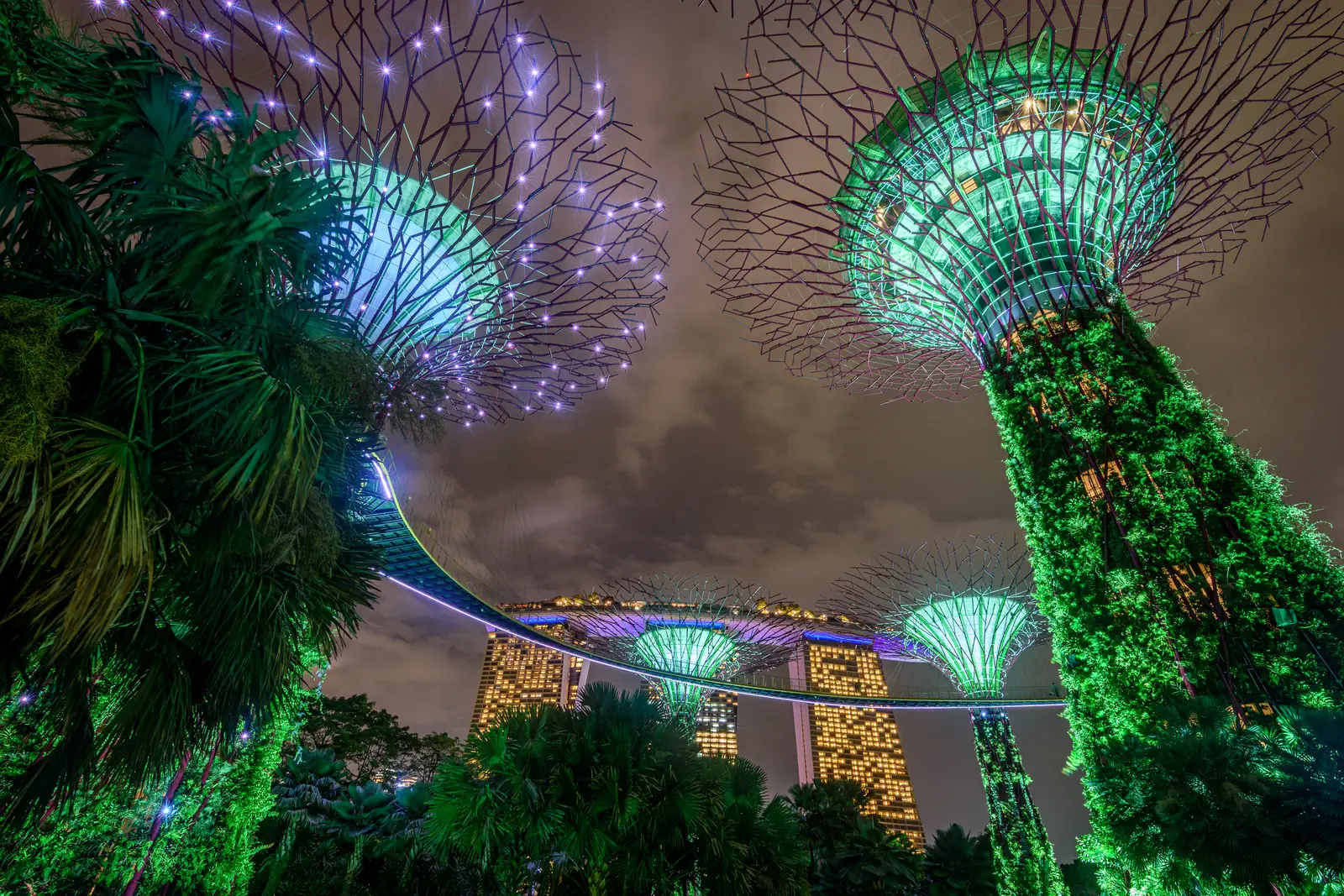
Short answer: On the ground in Singapore, plan on roughly S$60–105 (about $45–80) per person per day on a hostel-and-hawker budget, S$165–275 (about $130–215) in a hotel room shared by two, and from about S$370–435 (about $290–340) for large-hotel comfort, taxis and big-ticket attractions. A week costs roughly S$420–735 ($330–575) on a budget, S$1,155–1,925 ($900–1,505) mid-range and from about S$2,590 ($2,025) in comfort, before flights and shopping.
Singapore has a reputation as one of Asia’s most expensive cities, and that is true of its hotels. Almost everything else is easier on the wallet than people expect: a plate of chicken rice at a hawker center, a ride on the spotless MRT, the free gardens and light shows at Marina Bay. This guide breaks the costs down with official figures from the Singapore Tourism Board and other sources, so you can build a realistic budget for your trip to Singapore. Dollar prices are rounded at about S$1.28 to the US dollar, the Federal Reserve’s rate in early October 2026; use our Money exchange tool for today’s rate.
Singapore daily costs at a glance
These example days are built from the sourced prices further down this page: one person, one city day. They leave out flights, shopping, nightlife and casino spending.
| Per person, per day | Budget | Mid-range | Comfort |
|---|---|---|---|
| Bed | Hostel dorm bed: S$35–50 | Half of a small or mid-size hotel room at S$125–270: S$65–135 | Half of a large hotel room at S$290–320, more in luxury hotels: from S$145–160 |
| Food | Three hawker meals and drinks: S$20–30 | Hawker lunch, café, half of a S$90 dinner for two: S$60–75 | Café, lunch, half of a S$200 dinner for two, drinks: about S$145 |
| Local transport | A few MRT and bus rides: S$6–12 | Rides or a S$17 Tourist Pass: S$10–17 | MRT plus taxis: S$30–40 |
| Sights | Free gardens and light shows, one paid sight: S$0–15 | One or two tickets: S$30–50 | Gardens domes, cable car or Universal Studios: S$50–90 |
| Total | About S$60–105 ($45–80) | About S$165–275 ($130–215) | From about S$370–435 ($290–340) |
Hotel ranges are the Singapore Tourism Board’s (STB) official 2026 monthly average room rates; hostel and meal prices are typical October 2026 figures from hostel guides and the crowd-sourced Numbeo index. Treat them as typical ranges, not quotes.
What visitors actually spend in Singapore
STB publishes how much international visitors spend each year. In 2025, Singapore welcomed about 16.2 million visitors, who spent S$32.8 billion between them, and the average stay was 3.5 days. Divided per visitor, that comes to:
| All visitors, 2025 | Total (S$ million) | Per visitor (about) |
|---|---|---|
| Accommodation | 5,414 | S$335 ($260) |
| Food and drink | 4,912 | S$305 ($235) |
| Shopping | 5,208 | S$320 ($250) |
| Sightseeing, entertainment and gaming | 7,349 | S$455 ($355) |
| Other items | 9,871 | S$610 ($475) |
| Total | 32,755 | S$2,020 ($1,575) |
These averages mix leisure and business travelers with day visitors from Malaysia and cruise passengers, so they are a rough guide only, but they show where the money goes: sightseeing and entertainment (including casinos) is the biggest named item, ahead of hotels. On our Travel costs by country scale, Singapore’s general price level scores 59 against 100 for the United States, yet we place it in our second-highest travel cost band because hotels, which make up much of a visit, cost far more than prices in general. In plain words: expect US-style hotel bills but cheaper food and transport.
Accommodation costs
Your bed is by far the biggest line in a Singapore budget. STB’s official statistics put the average room rate across Singapore’s licensed hotels at S$273.50 for 2025 (about $215) with average occupancy of 82%, so hotels are busy year-round. In 2026 the monthly average has moved between S$260.70 in June and S$290.10 in February, and stood at S$284.40 in August.
STB also splits the figures by hotel size, which is a handy guide to what you will pay:
| Average room rate, 2026 (Jan–Aug) | Lowest month | Highest month |
|---|---|---|
| Small hotels | S$125.80 (June) | S$149.40 (February) |
| Medium hotels | S$240.00 (June) | S$270.50 (February) |
| Large hotels | S$287.40 (June) | S$316.70 (February) |
| All hotels | S$260.70 (June) | S$290.10 (February) |
The busiest month in 2025 was October, when the average jumped to S$311.40, the month of the Formula 1 night race; February 2026 was high too, around Chinese New Year. Hostels are the budget option: hostel guides put a dorm bed at roughly $25–40 (about S$35–50) a night, more on Grand Prix and big-concert weekends. If you want a resort feel, Sentosa island has its own beach hotels, usually at the upper end of the market.
Food and drink costs
Food is where Singapore turns cheap. Hawker centers, the open-air food courts found in every neighborhood, serve dishes such as chicken rice, laksa and char kway teow for roughly S$5–8 a plate. Numbeo’s October 2026 figures show a meal at an inexpensive restaurant at about S$15 (range S$7–30), a three-course dinner for two at a mid-range restaurant at about S$90 (range S$50–200), a fast-food combo at S$11, a regular cappuccino at about S$6.60 and a bottle of water at about S$1.60.
Alcohol is the budget breaker: a half-liter of local draft beer averages about S$10.50 (range S$6–18). In restaurants and bars, watch for “++” after menu prices: it means a 10% service charge and 9% GST (Singapore’s goods and services tax) are added to the bill. Hawker stalls and most cafés price everything in, with no service charge.
Getting around: MRT, buses, the Tourist Pass and taxis
Singapore’s MRT has more than 140 stations on six lines, and fares are low and distance-based. You do not need a special card: adult riders can tap in and out with a contactless Visa, Mastercard or American Express card or a mobile wallet such as Apple Pay or Google Pay. Single rides cost roughly S$1.30–2.60 depending on distance, after adult card fares rose by 9–10 cents per journey on 27 December 2025.
- Singapore Tourist Pass: unlimited rides on basic buses, MRT and LRT for S$17 (1 day), S$24 (2 days), S$29 (3 days), S$37 (4 days) or S$45 (5 days); multi-day passes run on consecutive days. It does not cover the Sentosa Express monorail, express buses or other premium services. Unless you ride a lot, paying per trip with your bank card is usually cheaper.
- Sentosa Express: S$4 from VivoCity, which also covers your entry to Sentosa island; rides within the island are free.
- Taxis: Numbeo’s figures put the standard flag-down at about S$4.60 plus around S$1 per kilometer; ride-hailing apps such as Grab work too. Surcharges apply at peak hours, late at night and from the airport.
Changi Airport is on the MRT network, so the cheapest way into town is the train. Singapore is small, and most visitors never need a car.
Sightseeing fees and free things to do
Singapore’s headline attractions are priced like theme parks, but many of its best sights cost nothing. Online adult prices for non-residents, as of October 2026:
| Sight | Adult price |
|---|---|
| Gardens by the Bay: Flower Dome and Cloud Forest | S$46 |
| National Orchid Garden, Singapore Botanic Gardens | S$15 (under 12 free) |
| Universal Studios Singapore, one day | S$76–89 depending on the date |
| Singapore Cable Car SkyPass (both lines, round trip) | S$35 |
| SkyHelix Sentosa | S$20 |
| Garden Rhapsody light show, Supertree Grove (7:45 and 8:45 p.m.) | Free |
| Singapore Botanic Gardens (outside the Orchid Garden) | Free |
| Jewel Changi Airport Rain Vortex and its light show | Free |
More free and cheap ideas: walk the Marina Bay waterfront and the outdoor Supertree Grove, wander Chinatown, Little India and Kampong Glam, and walk the Sentosa Boardwalk instead of taking the monorail. Our top places to visit in Singapore mixes free and paid stops, and our Singapore itinerary shows how to fit them into a few days.
Taxes and fees visitors pay
- GST: 9% on most goods and services, usually included in shop prices but added on top in “++” restaurant and hotel prices.
- GST refund for tourists (eTRS): visitors aged 16 and over can claim GST back on goods bought from participating shops, with a minimum spend of S$100 including GST in one shop (up to three same-day receipts). Show your passport when you buy, and claim at the airport kiosk when you leave within two months. Services such as hotels and meals do not qualify, and a handling fee may be deducted.
- SG Arrival Card: free. Submit it on the official ICA website or MyICA app within three days before arrival, and ignore sites that charge for it.
- Sustainable aviation fuel levy: a new levy applies to tickets sold from 1 October 2026 for flights leaving Singapore from 1 January 2027. In economy it is S$1 to Southeast Asia, S$2.80 to Northeast Asia, South Asia and Australia, S$6.40 to Europe, Africa, the Middle East and New Zealand, and S$10.40 to the Americas, and four times that in premium cabins. It is shown as a separate line on your ticket; passengers only transiting Singapore do not pay it.
Tipping in Singapore
Tipping is not widely practiced in Singapore, because most hotels and restaurants already add a 10% service charge, as Visit Singapore’s visitor material explains. You can leave something extra for great service, but no one expects it at hawker stalls, cafés or in taxis, and airport staff do not accept tips. If you do want to tip a guide, our tip calculator does the math.
Money-saving tips for Singapore
- Eat where locals eat. A hawker meal costs a fraction of a restaurant dinner with “++” charges.
- Go easy on alcohol. A beer can cost more than a hawker lunch; save drinks for one special evening.
- Tap your bank card on the MRT instead of buying a Tourist Pass unless you plan many rides a day.
- Avoid the priciest weeks. Hotel rates peaked at S$311.40 on average in October 2025 (Formula 1 month) and were high around Chinese New Year; June was the cheapest month in 2026.
- Mix free and paid sights. Garden Rhapsody, the Botanic Gardens and the Rain Vortex are free; pick one or two ticketed attractions.
- Group your shopping so you reach the S$100 minimum for a GST refund in one shop.
For the weather side of timing your trip, see our best time to visit Singapore guide. To compare Singapore with other countries, see Travel costs by country.
Plan your trip: our free trip planner can build a day-by-day plan for Singapore from our guides, including Sentosa. Then use the Money exchange tool to turn Singapore dollars into your own currency, and the Destination weather tool to pick your dates.
Frequently asked questions
How much money do I need for a week in Singapore?
Using the example days above, seven days on the ground cost roughly S$420–735 (about $330–575) per person on a tight budget, S$1,155–1,925 (about $900–1,505) mid-range, and from about S$2,590–3,045 (about $2,025–2,380) in comfort, before flights and shopping. Most visitors stay fewer days: the average stay in 2025 was 3.5 days.
Is Singapore expensive?
Its hotels are: the official average room rate was S$273.50 (about $215) in 2025. Food at hawker centers and public transport are cheap, and many top sights are free, so a traveler who sleeps in a hostel or small hotel can keep daily costs well below those of most Western cities.
Do I need cash in Singapore?
Very little. Cards and mobile wallets work almost everywhere, including the MRT and buses, and many hawker stalls accept QR or card payments. A small amount of cash is still handy for older stalls and markets.
Is the Singapore Tourist Pass worth it?
Only on very busy days. The 1-day pass costs S$17, while single MRT and bus rides cost roughly S$1.30–2.60 when you tap a bank card, so you would need many rides to come out ahead. It also does not cover the Sentosa Express.
What is the cheapest month to visit Singapore?
Hotel prices change less than in many destinations. In 2026 so far, June had the lowest average room rate (S$260.70) and February the highest (S$290.10); in 2025 October topped the year at S$311.40. Avoiding Grand Prix week and Chinese New Year saves the most.
Can I get the GST back on shopping?
Yes, on goods (not services) bought at participating shops, if you are 16 or older, spend at least S$100 including GST in one shop, and leave with the goods within two months through Changi or Seletar airport. Claim at the eTRS kiosk before you check in.