Short answer: The top places to visit in Singapore are Marina Bay, Gardens by the Bay, Chinatown, Little India and Kampong Glam, the Civic District and the Singapore River, Sentosa, the Singapore Botanic Gardens, the Mandai wildlife parks, the Southern Ridges and rainforest reserves, and Jewel Changi Airport with Pulau Ubin. Three or four days covers the first six; add a day or two for the zoo, the Night Safari and a nature walk.
Singapore is a city, an island and a country at once, so this list is about neighborhoods, gardens and islands rather than far-apart regions. The good news: almost everything is less than an hour apart on the MRT, and the city is green, spotless and easy to get around in English.
The list is ordered the way we would recommend it for a first visit. Weather timing comes from the Meteorological Service Singapore (MSS) 1991–2020 normals for Changi, and facts were checked in October 2026.
1. Marina Bay
Why it made the list: this is the Singapore postcard: the three towers and rooftop “ship” of Marina Bay Sands, the lotus-shaped ArtScience Museum, the spiky domes of the Esplanade theaters and the Merlion spouting water into the bay. A 3.5 km (2-mile) promenade loops around the water and over the Helix Bridge, and it ties the whole city center together.
When to go: any month, but come at dusk, when the heat eases and the skyline lights up. February is the driest month, with about 105 mm (4.1 in) of rain on 6 days. On the Formula 1 night-race weekend, parts of the bay are closed to non-ticket holders and hotels are at their priciest.
Don’t miss: the promenade loop at sunset, then the view from above, from Marina Bay Sands’ rooftop observation deck or the Singapore Flyer wheel.
Getting there and how long: the MRT’s Thomson-East Coast Line is handy for Marina Bay. Give it an evening, and combine it with Gardens by the Bay next door.
Practical note: paying for the MRT is easy: just tap a contactless Visa, Mastercard or American Express card, or a phone wallet, at the gates. See our Singapore travel guide for transport and entry rules.
2. Gardens by the Bay
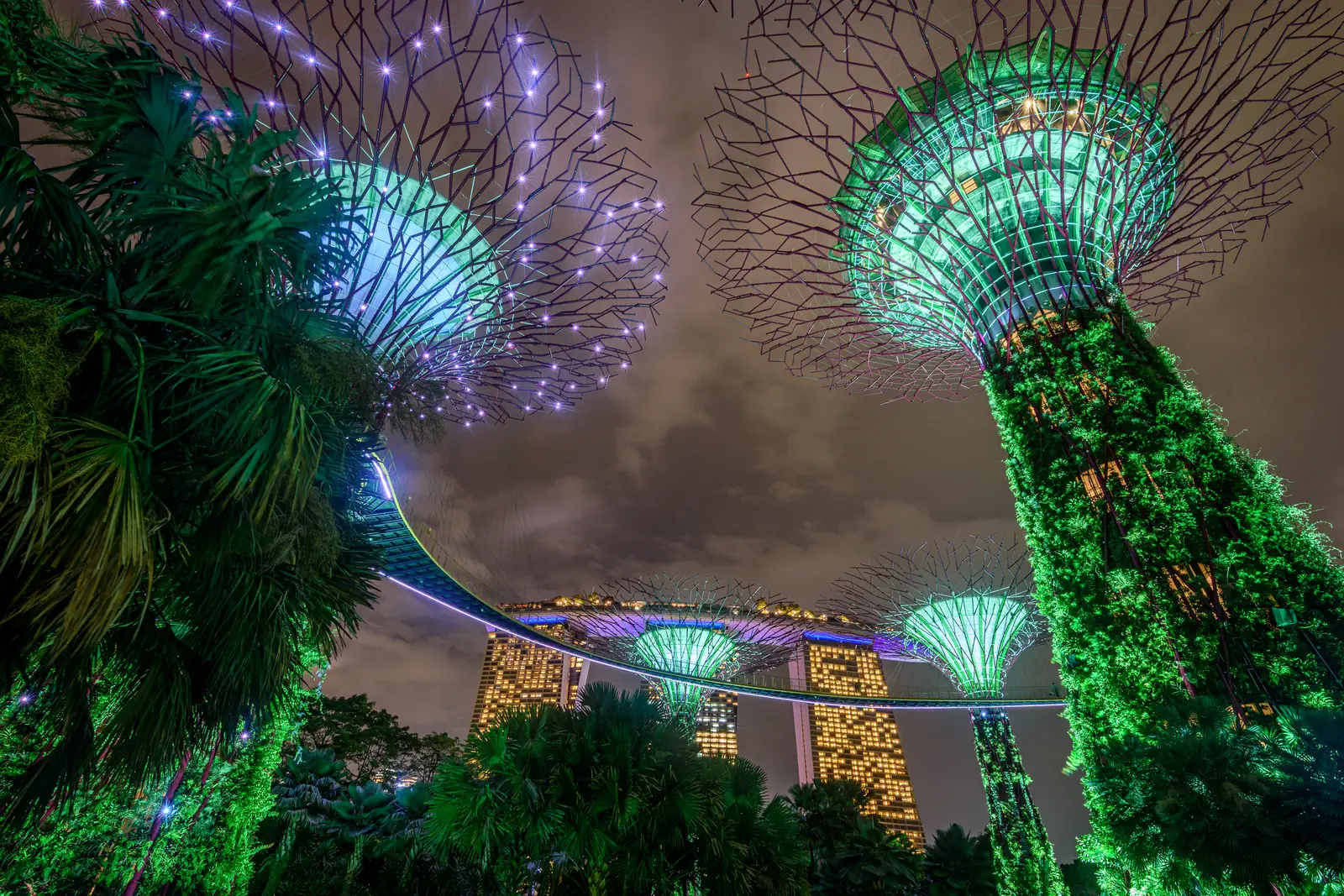
Why it made the list: behind Marina Bay Sands, the Supertree Grove of 16-story vertical gardens is one of the most futuristic sights in Asia, and walking among the Supertrees is free. Two giant glass conservatories add a world of flowers and a misty indoor mountain.
When to go: any day of the year, in the evening. The free light-and-music show, Garden Rhapsody, runs every night at 7:45 and 8:45 p.m.
Don’t miss: Garden Rhapsody from the ground under the Supertrees, and the Cloud Forest, with its indoor waterfall and cool, misty air on a hot afternoon.
Getting there and how long: a short walk from Marina Bay Sands. Allow three to four hours to see both domes and stay for the show.
Practical note: the Flower Dome and Cloud Forest open from 9 a.m. to 9 p.m., and a combined ticket costs S$46 (about US$36) for non-resident adults as of October 2026. Visiting the domes at midday and the Supertrees after dark beats the heat.
3. Chinatown
Why it made the list: restored shophouses, lanterns and markets, temples of three faiths on one street, and two of the city’s best hawker centers. Chinatown is where you taste the food Singapore is famous for, at a few dollars a plate.
When to go: any time, and best in the weeks before Chinese New Year, when the streets fill with lanterns and markets. Chinese New Year falls on February 6–7, 2027; many small shops and hawker stalls close for a day or two.
Don’t miss: the five-story Buddha Tooth Relic Temple, Sri Mariamman, the city’s oldest Hindu temple, and lunch at Maxwell Food Centre: Hainanese chicken rice is the classic order.
Getting there and how long: Chinatown has its own MRT station. Spend half a day, and come back for dinner in Tanjong Pagar or on Keong Saik Road.
Practical note: a hawker meal costs about S$5–8 (about US$4–6). A packet of tissues on a table means the seat is taken, and you return your tray when you finish.
4. Little India and Kampong Glam
Why it made the list: two of Singapore’s most colorful old quarters sit side by side. Little India is loud and fragrant, with flower-garland stalls, ornate temples and banana-leaf curry houses. A short walk east, Kampong Glam, the old Malay and Arab quarter, centers on the golden domes of the Sultan Mosque.
When to go: at festival time if you can. Little India is lit up for weeks around Deepavali, the festival of lights (November 8, 2026, and October 28, 2027), and Kampong Glam glows during Ramadan and Hari Raya Puasa (March 10, 2027).
Don’t miss: the Sri Veeramakaliamman Temple and a meal at the Tekka Centre, then the Sultan Mosque, Arab Street’s textile shops and the murals and indie boutiques of Haji Lane.
Getting there and how long: they are a short walk apart. Half a day covers both; Bugis and Little India are also good-value places to stay.
Practical note: cover shoulders and knees and take off your shoes in temples and mosques, where loose robes are often provided.
5. The Civic District and the Singapore River
Why it made the list: Singapore’s colonial heart, on the north bank of the river, holds its best museums. The old Supreme Court and City Hall are now the National Gallery Singapore, with the world’s largest public collection of Southeast Asian art, and the Raffles Hotel is the home of the Singapore Sling.
When to go: any month, and on wet days in particular: November to January is the rainiest stretch, and December is the wettest month, with about 332 mm (13.1 in) of rain. The museums make a perfect rainy-afternoon plan.
Don’t miss: the National Gallery and the Asian Civilisations Museum by the river, then a bumboat cruise past Boat Quay, Clarke Quay and Robertson Quay.
Getting there and how long: walk from Marina Bay. One day covers the museums and an evening on the river.
Practical note: alcohol is heavily taxed, so riverside drinks are expensive; happy hours help, and no one expects a tip, because a 10% service charge is already added.
6. Sentosa
Why it made the list: Singapore’s resort island packs three palm-fringed beaches, Universal Studios Singapore, the Singapore Oceanarium, the Skyline Luge, a cable car and a WWII coastal fort into about 5 km² (2 sq miles). It is the city’s playground, and the best day out with children.
When to go: February to April for the most sunshine, or June to September, when rain comes in short bursts. Weekday mornings are calmest; weekends and school holidays are crowded.
Don’t miss: Universal Studios (about S$76–89 for a one-day adult ticket online as of October 2026), and the free Fort Siloso Skywalk, a treetop walkway 11 stories high that leads into the fort.
Getting there and how long: take the MRT to HarbourFront and the Sentosa Express monorail from the VivoCity mall, about 15 minutes from the city; or walk the free Sentosa Boardwalk. Give it a full day, or stay a night.
Practical note: the monorail costs S$4 (about US$3) from VivoCity, which covers island entry, and is free within the island. The beaches are man-made and the water is calm but not crystal clear, so think city beach, not snorkeling trip. See our Sentosa travel guide and our guide to beaches.
7. The Singapore Botanic Gardens
Why it made the list: the gardens at the western end of Orchard Road are a UNESCO World Heritage Site, a green, shady escape with lakes, rainforest and a famous orchid garden, and they are free to enter.
When to go: early in the morning, any month; February and March bring the driest, breeziest days. The gardens open daily from 5 a.m. to midnight, according to the National Parks Board.
Don’t miss: the National Orchid Garden, open from 8:30 a.m. to 7 p.m. (last entry 6 p.m.), and breakfast or lunch at Dempsey Hill nearby.
Getting there and how long: Botanic Gardens MRT station is at the northern edge. Two or three hours is enough; pair them with Orchard Road’s malls in the afternoon heat.
Practical note: the gardens are free, but the National Orchid Garden costs S$15 for non-resident adults, and children under 12 go in free. Bring insect repellent for the shady paths.
8. Mandai: the zoo, Night Safari and Bird Paradise
Why it made the list: in the green north of the island, the Mandai wildlife parks are among the best in Asia: the open-concept Singapore Zoo, the Night Safari, the world’s first nocturnal zoo, River Wonders with its giant pandas, and Bird Paradise.
When to go: any month. The Night Safari is cooler and good year-round, but avoid the school holidays if you can (in 2027: March 13–21, May 29 to June 27, September 4–12, and from late November).
Don’t miss: an afternoon at the zoo followed by an evening at the Night Safari, the classic pairing.
Getting there and how long: Mandai is in the north, so allow time to get there by taxi or ride-hailing, or by MRT and a connecting bus. Plan a full afternoon and evening; Bird Paradise and River Wonders need another half day.
Practical note: the zoo opens from 8:30 a.m. to 6 p.m. (last entry 5 p.m.), and the Night Safari from 6:30 p.m. to midnight, according to Mandai. Combined tickets save money.
9. The Southern Ridges and the rainforest reserves
Why it made the list: around half of Singapore is green, and its nature walks are a surprise to most visitors. The Southern Ridges are a 10 km (6-mile) chain of parks and walkways from Mount Faber to Kent Ridge, with the wave-shaped Henderson Waves bridge, and the MacRitchie TreeTop Walk crosses the rainforest canopy on a suspension bridge.
When to go: February and March are the most comfortable months. In any month, start early: rain mostly comes in the afternoon, and lightning is common in storms, so leave open ground when thunder starts.
Don’t miss: Henderson Waves at sunrise on the Southern Ridges, or MacRitchie’s TreeTop Walk, where long-tailed macaques live. Bukit Timah Hill is the island’s highest point, at 163 m (535 ft).
Getting there and how long: the Southern Ridges start at Mount Faber, the mainland terminus of the cable car to Sentosa, so they combine well with a Sentosa day. Allow a morning for either walk.
Practical note: carry water and repellent, and don’t feed the monkeys or carry food in open bags. See our hiking guide.
10. Jewel Changi Airport and Pulau Ubin
Why they made the list: the two faces of Singapore’s east. Jewel is a glass dome linked to Changi’s terminals, open to everyone, whose Rain Vortex is billed as the world’s tallest indoor waterfall, falling 40 m (130 ft) through a terraced forest. Nearby, a 10-minute bumboat ride from Changi Point Ferry Terminal, Pulau Ubin is a rural island of old kampong (village) houses, mangroves and bike trails.
When to go: Jewel any day, in the evening; Pulau Ubin on a dry morning, ideally from February to April.
Don’t miss: the Rain Vortex light-and-music show at 8 or 9 p.m. (plus 10 p.m. from Friday to Sunday and on public holidays), and a bike ride on Pulau Ubin to the Chek Jawa wetlands.
Getting there and how long: Jewel is part of the airport, so see it on arrival, on departure or on a layover. Pulau Ubin is a half-day trip.
Practical note: the waterfall is free to see from 10 a.m. to 10 p.m.; Canopy Park on the top floor is ticketed. On a long layover you can leave the airport, as long as you meet the entry rules and file the free SG Arrival Card. See our guide to cycling.
How to fit them into one trip
Most first-time visitors spend three or four days in Singapore, often as a stopover. In three days: day one for Marina Bay, Gardens by the Bay and the Civic District and river; day two for Chinatown, the Botanic Gardens and Orchard Road; day three for Little India and Kampong Glam, with the Night Safari in the evening. With five days, add a full day on Sentosa (start with a morning on the Southern Ridges and ride the cable car across from Mount Faber), a day at the zoo or Bird Paradise, and an evening of Peranakan food in Katong. Keep Jewel for your way to or from the airport, and add Pulau Ubin on a week-long stay.
Pick your dates with our best time to visit Singapore guide, and our AI trip planner builds the day-by-day plan for your dates.
Plan your trip
Read our Singapore travel guide for the SG Arrival Card, laws and costs, check the rain for your dates in the Destination weather tool, convert Singapore dollars with the Money exchange tool, and let the trip planner build the route.
Frequently asked questions
What is the best place in Singapore for first-time visitors?
Marina Bay with Gardens by the Bay. In one evening you see the skyline, the Merlion, the Supertrees and the free Garden Rhapsody light show, and the Civic District’s museums and the river are a short walk away.
What is the most beautiful place in Singapore?
Most visitors would pick the Supertree Grove at Gardens by the Bay after dark, or the Marina Bay skyline at dusk. For something greener and quieter, the UNESCO-listed Botanic Gardens early in the morning are hard to beat.
How many days do you need in Singapore?
Three days covers the main neighborhoods and Gardens by the Bay. Allow four or five to add Sentosa, the zoo or Night Safari, and a nature walk. A 24-hour stopover still lets you see Marina Bay, Chinatown and Jewel.
Which places in Singapore are free?
Walking among the Supertrees and the Garden Rhapsody show, the Marina Bay promenade, the Botanic Gardens (except the National Orchid Garden), Jewel’s Rain Vortex, Sentosa’s beaches and the Fort Siloso Skywalk, and the temples and mosques of Chinatown, Little India and Kampong Glam.
Is Singapore worth visiting for more than a stopover?
Yes, if you like food, gardens and easy city travel. Four or five days lets you add Sentosa, the wildlife parks and the rainforest walks to the city sights, and day trips reach Pulau Ubin and the Southern Islands.