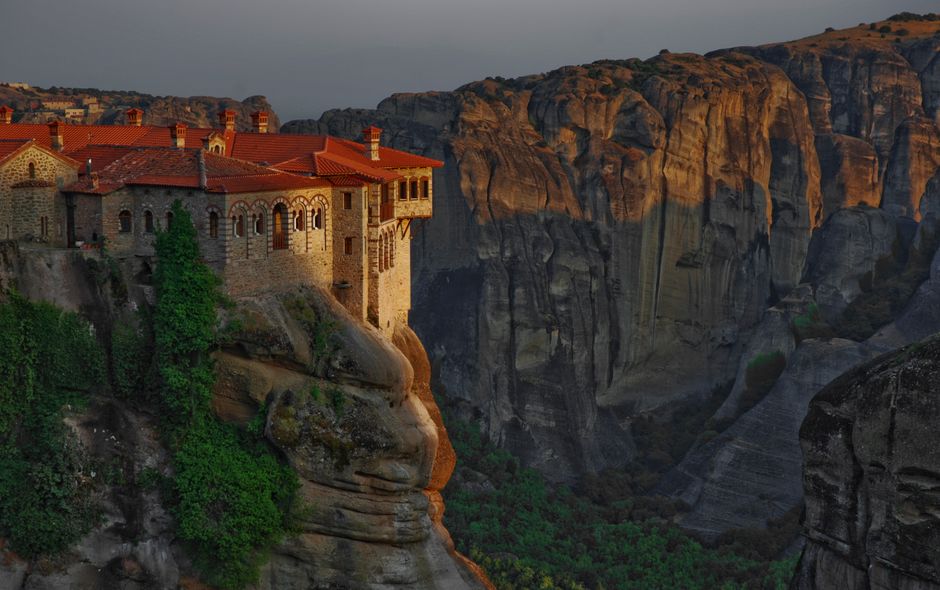
The monasteries of Meteora are six working Orthodox monasteries built on the summits of giant rock pillars above Kalambaka in central Greece, four for monks and two for nuns, all open to visitors. Each sets its own hours and closing day, so on any day at least four are open. As of October 2026 each charges a small entrance fee, reported at €5 per person, paid in cash at the door, and all enforce a strict dress code: long trousers for men, a skirt below the knee for women, shoulders covered. Summer hours run until 31 October; from 1 November winter hours are shorter and the Great Meteoron closes three days a week.
Right now in Monastery of Great Meteoron
- Wed7–22°C45–71°FPartly cloudy
- Thu7–22°C45–72°FPartly cloudy
- Fri12–24°C54–76°F1 mm rain
Tickets and tours for Monastery of Great Meteoron
See all tours for Monastery of Great Meteoron →
From local operators, with prices and reviews; you check availability and book on Viator, our partner. We may earn a commission at no extra cost to you. How we earn money
Why the monasteries matter
Hermits lived in the caves of these sandstone and conglomerate towers from around the 11th century. In the 14th century St Athanasios the Meteorite founded the first great monastery on the “Broad Rock”, and by the 16th century more than twenty monasteries crowned the pillars, reached only by retractable ladders or by nets hauled up on ropes. Most fell into ruin; six survive as active communities, with superb Byzantine and post-Byzantine frescoes, and steps and bridges have replaced the nets. Meteora has been a UNESCO World Heritage Site since 1988. These are places of worship first: the monks and nuns welcome visitors, but on their terms.
The six monasteries
Great Meteoron
The largest and highest, founded by St Athanasios. About 300 steps, partly cut through the rock, lead to the frescoed church of the Transfiguration, the old kitchen, the ossuary with monks’ skulls, a museum of manuscripts and icons, and the tower with the old winch. It is the most visited: go at opening time.
Varlaam
Facing the Great Meteoron across a ravine, with some of the finest 16th-century frescoes in Meteora, a giant old wine barrel and a restored rope-and-net winch. Fewer steps than its neighbour.
Roussanou
A nunnery that seems to grow out of its narrow rock, reached by a short path and footbridges, with vivid frescoes in its small church. It is one of the most photographed silhouettes in Meteora.
Holy Trinity (Agia Triada)
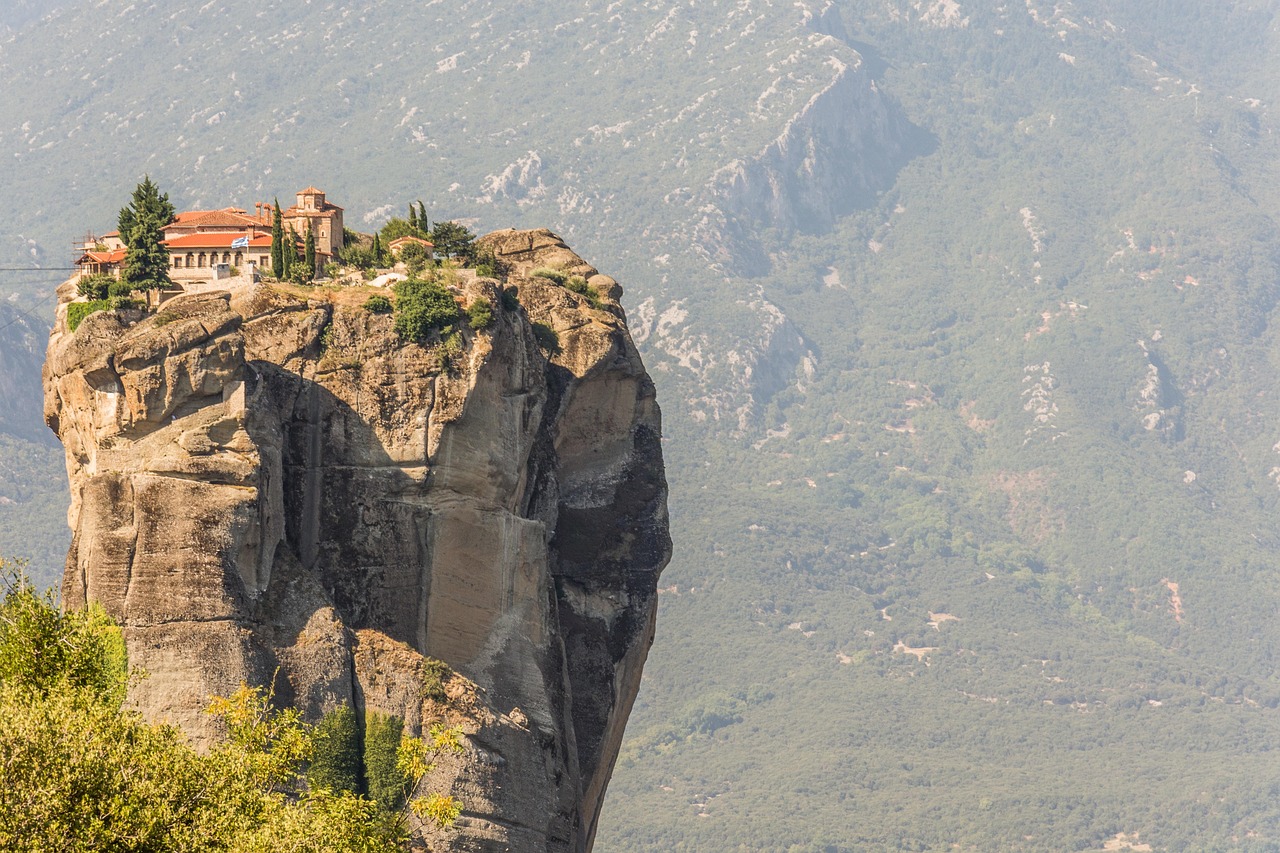
The most dramatic perch, on an isolated pillar reached by about 140 steps cut into the rock, famous from the 1981 James Bond film For Your Eyes Only. Its rear terrace looks over Kalambaka and the Pinios valley.
St Stephen (Agios Stefanos)
A nunnery with no stairs to climb: a bridge from the road leads straight in, so it is the best choice for visitors with limited mobility. It looks straight down onto Kalambaka.
St Nicholas Anapafsas
The first you reach from Kastraki, small and built on several levels on a narrow rock, with 16th-century frescoes by the Cretan painter Theophanis Strelitzas. A short steep path leads up from the road.
Which monastery is open when
Hours from the Municipality of Meteora and the Great Meteoron, as of October 2026 (summer = 1 April to 31 October, winter = 1 November to 31 March):
- Great Meteoron: summer 9:30–15:00, closed Tuesday; winter 9:30–14:00, closed Tuesday, Wednesday and Thursday. Also closed 5–7 August, 30 September–1 October and all of February.
- Varlaam: summer 9:00–16:00, winter 9:00–15:00; closed Friday (some sources say also Thursday in winter).
- Roussanou: summer 9:30–16:30, winter 9:30–14:00 (Sundays from 10:30); closed Wednesday.
- Holy Trinity: summer 9:00–16:30, winter 10:00–16:00; closed Thursday.
- St Stephen: summer 9:00–13:20 and 15:30–17:30 (Sundays from 9:30), winter 9:30–13:00 and 15:00–17:00; closed Monday.
- St Nicholas Anapafsas: 9:00–17:00; reportedly closed Friday.
The monasteries can change hours without notice, especially on feast days and at Easter, so ask at your hotel the evening before.
Practical information
- Tickets: no advance booking. Pay at each door; the fee is reported at €5 per person per monastery as of October 2026, in cash, with children usually free. Bring small notes and coins.
- Dress code: the Great Meteoron’s rule is that men may not enter in shorts, Bermudas or sleeveless shirts, and women may not wear trousers or sleeveless tops. Most monasteries lend wrap-around skirts at the entrance, but bring your own to be safe.
- Behaviour: keep your voice low, don’t photograph inside the churches (most forbid it), and don’t pass ropes into the monks’ areas.
- Heat and crowds: coach tours crowd the monasteries from about 10:00 to 13:00, and the steps are hot in July and August. Go at opening time or after 14:00 (St Stephen, Holy Trinity and Roussanou stay open later).
- Accessibility: St Stephen is reached by a bridge with no stairs; the others involve from a few dozen to about 300 steps. The roadside viewpoints are easy.
- How long: about an hour per monastery including the climb. Two or three monasteries make a full, unhurried morning.
Getting there and between them
Kalambaka, the town at the foot of the rocks, is reached by train or KTEL bus from Athens (normally about 4½–5 hours) or Thessaloniki; check the rail service, which has often been replaced by buses during upgrade works. A 17 km road loops past all six monasteries, and parking at the Great Meteoron and Varlaam fills by late morning in summer. Without a car, take a taxi from Kalambaka’s main square to the top and walk down, use the seasonal local bus to the Great Meteoron, or join a half-day minibus tour. Old footpaths link Kastraki to the Great Meteoron and Kalambaka to Holy Trinity and St Stephen, each about 45–60 minutes uphill: see our hiking guide.
Combine it with
Stay at least one night in Kalambaka or Kastraki and watch the sunset from Psaropetra, near Roussanou, or the viewpoint by St Stephen. Read our Meteora travel guide for hiking, viewpoints and where to stay, and our Greece travel guide. Meteora fits well between Athens and Thessaloniki, or on a mainland loop with Delphi and Nafplio.
Meteora monasteries FAQ
Which Meteora monasteries are open on which days?
In summer the usual closing days are Monday for St Stephen, Tuesday for the Great Meteoron, Wednesday for Roussanou, Thursday for Holy Trinity and Friday for Varlaam (and reportedly St Nicholas). In winter the Great Meteoron also closes on Wednesday and Thursday.
How much does it cost to enter the Meteora monasteries?
Each monastery charges its own fee, reported at €5 per person as of October 2026, paid in cash at the door. Children usually enter free.
What is the dress code at Meteora?
Men need long trousers and sleeved shirts; women need a skirt below the knee and covered shoulders. Most monasteries lend wrap skirts, but bring your own.
How many monasteries can you visit in one day?
Three or four comfortably, by car or taxi. The Great Meteoron and Varlaam are next to each other; add Roussanou or St Stephen in the afternoon.
Which Meteora monastery has no stairs?
St Stephen’s nunnery, reached by a bridge from the road. It is the best choice for visitors with limited mobility.
Can you take photos inside the monasteries?
Outside, yes, and the views are superb. Inside the churches photography is usually forbidden; follow the signs.