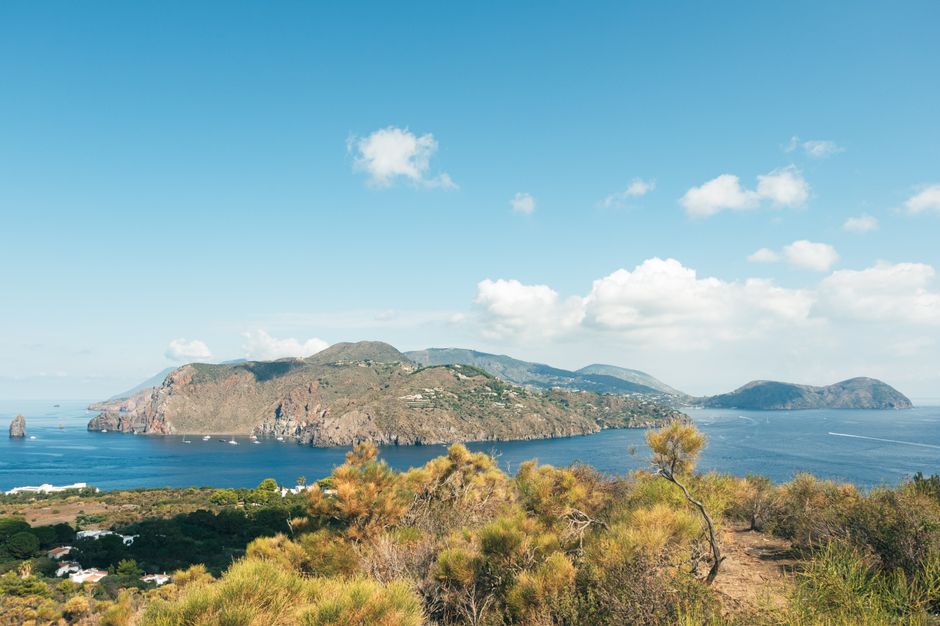
The Aeolian Islands are seven volcanic islands strung across the Tyrrhenian Sea off the north coast of Sicily, named after Aeolus, the Greek god of the winds, and listed by UNESCO for their volcanoes. Each has its own personality: busy Lipari with its castle and port; Vulcano, where you can walk up a steaming crater and bathe in sulphur mud; green, vine-covered Salina; tiny, stylish Panarea; Stromboli, one of the most continuously active volcanoes on Earth, throwing up glowing bursts every few minutes; and remote Filicudi and Alicudi, where donkeys still carry the shopping. Boats from Milazzo take about an hour to the nearest islands. Come for black-sand beaches, clear water, island-hopping by hydrofoil, capers, Malvasia wine and Stromboli at night. The best months are late May, June and September.
Right now in Aeolian Islands (Lipari)
- Wed22–25°C71–77°F1 mm rain
- Thu24–27°C75–80°FPartly cloudy
- Fri21–26°C70–78°F2 mm rain
Top tours in Aeolian Islands
See all tours for Aeolian Islands →
From local operators, with prices and reviews; you check availability and book on Viator, our partner. We may earn a commission at no extra cost to you. How we earn money
Aeolian Islands at a glance
- Best for: volcanoes, island-hopping, swimming and snorkeling, boat trips, slow food and wine, and switching off.
- How long: 4–7 nights, split between a base on Lipari or Salina and a night or two on Stromboli or Panarea.
- Best time: late May–June and September. July and August are hot and very busy; from November to March many hotels close and boats are fewer.
- Book ahead: rooms for June to September, hydrofoils in August, and an authorised guide for the Stromboli climb.
- Getting in: hydrofoils and ferries from Milazzo, the main port, plus hydrofoils from Messina and Reggio Calabria and seasonal boats from Naples and Palermo. A landing fee is included in your ticket.
- Before you go: entry rules, money, trains and general safety are on our Italy travel guide.
The islands and who each one suits
Six of the islands belong to the town of Lipari; Salina is divided between three small towns of its own. Hydrofoils link them all, so you can stay on one and hop to the others, or move between two or three.
Lipari
The largest island and the hub of the archipelago, with the most hotels, restaurants, shops and boat connections. Lipari town spreads between two harbours below a walled acropolis, the Castello, that has been inhabited for 6,000 years. Around the island are pumice cliffs, the Quattrocchi viewpoint over Vulcano, and pebble beaches at Canneto and Acquacalda. Best for: first-timers, island-hoppers and anyone without a car.
Vulcano
The closest island to Sicily and the one that smells of sulphur from the moment you land. Its Gran Cratere, the Fossa, can be climbed in about an hour; by the port are the black-sand Sabbie Nere beach, the Acque Calde, where gas bubbles up through the sea, and the famous mud pool. Best for: a day trip from Lipari, beaches and a first volcano walk.
Salina
The greenest island, formed by two extinct volcanoes, with Monte Fossa delle Felci, at 962 m the highest point in the archipelago. Vineyards for sweet Malvasia wine, caper bushes and small villages (Santa Marina, Malfa, Leni, Lingua and Rinella) make it the most relaxed and food-focused island. Pollara, a half-sunken crater by the sea, is where the film Il Postino was shot. Best for: couples, food and wine, walking and quiet.
Panarea
The smallest inhabited island, with whitewashed houses, bougainvillea, electric carts instead of cars, a chic summer scene and a string of islets offshore. Walk to the Bronze Age village at Capo Milazzese above the cove of Cala Junco. Best for: style, sea and evenings out in summer; it is very quiet out of season.
Stromboli
A near-perfect cone, 924 m high, that has been erupting almost continuously for thousands of years. The main village spreads along the north-east coast below white houses and black beaches; tiny Ginostra, on the south-west side, has no roads at all. The great sight is the Sciara del Fuoco, the slope down which lava and glowing rocks tumble into the sea. Best for: volcano lovers; stay at least one night to see the eruptions after dark.
Filicudi and Alicudi
The two western islands are wild, steep and almost empty. Alicudi has no roads, only stepped mule tracks; Filicudi has a few, a prehistoric village and a sea stack, La Canna. Boats are fewer, especially in winter. Best for: hikers and people who want real isolation.
Top things to see in the Aeolian Islands
Prices and hours below were checked on the official sites in October 2026, unless we say otherwise; volcano access rules change with activity, so check again before you go.
Stromboli’s eruptions and the crater rules
Since the violent eruptions of 2019 the summit craters have been closed to visitors, and climbs are regulated by the mayor of Lipari according to the volcano’s alert level. Under the ordinance in force as archived by the INGV’s Aeolian monitoring centre (May 2025), you may walk without a guide only up to 290 m, on set paths from the observatory area; from 290 m to 400 m you must go with an authorised alpine or volcanological guide, in groups of up to 25 and no more than 75 people above 290 m at a time, wearing a helmet and dust mask supplied by the guide. The summit itself, at 924 m, is off-limits. Guided climbs usually start in the late afternoon so you watch the bursts at dusk from about 400 m, then descend by torchlight; book with a licensed guide agency in the village. The rules can tighten at any moment if activity increases, so ask the guides or the town’s civil protection office on arrival. The other classic way to see the eruptions is from the sea: evening boat trips from Stromboli, Lipari and the other islands stop off the Sciara del Fuoco after dark.
The Gran Cratere on Vulcano
A marked path climbs from near the port to the rim of the Fossa crater, at about 390 m, in about an hour, over loose volcanic sand with no shade. At the top you walk along the rim among yellow sulphur fumaroles, with views over all seven islands. Access has been closed or limited at times since a period of increased gas emissions in 2021–2023, and in summer the path may be closed in the hottest hours; follow the signs and warning lights at the start, and do not linger near the fumaroles. Go early in the morning with plenty of water. Near the port, the mud pool (Laghetto di Fanghi) has also had long closures: check locally whether it is open.
Lipari’s Castello and archaeological museum
Climb the stairs from the harbour to the Castello, the walled hilltop with the cathedral, ruined churches and excavations showing layers of settlement from the Neolithic to the Greeks. The castle area is free. Inside, the Luigi Bernabò Brea regional archaeological museum is one of the finest in the Mediterranean, famous for its Greek theatre masks, painted vases and the obsidian that made the islands rich in prehistory. As of October 2026 the Region of Sicily’s archaeological park lists tickets at €8 (€4 reduced); the museum opens daily 9:00–19:30 (ticket office closes 18:30), and 9:00–13:30 on public holidays.
Salina’s villages, Pollara and Fossa delle Felci
Walk from Santa Marina to Lingua and its salt lake, take the bus to Malfa and Pollara for the sunset over the sunken crater, and climb Monte Fossa delle Felci through ferns and woods, about two to three hours up from the sanctuary of Valdichiesa. Visit a winery for Malvasia delle Lipari, the sweet amber wine, and eat a pane cunzato with capers.
More to see
- Quattrocchi, Lipari: the island’s best-known viewpoint, over the sea stacks towards Vulcano.
- Capo Milazzese, Panarea: the oval huts of a Bronze Age village on a headland, free to visit.
- Strombolicchio: a volcanic plug with a lighthouse off Stromboli, seen on boat trips.
- Valle dei Mostri, Vulcano: lava rocks eroded into strange shapes on the Vulcanello peninsula.
Other things to do in the Aeolian Islands
Boat trips and island-hopping
Day cruises leave Lipari, Milazzo and the other islands in season, typically combining Panarea and Stromboli with an evening off the Sciara del Fuoco, or Salina and Lipari with swim stops; a boat round Lipari and Vulcano shows the pumice cliffs and sea caves. Renting a small boat for the day is popular too. See our boat trips guide.
Beaches, snorkeling and diving
Beaches here are mostly black sand or pebbles: the Sabbie Nere on Vulcano, Ficogrande and Forgia Vecchia on Stromboli, Canneto on Lipari and the pebble coves of Salina. The water is very clear, with rocky walls, underwater fumaroles off Panarea and plenty of fish, so bring a mask for snorkeling; dive centres operate on Lipari, Salina, Panarea and Stromboli, see our diving guide. Water shoes help on the stones and the hot sand. See also our beaches guide.
Hiking
Every island has walks: the Vulcano crater, the Stromboli climb (within the limits above), Fossa delle Felci on Salina, the coastal path on Lipari’s west side and the steep tracks of Alicudi and Filicudi. Paths are exposed and shadeless, so start early and carry water. See our hiking guide.
Food and wine
Salina’s capers and Malvasia are the stars, alongside fresh fish, swordfish, pane cunzato (bread topped with tomatoes, capers, olives and cheese) and almond granita for breakfast. Several Salina estates offer tastings; see our wine tasting guide.
Day trips and onward travel
Taormina and Etna
Back on the mainland, Taormina, with its Greek theatre above the sea, is about two hours from Milazzo by road, and Etna is a natural pairing for a volcano-themed trip. Combine three or four nights on the islands with a few nights in Taormina and fly out of Catania.
Cefalù and Palermo
Going west, Milazzo is linked by train and road along the north coast to Cefalù and Palermo, and in summer hydrofoils also run between Palermo and the islands. Our Sicily guide has suggested routes round the island.
Nearby destinations
Getting there and getting around
Hydrofoils and ferries from Milazzo
Milazzo, on Sicily’s north-east coast, is the main gateway. Liberty Lines runs fast hydrofoils, and Siremar (part of Caronte & Tourist) and other companies run slower car ferries. Hydrofoils reach Vulcano in under an hour and Lipari in about an hour, with Salina, Panarea and Stromboli further on; ferries take roughly twice as long. As an example, Siremar’s price list valid from 10 September 2026 gives a deck fare Milazzo–Lipari of €17.16 or €18.86 one way, depending on the season. Liberty Lines publishes its fares only through its booking system, and both companies state that fares include port taxes and the landing fee. Liberty Lines also sails from Messina and Reggio Calabria, and in summer from Naples and Palermo; Siremar runs a slower ferry from Naples. Boats are cancelled in strong winds, so do not plan a flight for the same day as your last crossing.
The landing fee
The town of Lipari (Lipari, Vulcano, Panarea, Stromboli, Filicudi and Alicudi) and the three towns of Salina charge visitors a contributo di sbarco, added to the boat ticket. Local news reports for 2026 give €2.50 in spring and October and €5 from June to September; we could not confirm the amounts on the town’s own website, so treat them as a guide.
Reaching Milazzo
The nearest airports are Catania (CTA) and Palermo (PMO); from Catania, direct buses run to Milazzo port in summer, otherwise take a bus or train via Messina. Milazzo’s railway station, on the Messina–Palermo line, is a few kilometres from the port; take a local bus or taxi. Drivers can leave the car in paid car parks near the port.
On the islands
Lipari and Salina have local buses connecting their villages, plus taxis and scooter, e-bike and small-car rentals. Vulcano is walkable around the port; Panarea and Stromboli use electric carts and three-wheeled taxis, and Alicudi has no roads at all. Cars of non-residents are banned from landing on several islands in summer, and you will not need one: leave it in Milazzo.
When to go and how long to stay
The islands have a Mediterranean climate: hot, dry summers and mild, windy, wetter winters. There is no long-term station on the islands, so the table uses the WMO 1991–2020 climate normals of the Italian Air Force station at Messina, on the same corner of Sicily about 70 km away and the same station used on our Sicily and Taormina guides: average daily highs and lows, and days with at least 1 mm of rain. On the islands, the sea breeze usually takes the edge off summer heat.
| Season | Average high / low | Rainy days per month | What it’s like | Good for |
|---|---|---|---|---|
| Winter (Dec–Feb) | 15–16 °C / 10–11 °C | 10–12 | Mild but windy and rainy; many hotels closed, fewer boats | Quiet walks, Stromboli without crowds |
| Spring (Mar–May) | 17–23 °C / 11–17 °C | 4–9 | Wildflowers, the season opens around Easter | Hiking, island-hopping, first swims in late May |
| Summer (Jun–Aug) | 28–31 °C / 21–25 °C | 2–3 | Hot, sunny and busy, especially in August | Swimming, boat trips, nights out on Panarea |
| Autumn (Sep–Nov) | 28 °C falling to 20 °C / 21 °C falling to 15 °C | 7–11 | Warm sea in September, storms and closures from late October | Swimming, walking, wine harvest on Salina |
The sea is warmest from July to September. Hiking the volcanoes is most pleasant in spring and autumn, when the paths are cooler.
Events worth planning around
- 24 August: the feast of San Bartolomeo, patron of the islands, with a procession and fireworks in Lipari.
- Late spring: the caper festival on Salina, at Pollara; check dates locally.
- September: the grape harvest on Salina, when some wineries welcome visitors.
How long to stay: 3, 5 and 7 days
3 days: base on Lipari; day one, the Castello and museum; day two, Vulcano for the crater and the beach; day three, a boat trip to Panarea and Stromboli with the eruptions at night.
5 days: three nights on Lipari as above, then two on Salina for Pollara, a winery and Fossa delle Felci. 7 days: add two nights on Stromboli for the guided climb and the black beaches, or a quiet day on Filicudi.
Where to stay in the Aeolian Islands and the tourist tax
- Lipari town: the most practical base, with the best boat connections and the widest choice.
- Salina: boutique hotels and quiet villages; great food.
- Stromboli: for the volcano; simple to stylish, and quiet once the day boats leave.
- Panarea: small, chic and expensive in summer.
- Vulcano: beach hotels close to the port; the sulphur smell is noticeable.
Book well ahead for June to September, especially on Panarea and Stromboli, and check whether your hotel is open in spring and autumn. The islands’ towns charge a tourist tax (imposta di soggiorno) per person per night, paid at your accommodation; ask for the current rate when you book. It is separate from the landing fee in your boat ticket.
Practical tips for the Aeolian Islands
- Watch the wind: hydrofoils stop in rough seas; leave a spare day before flights.
- Respect the volcanoes: keep to the altitude limits on Stromboli and the warnings on Vulcano; fines are heavy and the danger is real.
- Carry cash: the smaller islands have few cash machines.
- Sulphur and silver: take off silver jewellery before the Vulcano mud and hot water.
- Emergencies: call 112.
What to pack for the Aeolian Islands
Pack light: you will carry your bags on and off boats and up steps. For the volcano walks you need sturdy shoes with good grip (volcanic sand gets everywhere), a head torch for the Stromboli descent, a warm layer and a windproof jacket for the top, plus a hat, sunscreen and at least two litres of water. Water shoes help on pebbles and hot black sand, and a snorkel mask is worth bringing. Add an old swimsuit for the Vulcano mud, which stains, and travel-sickness tablets if the hydrofoils bother you.
Aeolian Islands travel FAQ
How do I get to the Aeolian Islands?
By hydrofoil or ferry from Milazzo, about an hour to Vulcano or Lipari by hydrofoil. There are also hydrofoils from Messina and Reggio Calabria, and seasonal boats from Naples and Palermo. Fly into Catania or Palermo.
Which Aeolian island is best to stay on?
Lipari for connections and choice, Salina for peace and food, Stromboli for the volcano, Panarea for style. Many people split a week between Lipari or Salina and Stromboli.
Can you climb Stromboli?
Partly. Under the mayor’s ordinance archived in 2025, you can walk alone up to 290 m, and up to 400 m only with an authorised guide; the summit at 924 m is closed. Rules change with the volcano’s activity, so check on arrival.
How can I see Stromboli erupt?
On a guided evening climb to 400 m, or from an evening boat trip that waits off the Sciara del Fuoco after dark. Both are best on a clear, calm night.
Is there a landing fee for the Aeolian Islands?
Yes. A contributo di sbarco is included in boat tickets to the islands of Lipari and Salina; local reports give €2.50 in the shoulder season and €5 from June to September in 2026.
How much is the ferry from Milazzo to Lipari?
Siremar’s car-ferry deck fare is €17.16 or €18.86 one way, depending on the season, in its price list valid from 10 September 2026. Liberty Lines hydrofoils are faster; check its booking site for the fare.
Can I climb the crater on Vulcano?
Usually yes: the walk to the rim of the Gran Cratere takes about an hour. Access has been limited at times because of volcanic gas, so follow the signs at the start, go early and carry water.
Do I need a car on the Aeolian Islands?
No. Buses, taxis, scooters and boats cover everything, and non-resident cars are banned from several islands in summer. Leave yours in Milazzo.
When is the best time to visit the Aeolian Islands?
Late May, June and September, when the sea is warm, boats are frequent and the islands are calmer than in August.
How many days do you need in the Aeolian Islands?
At least three to see Lipari, Vulcano and Stromboli from a single base; five to seven to add Salina and a night on Stromboli without rushing.
Plan your trip
Partner links: TravelerCenter may earn a commission if you book, at no extra cost to you.
🇮🇹 Useful Italian phrases for Aeolian Islands
All 38 Italian phrases: restaurant, hotel, emergencies, romance (printable) →
Sources · last reviewed 4 October 2026
Researched and last reviewed on 4 October 2026. Stromboli climbing rules: the mayor of Lipari’s ordinance as published by the INGV’s Aeolian monitoring centre; Lipari museum prices and hours: the Region of Sicily’s Aeolian Islands archaeological park; ferry fares: Siremar’s (Caronte & Tourist) published price list; hydrofoil routes and fare rules: Liberty Lines; climate: WMO 1991–2020 normals of the Italian Air Force station at Messina. The Town of Lipari’s website could not be reached, so the landing fee amounts, the tourist tax, the Vulcano crater and mud pool rules and the summer car ban come from local news and are flagged for checking. Crossing times are typical. For entry rules, money and general safety, see our Italy travel guide.
Data: Weather: MET Norway (CC BY 4.0) · Sea temperature: NOAA CoastWatch · Rates: ECB · Costs: World Bank ICP and price levels · Wikidata (CC0)