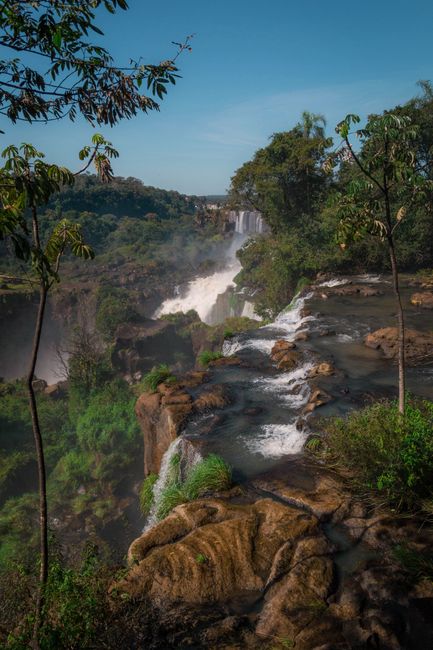
Iguazú National Park, in Argentina’s far north-eastern province of Misiones, protects the Argentine side of Iguazú Falls, one of the natural wonders of the world: the Iguazú River, the border with Brazil, spills over a horseshoe of about 275 separate falls in a cloud of spray and rainbows, surrounded by subtropical Atlantic Forest. Steel walkways take you right over the edge of the Devil’s Throat (Garganta del Diablo), where half the river plunges into a narrow chasm, and along the Upper and Lower circuits past dozens of cascades. The park, created in 1934 and a UNESCO World Heritage Site since 1984, is also home to toucans, coatis, monkeys, caimans and clouds of butterflies. Most visitors spend one full day on the Argentine side, where you walk among the falls, and half a day on the Brazilian side for the panorama.
Right now in Iguazú National Park (Puerto Iguazú)
- Wed19–29°C67–85°F1 mm rain
- Thu22–28°C71–82°F4 mm rain
- Fri22–28°C71–83°F18 mm rain
- Mon 12 Oct Day of Respect for Cultural Diversity (Día del Respeto a la Diversidad Cultural)
Top tours in Iguazú National Park
See all tours for Iguazú National Park →
From local operators, with prices and reviews; you check availability and book on Viator, our partner. We may earn a commission at no extra cost to you. How we earn money
Iguazú National Park at a glance
- Best months: March to May and August to November, when it is warm rather than hot; the falls flow all year, with the most water after heavy rain.
- Time needed: one full day for the three main circuits and the train; two days to add the Macuco trail, a boat ride and a relaxed second look at half price.
- Fee (as of October 2026): ARS 60,000 (about US$39) per day for foreign visitors, including the train; 50% off a second day within 72 hours.
- Hours: daily 8 a.m. to 6 p.m., last entry 4 p.m.; open in rain and on holidays.
- Getting there: fly to Cataratas del Iguazú airport (IGR), about two hours from Buenos Aires; the park entrance is about 18 km (11 miles) from Puerto Iguazú.
- Before you go: entry rules, money and general safety are in our Argentina travel guide.
Fees, hours and tickets (as of October 2026)
The park is managed by Argentina’s National Parks Administration (APN), and the Área Cataratas, the falls area with the trains, walkways and visitor services, is run by a concession company, Iguazú Argentina. According to the APN fee table in force since June 1, 2026, and the park’s official site:
| Ticket | Price | Notes |
|---|---|---|
| International visitors | ARS 60,000 (about US$39) | Includes the Rainforest Ecological Train |
| Residents of Argentina | ARS 25,000 | Argentine ID required |
| Second day (same park, within 72 hours) | 50% off | Buy online with your first ticket, or at the gate with your first-day ticket |
| Flexipass 3 days / 7 days (general) | ARS 120,000 / ARS 210,000 | For long stays |
| Children up to 6, visitors with a disability certificate and one companion | Free | Show documents |
- Hours: the Área Cataratas opens every day of the year, including rainy days and holidays, from 8 a.m. to 6 p.m.; last entry is at 4 p.m. On some peak days the park opens at 7 a.m.
- Tickets: buy online on the park’s official site, iguazuargentina.com, or at the entrance; carry the passport you used to buy. Paying online avoids lines in high season.
- Extras: car parking and lockers (about ARS 13,500–21,000 as of October 2026) are paid at the entrance. The official full-moon walks and sunset visits cost ARS 95,000 (about US$63) for adults and half for children 6 to 12.
- Exchange: on October 2, 2026, the Central Bank of Argentina’s reference rate was about ARS 1,520 per US dollar; foreign cards are settled at the financial (“MEP”) dollar rate.
Top things to see at Iguazú
The falls area is a network of walkways and trails linked by the narrow-gauge Rainforest Ecological Train (Tren Ecológico de la Selva), which runs from Central Station near the entrance to Cataratas Station and on to Garganta Station. According to the park, the first train leaves Central Station at 8:20 a.m., trains then run every 20 to 30 minutes (every 15 minutes in high season), the last train to the Devil’s Throat leaves at 3:30 p.m., and the last train back leaves Garganta at 5:30 p.m. You can also walk the 15-minute Sendero Verde from Central to Cataratas station.
The Devil’s Throat (Garganta del Diablo)
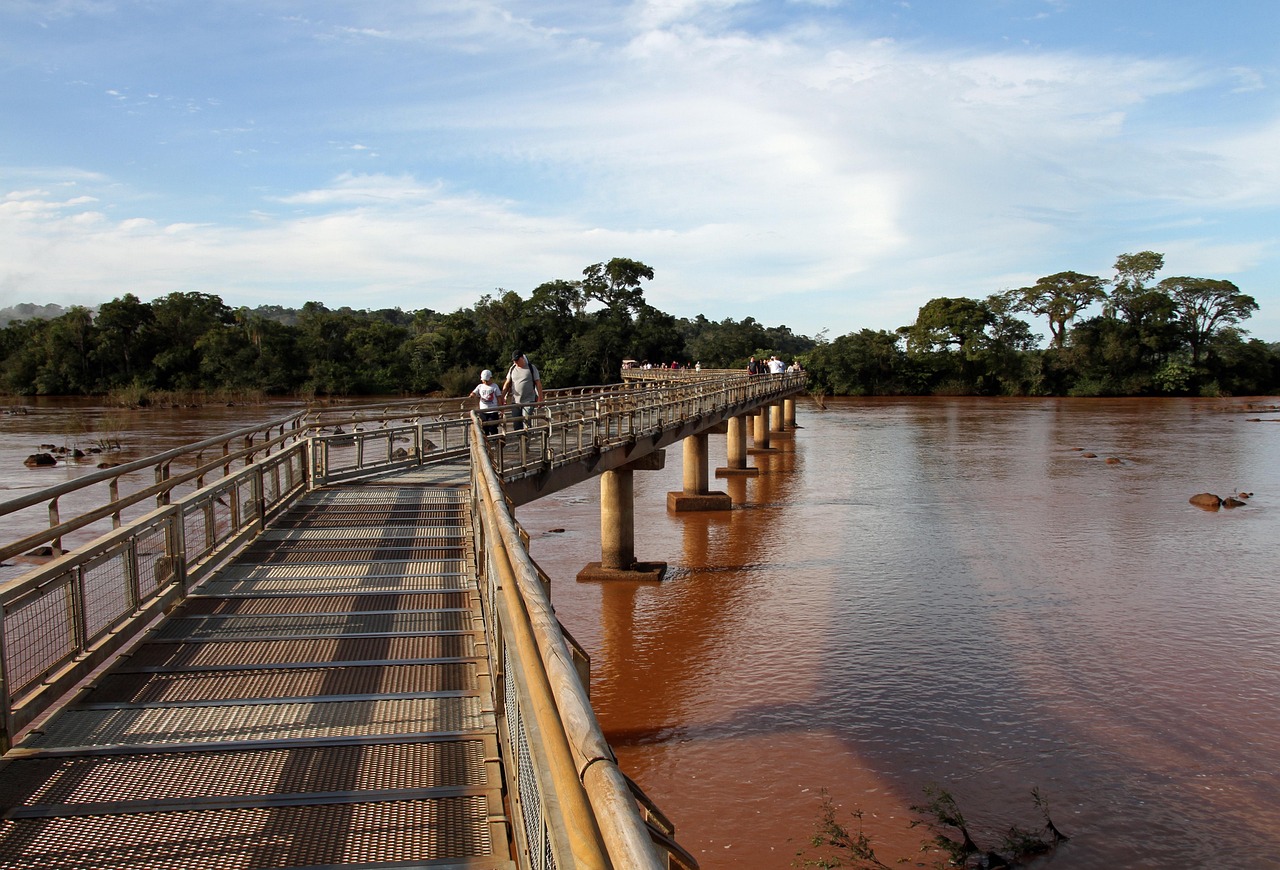
The highlight: a walkway of about 1.1 km (0.7 miles) each way crosses the wide upper river to a balcony on the very lip of the Devil’s Throat, an 80-meter (260-foot) U-shaped chasm where the roar and spray are overwhelming. Take the train to Garganta Station; the walkway is level and fully wheelchair accessible. Go early or late to avoid the midday crowds, and expect to get wet. The walkway closes in very high water: when we checked on October 4, 2026, the Devil’s Throat circuit was temporarily closed as a precaution because of a rise in the river’s flow, while the other circuits were open. Check the park’s site on the day.
The Upper Circuit (Circuito Superior)
A loop of 3.7 km (2.3 miles), about 90 minutes, along the top of the falls, with views straight down over Salto Dos Hermanas, Bossetti, Adán y Eva and the great San Martín falls. It is easy and 100% wheelchair accessible, according to the park.
The Lower Circuit (Circuito Inferior)
A loop of 2.9 km (1.8 miles), about 90 minutes, through the forest below the falls, with close-up views of Salto Lanusse, Álvar Núñez and Salto Chico, and panoramas toward the Devil’s Throat and San Martín. It has steep stairs on some sections (with an adapted alternative path) and is often the best place for rainbows in the morning. The boats for the rides under the falls leave from the bottom of this area.
The Macuco trail
For a quieter walk in the forest, the Macuco trail runs 7.6 km (4.7 miles) round trip, about three hours, from near Central Station to the Arrechea waterfall, a 23-meter (75-foot) fall with a natural pool. It opens from 8 a.m. to 3 p.m. when rangers allow, depending on the weather, and has no services. Look for monkeys, toucans and the big black-and-red guans called yacutingas.
Wildlife
The park protects one of the largest remaining blocks of the Paranaense (Atlantic) Forest, home to jaguars (rarely seen), capuchin monkeys, toucans, parrots, great dusky swifts nesting behind the falls, caimans in the upper river, and hundreds of butterfly species. The ring-tailed coatis around the walkways and snack bars look cute but bite and scratch: don’t feed them, and keep food in closed bags. Feeding any animal is forbidden.
Other things to do at Iguazú
Boat rides under the falls
Licensed operators inside the park run speedboat trips up the lower river and right into the spray of the San Martín falls and toward the Devil’s Throat, as well as gentler floats on the upper river. You will be soaked: bring a dry bag for your phone and a change of clothes. Prices are set by the operators, so check what is included (a jungle truck ride, transfers) before you book. See our guide to boat trips.
Full-moon walks
On the nights around each full moon, the park runs a small number of guided walks to the Devil’s Throat, booked in advance, subject to the weather.
Hiking and birdwatching
Besides the Macuco trail, the park’s guides lead nature walks, and the early mornings near the entrance are good for birds. See our guide to hiking.
Getting there
- By air: Cataratas del Iguazú International Airport (IGR) has direct flights from Buenos Aires (Aeroparque and Ezeiza), about 1 hour 50 minutes, and some from other Argentine cities. It is about 20 km (12 miles) from Puerto Iguazú and closer to the park entrance; use taxis, remises or shuttle buses.
- By bus: long-distance buses run from Buenos Aires (about 18 hours) and other cities to Puerto Iguazú’s bus terminal. From the terminal, buses to the park run about every 20 minutes, according to the park.
- By car: the park entrance is on National Route 101 at km 142; there is a paid parking lot.
- From Brazil: Foz do Iguaçu, the Brazilian town, is across the Tancredo Neves bridge; taxis and buses cross the border, with immigration stops on both sides. The Brazilian national park is covered in our Brazil travel guide.
Getting around Puerto Iguazú
The town is small and walkable, with restaurants around Avenida Victoria Aguirre and the bus terminal. Río Uruguay buses run between the terminal and the park entrance about every 20 minutes during opening hours, according to the park; taxis and remises wait at the terminal and can be hired for a round trip with waiting time. For the Brazilian side, shared tours, taxis and international buses cross the bridge; allow extra time for immigration on busy days, and keep your passport and the entry stamps or records of both countries.
Around Iguazú
- Puerto Iguazú: the small town that serves the park, with hotels, restaurants and the Hito Tres Fronteras, a viewpoint where Argentina, Brazil and Paraguay meet at the junction of the Iguazú and Paraná rivers.
- The Brazilian side: the Brazilian national park shows the whole sweep of the falls from the opposite bank and is usually a half-day visit; bring your passport, and check entry rules for Brazil before you cross.
- Güirá Oga: a wildlife rescue center near the park road, with injured and confiscated animals of the region.
- The Jesuit missions: about four hours south by road, San Ignacio Miní is one of the best-preserved Jesuit Guaraní mission ruins, a UNESCO World Heritage Site.
More trips from Puerto Iguazú
- Itaipú Dam: one of the world’s largest hydroelectric dams, on the Paraná River between Brazil and Paraguay, visited on tours from the Brazilian side.
- Ciudad del Este, Paraguay: a sprawling duty-free shopping city across the river; busy and chaotic, with its own border formalities.
- Yerba mate plantations: farms in Misiones show how Argentina’s national drink is grown and dried.
- The Moconá Falls: a rare waterfall that runs lengthwise along the Uruguay River, a long drive south-east, visible only when the river is low.
Nearby destinations
- Foz do Iguaçu21 km
When to go and how long to stay
Iguazú has a humid subtropical climate, hot and wet in summer and mild in winter, with rain in every month. The table uses the National Meteorological Service’s 1991–2020 normals for the Iguazú airport station, as published by the World Meteorological Organization: average daily highs and lows, and days with at least 1 mm of rain.
| Season | Average high / low | Rainy days per month | What it’s like |
|---|---|---|---|
| Summer (Dec–Feb) | 31–32 °C (88–90 °F) / 20–21 °C (68–69 °F) | 9–10 | Hot and sticky, with storms; busy in January and Easter week |
| Fall (Mar–May) | 31 °C falling to 24 °C (87 to 74 °F) / 19 °C falling to 13 °C (67 to 56 °F) | 7–8 | Warm days, fewer crowds; a good time |
| Winter (Jun–Aug) | 22–25 °C (72–77 °F) / 11–12 °C (52–54 °F) | 6–8 | Mild and pleasant, sometimes cool mornings; busy in the July school holidays |
| Spring (Sep–Nov) | 27 °C rising to 30 °C (80 to 86 °F) / 14 °C rising to 18 °C (58 to 64 °F) | 8–11 | Warm; October is the wettest month |
The airport station records about 1,960 mm (77 in) of rain a year, with October the wettest month at about 250 mm (10 in). The amount of water going over the falls depends on rain across the huge river basin upstream in Brazil, not just on local weather, and dams upstream also affect the flow, so it can vary a lot from week to week. Very high water can close the Devil’s Throat walkway; low water in a drought shows more rock but still impresses.
Iguazú month by month
Average daily highs and lows at the Iguazú airport station (SMN 1991–2020 normals, via the WMO).
| Month | High / low | What to expect |
|---|---|---|
| January | 32 °C (90 °F) / 21 °C (69 °F) | Hot and humid, summer holidays, big crowds |
| February | 32 °C (89 °F) / 20 °C (69 °F) | Hot, storms; Carnival weekends busy |
| March | 31 °C (87 °F) / 19 °C (67 °F) | Still hot; crowds thin after the holidays |
| April | 28 °C (82 °F) / 17 °C (62 °F) | Warm and pleasant; Easter is busy |
| May | 24 °C (74 °F) / 13 °C (56 °F) | Mild, comfortable for walking, often high water |
| June | 22 °C (72 °F) / 12 °C (54 °F) | Cool mornings, quiet |
| July | 23 °C (72 °F) / 11 °C (52 °F) | Winter school holidays bring crowds |
| August | 25 °C (77 °F) / 12 °C (54 °F) | Driest month, often lower water |
| September | 27 °C (80 °F) / 14 °C (58 °F) | Warming up, flowering trees |
| October | 29 °C (84 °F) / 17 °C (63 °F) | Wettest month, often powerful falls |
| November | 30 °C (86 °F) / 18 °C (64 °F) | Hot, fewer visitors |
| December | 31 °C (88 °F) / 20 °C (68 °F) | Hot; busy from Christmas |
Crowds: the park is busiest in January, around Easter, during the July winter school holidays and on long weekends; arrive at opening or after 2 p.m. to avoid the tour groups.
One day at Iguazú
Arrive at opening, take the first train to Garganta Station and walk to the Devil’s Throat before the crowds (if it is open), ride back to Cataratas Station, walk the Upper Circuit, have lunch, and finish with the Lower Circuit and its afternoon light. Book a boat ride for the early afternoon if you want one.
Two days
On day two, use the half-price second-day ticket to walk the Macuco trail early, add a boat ride or a second visit to the Devil’s Throat, then cross to the Brazilian side for the panoramic view, or spend the afternoon at the Hito Tres Fronteras in Puerto Iguazú.
Where to stay at Iguazú
- Puerto Iguazú: most hotels, hostels and restaurants are in town, about 18 km (11 miles) from the park entrance, with frequent buses.
- The park road and the jungle: lodges and resorts in the forest along Route 101 between town and the park, some with pools and nature trails.
- Inside the park: one hotel sits within the Área Cataratas, close to the falls, for early and late walks.
Foreign tourists who pay for accommodation with a card issued abroad don’t pay Argentina’s 21% VAT (IVA) on the room; give the hotel your passport details.
Choosing where to stay
Stay in Puerto Iguazú’s center if you want restaurants within walking distance and cheap buses to the park; the lodges along Route 101 suit travelers who want birdsong, pools and a car or hotel shuttle; and the hotel inside the Área Cataratas suits those who want the walkways early or late. Families like the resorts with pools on the jungle road. Many hotels arrange tours to both sides of the falls.
Food and drink at Iguazú
Inside the park, snack bars and restaurants near the stations sell sandwiches, empanadas and buffet lunches; bring water and snacks in sealed bags, and remember the coatis. In Puerto Iguazú, try river fish such as surubí and pacú, grilled or in empanadas, alongside Argentine steak, and chipá (cheese bread) from the region’s Guaraní tradition. Misiones is the heartland of yerba mate, so you will see locals carrying thermoses everywhere; buy a gourd and yerba as a souvenir. Restaurants on the town’s main avenues open for dinner from about 8 p.m.
What a trip to Iguazú costs
These are our estimates for October 2026 at about ARS 1,520 per US dollar, except the park fee, which is official.
| Item | Typical price |
|---|---|
| Park entry, foreign visitor, one day | ARS 60,000 (US$39), official |
| Second day within 72 hours | ARS 30,000 (US$20), official |
| Bus from the terminal to the park, round trip | ARS 6,000–10,000 (US$4–7) |
| Boat ride under the falls | ARS 70,000–120,000 (US$46–79) |
| Hostel bed in Puerto Iguazú | ARS 20,000–35,000 (US$13–23) |
| Mid-range double room | ARS 90,000–160,000 (US$60–105) |
| Lunch in the park | ARS 15,000–30,000 (US$10–20) |
| Dinner in town with a drink | ARS 25,000–45,000 (US$16–30) |
Practical tips for Iguazú
- Get wet: bring a light rain jacket or poncho and a waterproof phone case; the spray at the Devil’s Throat and on the Lower Circuit soaks you.
- Heat and sun: carry water, a hat and sunscreen; summer days are hot and humid.
- Coatis: don’t feed them or eat near them; they bite.
- Bugs: use insect repellent; dengue is present in the region in the warm months.
- Money: the park sells tickets by card and online; carry some pesos for buses and small purchases in town.
- Safety: stay on the walkways and behind the railings, follow rangers’ instructions when circuits close for high water, and watch your step on wet stairs on the Lower Circuit. Keep valuables out of sight in parked cars. For emergencies, call 911.
What to pack for Iguazú
Light, quick-drying clothes, a rain jacket or poncho, comfortable shoes with good grip (or sport sandals for the boat ride), a hat, sunglasses, sunscreen, insect repellent, a dry bag or waterproof phone pouch, a refillable water bottle, and a change of clothes if you take a boat. Argentina uses 220 V and type I plugs.
Iguazú travel FAQ
How much does Iguazú National Park cost in 2026?
As of October 2026, foreign visitors pay ARS 60,000 (about US$39) per day, including the jungle train. A second day within 72 hours costs half.
What are the opening hours of Iguazú National Park?
Every day from 8 a.m. to 6 p.m., with last entry at 4 p.m. The last train to the Devil’s Throat leaves Central Station at 3:30 p.m.
Is the Devil’s Throat open?
It closes temporarily when the river is very high. When we checked on October 4, 2026, it was closed as a precaution while the other circuits were open, so check the park’s official site before you go.
Which side of Iguazú Falls is better, Argentina or Brazil?
They complement each other: the Argentine side puts you among the falls on longer walkways, and the Brazilian side gives the panoramic view. Most visitors spend a full day in Argentina and half a day in Brazil.
How many days do I need at Iguazú?
One full day covers the Argentine side; two days let you add the Macuco trail, a boat ride and the Brazilian side.
Can I pay with a credit card at Iguazú?
Yes. Tickets are sold online and at the entrance by card; foreign cards are settled at the financial dollar rate.
Is Iguazú wheelchair accessible?
The Devil’s Throat and Upper circuits and the train are fully accessible, according to the park; the Lower Circuit is about 70% accessible, with an adapted alternative to the stairs.
Are the coatis dangerous?
They can bite and scratch when they go after food. Don’t feed them, and keep snacks sealed.
Where should I stay to visit Iguazú Falls?
In Puerto Iguazú for value and restaurants, at a lodge on the park road for nature, or at the hotel inside the park for early and late access.
When does Iguazú have the most water?
It depends on rain upstream in Brazil, but flows are often strongest after wet spells, including October; very high water can close the Devil’s Throat walkway.
Plan your trip
Partner links: TravelerCenter may earn a commission if you book, at no extra cost to you.
🇪🇸 Useful Spanish phrases for Iguazú National Park
All 38 Spanish phrases: restaurant, hotel, emergencies, romance (printable) →
Sources · last reviewed 4 October 2026
Researched and last reviewed on 4 October 2026. Entry fees, second-day discount and Flexipass: the National Parks Administration (APN) fee table in force since June 1, 2026; opening hours, train times, circuit lengths and status, lockers and night walks: the park’s official site run by the concession Iguazú Argentina; exchange rate and card rules: the Central Bank of Argentina; VAT refund on hotels: the tax agency (ARCA); climate: the National Meteorological Service’s 1991–2020 normals for Iguazú airport, as published by the World Meteorological Organization. The number of falls, the park’s history, wildlife, boat trips, flight and bus times, distances and nearby sights come from general references and are flagged for checking. Fees and hours change, so check the official sites before you go. For entry rules and money, see our Argentina travel guide.
Data: Weather: MET Norway (CC BY 4.0) · Air quality: OpenAQ · Rates: ECB · Holidays: Nager.Date · Costs: World Bank ICP and price levels · Wikidata (CC0)