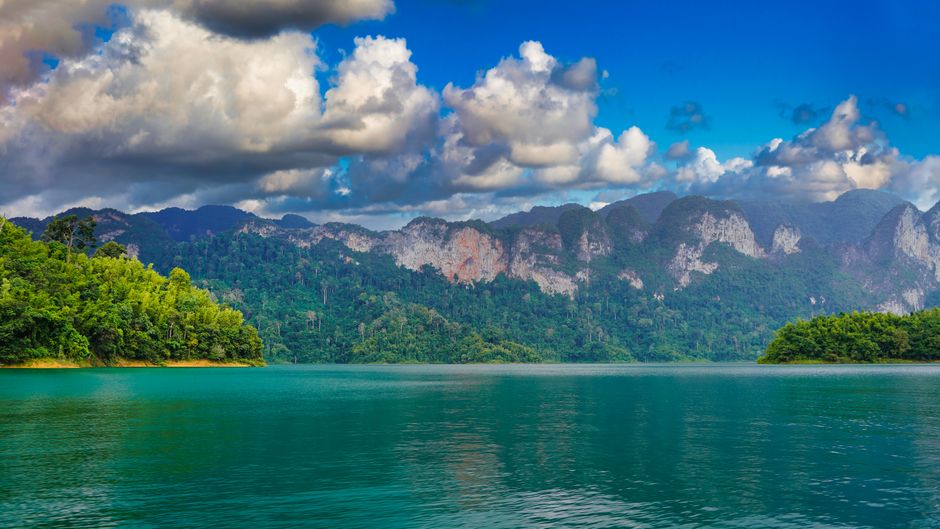
Khao Yai National Park, about 3 hours northeast of Bangkok, is Thailand’s first national park, established in 1962, and one of its largest, covering about 2,170 km² (840 sq miles) of forested hills across four provinces: Nakhon Ratchasima, Saraburi, Prachin Buri and Nakhon Nayok. It is the best place in the country to see wildlife in the wild, with herds of wild elephants that wander along the park road, gibbons calling at dawn, great hornbills, sambar deer and macaques, and a series of waterfalls in deep green forest. Khao Yai is part of the Dong Phayayen–Khao Yai Forest Complex, a UNESCO World Heritage site. Most visitors drive in from Pak Chong, the town on the park’s northern side, where a whole holiday region of vineyards, farm cafés, glamping sites and resorts has grown up along the approach road. Come for wildlife-watching drives and night spotting, the waterfalls of Haew Suwat and Haew Narok, viewpoints over the forest, birding and short jungle trails, and cool mornings from November to February.
Right now in Khao Yai National Park (Khao Yai)
- Fri19–26°C67–79°F3 mm rain
- Sat20–26°C69–78°F15 mm rain
- Sun20–24°C68–75°F4 mm rain
Top tours in Khao Yai National Park
See all tours for Khao Yai National Park →
From local operators, with prices and reviews; you check availability and book on Viator, our partner. We may earn a commission at no extra cost to you. How we earn money
Khao Yai at a glance
- Best for: wildlife-watching (wild elephants, gibbons and hornbills), waterfalls, birding, short jungle walks, scenic drives and weekend escapes from Bangkok.
- How long: 1 long day for the main road, waterfalls and viewpoints; 2–3 days for dawn and dusk wildlife-watching, a guided trek and the wineries around Pak Chong.
- Best time: November to February, when it is dry and cool, with highs of about 30–31 °C (86–88 °F) on the plains and colder nights in the hills; the waterfalls are fullest from August to October.
- Getting there: about 3 hours by car from Bangkok, or a bus, minivan or train to Pak Chong and a songthaew to the park gate; there is no public transport inside the park.
- Fees: foreign visitors pay a park entry fee, bought in advance through the park’s e-ticket system, plus a vehicle charge; see below.
- Rules to know: stay in your vehicle near elephants, don’t feed animals, no drones without permission, and some waterfalls and viewpoints close in certain months.
- Before you go: entry rules, the Thailand Digital Arrival Card, money and general safety are in our Thailand travel guide.
Fees, tickets and rules (as of October 2026)
Khao Yai is run by the Department of National Parks, Wildlife and Plant Conservation (DNP). The park has two road entrances: the northern gate near the Chao Pho Khao Yai Shrine, 23 km (14 miles) south of Pak Chong on Thanarat Road (Route 2090), used by most visitors, and the southern gate at Noen Hom near Prachin Buri. The main road crosses the park between them, about 60 km (37 miles), passing the visitor center at Kong Kaew.
Entry fees and e-tickets
Since July 2023, according to the Tourism Authority of Thailand, park tickets must be bought in advance through an app (the QueQ app was introduced then) rather than in cash at the gate. Foreign visitors paid 200 baht per adult and 100 baht per child in the app, plus a further 200 baht per adult and 100 baht per child in cash at the Chao Pho Khao Yai or Noen Hom gate: 400 baht (about US$12) per adult in all. Cars and motorcycles pay a small vehicle fee. Fees and the booking system have been adjusted since then, so check the current price on the park’s official channels before you go, and carry your passport.
Opening hours
The gates are generally open from 6 a.m. to 6 p.m. for day visitors; if you are staying overnight at a park campsite or bungalow, you can be inside after the gates close. The visitor center at Kong Kaew opens in the daytime and has maps, exhibits and information on trails.
Seasonal closures
According to the national parks department, some sites close every year:
- Haew Suwat–Kong Kaew nature trail: closed from July 1 to August 31.
- Pha Diao Dai viewpoint: closed from June 1 to September 30.
- Kaeng Hin Phoeng and Takhro waterfalls: closed from March 1 to April 30.
- Sarika Waterfall: closed from April 1 to April 30.
- Krok E Dok Waterfall: temporarily closed, with no reopening date announced.
Sites can also close at short notice after heavy rain or when elephants are active nearby; ask at the visitor center.
The park’s key rules
Drive at 60 km/h (37 mph) or less, and never get out of your car to approach elephants. Feeding wildlife, especially the macaques along the road, is banned. Take your trash with you, keep noise down at campsites, and stay on marked trails; longer forest treks need a park ranger or licensed guide. Flying a drone needs permission from the park and registration with Thailand’s Civil Aviation Authority.
The main sights along the park road
Haew Suwat Waterfall
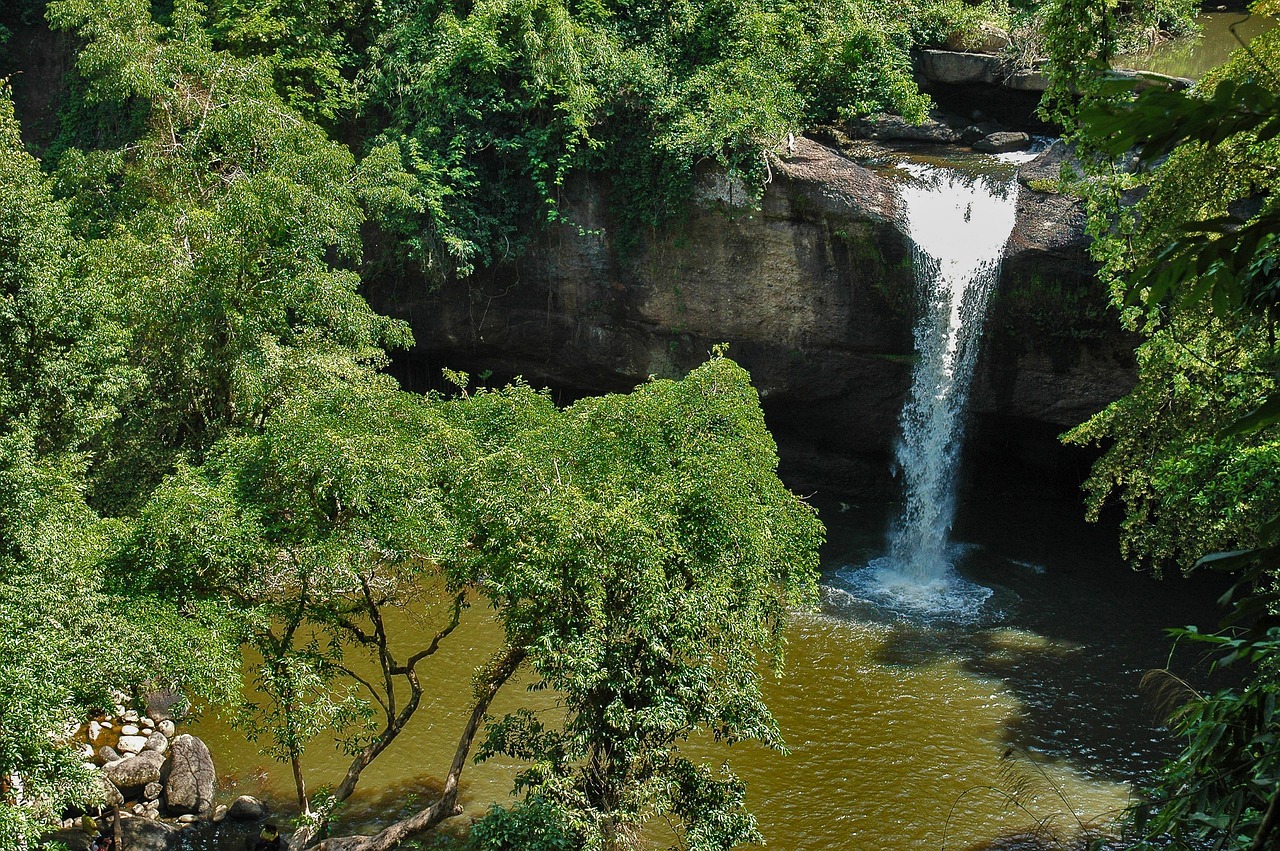
The park’s best-known waterfall, a 20 m (66 ft) curtain of water over a rock ledge into a wide pool, made famous by the film The Beach. It is a short walk from the parking area; you can’t swim in the pool. Water is strongest from about July to November.
Haew Narok Waterfall
Khao Yai’s tallest, a three-tiered fall of about 150 m (490 ft) in the south of the park, reached by a paved trail and steps of about 1 km (0.6 miles). Elephants have fallen over the falls in the past; the viewing platform gives a dramatic view of the drop in the rainy season.
Pha Diao Dai and Khao Khiao viewpoints
On the road to Khao Khiao, one of the park’s highest peaks at about 1,350 m (4,430 ft), the cliff-edge viewpoint of Pha Diao Dai looks over a sea of forest and, on clear mornings, mist in the valleys. It is a favorite at sunrise in the cool season and closed from June to September.
Nong Phak Chi and Mo Sing To
Two wildlife observation towers overlooking grassland and ponds, where elephants, sambar deer, gaur and many birds come to feed. Nong Phak Chi is reached by a short trail from the road; go at dawn or late afternoon, and be patient.
Kong Kaew and the visitor center
The visitor center, at the heart of the park, has exhibits on wildlife and the forest, a café and the start of the Kong Kaew waterfall walk, an easy stroll beside a small cascade.
More stops
- Pha Kluai Mai Waterfall: a cascade with orchids on the rocks near the campsite of the same name.
- Lam Takhong: a river and campsite where deer often graze around the tents.
- Viewpoints on Thanarat Road: roadside lookouts on the way into the park, with views back over Pak Chong.
- Khao Rom
Wildlife, trails and night drives
Wildlife-watching
Khao Yai is home to around 200–300 wild elephants, white-handed and pileated gibbons, sambar and barking deer, gaur, macaques, porcupines, civets, and over 300 species of birds, including four species of hornbill. Elephants are most often seen on the road between the northern gate and Kong Kaew, especially around dusk; gibbons are easiest to hear and see in the early morning near the campsites. Hiring a local wildlife guide or joining a small-group tour from Pak Chong greatly improves your chances. See our guide to hiking.
Hiking trails
Several marked trails start near the visitor center and campsites, from short nature walks of 1–2 km (about 1 mile) to longer forest routes linking Kong Kaew with Haew Suwat. The park advises walking longer routes with a ranger or registered guide, partly to avoid getting lost and partly for wildlife safety. Leeches are common in the rainy season; leech socks help.
Night spotting
The park runs evening spotlighting trips in open trucks from the visitor center area, when you may see deer, civets and, with luck, elephants. Ask at the visitor center about times and bookings.
Activities and best months
- HikingKhao Yai, Thailand's first national park (1962, over 2,100 km2), sells e-tickets through the QueQ app (foreign adults 200 baht in the app plus 200 baht at the gate); the Kong Kaew-Haew Suwat nature trail closes 1 July-31 August and the Pha Diao Dai viewpoint 1 June-30 September.
Other things to do around Khao Yai
Pak Chong and Thanarat Road
Pak Chong, on the main highway and railway northeast of Bangkok, is the gateway town, with a busy night market, banks and buses. The 20-odd km (12 miles) of Thanarat Road between the town and the park gate are lined with resorts, cafés, farm attractions and restaurants.
Wineries, farms and glamping
The hills around Khao Yai are home to some of Thailand’s best-known vineyards, such as PB Valley and GranMonte, with tastings and restaurants among the vines, as well as dairy farms, flower gardens and boutique campsites, and the Tourism Authority of Thailand describes the area as the center of the country’s glamping boom. Khao Yai Art Forest, a sculpture park and retreat in the park’s buffer zone, combines art with forest walks.
The bat cave at Khao Look Chang
Outside the park, near the road to Pak Chong, millions of wrinkle-lipped bats stream out of a cave at dusk in a long, twisting ribbon across the sky. It is a short stop on most wildlife tours.
Food and drink
Pak Chong’s night market is the place for northeastern (Isan) food: som tam (papaya salad), gai yang (grilled chicken), larb and sticky rice. Dairy farms sell fresh milk and ice cream, the vineyards have restaurants with views, and Thanarat Road has everything from farm-to-table cafés to steak houses.
Around Khao Yai
- Thap Lan National Park: a neighboring park in the same World Heritage forest complex, with forests of talipot palms; according to the national parks department, some of its sites, including Pha Kep Tawan and the Suan Hom waterfalls, close from March 1 to May 31.
- Lam Takhong Reservoir: a lake on the northern edge of the park, with views and a wind farm.
- Nakhon Ratchasima (Korat): the big city of the northeast, about 1.5 hours away, with the Thao Suranari monument and the Khmer temple of Phimai beyond.
- Ayutthaya: the old capital’s temple ruins, about 2.5 hours away; see our Ayutthaya guide.
- Bangkok: about 3 hours by road; see our Bangkok guide.
Nearby destinations
- Ayutthaya93 km
- Bangkok120 km
- Pattaya167 km
- Ko Samet198 km
- Kanchanaburi209 km
- Hua Hin255 km
- Ko Chang269 km
- Siem Reap (Angkor)283 km
Getting there
By car
Most visitors drive from Bangkok: Highway 1 and then Highway 2 (Mittraphap Road) to Pak Chong, then Thanarat Road (Route 2090) south to the northern gate, about 180 km (110 miles) and 3 hours in normal traffic; Friday evenings and Sunday afternoons can be much slower. A car is the easiest way to explore inside the park.
By bus, minivan and train
Buses and minivans run frequently from Bangkok’s Mo Chit bus terminal to Pak Chong in about 2.5–3 hours. The State Railway of Thailand’s northeastern line from Krung Thep Aphiwat Central Terminal stops at Pak Chong in about 3–4 hours. From Pak Chong, songthaews run along Thanarat Road to the northern gate, but not inside the park; from there you need a tour, a hired car with driver, or a lift.
Getting around: practical details
There is no public transport in the park, and distances are long: about 14 km (9 miles) from the northern gate to the visitor center and more than 20 km (12 miles) to Haew Narok. Tours from Pak Chong hotels include transport, a guide and park fees; car rental is available in Pak Chong and Bangkok. Fuel up before entering, and drive slowly, especially at dusk.
When to go and how long to stay
Khao Yai has three seasons: cool and dry from November to February, hot from March to May, and rainy from May to October, when the forest is greenest and the waterfalls strongest but trails are muddy and leechy. There is no long-term weather station inside the park, so the table uses the 1991–2020 normals of the Thai Meteorological Department (TMD) for its Nakhon Ratchasima station, about 70 km (43 miles) to the northeast at 187 m (614 ft), as submitted to the World Meteorological Organization (WMO): average daily highs and lows, total rain, and days with at least 1 mm of rain. The park’s hills, mostly 400–1,000 m (1,300–3,300 ft) high, are several degrees cooler and wetter.
| Month | Average high / low | Rain (days with 1 mm or more) | What to expect |
|---|---|---|---|
| January | 31 °C (88 °F) / 19 °C (67 °F) | 9 mm (0.3 in), 1 day | Cool and dry; chilly nights in the park; peak season |
| February | 34 °C (92 °F) / 21 °C (70 °F) | 13 mm (0.5 in), 1 day | Dry and clear; good for viewpoints |
| March | 36 °C (96 °F) / 24 °C (75 °F) | 46 mm (1.8 in), 4 days | Hot; some waterfalls dry and closed |
| April | 37 °C (98 °F) / 25 °C (77 °F) | 80 mm (3.1 in), 6 days | The hottest month; Songkran holiday crowds |
| May | 35 °C (96 °F) / 25 °C (78 °F) | 152 mm (6.0 in), 10 days | First rains; the forest turns green |
| June | 35 °C (94 °F) / 25 °C (78 °F) | 120 mm (4.7 in), 9 days | Showers; Pha Diao Dai closed from June 1 |
| July | 34 °C (93 °F) / 25 °C (77 °F) | 130 mm (5.1 in), 10 days | Rainy; leeches on trails; Haew Suwat trail closed |
| August | 33 °C (92 °F) / 25 °C (77 °F) | 178 mm (7.0 in), 12 days | Wet; waterfalls filling up |
| September | 32 °C (90 °F) / 24 °C (76 °F) | 239 mm (9.4 in), 14 days | The wettest month; waterfalls at their best |
| October | 31 °C (88 °F) / 24 °C (74 °F) | 135 mm (5.3 in), 9 days | Rains ease; lush and quieter |
| November | 31 °C (88 °F) / 22 °C (71 °F) | 20 mm (0.8 in), 2 days | Cool season begins; clear mornings |
| December | 30 °C (86 °F) / 19 °C (67 °F) | 3 mm (0.1 in), fewer than 1 day | Cool and dry; busy at New Year |
The Nakhon Ratchasima station records about 1,120 mm (44 in) of rain a year, mostly from May to October; inside the park it is noticeably wetter. On cool-season nights temperatures in the park can drop to about 10 °C (50 °F) or lower.
Weather month by month
One day in Khao Yai
Enter at the northern gate at 6 a.m. and drive slowly towards Kong Kaew, watching for elephants and hornbills. Visit Nong Phak Chi tower, the visitor center and Haew Suwat, then Haew Narok in the south. In the cool season, add Pha Diao Dai, and leave at dusk to watch the bats at Khao Look Chang.
Two or three days
Spend a night at a park campsite or a resort on Thanarat Road, take a guided morning trek for gibbons and hornbills, join a night spotting trip, and spend an afternoon at a vineyard or farm.
Where to stay
- Park campsites and bungalows: Lam Takhong and Pha Kluai Mai campsites have tents for rent and simple facilities, and the DNP rents bungalows; book well ahead for weekends and holidays through the national parks’ booking system.
- Thanarat Road: the widest choice, from homestays to luxury resorts and glamping, 10–30 minutes from the gate.
- Pak Chong town: cheaper hotels near the bus and train stations and the night market.
- Wine country and the hills: boutique resorts among vineyards and farms, best with a car.
Prices rise at weekends and on Thai holidays, when the park and Thanarat Road get very busy.
What a trip to Khao Yai costs
Prices are approximate, for October 2026, converted at about 33 baht to the US dollar.
| Item | Typical cost |
|---|---|
| Park entry, foreign adult (2023 rate, check current) | 400 baht (about US$12) |
| Car entry fee | about 50 baht (about US$1.50) |
| Minivan from Bangkok to Pak Chong | 150–250 baht (about US$4.50–7.50) |
| Full-day guided wildlife tour from Pak Chong | 1,500–2,500 baht (about US$45–75) |
| Tent rental at a park campsite | 250–600 baht (about US$7.50–18) |
| Night market meal | 50–120 baht (about US$1.50–3.60) |
| Wine tasting at a vineyard | 300–700 baht (about US$9–21) |
| Mid-range resort double on Thanarat Road | 1,800–4,500 baht (about US$55–135) |
Practical tips for Khao Yai
- Go early: wildlife is most active at dawn and dusk, and the main sights are crowded by late morning at weekends.
- Book your ticket: buy the park e-ticket in advance and carry your passport; signal can be weak inside the park.
- Avoid long weekends: Thai holidays bring traffic jams on Thanarat Road and full campsites.
- Bring cash: for gate charges, campsites and park cafés; ATMs are in Pak Chong.
- Cannabis and vaping: cannabis flower needs a Thai prescription, and e-cigarettes are illegal in Thailand.
- Help: the Tourist Police (1155) speak English, and the TAT Contact Center (1672) answers tourist questions.
Safety
Khao Yai is safe for visitors who respect its wildlife; most incidents involve elephants, macaques or the roads.
- Wild elephants: if you meet elephants on the road, stop well back, keep the engine running, don’t honk, flash lights or get out, and never try to pass close by; wait until they move off or the rangers clear the road. Elephants have damaged cars that came too close.
- Macaques: don’t feed them or carry food in your hands; keep car windows closed near groups of monkeys.
- Trails: walk longer routes with a ranger or guide, stay on the path, and check for leeches and ticks; snakes are present but rarely seen.
- Waterfalls: rocks are slippery, and water levels can rise quickly after rain; don’t swim where it is not allowed or climb the falls.
- Roads: the park road is steep and winding, with wildlife crossing; drive slowly, especially at dusk and in fog.
- Cold nights: bring warm layers for campsites from December to February.
- Emergencies: call 1155 for the Tourist Police (English spoken), 191 for the police and 1669 for an ambulance.
What to pack for Khao Yai
Binoculars, comfortable walking shoes, leech socks and insect repellent in the rainy season, a light rain jacket, a warm fleece for cool-season mornings and nights, a headlamp, sunscreen and a hat, and a reusable water bottle. Thailand uses 220 V; sockets take both flat two-pin and round two-pin plugs.
What to pack
- Day packs and anti-theft bagsA 20–30 litre pack carries layers, water, a head torch and snacks on full-day levada walks.
- Fleeces and warm layersSummits like Pico do Areeiro averaged about 11 °C over 2024, so a fleece is needed even in summer.
- HeadlampsLevada routes such as PR1 and PR9 pass through long, dark, wet tunnels.
- Hiking shoes and bootsMadeira's levadas and the Azores' crater rims are wet, rocky and slippery, so grippy shoes matter more than anywhere else in Portugal.
- Rain jacketsMountain and island weather changes fast; a real shell beats an umbrella in the wind.
- Trekking polesLong stone staircases and steep descents on Madeira's peaks and the Azores' crater rims are easier on the knees with poles.
- Water bottles and hydration packsAlgarve and Alentejo trails are hot and exposed with few refill points.
Khao Yai travel FAQ
How much does it cost to enter Khao Yai National Park?
According to a 2023 Tourism Authority of Thailand notice, foreign adults pay 400 baht in total (200 baht in advance by app and 200 baht at the gate) and children 200 baht, plus a vehicle fee. Check the current price before you go.
What time does Khao Yai open?
The gates generally open from 6 a.m. to 6 p.m. for day visitors; overnight guests at park campsites and bungalows can stay inside.
Can I see wild elephants in Khao Yai?
Often, yes. Herds are regularly seen on the park road, especially at dusk, but sightings are never guaranteed.
How do I get to Khao Yai from Bangkok?
Drive about 3 hours via Pak Chong, or take a bus, minivan or train to Pak Chong and then a tour or hired car into the park.
Can I visit Khao Yai without a car?
Yes, by joining a tour from Pak Chong or hiring a car with driver; there is no public transport inside the park.
When is the best time to visit Khao Yai?
November to February for cool, dry weather and clear viewpoints; August to October for the fullest waterfalls.
Can I swim at Haew Suwat Waterfall?
No, swimming is not allowed at Haew Suwat; some smaller falls have pools where it is permitted, depending on conditions.
Is Khao Yai a UNESCO World Heritage site?
Yes, as part of the Dong Phayayen–Khao Yai Forest Complex.
Can I camp in Khao Yai?
Yes, at the Lam Takhong and Pha Kluai Mai campsites, where tents can be rented; book ahead for weekends.
How many days do I need in Khao Yai?
One long day covers the main road, waterfalls and viewpoints; two or three days allow dawn and dusk wildlife-watching and a guided trek.
Plan your trip
Partner links: TravelerCenter may earn a commission if you book, at no extra cost to you.
🇹🇭 Useful Thai phrases for Khao Yai National Park
All 38 Thai phrases: restaurant, hotel, emergencies, romance (printable) →
Sources · last reviewed 4 October 2026
Researched and last reviewed on 4 October 2026. Seasonal closures: the Department of National Parks, Wildlife and Plant Conservation; e-ticketing and 2023 fees, the park’s area and history, the glamping region and Khao Yai Art Forest, cannabis and e-cigarette rules and the Tourist Police: the Tourism Authority of Thailand (TAT); climate normals: the Thai Meteorological Department via the World Meteorological Organization’s 1991–2020 normals; World Heritage listing: UNESCO via Wikidata; exchange rate: the US Federal Reserve. Current fees, gate hours, distances, wildlife numbers, trail details and typical prices are general references or estimates, flagged for checking. Prices and rules change, so check the park’s official channels before you go. For entry rules, money and general safety, see our Thailand travel guide.
Also: tatnews.org · TMD normals 1991–2020, Nakhon Ratchasima (climate)
Data: Weather: MET Norway (CC BY 4.0) · Air quality: OpenAQ · Rates: ECB · Costs: World Bank ICP and price levels · © OpenStreetMap contributors (ODBL) · Wikidata (CC0)