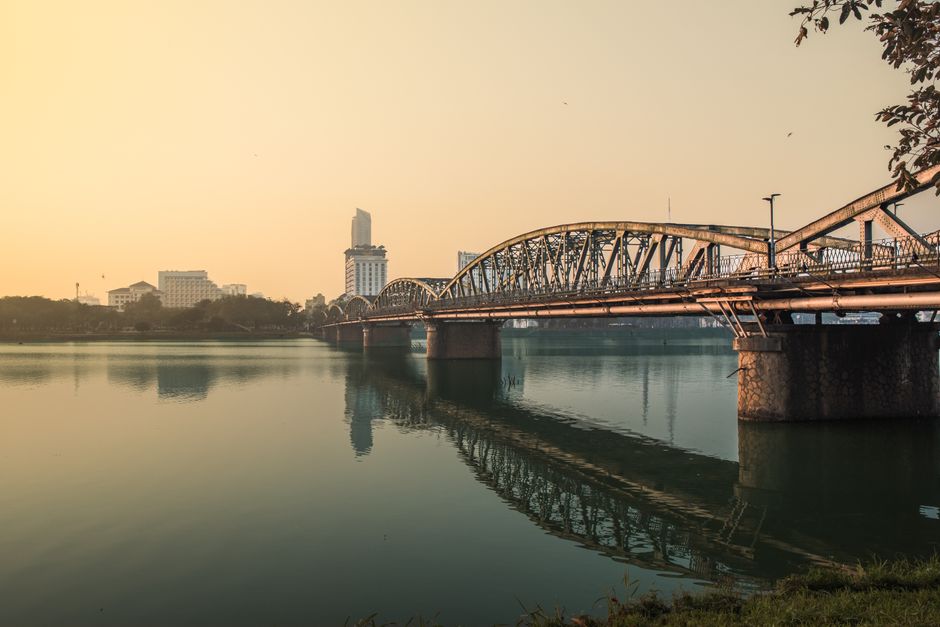
Hue was the capital of Vietnam under the Nguyen dynasty, the country’s last royal family, from 1802 to 1945, and it remains its most graceful and contemplative city: a walled citadel of palaces, gates and lotus ponds on the north bank of the Perfume River, with the tombs of emperors set in pine-covered hills upstream and pagodas along the water. The Complex of Hue Monuments was the first site in Vietnam to be inscribed by UNESCO as a World Heritage Site, in 1993. Hue is also a city of food, with dishes once cooked for the court and a spicy beef noodle soup known across the country, and the base for trips to the beaches of Lang Co, the Bach Ma mountains and the battlefields of the former Demilitarized Zone (DMZ) to the north. Hue became a centrally governed city in 2025. It is the wettest major city in Vietnam: the best months are from February to April, summer is very hot, and from September to December heavy rain and floods are common.

Right now in Hue
- Thu24–26°C75–79°F63 mm rain
- Fri23–29°C74–83°F22 mm rain
- Sat24–26°C75–79°F39 mm rain
Top tours in Hue
See all tours for Hue →
From local operators, with prices and reviews; you check availability and book on Viator, our partner. We may earn a commission at no extra cost to you. How we earn money
Hue at a glance
- Best for: imperial history and architecture, royal tombs, pagodas, river trips, food, and the DMZ.
- How long: 2 days for the citadel, the tombs and the river; 3 with the DMZ or Bach Ma.
- Best time: February to April, when it is warm and fairly dry; May to August is hot and dry; September to December is the rainy season.
- Getting there: Phu Bai International Airport is about 15 km (9 miles) south; Hue Station is on the Reunification Express line, about 2.5 to 3 hours from Da Nang.
- Getting around: on foot or by bicycle and cyclo in the citadel, by Grab or taxi to the tombs, and by dragon boat on the Perfume River.
- Good to know: the Nguyen dynasty’s throne returned to the Thai Hoa Palace on June 4, 2026, after a year of restoration.
- Before you go: the e-visa, visa-free stays, money and general safety are in our Vietnam travel guide.
Hue’s areas and where to stay
The Perfume River (Song Huong) divides the city in two. The citadel and the old town are on the north bank, and the modern center, with most hotels, is on the south bank.
The citadel and the north bank
Inside the citadel’s 10 km (6 miles) of walls and moats are the Imperial City, quiet residential lanes, lotus ponds, small museums and garden houses. The Dong Ba Market lies just outside the walls on the riverbank. A few guesthouses and homestays are here, ideal for early visits.
The south bank
Between the Truong Tien Bridge and Le Loi Street, the south bank has most of the hotels, from backpacker guesthouses on Pham Ngu Lao and Chu Van An streets to riverside luxury hotels, plus restaurants, bars and the walking street along the river.
The countryside and the tombs
Southwest of the city, along the Perfume River, the royal tombs, pagodas and garden houses are set among villages and pine forests. A few boutique resorts and homestays here offer peace and space, a 15- to 20-minute drive from the center.
Thuan An and the lagoon
To the east, the Tam Giang–Cau Hai lagoon system and the beach at Thuan An have seafood restaurants and a few beach resorts, about 30 minutes from the city.
Top things to see in Hue
The Imperial City (Dai Noi)
At the heart of the citadel, the Imperial City was the seat of the Nguyen emperors. Enter through the Ngo Mon (Noon Gate), a massive gate topped by the Five Phoenix Pavilion, where emperors watched ceremonies; cross the Golden Water Bridge to the Thai Hoa Palace, the throne hall. The throne, a National Treasure, was damaged on May 24, 2025, and, after restoration, returned to the palace on June 4, 2026, according to Hue’s tourism department. Beyond lie the Forbidden Purple City, once reserved for the emperor and his household, largely destroyed in 1968 and being progressively rebuilt; the To Mieu temple with the Nine Dynastic Urns cast in bronze in the 1830s; the Hien Lam Pavilion; the royal theater, Duyet Thi Duong, where court music is performed; and gardens and galleries. Allow at least half a day. During festivals, the Hue Monuments Conservation Center opens parts of the Imperial City at night under the name “Hoang Cung Huyen Ao” (“Mystical Royal Palace”), with lantern-lit tours and royal-style banquets.
Imperial City and tomb tickets
The Hue Monuments Conservation Center collects the fees, set by the Hue City People’s Council; the current schedule is Resolution No. 55/2025/NQ-HDND of December 25, 2025. Under the previous schedule, adopted in 2019 and reported by Hue’s tourism department, the adult ticket was 200,000 VND (about US$7.70) for the Imperial City and 150,000 VND (about US$5.80) each for the tombs of Tu Duc, Khai Dinh and Minh Mang, with cheaper combined tickets for several sites. The center’s own website could not be reached for this review, so check current prices at the ticket offices or on hueworldheritage.org.vn before you go. Vietnamese citizens enter free on certain national holidays.
The royal tombs
Each Nguyen emperor designed his own tomb as a landscape of gates, courtyards, temples and pavilions, set among hills, lakes and pine trees southwest of the city.
- Tomb of Minh Mang: the most harmonious, laid out symmetrically along an axis through gardens, lakes and bridges, about 12 km (7.5 miles) from the center.
- Tomb of Tu Duc: a romantic complex of lakes and pavilions where the poet-emperor wrote and fished; he is believed to be buried elsewhere, in a secret location.
- Tomb of Khai Dinh: a dramatic, later tomb of gray concrete on a hillside, with a dazzling interior of porcelain and glass mosaics, mixing Vietnamese and European styles.
- Tomb of Gia Long: the remote, peaceful tomb of the dynasty’s founder, rarely visited.
Thien Mu Pagoda
On a bluff above the Perfume River, about 4 km (2.5 miles) upstream from the citadel, the seven-story Phuoc Duyen tower of the Thien Mu Pagoda, founded in 1601, is the symbol of Hue. In the pagoda grounds is the Austin car in which the monk Thich Quang Duc traveled to Saigon in 1963 before his self-immolation in protest. Come in the late afternoon, when the monks chant.
The Perfume River
Dragon boats, decorated with carved dragon heads, take visitors upriver to Thien Mu and, in a half-day trip, to some of the tombs. In the evening, boats with musicians perform ca Hue, traditional Hue chamber songs; Nha nhac, the Nguyen court music, is recognized by UNESCO as intangible cultural heritage.
More classic sights
- Dong Ba Market: the city’s main market, with food stalls, conical hats and local specialties.
- Truong Tien Bridge: the iron bridge designed in the 1890s, lit in changing colors at night.
- Hue Museum of Royal Antiquities: royal ceramics, furniture and costumes in the Long An Palace.
- Garden houses (nha vuon): traditional houses with gardens, such as An Hien, in the Kim Long area.
- Thanh Toan Tile-Roofed Bridge: an 18th-century covered bridge among rice fields, about 7 km (4 miles) east.
Other things to do in Hue
Food and drink
Bun bo Hue, a spicy, lemongrass-scented beef and pork noodle soup, is the city’s best-known dish; Hue celebrated it with a special day in its 2026 Culinary Capital program. Try also com hen, rice with baby clams, peanuts and herbs; small steamed rice cakes such as banh beo, banh nam and banh loc; banh khoai, a crisp pancake served with a peanut and liver sauce; and the many Buddhist vegetarian dishes the city is known for. Royal banquets, recreating court dishes and costumes, are offered in some restaurants and garden houses. The Vietnam National Administration of Tourism listed a “Hue – Culinary Capital 2026” festival in September.
Festivals
The Hue Festival, a program of arts, heritage and food events, is held across the year, with seasonal editions; in 2026, it included an autumn festival. Tet (February 6, 2027) is celebrated with royal-style ceremonies, and the citadel’s lotus ponds bloom in summer. See our city sightseeing guide.
Cycling and the countryside
The flat countryside around Hue, with villages, rice fields, the Thanh Toan bridge and the lagoon, is ideal for cycling; many guesthouses rent bicycles. See our cycling guide.
Day trips from Hue
- The DMZ: the former Demilitarized Zone along the Ben Hai River, which divided North and South Vietnam from 1954 to 1975, about 100 km (60 miles) north, now in Quang Tri province. Tours visit the Hien Luong Bridge, the Vinh Moc tunnels, where villagers lived underground during the bombing, the Quang Tri Citadel and sometimes the Khe Sanh combat base.
- The Hue–Phong Nha heritage train: since August 28, 2026, Vietnam Railways has run a tourist train, HQ1/HQ2, on the roughly 190 km (120-mile) line between Hue and Dong Hoi, gateway to Phong Nha–Ke Bang National Park, with swiveling seats and stops near the Quang Tri Citadel, the Vinh Moc tunnels and the Hien Luong–Ben Hai relic site. Group discounts apply until December 31, 2026.
- Bach Ma National Park: a former French hill station in the cloud forest, with waterfalls and trails, about 1 hour south. See our hiking guide.
- Lang Co and the Hai Van Pass: a beach and lagoon at the foot of the pass, on the way to Da Nang. See our Da Nang guide.
- Hoi An: about 3 hours south; better with a night. See our Hoi An guide.
Nearby destinations
- Da Nang80 km
- Hoi An103 km
- Phong Nha-Ke Bang National Park194 km
- Sanya285 km
Getting there and getting around
By air
Phu Bai International Airport (HUI), about 15 km (9 miles) south of the city, has domestic flights from Hanoi and Ho Chi Minh City and a few international routes. Grab, taxis and an airport bus run to the center in 25 to 30 minutes. Many visitors fly into Da Nang instead, for more choice, and travel to Hue by road or train in 2.5 to 3 hours.
By train and bus
Hue Station, on the south bank, is on the Reunification Express railway between Hanoi and Ho Chi Minh City. The stretch south to Da Nang over the coast beside the Hai Van Pass is one of the most beautiful train rides in Vietnam. Book on Vietnam Railways’ website, dsvn.vn. Buses and limousine vans connect Hue with Da Nang, Hoi An, Dong Hoi and Hanoi; open-tour buses stop near the backpacker area.
Around the city
Walk or cycle in the citadel; cyclos wait at the gates. Grab and taxis are the easiest way to reach the tombs, or you can hire a car or a motorbike with driver for the day. Dragon boats leave from the riverbank near the Toa Kham pier on the south bank.
When to go and how long to stay
Hue has the rainiest climate of any major Vietnamese city. February to April is the most comfortable period, with mild, mostly dry weather. May to August is hot and dry, often above 35 °C (95 °F), with the dry “Lao wind” blowing from the west. The rainy season runs from September to December, peaking in October and November, when tropical storms and prolonged downpours regularly flood the city; between October 25 and 30, 2025, two rounds of flooding inundated parts of the heritage complex, according to the government. January is cool and drizzly. There is no long-term official climate station for Hue in the World Meteorological Organization’s (WMO) public lists, so the table uses the 1991–2020 climate normals for Da Nang, about 80 km (50 miles) south, from Vietnam’s National Center for Hydro-Meteorological Forecasting (NCHMF); Hue is generally a little wetter, especially from October to December.
| Month | Average high / low | Rain (rainy days) | What to expect |
|---|---|---|---|
| January | 25 °C (77 °F) / 20 °C (67 °F) | 83 mm (3.3 in), 14 days | Cool and drizzly; mists over the river |
| February | 26 °C (79 °F) / 20 °C (69 °F) | 22 mm (0.9 in), 7 days | Mild and drying out; Tet on February 6 in 2027 |
| March | 28 °C (83 °F) / 22 °C (72 °F) | 36 mm (1.4 in), 7 days | Warm and mostly dry; a lovely month |
| April | 31 °C (88 °F) / 24 °C (75 °F) | 50 mm (2.0 in), 7 days | Warm, dry and sunny; good for the tombs |
| May | 33 °C (92 °F) / 25 °C (78 °F) | 71 mm (2.8 in), 10 days | Hot; Lao wind from the west |
| June | 35 °C (95 °F) / 26 °C (79 °F) | 68 mm (2.7 in), 9 days | Very hot and dry |
| July | 34 °C (94 °F) / 26 °C (79 °F) | 92 mm (3.6 in), 12 days | Very hot; occasional storms |
| August | 34 °C (93 °F) / 26 °C (78 °F) | 167 mm (6.6 in), 14 days | Hot, with more afternoon storms |
| September | 32 °C (90 °F) / 25 °C (77 °F) | 394 mm (15.5 in), 17 days | Rainy season begins; storm risk rises |
| October | 30 °C (85 °F) / 24 °C (75 °F) | 658 mm (25.9 in), 21 days | Very wet; floods likely |
| November | 28 °C (82 °F) / 23 °C (73 °F) | 486 mm (19.1 in), 21 days | The wettest period; floods and storms |
| December | 25 °C (78 °F) / 21 °C (69 °F) | 272 mm (10.7 in), 21 days | Wet and cool; floods possible early in the month |
Da Nang gets about 2,400 mm (94 in) of rain a year, and Hue receives somewhat more; most of it falls between September and December.
2 days in Hue
Day one, the Imperial City in the morning, lunch of bun bo Hue, Dong Ba Market and the citadel’s quiet lanes in the afternoon, and a ca Hue performance on the river at night. Day two, a dragon-boat trip to Thien Mu Pagoda, then the tombs of Minh Mang, Khai Dinh and Tu Duc by car.
3 days with the DMZ
Add a day trip to the DMZ and the Vinh Moc tunnels, or take the heritage train north toward Phong Nha.
Where to stay in Hue
- South bank, riverside: upscale hotels with river views, close to the walking street and the boats.
- South bank, backpacker area: guesthouses and budget hotels on Pham Ngu Lao and Chu Van An.
- Inside the citadel: homestays and garden houses for early visits to the Imperial City.
- Along the river and in the countryside: boutique resorts near the tombs and pagodas.
Rooms fill during the Hue Festival, Tet and Vietnamese holidays.
What a trip to Hue costs
Prices are approximate, for October 2026, converted at about 26,000 dong (VND) to the US dollar.
| Item | Typical cost |
|---|---|
| Imperial City, adult (2019 schedule; check current price) | 200,000 VND (about US$7.70) |
| Tomb of Minh Mang, Tu Duc or Khai Dinh (2019 schedule) | 150,000 VND each (about US$5.80) |
| Bowl of bun bo Hue | 35,000–60,000 VND (about US$1.35–2.30) |
| Plate of banh beo or com hen | 20,000–40,000 VND (about US$0.75–1.55) |
| Dragon boat to Thien Mu and back, per boat | 300,000–600,000 VND (about US$12–23) |
| Car with driver to the tombs, half day | 600,000–900,000 VND (about US$23–35) |
| Grab car from Phu Bai airport | 150,000–250,000 VND (about US$6–10) |
| Mid-range hotel double, per night | 600,000–1,500,000 VND (about US$23–58) |
Practical tips for Hue
- Start early: the Imperial City and tombs are hot and shadeless by midday from April to August.
- Dress for temples: cover shoulders and knees at pagodas and the To Mieu temple.
- Buy combined tickets: combination tickets for the citadel and tombs save money if you plan to see several.
- Check flood forecasts: in October and November, roads to the tombs and parts of the citadel can be under water.
- Hire a driver for the tombs: they are spread over 15 km (9 miles) of hilly countryside.
Safety
Hue is a quiet, safe city with little crime. The main hazard is the weather: from September to December, tropical storms and long periods of heavy rain cause regular floods and landslides in the city and surrounding areas, closing roads and sometimes heritage sites; follow forecasts from the National Center for Hydro-Meteorological Forecasting and local instructions. In the former DMZ and other old battlefields in central Vietnam, unexploded ordnance remains a hazard: according to Vietnam’s National Mine Action Center, about 6.1 million hectares, or 18.71% of the country’s area, are contaminated or suspected to be contaminated by bombs, mines and explosives left from the war, and central provinces have suffered the most casualties. Stay on marked paths and roads at war sites, never touch metal objects in the ground, and visit with a guide. In summer, heat is intense; drink plenty of water. Helmets are compulsory on motorbikes, and a license valid in Vietnam is required to ride. In an emergency, call 113 for police, 114 for fire and 115 for an ambulance.
What to pack for Hue
Light clothes, a hat and sunscreen for the hot months; an umbrella or rain jacket and quick-drying shoes from September to January; a light sweater for winter evenings; and clothes covering shoulders and knees for temples and pagodas. Vietnam uses 220 V, with sockets for flat (type A) and round (type C) two-pin plugs. See our rain jackets and travel adapters guides.
Hue travel FAQ
How much is the ticket to the Hue Imperial City?
Under the 2019 fee schedule reported by Hue’s tourism department, it was 200,000 VND for adults. A new fee resolution, No. 55/2025, applies from 2026, so check the current price at the ticket office or on the Hue Monuments Conservation Center’s website.
How many days do I need in Hue?
Two days for the Imperial City, the tombs and Thien Mu Pagoda; three with a DMZ day trip.
What is the best time to visit Hue?
February to April, when it is warm and fairly dry. October and November are the wettest months, with frequent floods.
Which royal tombs should I visit?
Minh Mang for harmony and setting, Tu Duc for its lakes and pavilions, and Khai Dinh for its extraordinary mosaics. You can see all three in half a day by car.
Is Hue worth visiting?
Yes, for its imperial architecture, peaceful tombs and pagodas, river and food; it is quieter and more reflective than Hanoi or Ho Chi Minh City.
How do I get from Hue to Hoi An?
By car, bus or limousine van in about 3 hours via Da Nang, often stopping at the Hai Van Pass, or by train to Da Nang and then by road.
What food is Hue famous for?
Bun bo Hue, com hen, banh beo, banh khoai and royal and vegetarian cuisine.
Can I visit the DMZ from Hue?
Yes. Day tours visit the Hien Luong Bridge, the Vinh Moc tunnels and the Quang Tri Citadel, about 100 km (60 miles) north. Since August 2026, a heritage train also runs from Hue toward Dong Hoi.
Is the Imperial City open at night?
On some festival dates, the Hue Monuments Conservation Center opens parts of it at night as “Hoang Cung Huyen Ao,” with lanterns, performances and banquets; check the event calendar.
Does Hue flood?
Yes. From September to December, and especially in October and November, heavy rain regularly floods parts of the city; in late October 2025, floods reached parts of the heritage complex.
Plan your trip
Partner links: TravelerCenter may earn a commission if you book, at no extra cost to you.
🇻🇳 Useful Vietnamese phrases for Hue
All 38 Vietnamese phrases: restaurant, hotel, emergencies, romance (printable) →
Sources · last reviewed 4 October 2026
Researched and last reviewed on 4 October 2026. The 2019 ticket prices, Resolution 55/2025/NQ-HDND, free-entry days, the throne’s damage and return, the “Hoang Cung Huyen Ao” night program, the Hue–Phong Nha heritage train and the Hai Van Gate: the Hue Department of Tourism (visithue.vn); the October 2025 floods and Hue’s status as a centrally governed city: the Government of Vietnam’s news portal; train group discounts: Vietnam Railways; unexploded ordnance figures: Vietnam National Mine Action Center (VNMAC); the 2026 culinary festival: the Vietnam National Administration of Tourism; climate normals for Da Nang: Vietnam’s National Center for Hydro-Meteorological Forecasting (NCHMF), via the World Meteorological Organization’s World Weather Information Service; exchange rate: Vietcombank. The Hue Monuments Conservation Center’s website (hueworldheritage.org.vn) could not be reached, so current 2026 ticket prices are unconfirmed. The UNESCO inscription year, monument history, tomb distances, Hue’s higher rainfall, boat and car prices and other typical prices are general references or estimates, flagged for checking. Prices and hours change, so check the official sites before you go. For entry rules, money and general safety, see our Vietnam travel guide.
Data: Weather: MET Norway (CC BY 4.0) · Sea temperature: NOAA CoastWatch · Rates: ECB · Costs: World Bank ICP and price levels · Wikidata (CC0)