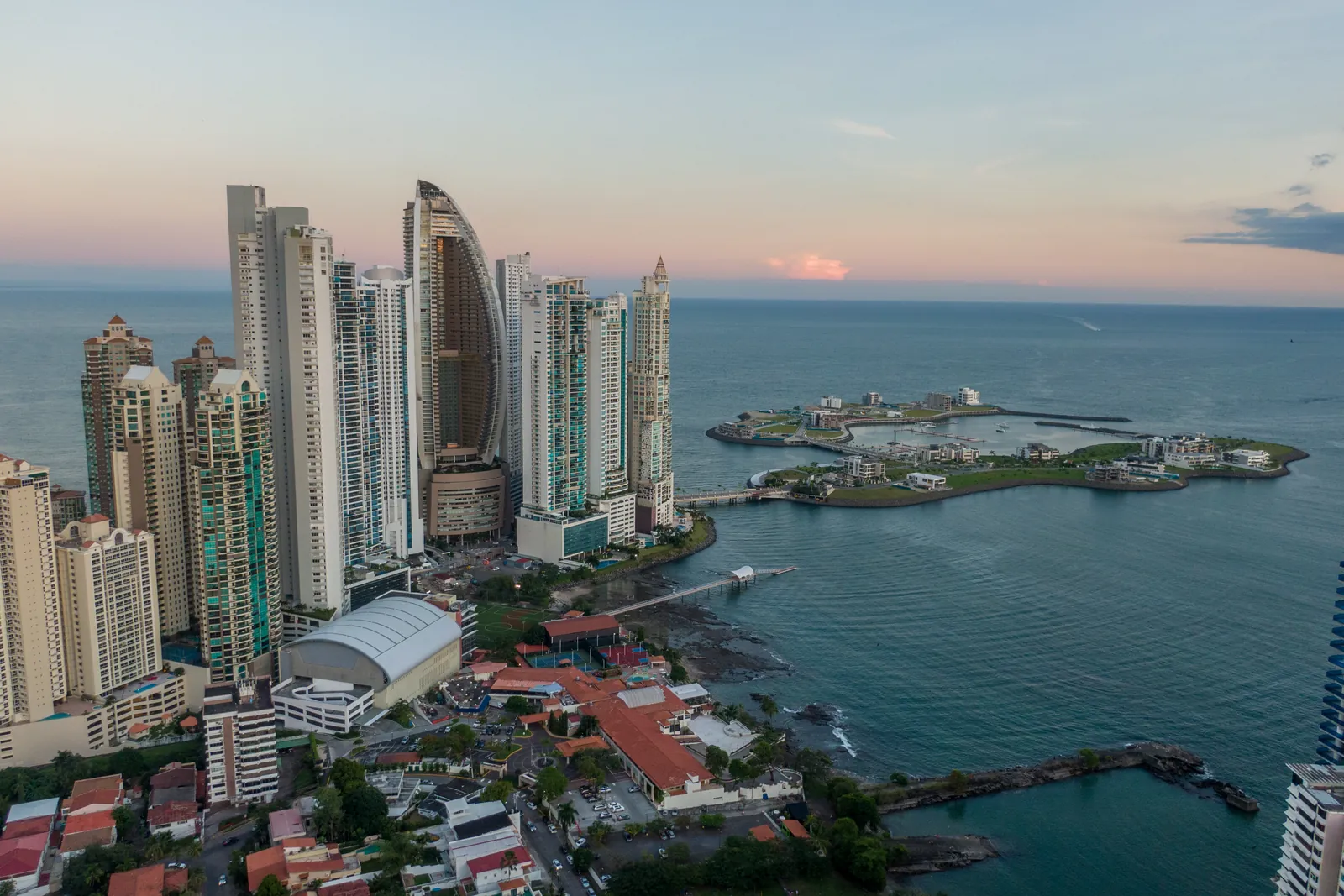
Short answer: For a first trip, the top places to visit in Panama are Panama City with its old quarter, Casco Viejo, the Panama Canal at the Miraflores Locks, the Guna islands of San Blas, the Caribbean islands of Bocas del Toro and the coffee town of Boquete. Round out the list with the rainforest of Soberanía National Park, the colonial forts of Portobelo, the volcanic crater of El Valle de Antón, the Pearl Islands and the marine park of Coiba.
The list is ordered the way we would recommend places to a first-time visitor: the capital and the canal first, then the islands and mountains, then the wilder corners for a longer trip. Panama’s dry season normally runs from December 16 to May 15, and fees are the official figures as of October 2026; Panama uses the US dollar alongside its own balboa coins, at par.
1. Panama City and Casco Viejo
Why it made the list: almost every trip starts in the capital, a city of glass towers on the Pacific with a restored colonial quarter, Casco Viejo, on a small peninsula at its edge.
Best time to go: the dry season, from mid-December to mid-May. October is normally the rainiest month of the year in Panama.
Don’t miss: an evening walk through Casco Viejo’s plazas and rooftop bars, and the ruins of Panamá Viejo, the city’s first site, with its stone cathedral tower and a site museum.
Getting there and how long: Tocumen International Airport is about 40 minutes from downtown, and the metro’s Line 2 now reaches the airport. Stay three nights, including a day for the canal.
Practical note: Panamá Viejo opens Tuesday to Sunday from 8:30 a.m. to 5:30 p.m. (ticket office until 4:30), and non-resident adults pay US$17, which includes the museum and the cathedral viewpoint. See our Panama City travel guide.
2. The Panama Canal: Miraflores and Agua Clara
Why it made the list: watching a giant ship rise or fall through the locks, a few feet from the viewing deck, is the experience that defines a trip to Panama. Miraflores, on the edge of the capital, is the easiest place to see it.
Best time to go: any month, but timing on the day matters more than the season. On the day we checked, ships were passing Miraflores in the morning until about 8:30 a.m. and again from about 2:20 p.m.; the canal authority updates these windows daily on its visitor website.
Don’t miss: the terraces and bleachers at the Miraflores Visitor Center and its IMAX film, narrated by Morgan Freeman. On the Caribbean side, the Agua Clara Visitor Center overlooks the newer, larger locks.
Getting there and how long: Miraflores is a short taxi ride from downtown; allow about an hour and a half there. Agua Clara is near Colón and pairs well with Portobelo.
Practical note: Miraflores is open daily from 8 a.m. to 6 p.m. (tickets until 5 p.m.); non-resident adults pay B/.17.22 (US$17.22), children 6 to 12 B/.7.22, and under-6s go free. Agua Clara opens daily, including holidays, from 8 a.m. to 5 p.m. See our Panama City travel guide.
3. The San Blas Islands (Guna Yala)
Why it made the list: more than 365 small islands of white sand and palms on the Caribbean coast, governed by the Guna people as an autonomous Indigenous region. There are no big hotels: you sleep in simple cabins or hammocks and spend the days swimming, snorkeling and island-hopping by boat.
Best time to go: the dry season, from mid-December to mid-May, when the trade winds bring sunny days and calmer conditions for the boat rides.
Don’t miss: a day of island-hopping to sandbars and tiny cays, and a visit to a Guna community to see molas, the layered, hand-stitched textile panels the Guna are famous for.
Getting there and how long: about two and a half hours by licensed 4×4 from Panama City through the mountains to the port near Cartí, then a small boat to your island; small planes also fly to several island airstrips. Stay two nights.
Practical note: the Guna General Congress sets the rules: an entry fee is collected on the way in, boat fares are fixed by destination, scuba tanks are not allowed, and you need permission before photographing people. Bring cash. See our San Blas Islands travel guide.
4. Bocas del Toro
Why it made the list: an archipelago of nine main islands near the Costa Rican border, with an easygoing Afro-Caribbean town on Isla Colón, coral reefs, mangroves and surf. It is Panama’s favorite island escape for both locals and visitors.
Best time to go: September and October are often the calmest, sunniest weeks on this coast, when the rest of Panama is at its wettest; Panama’s tourism authority (ATP) notes that the sea is usually calm from August to October. Turtles nest from May to October, peaking in July and August.
Don’t miss: a boat day in Bastimentos Island National Marine Park, with the Zapatilla cays and Red Frog Beach, and the walk to Starfish Beach (Playa Estrella) on Isla Colón.
Getting there and how long: a 45-minute flight from Panama City’s Albrook airport to Bocas Town, or by road to Almirante and a 35-minute water taxi. Stay three or four nights.
Practical note: the sea stays around 26°C (79°F) all year; at Starfish Beach, look but do not touch or lift the starfish. See our Bocas del Toro travel guide.
5. Boquete and Barú Volcano
Why it made the list: a cool, green valley in the Chiriquí highlands, famous for Geisha coffee, cloud-forest trails, hot springs and birdwatching. It is the antidote to the heat of the coast, with temperatures from about 12 to 30°C (53–86°F).
Best time to go: January to April, the dry season, which is also the coffee harvest (December to March) and the best time to look for the resplendent quetzal (late February to April). Expect fine mist, called bajareque, even in the dry months.
Don’t miss: a coffee farm tour with tasting, and the Quetzal Trail or a sunrise climb of Barú Volcano, at 3,474 m (11,398 ft) Panama’s highest point, from where both oceans can be seen on clear mornings.
Getting there and how long: fly from Panama City to David, then drive about 50 minutes; by road it is about seven hours. Stay three nights.
Practical note: mountain trails are poorly marked, so hike Barú and the longer routes with a local guide; the Barú summit hike usually starts around midnight to reach the top for sunrise. See our Boquete travel guide.
6. Soberanía National Park and Gamboa
Why it made the list: real tropical rainforest, about 30 minutes from the capital, along the banks of the canal. Its Pipeline Road holds the record for the most bird species seen in 24 hours: 357, according to Panama’s tourism authority.
Best time to go: the dry season for drier trails, but birding is good year-round; go early in the morning, when the forest is most active.
Don’t miss: a dawn birding walk on Pipeline Road with a guide, and the canopy tower at the Panama Rainforest Discovery Center, whose top deck stands 32 m (105 ft) above the forest floor. History lovers can walk part of the Camino de Cruces, a colonial trail built in 1527.
Getting there and how long: drive toward Gamboa on Avenida Omar Torrijos, or take a local bus from the Albrook terminal toward Chilibre, which stops at the park office. A half day or full day is enough.
Practical note: the park covers about 22,000 hectares; Gamboa, at its edge, has lodges if you want to stay in the forest. We do not have a Soberanía page yet; see the day trips in our Panama City travel guide.
7. Portobelo
Why it made the list: a small Caribbean town founded in 1597, where Spanish forts and cannons still face the bay. The forts are part of a UNESCO World Heritage Site, and the town’s Afro-Panamanian Congo culture is recognized by UNESCO as Intangible Cultural Heritage.
Best time to go: the dry season, December to April, for the beaches. On October 21, pilgrims gather for the festival of the Black Christ in the Church of San Felipe.
Don’t miss: the ruins of Santiago de la Gloria castle and its batteries at the entrance to town, the old Customs House museum, and a short boat ride to the beaches and reefs of Portobelo National Park.
Getting there and how long: about an hour and a half by car from Panama City on the Panama–Colón highway (tolls in cash), or two and a half to three hours by bus via Colón. Do it as a long day trip or stay one night.
Practical note: bring cash for boats and local food, as many places do not take cards. The fortifications have been on UNESCO’s List of World Heritage in Danger since 2012, which is a good reason to visit gently and with a local guide. We do not have a Portobelo page yet; see our Panama travel guide.
8. El Valle de Antón
Why it made the list: a mountain village set inside the crater of an extinct volcano, with a mild climate, waterfalls, hiking trails and weekend markets. UN Tourism named it one of its Best Tourism Villages in 2024.
Best time to go: the dry season, December to April, for clear views from the crater rim; the valley stays green and pleasant all year.
Don’t miss: a hike on the crater rim, such as the trail to La India Dormida, part of the 30 km (18.6 miles) Ruta de la Caldera, and a morning at the local market for produce and crafts.
Getting there and how long: about two hours on the Inter-American Highway to Las Uvas, then about 45 minutes up to the village; buses leave the Albrook terminal every 30 minutes. Stay one or two nights.
Practical note: El Valle is one of the few homes of Panama’s golden frog and has recorded more than 300 bird species, so bring binoculars. We do not have an El Valle page yet; see our Panama travel guide.
9. The Pearl Islands and Contadora
Why it made the list: an archipelago of 39 islands and about 100 islets in the Gulf of Panama, mostly in a natural state, with white-sand beaches and clear water a short trip from the capital.
Best time to go: the dry season for beach days; from about July to October humpback whales come to these waters to give birth and raise their young.
Don’t miss: Contadora’s beaches, such as Playa Larga and Playa Sueca, and a boat tour to the uninhabited islands, including Mogo Mogo, for snorkeling and empty sand.
Getting there and how long: a ferry from Panama City takes about two hours and runs daily, or a short flight from Albrook to Contadora’s airstrip. Stay one or two nights.
Practical note: Contadora has the most services and rental houses, so it is the easiest base; the round-trip ferry costs a little over US$100, according to Panama’s tourism authority. We do not have a Pearl Islands page yet; see our Panama travel guide.
10. Coiba National Park and Santa Catalina
Why it made the list: Coiba, a UNESCO World Heritage Site since 2005, protects 38 islands and more than 270,000 hectares of forest, mangroves and sea. A prison for almost 100 years kept it untouched, and divers come for manta rays, whale sharks and hammerhead sharks.
Best time to go: the dry season, December to April, for calmer boat crossings; from July to October whales can be seen in the area.
Don’t miss: a full-day snorkel or dive trip with a licensed operator from Santa Catalina, including the reef at Bahía Damas, one of the largest in the eastern tropical Pacific.
Getting there and how long: about six hours by road from Panama City to Santa Catalina, a surf village on the Pacific coast of Veraguas, then by boat to the park. Stay three nights.
Practical note: visits are arranged through tour operators, who handle the park permit, so book ahead and bring cash for the village. We do not have a Coiba page yet; see our Panama travel guide.
How to fit them into one trip
Panama is compact, but the best islands are reached by small plane, 4×4 or boat, so give each base at least two nights and keep the capital as your hub.
One week: three nights in Panama City with Casco Viejo, Miraflores and a morning in Soberanía, then two nights in San Blas and a final night in Portobelo or El Valle de Antón.
Ten days: add the west: fly to David for three nights in Boquete, then continue to Bocas del Toro for three nights and fly back to the capital.
Two weeks: combine the city, San Blas, Boquete and Bocas, and add Santa Catalina and Coiba or a couple of beach days in the Pearl Islands.
Timing changes the route: the Pacific side, the capital and San Blas are at their best in the dry season, while Bocas del Toro is often best in September and October. Our best time to visit Panama guide goes month by month, and our AI trip planner builds the day-by-day plan for your dates.
Plan your trip
Start with our Panama travel guide for entry rules, money and getting around. Use the AI trip planner to turn this list into a route, check what to expect on your dates with the Destination weather tool, and build a list for beaches, rain and cool mountains with the packing list tool.
Frequently asked questions
What is the most beautiful place in Panama?
Most visitors pick the San Blas Islands, with their palm-dotted cays and clear water, followed by the islands of Bocas del Toro and the remote marine park of Coiba.
How many days do you need in Panama?
A week covers Panama City, the canal and San Blas. Ten days lets you add Boquete and Bocas del Toro, and two weeks gives time for Coiba or the Pearl Islands as well.
What is the best place in Panama for first-time visitors?
Panama City. It has the international airport, the canal at Miraflores, the old quarter of Casco Viejo and rainforest within half an hour, and it is the hub for flights and transfers to the islands and mountains.
Do I need a 4×4 to get to San Blas?
You need a licensed one. Only 4×4 vehicles approved by the transit authority and the Guna General Congress may use the road to the ports, and regular buses do not go, so most visitors book a package that includes the transfer, boat and lodging.