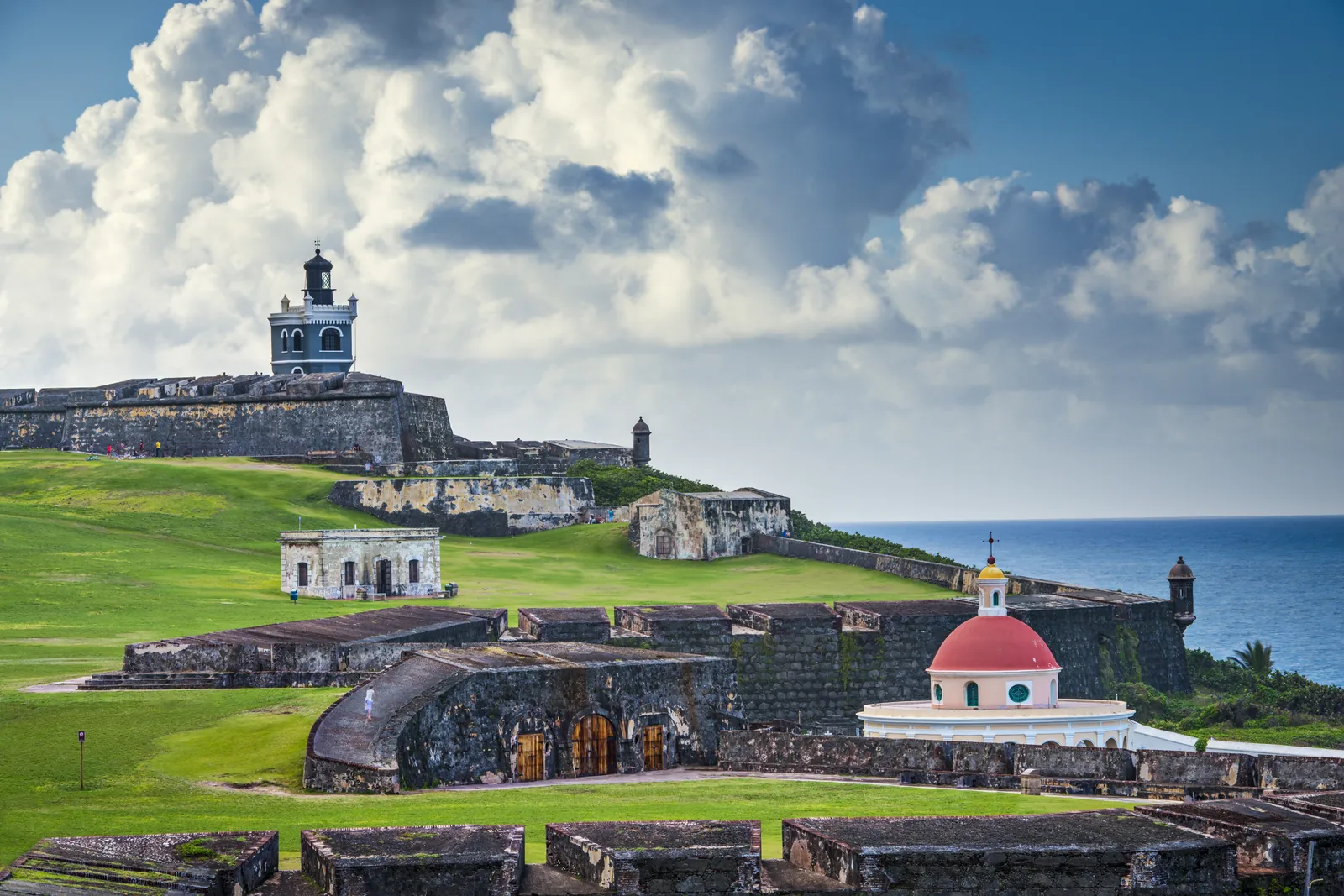
Short answer: The top places to visit in Puerto Rico are Old San Juan and its Spanish forts, El Yunque rainforest, Vieques and its glowing Mosquito Bay, Culebra’s Flamenco Beach and the surf town of Rincón. Round out a longer trip with Fajardo and Luquillo, Cabo Rojo, Ponce, the Guánica dry forest and La Parguera, and the coffee mountains along the Ruta Panorámica.
Puerto Rico is small, but it holds a 500-year-old walled city, a rainforest, a cactus-covered dry forest, two quiet offshore islands, bays that glow at night and cool coffee mountains. The list is ordered as we would plan a first visit, with opening details checked on official sites in October 2026. Our Puerto Rico travel guide covers entry rules, money, ferries and costs.
1. Old San Juan
Why it made the list: founded in the early 1500s, Old San Juan is a walled town of blue cobblestones, pastel houses and shady plazas guarded by two huge Spanish forts, El Morro and San Cristóbal. Together they form San Juan National Historic Site, run by the National Park Service and part of a World Heritage Site.
Best time to go: December to April, the driest and breeziest months, are best for walking. The San Sebastián Street Festival fills the old town with music in the third week of January.
Don’t miss: the ramparts and sentry boxes of El Morro above the Atlantic, and a slow walk from the Paseo de la Princesa through the old city gate to the cathedral and Calle del Cristo.
Getting there and how long: about 20 to 30 minutes from the main airport (SJU); cruise ships dock at the old town’s piers. Give San Juan three days, or four to five with day trips.
Practical note: as of October 2026, according to the National Park Service, the forts open daily from 9 a.m. to 5 p.m. (closed Thanksgiving, Christmas and New Year’s Day), and a $10 pass covers both for 24 hours; under-16s enter free, and no cash is accepted. El Morro’s dry moat is temporarily closed as far as the Santa Elena Bastion during cliff stabilization work. See our San Juan travel guide.
2. El Yunque National Forest
Why it made the list: the only tropical rainforest in the US national forest system, El Yunque covers nearly 29,000 acres of misty peaks, waterfalls, tree ferns and singing coquí frogs, less than an hour from San Juan.
Best time to go: early morning, any season. It rains almost every day, but February and March are the least rainy months.
Don’t miss: La Coca Falls and the Yokahú tower, then the Mount Britton trail through cloud forest to a stone tower near the summit. The El Portal Rainforest Center tells the story of the forest and the endangered Puerto Rican parrot.
Getting there and how long: drive east to Río Grande and up road PR-191, about 45 minutes to an hour from San Juan, or join a tour. Half a day covers the main stops; a full day adds a hike and Luquillo Beach.
Practical note: according to the USDA Forest Service, the PR-191 corridor is free, needs no reservation and is open from 8 a.m. to 5 p.m.; the gate closes for a while when parking is full, so arrive early. El Portal charges $8 for adults. The La Mina and Big Tree trails remain closed, the El Yunque trail is open only as far as Los Picachos, and ride apps can’t pick you up inside the forest. See our El Yunque National Forest travel guide.
3. Vieques and Mosquito Bay
Why it made the list: Vieques is Puerto Rico at its slowest, with wild horses on the roads and dozens of empty beaches, many inside a national wildlife refuge on land the US Navy left in 2003. At night, Mosquito Bay glows blue-green around your paddle; Guinness World Records named it the world’s brightest bioluminescent bay in 2006.
Best time to go: January to April is driest. For the bay, pick nights around the new moon, when the glow is brightest.
Don’t miss: a guided kayak or electric-boat tour of Mosquito Bay from Esperanza, and a day on the refuge beaches in the east, such as Caracas and La Chiva.
Getting there and how long: the public ferry from Ceiba takes about an hour and costs $2.00 one way for adults as of October 2026, according to the operator Puerto Rico Ferry; small planes take about 25 minutes from Isla Grande airport near Old San Juan. Stay at least three nights, so you have a spare dark night for the bay.
Practical note: visitors’ rental cars can’t go on the ferry, so book a jeep on the island early in winter. Bay tours are run by licensed operators only, and you skip repellent and sunscreen in the water. See our Vieques travel guide.
4. Culebra and Flamenco Beach
Why it made the list: Culebra is smaller and sleepier than Vieques, and home to Flamenco Beach, a mile-long horseshoe of white sand and shallow turquoise water in a sheltered bay, often ranked among the world’s best beaches.
Best time to go: April to August for the calmest snorkeling seas; December to April is driest. Go midweek if you can, as weekend and holiday ferries fill up.
Don’t miss: a swim at Flamenco and the old painted military tank on the sand, then snorkeling at Carlos Rosario and Tamarindo beaches.
Getting there and how long: the ferry from Ceiba takes about an hour and a half and costs $2.25 one way for adults as of October 2026, according to Puerto Rico Ferry; small planes also fly in. A shuttle or taxi takes you from the dock to the beach. A day trip is possible, but two nights is far more relaxed.
Practical note: according to Discover Puerto Rico, Flamenco has lifeguards, showers, restrooms, a camping area and food kiosks. Book your return ferry early and be at the terminal an hour before departure.
5. Rincón
Why it made the list: on the island’s western tip, Rincón is Puerto Rico’s surf town, with famous breaks at Domes, María’s and Tres Palmas, humpback whales offshore in winter and the island’s best sunsets.
Best time to go: November to March for surf, roughly January to March for whales, and April to August for flat, clear water.
Don’t miss: sunset at the Punta Higüero lighthouse park, where whales can pass within about 100 yards of the coast in winter, and summer snorkeling in the Tres Palmas Marine Reserve off Steps Beach.
Getting there and how long: about two and a half hours’ drive from San Juan, or about half an hour from Aguadilla’s airport (BQN). Stay three or four nights; you need a car.
Practical note: Tres Palmas is an experts-only big-wave spot, where Discover Puerto Rico says winter waves can reach 20 feet (6 m). When the surf is up, swim at the calmer south-facing beaches. See our Rincón travel guide.
6. Fajardo, Luquillo Beach and Laguna Grande
Why it made the list: the northeast corner pairs perfectly with El Yunque. Luquillo’s reef-sheltered public beach has a famous row of food kiosks next door, and Fajardo is the boating hub, with catamaran trips to offshore cays and Laguna Grande, the bioluminescent lagoon closest to San Juan.
Best time to go: any time; April to August has the calmest water for boat trips. For the lagoon, choose a night with little or no moon.
Don’t miss: an evening kayak tour through the mangroves into Laguna Grande, and lunch at the Luquillo kiosks after a morning in El Yunque.
Getting there and how long: Discover Puerto Rico puts Laguna Grande about an hour and 15 minutes’ drive from San Juan along PR-3. Do it as a day trip, or stay a night or two before the ferry from nearby Ceiba.
Practical note: it is one of Puerto Rico’s three bioluminescent bays, with Mosquito Bay and La Parguera. If you are going to Vieques, save your bio bay night for Mosquito Bay.
7. Cabo Rojo
Why it made the list: the island’s southwest tip is wild and beautiful, with salt flats that have produced salt since 1511, the Los Morrillos lighthouse of 1882 on limestone cliffs, and Playuela (Playa Sucia), a crescent of white sand below it, according to Discover Puerto Rico.
Best time to go: the dry winter and spring months, best for the exposed walk to the lighthouse; winter also brings migratory birds to the salt flats.
Don’t miss: the lighthouse’s observation deck over the cliffs and the Caribbean, then a swim at Playuela and seafood in Boquerón.
Getting there and how long: about an hour south of Rincón by car. Spend a day, or a night in Boquerón or La Parguera on a loop around the island.
Practical note: according to Discover Puerto Rico, the salt flats and lighthouse are closed on Mondays, the last stretch is a dirt road and an uphill walk, and there are no restaurants or kiosks, so bring water and snacks.
8. Ponce
Why it made the list: Puerto Rico’s second city is the cultural capital of the south, with a grand plaza, a cathedral and the striped red-and-black Parque de Bombas, the island’s first fire station. Above the city, the Castillo Serrallés mansion has gardens and wide views.
Best time to go: February, for Ponce’s carnival and its horned vejigante masks; the south is drier and calmer than the north all year.
Don’t miss: an evening stroll around Plaza Las Delicias, and Castillo Serrallés, which Discover Puerto Rico lists as open Thursday to Monday.
Getting there and how long: about 90 minutes south of San Juan by expressway, or fly to Ponce’s Mercedita airport (PSE). One night is enough; two if you add Guánica.
Practical note: some landmarks are closed for work. The Museo de Arte de Ponce has been closed since the 2020 earthquakes, with reconstruction under way since May 2026, and Discover Puerto Rico lists the Parque de Bombas as closed for renovations until further notice, so admire it from the plaza.
9. Guánica Dry Forest and La Parguera
Why it made the list: the Guánica dry forest, a UNESCO biosphere reserve of cactus, scrub and limestone, is the opposite of El Yunque, and nearby La Parguera has mangrove channels, cays and the island’s third bioluminescent bay.
Best time to go: winter for cooler hiking; summer for calm water and diving.
Don’t miss: one of the forest’s 12 trails, such as Fuerte Caprón to an old fort above Guánica Bay or the shorter Ballena trail toward a remote beach, then an evening boat trip in La Parguera to see the glow.
Getting there and how long: both are easy drives west of Ponce. Plan a day, ideally with a night in La Parguera between Ponce and Cabo Rojo.
Practical note: according to Discover Puerto Rico, the ranger at the forest entrance can give you a trail map. Shade is scarce, so start early and carry plenty of water.
10. The central mountains and the Ruta Panorámica
Why it made the list: the Ruta Panorámica winds along the island’s mountain spine through coffee country, small towns and cloud forest, with cooler air, big views and very few tourists.
Best time to go: the drier months from December to April; leave early, as clouds build in the afternoon.
Don’t miss: a working coffee hacienda, where Discover Puerto Rico suggests a farm tour and tasting, and Toro Negro State Forest, which Puerto Rico’s Department of Natural Resources says has more than 11 miles of trails. Stop at Guavate for roast pork on the way back to San Juan.
Getting there and how long: drive part of the route between Ponce or the west coast and San Juan. A full day gives you a feel for it; a night at a mountain inn makes it a highlight.
Practical note: roads are narrow, steep and winding, and mobile coverage is patchy, so allow extra time and download offline maps.
How to fit them into one trip
Puerto Rico splits neatly into east and west. In one week, spend three nights in San Juan with a day in El Yunque and Luquillo, then three nights on Vieques, adding Culebra if you have time. In ten days, follow San Juan and El Yunque with a loop: west to Rincón for three nights, south through Cabo Rojo and La Parguera to Ponce, and back through the mountains.
Our AI trip planner builds the day-by-day plan for your dates, and our guide to the best time to visit Puerto Rico explains the weather, festivals and prices month by month.
Plan your trip
December to April is the driest and most popular season; June to November is hotter, wetter and the Atlantic hurricane season, with most activity from mid-August to mid-October, according to NOAA’s National Hurricane Center. Check typical conditions for your dates with the Destination weather tool and pack for beach, rainforest and mountains with our packing list.
Frequently asked questions
What is the most beautiful place in Puerto Rico?
Many visitors would pick Flamenco Beach on Culebra, a mile-long horseshoe of white sand and turquoise water. Old San Juan’s colorful streets and El Yunque’s misty rainforest are close behind, and Mosquito Bay on Vieques is unforgettable on a dark night.
What is the best place in Puerto Rico for first-time visitors?
San Juan. Stay in or near Old San Juan for the forts, food and nightlife, and take day trips to El Yunque, Luquillo Beach and the bioluminescent lagoon in Fajardo.
How many days do you need in Puerto Rico?
A week is ideal for a first trip: three or four days in San Juan with El Yunque, and three nights on Vieques or in Rincón. Four days covers San Juan and El Yunque; ten days to two weeks lets you loop the island and visit both offshore islands.
Which is better, Vieques or Culebra?
Choose Vieques for variety: more beaches, wild horses, restaurants in Esperanza and the brightest bioluminescent bay. Choose Culebra for Flamenco Beach, snorkeling and an even quieter pace. With four or more nights you can do both, as ferries also link the two islands.
Can you visit the Camuy caves or the Arecibo Observatory?
Not easily, which is why they are not on this list. We could not confirm that the Río Camuy Cave Park has reopened, and the Arecibo Observatory’s science and visitor center has offered only limited public hours, with tickets bought online in advance. Check their official sites before planning a day around them.