Short answer: For a first trip, the top places to visit in Albania are the Albanian Riviera between Dhërmi and Himarë, the UNESCO-listed stone towns of Berat and Gjirokastër, the ancient city of Butrint and the turquoise water of Ksamil. Round out the list with the capital Tirana, the mountains of Theth and Valbona, the Blue Eye spring, the Roman amphitheater of Durrës and the castle town of Kruja.
The list is ordered the way we would recommend places to a first-time visitor: the coast and the great historic sites first, then the capital, the mountains and the easy extras near Tirana. Albania uses its own currency, the lek; on October 2, 2026, the Bank of Albania’s official rate was about 92 lek to the euro, so 1,000 lek is roughly €11.
1. The Albanian Riviera
Why it made the list: this is the reason most people come. South of Vlorë, the mountains of the Llogara National Park drop straight into the Ionian Sea, with white pebble coves, sandy bays and water that turns from turquoise to deep blue. Villages of olive groves and stone houses sit above the shore, and it is still less built-up than most of the Mediterranean.
Best time to go: June and September, with warm, settled weather, a warm sea and far fewer people than in July and August. Late May and early October are quieter still.
Don’t miss: the drive over the Llogara Pass, at a little over 1,000 m (3,300 ft), with the whole coast laid out below, and the hidden cove of Gjipe at the mouth of a canyon, reached only on foot in about 20 to 30 minutes or by boat. Himarë has an old castle village on the hill above its relaxed seafront.
Getting there and how long: from Tirana airport it is about four to five hours by car to Himarë. Since July 2024 the 6 km Llogara Tunnel has bypassed the pass for a toll; drive the old road at least once for the views. Stay four days to a week, ideally moving down the coast.
Practical note: every beach is public, but on busy ones much of the shore is rented to beach bars that charge for loungers, typically about €10–20 a day for two in summer; national rules keep a share of each beach free. Carry cash in lek. See our Albanian Riviera travel guide.
2. Berat
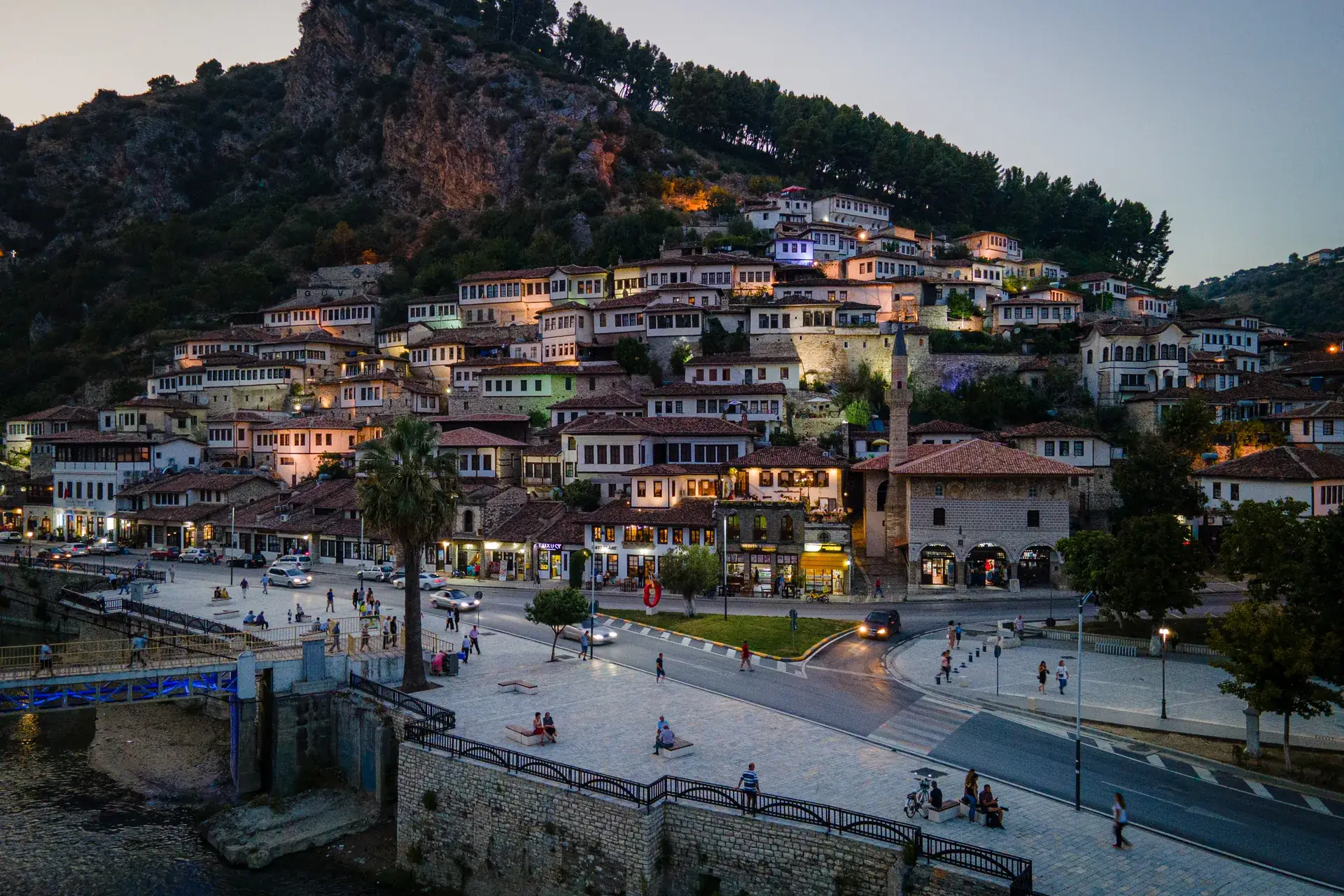
Why it made the list: Albania’s most beautiful old town, the “town of a thousand windows”, is a hillside of white Ottoman houses with rows of dark wooden windows above the Osum river. Above them, a castle still has people living inside its walls, among Byzantine churches.
Best time to go: April to June and September to October. Berat’s sheltered valley gets very hot in July and August, so sightsee early and late.
Don’t miss: the castle quarter and the Onufri Iconographic Museum, with icons by Albania’s finest 16th-century painter, then the view of Mangalem from across the seven-arched Gorica Bridge at dusk, when the houses are lit.
Getting there and how long: about two to two and a half hours south of Tirana by bus or car. One full day covers the town; stay a night or two to add the Osumi canyon or a winery.
Practical note: the walk up to the castle is a steep 20 minutes on slippery cobbles, so wear shoes with grip. The Onufri Museum usually closes on Mondays. Berat shares a UNESCO World Heritage listing with Gjirokastër. See our Berat travel guide.
3. Gjirokastër
Why it made the list: Berat’s UNESCO twin is grey where Berat is white: a steep town of stone-roofed tower houses below a vast hilltop fortress, looking over the Drino valley. It is the birthplace of the writer Ismail Kadare.
Best time to go: April to June and September to October, when the steep lanes are pleasant to walk.
Don’t miss: the castle, which holds an arms museum and has wide views over the valley, and a slow walk through the old bazaar and the lanes of tower houses.
Getting there and how long: about an hour inland from Sarandë, with the Blue Eye spring on the way. Stay one night if you can.
Practical note: the castle ticket is 400 lek. The town is steep and cobbled, so it is hard going with a wheelchair or pushchair. See our Albania travel guide.
4. Butrint
Why it made the list: Butrint is Albania’s most important ancient site and a UNESCO World Heritage Site since 1992. A wooded headland between a lagoon and the Vivari channel holds 2,500 years of history, from a Greek theater to Roman baths, a great basilica and a Venetian castle.
Best time to go: April to June and September to October. In summer, go at opening time or late in the afternoon.
Don’t miss: the loop path of about 2.5 km past the Greek theater, the 6th-century baptistery (its mosaic floor is usually covered with sand to protect it), the Lion Gate and the hilltop castle museum with views over the lagoon.
Getting there and how long: about 18 km south of Sarandë, just past Ksamil, with local buses to the entrance. Allow two to three hours.
Practical note: the adult ticket is reported at 1,000 lek, with children under 12 free; check at the gate. Bring water, a hat and insect repellent. See our Albanian Riviera travel guide.
5. Ksamil and Sarandë
Why it made the list: at the southern tip of the Riviera, Ksamil has small islands, shallow turquoise water and patches of white sand a short swim or boat ride offshore. Sarandë next door is the biggest resort town, with a long, lively promenade.
Best time to go: June and September. In July and August Ksamil is beautiful but crowded and expensive.
Don’t miss: a swim or paddle out to the Ksamil islands, and sunset over the bay from Lëkurësi castle, an Ottoman fort on the hill above Sarandë.
Getting there and how long: many visitors fly to Corfu and take the ferry to Sarandë, about half an hour by fast boat; Finikas Lines’ summer timetable runs from June 1 to October 15, with foot-passenger fares of roughly €10–25 one way. Stay two or three nights.
Practical note: arrive very early at the Ksamil beaches in August, and remember Albania is one hour behind Greece when you read ferry times. See our Albanian Riviera travel guide.
6. Tirana
Why it made the list: Albania’s capital is its liveliest city: brightly painted apartment blocks, packed cafés, a huge pedestrian square and a cable car up the mountain. Its 20th-century history is told in two bunker museums that are among the country’s most memorable sights.
Best time to go: April to June and September to October. July and August afternoons are often above 35 °C (95 °F).
Don’t miss: Skanderbeg Square and the small, beautifully painted Et’hem Bey Mosque, then Bunk’Art 1 or Bunk’Art 2, and the Dajti Ekspres cable car to Mount Dajti National Park, about 15 to 20 minutes up, for the view over the city.
Getting there and how long: most visitors fly into Tirana International Airport, 17 km away; an airport bus runs to the center every hour, day and night, for 400 lek. Give it two days.
Practical note: Bunk’Art 1 opens daily from 09:30 to 17:30 and Bunk’Art 2 from 09:30 to 18:30. The Dajti Ekspres runs every day except Tuesday. See our Tirana travel guide.
7. Theth, Valbona and Lake Komani
Why it made the list: the Albanian Alps in the far north are wild and beautiful: jagged limestone peaks, stone guesthouses, waterfalls and quiet valleys. The trip in, by ferry through a narrow, fjord-like gorge on Lake Komani, is an experience in itself.
Best time to go: mid-June to September, when the high passes are clear of snow and the guesthouses are open. Many close in winter.
Don’t miss: the classic hike over the Valbona Pass between Valbona and Theth, about six to eight hours, and the Komani Lake ferry, a ride of two to three hours.
Getting there and how long: Shkodër, with its lake and Rozafa castle, is the gateway. Give the mountains three nights, with a night in Shkodër on each side.
Practical note: trails are rough and mobile coverage is patchy, so carry water, cash and good boots. See our hiking guide and our Albania travel guide.
8. The Blue Eye
Why it made the list: in a shady forest of plane trees, a karst spring wells up from more than 50 m down into a pool of almost unreal blue, ringed with deep green. It is a protected natural monument and one of Albania’s most photographed places.
Best time to go: early in the morning, before the tour buses, from spring to autumn.
Don’t miss: the short riverside walk from the car park, about 15 to 20 minutes, and the viewpoint over the spring.
Getting there and how long: about 22 km inland from Sarandë, on the road to Gjirokastër, so combine the two. An hour or two is enough.
Practical note: swimming and jumping in the spring are banned, as it is a source of drinking water. A small entrance fee and a parking charge are paid in cash. See our Albanian Riviera travel guide.
9. Durrës
Why it made the list: Albania’s main port is one of the oldest cities on the Adriatic, the Roman Dyrrachium, with a huge 2nd-century amphitheater in the middle of town, Byzantine walls and a long sandy beach. It is an easy first or last stop near the airport.
Best time to go: June and September for the beach; April, May and October for sightseeing.
Don’t miss: the Roman amphitheater, once one of the largest in the Balkans and only rediscovered in the 1960s, with a small Byzantine chapel built into its stands; then the Archaeological Museum and a sunset walk on the promenade.
Getting there and how long: a direct bus from Tirana airport costs 600 lek, and buses from central Tirana take about an hour. One or two days is plenty.
Practical note: the beach is long, sandy and shallow, which suits small children, but it is busy and built-up; the water is clearer away from the port. See our Durrës travel guide.
10. Kruja
Why it made the list: this mountain stronghold above the coastal plain is where the national hero Skanderbeg held off the Ottomans in the 15th century. Today it has a castle with the Skanderbeg Museum, an ethnographic museum in an old merchant’s house and a cobbled bazaar of handicrafts.
Best time to go: all year; spring and autumn are the most comfortable.
Don’t miss: the castle and museum, then a stroll through the old bazaar, lined with handicraft stalls.
Getting there and how long: about an hour north of Tirana, an easy half-day trip.
Practical note: the bazaar lanes are steep and cobbled. Combine Kruja with a night near the airport before an early flight. See our Tirana travel guide.
How to fit them into one trip
Albania looks small on the map, but mountain roads are slow: Tirana to Sarandë is about 280 km and around five hours by car. Plan on one move every two or three days.
One week: two nights in Tirana, with an afternoon in Kruja or Durrës; one night in Berat; three nights on the Riviera in Himarë or Dhërmi, with a day for Butrint and the Blue Eye; then drive back to Tirana.
Ten days: two nights in Tirana, two in Berat, one in Gjirokastër, three on the Riviera split between Ksamil or Sarandë and Himarë, and a last night in Durrës on the way back to the airport. Or end with the ferry to Corfu.
Two weeks: add Shkodër and three nights in the Alps (Komani Lake ferry to Valbona, then the hike to Theth) before heading south. This works from mid-June to September.
The coast is best in June and September, the stone towns in May and October, and the mountains from mid-June to September. Our best time to visit Albania guide goes month by month, and our AI trip planner builds the day-by-day plan for your dates.
Plan your trip
Start with our Albania travel guide for buses, ferries, driving, money and entry rules. Use the AI trip planner to turn this list into a route, convert lek with the Money exchange tool, and check sea and air temperatures for your dates with the Destination weather tool.
Frequently asked questions
What is the most beautiful place in Albania?
Many travelers name the Albanian Riviera, especially the coves around Dhërmi, Gjipe and Himarë, along with the old town of Berat seen from the Gorica Bridge and the turquoise pool of the Blue Eye.
How many days do you need in Albania?
A week covers Tirana, Berat and the Riviera. Ten days lets you add Gjirokastër and Butrint at a gentler pace, and two weeks includes the Albanian Alps.
What is the best place in Albania for first-time visitors?
The Albanian Riviera, with Himarë as a central base, combined with a night in Berat. Together they give you Albania’s beaches, mountains and old towns in one short trip.
Is Berat or Gjirokastër better?
Both are worth seeing, and they share a UNESCO listing. Berat is greener and softer, with white houses by a river and wineries nearby; Gjirokastër is grey stone, steeper and more dramatic, with a huge fortress.
Can you swim in the Blue Eye?
No. The spring is a protected natural monument and a drinking-water source, and swimming and jumping are banned.
When is the sea warm enough to swim in Albania?
From about mid-June to early October for most swimmers, and warmest in August. June and September give you the same warm sea with far fewer people.