Short answer: The top places to visit in Bosnia and Herzegovina are Sarajevo, Mostar and its Old Bridge, the Kravica waterfalls, the dervish house at Blagaj, the Ottoman village of Počitelj, Jajce, the Una National Park, the bridge at Višegrad, Trebinje and Sutjeska National Park. For a first trip, plan a week to ten days and combine Sarajevo, Mostar and Herzegovina with Jajce or the rivers and mountains.
Bosnia and Herzegovina is a small, mountainous country where minarets, Orthodox domes and Catholic spires share the same skyline, emerald rivers run through deep valleys and prices are low. This list is ordered the way we would recommend the places for a first visit, with when to go, what not to miss, how to get there and a practical note for each.
May, June and September are the sweet spots: warm, green and less crowded, with full rivers for rafting. July and August are busy and very hot in Mostar, where highs average about 33 °C (92 °F), and December to March is cold and snowy, the ski season above Sarajevo. Our best time to visit Bosnia and Herzegovina guide covers every month.
1. Sarajevo
Why it made the list: the capital is one of Europe’s most fascinating cities, where East meets West in a single walk: from the copper workshops, mosques and ćevapi grills of the Ottoman bazaar, Baščaršija, into the Austro-Hungarian center. It sits in a narrow valley ringed by the hills and Olympic mountains of 1984.
Best time to go: May, June and September, with summer highs of about 25–28 °C (77–82 °F). August brings the Sarajevo Film Festival; December to March is the ski season at Jahorina and Bjelašnica.
Don’t miss: the Gazi Husrev-beg Mosque and the Sebilj fountain, the Latin Bridge and the restored City Hall (Vijećnica), and sunset from the Yellow Fortress. The Tunnel of Hope museum tells the story of the 1992–95 siege.
Getting there and how long: Sarajevo International Airport is the main gateway, a short ride from the center. Stay two or three days.
Practical note: the Trebević cable car climbs from the old town to the mountain and the 1984 bobsleigh track; a return ticket costs 30 KM, and a combined ticket with City Hall 35 KM. Prices are in convertible marks (KM). See our Sarajevo travel guide.
2. Mostar
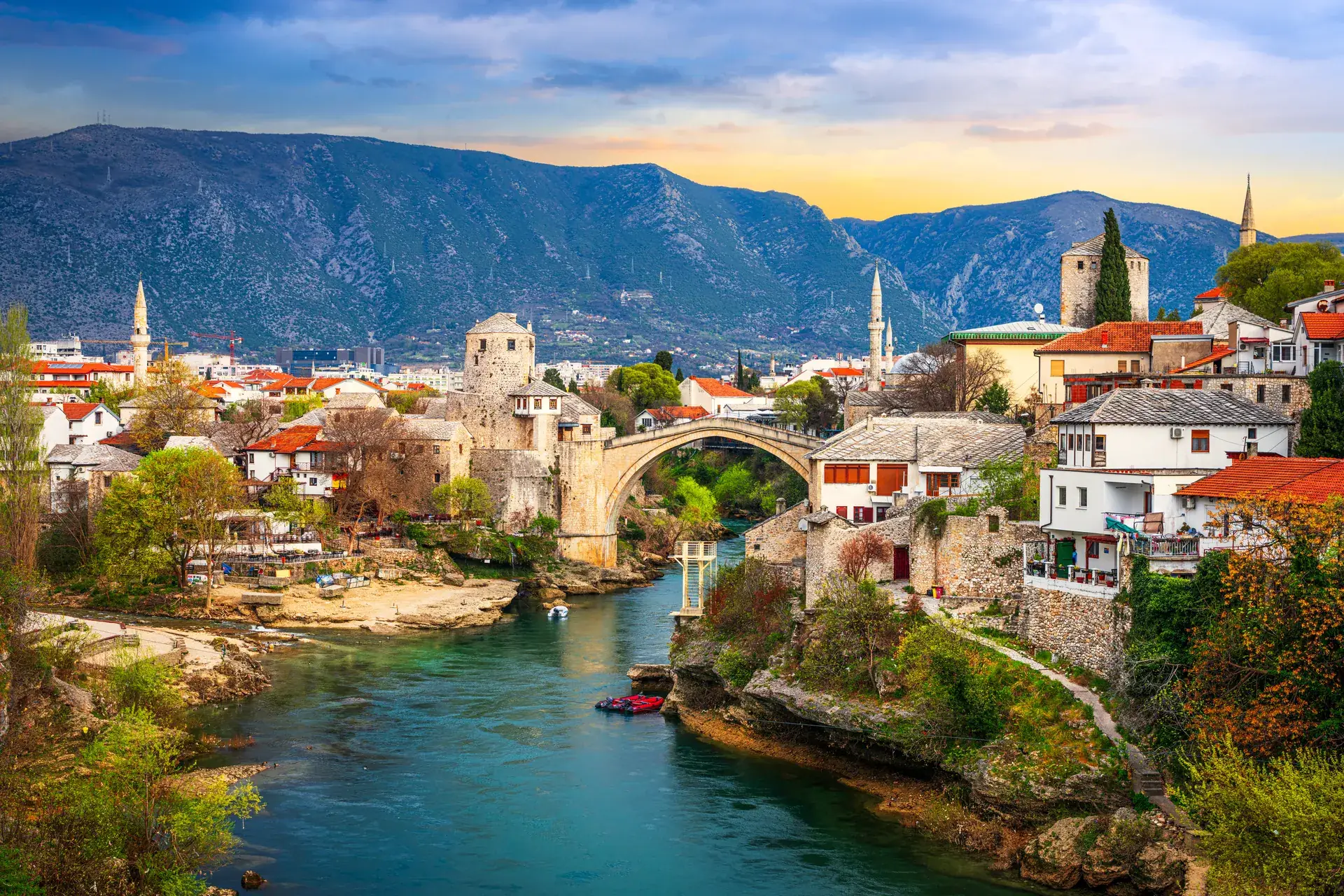
Why it made the list: Mostar’s Old Bridge (Stari Most), built in 1566, arches over the emerald Neretva and is the symbol of the country. It was destroyed in 1993 and rebuilt by 2004, and the Old Bridge Area of the Old City of Mostar has been a UNESCO World Heritage Site since 2005.
Best time to go: April to June and September to October. July and August are very hot, with average highs of about 33 °C (92 °F), and crowded with day-trippers from the coast by late morning.
Don’t miss: the Old Bridge in the evening light, the bridge divers leaping into the river, and the view of the bridge from the minaret of the Koski Mehmed-Pasha Mosque.
Getting there and how long: trains run from Sarajevo to Mostar along the Neretva valley in about two hours, one of the most beautiful routes in the Balkans. Stay two nights, with a day for Blagaj, Počitelj and Kravica.
Practical note: the traditional Old Bridge diving competition takes place in late July. Stay overnight to see the old town before and after the day-trip crowds. See our Mostar travel guide.
3. The Kravica waterfalls
Why it made the list: on the Trebižat river in Herzegovina, Kravica is a wide horseshoe of cascades falling into a green pool, and one of the country’s favorite summer swimming spots.
Best time to go: June to September for swimming; spring for the fullest falls. The site is open all year, until 22:00 from June to September.
Don’t miss: a swim in the pool below the falls and a walk along the cascades.
Getting there and how long: Kravica is an easy half-day trip from Mostar by car or tour. Allow two to three hours.
Practical note: entry costs 20 KM for adults and 10 KM for ages 7 to 18; under-7s are free. Swimming is at your own risk. See our Mostar travel guide for day trips.
4. Blagaj
Why it made the list: at Blagaj, a 16th-century dervish house (tekija) stands beside the spring of the Buna, which gushes from a cave at the foot of a 200-meter cliff. It is one of the most peaceful and photogenic places in the country.
Best time to go: April to June and September to October; in summer, come early in the morning before the tours.
Don’t miss: the rooms of the tekija, coffee or a trout lunch at a riverside terrace, and the view of the spring from the bank.
Getting there and how long: Blagaj is a short drive or local bus ride from Mostar. Allow two hours, or combine it with Počitelj and Kravica in one day.
Practical note: the tekija is open daily from 08:30 to 20:30. It is a place of worship, so dress modestly; wraps are provided. See our Mostar travel guide.
5. Počitelj
Why it made the list: a fortified Ottoman village of stone houses, a mosque and a hilltop tower climbing a slope above the Neretva. It is small, quiet and beautiful, and a perfect stop between Mostar and the coast.
Best time to go: spring and autumn; in summer, the climb is best early or late in the day.
Don’t miss: the climb to the tower for the view over the river valley, and the old mosque below it.
Getting there and how long: Počitelj is on the main road south of Mostar, easiest by car or on a day tour. Allow an hour or two.
Practical note: the village is free to wander. Wear good shoes, as the stone steps are steep and can be slippery.
6. Jajce
Why it made the list: one of Bosnia’s most photogenic towns, where the Pliva river plunges over a waterfall right in the town center, below a medieval fortress where the last Bosnian king was crowned. Upstream are the Pliva lakes and their little wooden watermills.
Best time to go: May to September, when it is warmest; spring brings the fullest waterfall. Winters are cold.
Don’t miss: the waterfall from the viewpoints below the town, the fortress walls, and the watermills on the Pliva lakes.
Getting there and how long: buses run from Sarajevo and Banja Luka, but a car is easiest. Stay one night, with a stop at Travnik, the old seat of the Ottoman viziers, about an hour east.
Practical note: Jajce works well as a stop between Sarajevo and the Una valley or Banja Luka.
7. Una National Park
Why it made the list: in the green north-west, near Bihać, the park protects the clear Una river and its waterfalls, the biggest of which is Štrbački buk, a broad wall of cascades. It is one of the best places in the country for rafting.
Best time to go: May to September; April to June for the biggest water. Banja Luka, the nearest big city, averages about 30 °C (86 °F) by day in August.
Don’t miss: the boardwalks at Štrbački buk, the falls at Martin Brod, and a rafting trip on the Una.
Getting there and how long: the park is near Bihać, a long drive from Sarajevo, so most visitors combine it with Jajce or with a trip from Croatia. Spend one or two nights.
Practical note: the park sets its Štrbački buk adult ticket by season, from 8 KM in the low season to 20 KM in the high season in 2026.
8. Višegrad and the Drina bridge
Why it made the list: the Mehmed Paša Sokolović Bridge over the Drina, built at the end of the 16th century by the great Ottoman architect Sinan, has 11 stone arches and is 179.5 m long. It has been a UNESCO World Heritage Site since 2007, and Ivo Andrić’s novel The Bridge on the Drina made it famous.
Best time to go: May to September, when the Drina valley is warm and green.
Don’t miss: a walk across the bridge and the view of it from the riverbank.
Getting there and how long: Višegrad is in the east of the country, on the road from Sarajevo toward Serbia. Stop for a few hours or stay one night.
Practical note: the bridge is free to cross on foot. Combine it with rafting on the Drina or Tara.
9. Trebinje
Why it made the list: a relaxed Herzegovinian town of plane-tree-shaded squares, an old town by the river, an Ottoman stone bridge and wineries, with the hilltop Hercegovačka Gračanica church above it. It is only 30 km from Dubrovnik.
Best time to go: April to June and September to October. August averages about 32 °C (90 °F) by day, and most rain falls from October to March.
Don’t miss: the market and cafés of the old town, sunset from Hercegovačka Gračanica, and a wine tasting at a local cellar.
Getting there and how long: Trebinje is about 30 minutes from Dubrovnik and a short drive from Montenegro’s Bay of Kotor. Stay one or two nights.
Practical note: Trebinje makes an easy, cheaper base for a Dubrovnik day, or a first stop in the country if you arrive from Croatia’s coast.
10. Sutjeska National Park
Why it made the list: the country’s wild south-east corner, with high mountains and the Perućica forest, one of the last primeval forests in Europe. Maglić (2,386 m), the highest peak in Bosnia and Herzegovina, rises on its border.
Best time to go: late May to early October, when the trails are free of snow.
Don’t miss: the viewpoint over the Skakavac waterfall in Perućica, and a hike in the high mountains. Rafting on the Tara is nearby, at Foča.
Getting there and how long: the park is in the south-east, near Foča, and a car is the best way to reach it. Stay at least one night.
Practical note: visits inside the Perućica reserve are allowed only when approved and accompanied by park staff, so book a guide through the park. Stay on marked paths in the mountains.
How to fit them into one trip
With a week, spend two or three days in Sarajevo, then take the train down the Neretva valley to Mostar for two nights, with a day for Blagaj, Počitelj and Kravica. Add a night in Trebinje on the way to Dubrovnik, or loop back north through Jajce and Travnik.
With ten days to two weeks, add the Una National Park after Jajce, a hike or rafting trip in Sutjeska, and Višegrad on the way east. Buses reach most towns, but a car makes it far easier to see Jajce, the national parks and the villages of Herzegovina. Many travelers combine the country with Croatia’s coast: Dubrovnik is about two and a half to three hours from Mostar.
Our AI trip planner builds the day-by-day plan for your dates, travelers and budget from our Bosnia and Herzegovina guides. Check the seasons in our best time to visit Bosnia and Herzegovina guide, look up typical conditions with the Destination weather tool, and work out mark prices with the Money exchange tool. For entry, money and transport, see our Bosnia and Herzegovina travel guide, and for the pilgrimage town nearby, our Međugorje travel guide.
Frequently asked questions
What is the most beautiful place in Bosnia and Herzegovina?
Many travelers would say Mostar’s Old Bridge at sunset. The Kravica waterfalls, the spring and dervish house at Blagaj, and the waterfall in the middle of Jajce are close behind.
How many days do you need in Bosnia and Herzegovina?
Four days covers Sarajevo and Mostar. A week adds Jajce, Herzegovina’s waterfalls and Trebinje, and ten days to two weeks leaves time for the national parks, rafting or a loop with Croatia’s coast.
What is the best place in Bosnia and Herzegovina for first-time visitors?
Sarajevo, followed by Mostar. Together they show the country’s history, food and mix of cultures, and the two cities are linked by a scenic train.
What is the best month to visit Bosnia and Herzegovina?
May, June or September: warm and green, with fewer crowds than July and August and comfortable temperatures in Mostar. See our best time to visit Bosnia and Herzegovina guide for every month.
Can you visit Mostar as a day trip from Dubrovnik?
Yes, many tours do, since Mostar is about two and a half to three hours away by road. But a night in Mostar lets you see the Old Bridge without the crowds and adds time for Blagaj and Kravica.