Short answer: For a first trip, the top places to visit in Ecuador are the Galápagos Islands, Quito’s colonial old town, Cotopaxi volcano, the Quilotoa crater lake and Otavalo’s Indigenous market. Round out the list with the waterfall town of Baños, the World Heritage city of Cuenca, the cloud forest of Mindo, a lodge in the Amazon and the whale-watching coast around Puerto López.
Ecuador’s Ministry of Tourism calls it the land of “four worlds”: the Andes, the Amazon, the Pacific coast and the Galápagos. The list is ordered the way we would recommend places to a first-time visitor. The Andes are driest from June to September, while the Galápagos are good all year, with two different seasons.
1. The Galápagos Islands
Why it made the list: nowhere else lets you walk among tame sea lions, giant tortoises, marine iguanas and blue-footed boobies like this. The archipelago, about 1,000 km (620 miles) offshore, was the first natural site declared a World Heritage Site by UNESCO, in 1978, and its marine reserve covers more than 193,000 km² (74,500 sq miles), according to Ecuador’s Ministry of Tourism.
Best time to go: any time. December to May is the warm season, with calmer seas and the best snorkeling; June to November is the cooler “garúa” season, with mist, rougher seas and more marine life. Mid-June to early September and the Christmas holidays are the busiest weeks.
Don’t miss: the giant tortoises and the Charles Darwin Research Station on Santa Cruz, and a snorkel with sea lions and turtles at sites such as Kicker Rock (León Dormido) off San Cristóbal.
Getting there and how long: fly from Quito or Guayaquil to Baltra (for Santa Cruz) or San Cristóbal; the flight takes about 1 hour 50 minutes from Guayaquil and up to 2 hours 30 minutes from Quito. Stay at least four nights, on a small cruise ship or in hotels on the inhabited islands.
Practical note: before check-in, buy the US$20 transit control card at the Galápagos Governing Council counter at Quito or Guayaquil airport, and bring cash for the national park fee, US$200 for foreign visitors over 12, paid on arrival. Keep at least 2 m (6 ft) from the wildlife. See our Galápagos Islands travel guide.
2. Quito’s old town
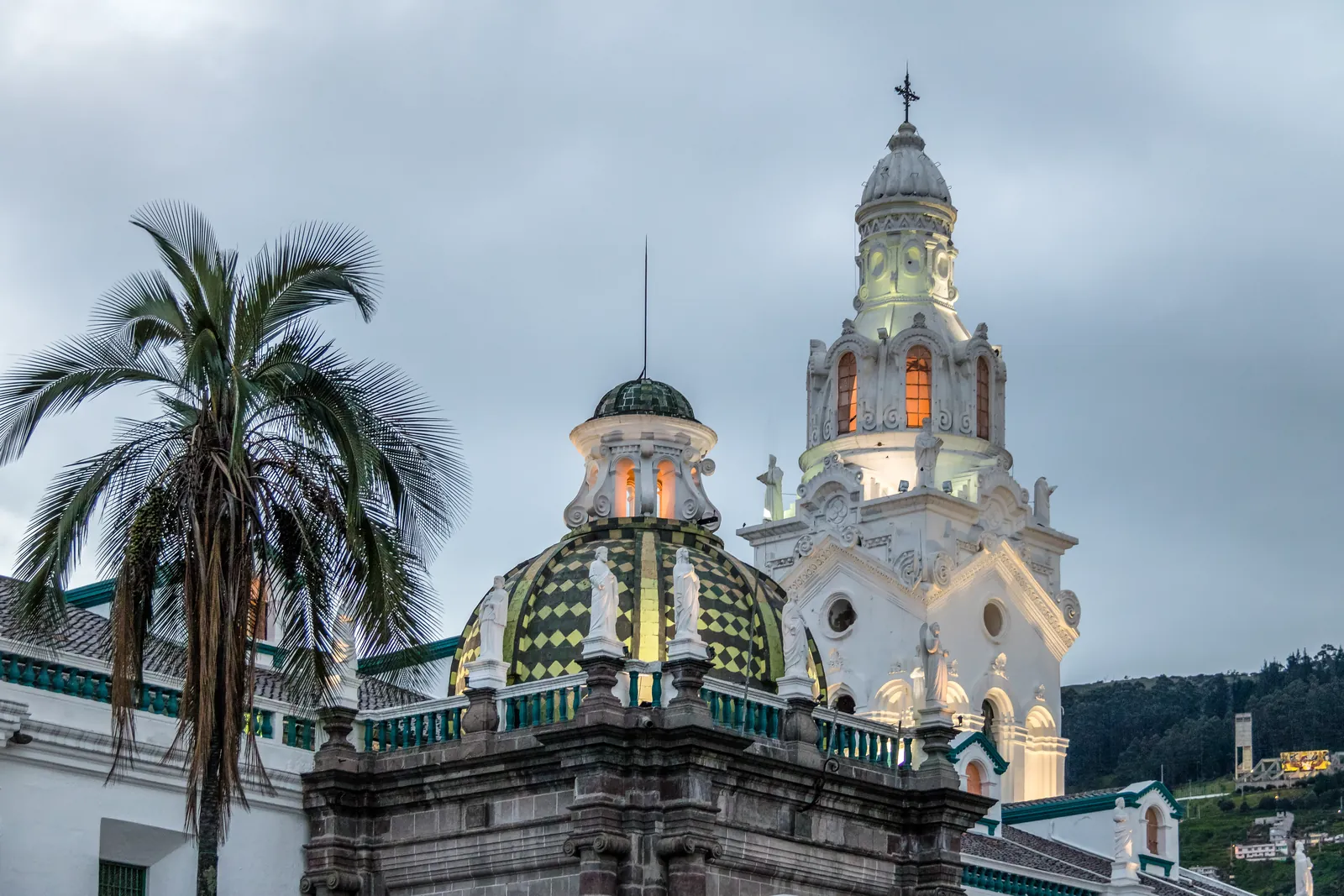
Why it made the list: Ecuador’s capital sits at about 2,850 m (9,350 ft) in a narrow Andean valley below Pichincha volcano. Its colonial center of churches, monasteries and plazas was declared a World Heritage Site as one of the best preserved in the region, according to the Ministry of Tourism, and it is the natural start of almost every trip.
Best time to go: June to September, the drier season. July is Quito’s driest month, with about 22 mm (0.9 in) of rain, and days stay at about 21–22 °C (70–72 °F) all year, with cool nights.
Don’t miss: a morning walk from the Plaza Grande through the old town’s churches and squares, and the TelefériQo cable car, which climbs to 4,050 m (13,290 ft) for views over the city and the volcanoes.
Getting there and how long: Mariscal Sucre International Airport, in Tababela, is about 45 minutes to an hour and a quarter from the city. Spend two or three nights, and use Quito as a base for day trips to Otavalo, Mindo and Cotopaxi.
Practical note: take it easy on your first day at this altitude: drink water, limit alcohol and use strong sunscreen, as the sun is intense on the equator. See our Quito travel guide.
3. Cotopaxi National Park
Why it made the list: the near-perfect snow cone of Cotopaxi, 5,897 m (19,347 ft) high and about 45 km (28 miles) south-east of Quito, is the classic image of the Andes. Ecuador’s Geophysical Institute lists it as active, with mainly fumarolic activity since its last eruptive period from October 2022 to July 2023. Around it, the páramo grassland is open for hiking, cycling and horseback riding.
Best time to go: July and August, the driest and windiest months in the central Andes, for the clearest views. Mornings are clearest all year.
Don’t miss: the walk up from the parking area toward the mountain refuge for the views, and a downhill bike ride on the park’s dirt roads.
Getting there and how long: about 1.5 hours south of Quito by road, as a day trip or with a night in a lodge on the edge of the park.
Practical note: it is cold and windy at this height, so bring warm layers, gloves and a hat. Climbing the glaciated summit requires an accredited guide; check the Geophysical Institute’s alerts before you go. See the Andes section of our Ecuador travel guide.
4. Otavalo
Why it made the list: Otavalo’s Plaza de los Ponchos is the largest Indigenous market in Latin America, according to the Ministry of Tourism, full of textiles, weavings and crafts made by Kichwa communities. The town sits among lakes and volcanoes, with the Peguche waterfall, Lake San Pablo and the Parque Cóndor bird park nearby.
Best time to go: the market runs all year; June to September is drier. Visit in late June for Inti Raymi, the solstice festival that fills the surrounding villages.
Don’t miss: the market itself, ideally on a Saturday morning when it spills into the surrounding streets, and the short walk to the Peguche waterfall.
Getting there and how long: about two hours north of Quito by road. It works as a long day trip, but a night lets you see the villages and lakes at a slower pace.
Practical note: ask before photographing people. See our Quito travel guide for day trips north.
5. Quilotoa crater lake
Why it made the list: a turquoise lake filling a volcanic crater about 2 km (1.2 miles) wide, at 3,914 m (12,841 ft), west of Latacunga, according to the Geophysical Institute, which dates its last eruption to about 800 years ago. The views from the rim are some of the most striking in the Andes.
Best time to go: June to September, the drier season, ideally in the morning before clouds build.
Don’t miss: the hike down to the water and back up, and, if you have time, the multi-day Quilotoa loop, which links Andean villages on foot.
Getting there and how long: a long day trip from Quito, or better, a night or two in the villages around the crater, combined with Cotopaxi on the way south.
Practical note: the climb back up from the lake is steep at this altitude, so allow time and bring water, sun protection and a warm layer. See the Andes section of our Ecuador travel guide.
6. Baños
Why it made the list: Ecuador’s adventure town sits in a green valley below Tungurahua volcano, 5,020 m (16,470 ft) high and only about 8 km (5 miles) from town, according to the Geophysical Institute. The Ministry of Tourism highlights its volcanic hot springs, its waterfalls and the “swing at the end of the world”.
Best time to go: any time; the drier months from June to September are best for the waterfall route and rafting.
Don’t miss: the Pailón del Diablo waterfall, reached by bike or bus along the road toward the Amazon, and a soak in the town’s hot springs.
Getting there and how long: about three to four hours by road from Quito, and a natural stop between the central Andes and the Amazon or Cuenca. Stay two nights.
Practical note: choose rafting, canopy and canyoning operators carefully and check their equipment. See the Andes section of our Ecuador travel guide.
7. Cuenca
Why it made the list: Ecuador’s third city lies in a spring-like valley crossed by four rivers, according to the Ministry of Tourism, with a World Heritage center of colonial and republican architecture, blue-domed cathedral towers and riverside walks. It is also one of the best places to buy toquilla straw hats, the hats the world calls “Panama hats”.
Best time to go: June to September is drier and best for hikes in nearby Cajas National Park. Cuenca celebrates its independence on November 3 and holds the Pase del Niño Viajero parade on December 24.
Don’t miss: the New Cathedral’s domes and the old town’s squares, and a day in the lake-dotted highlands of Cajas National Park.
Getting there and how long: a short domestic flight from Quito, or about nine to ten hours by road. Stay two or three nights.
Practical note: Cuenca is at about 2,550 m (8,370 ft), so nights are cool all year; pack layers. See our Cuenca travel guide.
8. Mindo and the cloud forest
Why it made the list: the cloud forests of the Chocó Andino around Mindo are one of the best places in South America for birdwatching, orchids and butterflies, according to the Ministry of Tourism, and home to the olinguito and the spectacled bear. It is the easiest way to see Ecuador’s wild side close to Quito.
Best time to go: any time for birds; the drier mornings from June to September are the most comfortable.
Don’t miss: an early-morning guided birding walk for hummingbirds and tanagers, and a cacao and chocolate tour in town.
Getting there and how long: about two hours north-west of Quito by road. Stay one or two nights to be out at dawn, when the birds are most active.
Practical note: bring a rain jacket and shoes with grip: it is a cloud forest, and showers are common. See our Quito travel guide.
9. The Amazon: Yasuní and the Napo River
Why it made the list: Yasuní, between Orellana and Pastaza provinces, is the largest protected area in mainland Ecuador and a biosphere reserve with more than 1,400 animal species, according to the Ministry of Tourism, and the territory of the Waorani people. A few nights in a rainforest lodge, exploring by canoe and on forest trails, is unforgettable.
Best time to go: the rainforest is hot and wet all year, so any month works. Higher water makes canoe trips easier; in drier spells more trails open.
Don’t miss: a dawn canoe trip for monkeys, macaws and toucans, and a visit to a Kichwa or Waorani community with your lodge. Further north, the Cuyabeno reserve has river dolphins and caimans.
Getting there and how long: fly from Quito to Coca, then continue by motorized canoe on the Napo River to your lodge; Tena, the gateway to the upper Napo, is reached by road. Allow three or four nights.
Practical note: the Ministry of Tourism recommends yellow fever vaccination for the Amazon provinces; see a travel clinic well before you go, and pack long sleeves and repellent. See the Amazon section of our Ecuador travel guide.
10. Puerto López and Machalilla National Park
Why it made the list: the fishing town of Puerto López is the base for Machalilla National Park, a stretch of dry forest, beaches and islands where you can see sea turtles, dolphins, seabirds and, in season, humpback whales. Inside the park, Los Frailes was named the best beach on the Pacific in a 2025 ranking, according to the Ministry of Tourism.
Best time to go: June to October for the humpback whales, which migrate along the coast in those months, according to the Ministry of Tourism. December to May is the hot, sunny-and-showery beach season.
Don’t miss: a boat trip to Isla de la Plata for snorkeling with turtles, rays and reef fish and its seabird colonies, combined with whale watching in season, and an afternoon on the sand at Los Frailes.
Getting there and how long: by road from Guayaquil, about four hours. Stay two or three nights; the surf town of Montañita is a short drive south.
Practical note: the coast is cool and gray from June to November and hot and rainy from December to May, with the heaviest rain from about January to April. See the coast section of our Ecuador travel guide.
How to fit them into one trip
Ecuador is compact, and Quito is the natural hub: every Galápagos flight leaves from Quito or Guayaquil, and the main Andean sights are a few hours by road.
One week: two or three nights in Quito with day trips to Otavalo and Cotopaxi, then four nights in the Galápagos, based on Santa Cruz and San Cristóbal or on a short cruise.
Ten days: add Mindo before the islands, or drive south from Quito past Cotopaxi and Quilotoa to Baños.
Two weeks: follow the “Avenue of the Volcanoes” from Quito to Cotopaxi, Quilotoa and Baños, then continue to Cuenca and fly to the Galápagos from Guayaquil; swap Cuenca for three nights in an Amazon lodge, or add Puerto López in whale season.
Allow a night on the mainland before your island flight in case of delays. Our best time to visit Ecuador guide goes month by month, region by region, and our AI trip planner builds the day-by-day plan for your dates.
Plan your trip
Start with our Ecuador travel guide for entry rules, the Galápagos fees, money and getting around. Use the AI trip planner to turn this list into a route, check what to expect on your dates in the Andes, the islands and the Amazon with the Destination weather tool, and build a list for cold volcano mornings and warm island days with the packing list tool.
Frequently asked questions
What is the most beautiful place in Ecuador?
For most visitors it is the Galápagos, with their wildlife, lava landscapes and clear water. On the mainland, the turquoise crater lake of Quilotoa and the snow cone of Cotopaxi on a clear morning are hard to beat.
How many days do you need in Ecuador?
A week covers Quito and four nights in the Galápagos. Ten days lets you add Otavalo, Cotopaxi or Mindo, and two weeks covers the volcano route to Baños and Cuenca, or an Amazon lodge, as well as the islands.
What is the best place in Ecuador for first-time visitors?
Quito. Its old town is a World Heritage Site, it has the main international airport, and it is the base for day trips to Otavalo, Mindo and Cotopaxi and for flights to the Galápagos.
Is it worth going to the Galápagos?
Yes, for anyone who loves wildlife: the animals are unafraid of people, and snorkeling with sea lions and turtles is a highlight of any trip to South America. It costs much more than the mainland, so budget for the park fee, the transit card, flights and island hotels or a cruise.
When is the best time to visit Ecuador?
June to September is the drier season in the Andes, with the clearest volcano views. The Galápagos are good all year: December to May for warm water and calm seas, June to November for cooler water and more marine life.