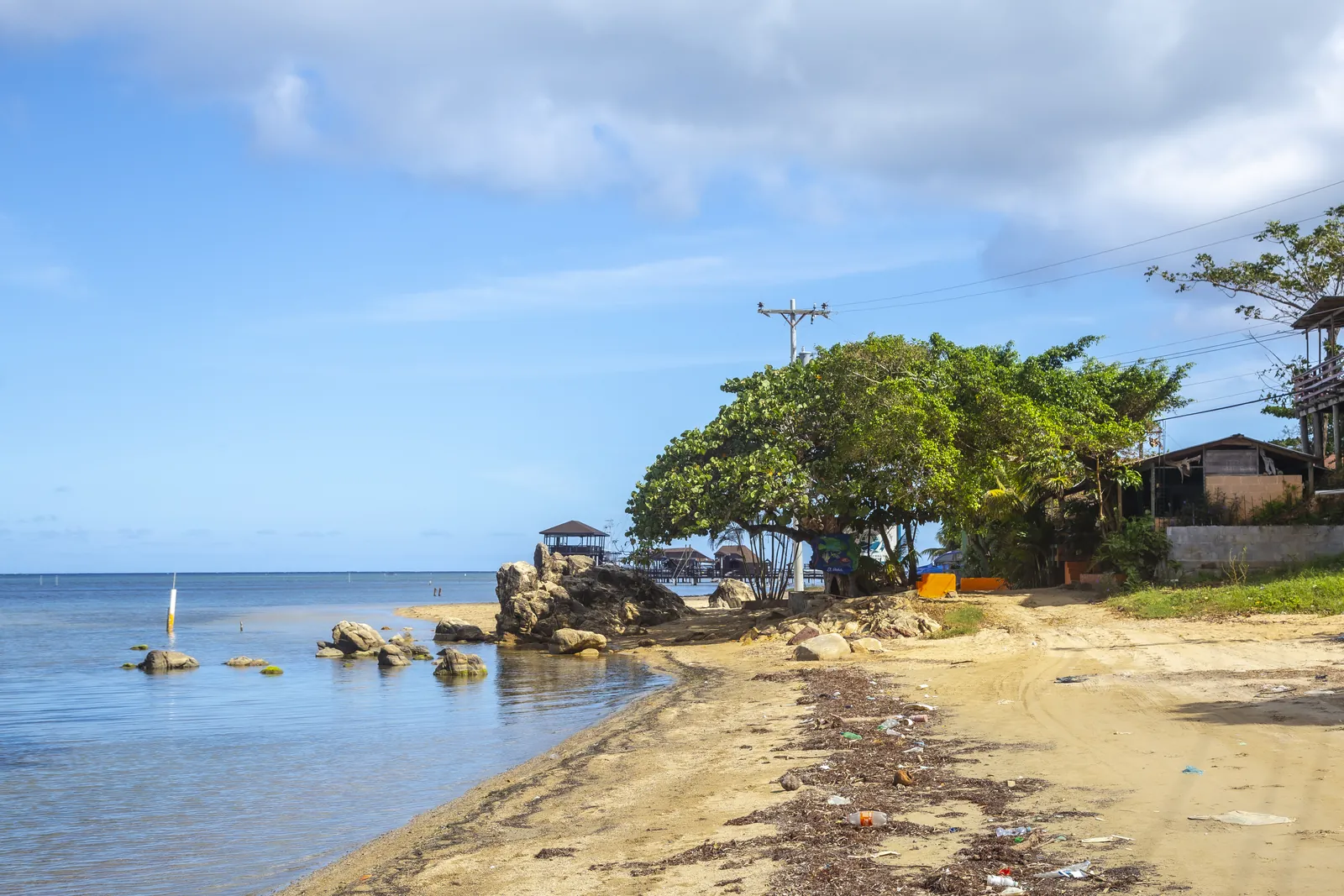
Short answer: For a first trip, the top places to visit in Honduras are Roatán and its reef, the Maya city of Copán, the dive island of Utila, the Cayos Cochinos and Lake Yojoa with the Pulhapanzak waterfall. Round out the list with La Ceiba’s rainforest and rivers, Tela and its gardens and parks, the colonial town of Gracias below Celaque, colonial Comayagua and the remote island of Guanaja.
Honduras has two travel worlds: the Bay Islands, on the Mesoamerican Reef, and the mainland, with Maya ruins, cloud forests, lakes and colonial towns. The list is ordered the way we would recommend places to a first-time visitor. The mainland is driest from November to April, while the islands and the north coast have their best weather from about February to August, so February to April suits a trip that combines both.
1. Roatán
Why it made the list: the largest of the Bay Islands has white-sand beaches at West Bay, a laid-back village at West End and reef just offshore for snorkeling and diving. It lies inside the Bay Islands National Marine Park, declared on June 10, 2010, which covers 647,153 hectares around Utila, Roatán and Guanaja and is the largest marine protected area in Honduras, according to the Roatán Marine Park.
Best time to go: February to August, for the calmest seas and least rain. October to January is the islands’ rainiest season, when cold fronts bring wind and rough water.
Don’t miss: snorkeling from the shore at West Bay or West End, and a dive on the reef walls, among the best value in the Caribbean.
Getting there and how long: direct flights from several US cities, mainly on weekends, domestic flights from San Pedro Sula and Tegucigalpa, or the Galaxy Wave ferry from La Ceiba, which leaves La Ceiba at 9:30 a.m. and 4:30 p.m. Stay four or five nights.
Practical note: divers and snorkelers usually pay a small marine park fee through their dive shop; ask what is included. US dollars are widely accepted on the island. See our Roatán travel guide.
2. Copán
Why it made the list: the Maya city of Copán has the finest sculpture of the ancient Maya world, with carved stelae, altars and the Hieroglyphic Stairway, the longest known Maya inscription, according to the Honduran Institute of Anthropology and History (IHAH). It has been a UNESCO World Heritage Site since 1980, and the cobbled town of Copán Ruinas next door is one of the most pleasant in Central America.
Best time to go: November to April, the dry season on the mainland; December to March is almost rainless.
Don’t miss: the Great Plaza’s stelae and the Hieroglyphic Stairway, and the Museum of Maya Sculpture, with its full-size replica of the painted Rosalila temple.
Getting there and how long: about three hours by road from San Pedro Sula, or by shuttle from Guatemala, crossing at El Florido, about 12 km (7 miles) from town. Stay two nights.
Practical note: the IHAH charges foreign visitors from outside Central America US$20 for the archaeological park and Las Sepulturas, US$15 for the tunnels and US$10 for the sculpture museum. Go early, before the heat. See our Copán Ruinas travel guide.
3. Utila
Why it made the list: the smallest of the Bay Islands, and the closest to the mainland, Utila is a sanctuary for the whale shark and is known for its many PADI dive schools and low-cost courses, according to Visit Centroamérica, the official tourism promotion site of the Central American Integration System (SICA). It is a relaxed, budget-friendly island with a backpacker feel.
Best time to go: March to August for calm seas; whale sharks are most often seen in March and April and again around September.
Don’t miss: an open-water dive course, and a boat trip looking for whale sharks on the north side of the island.
Getting there and how long: by ferry from La Ceiba or by small plane. Stay four or five nights if you are learning to dive.
Practical note: there are few cars, so you walk or rent a bicycle or golf cart; bring insect repellent for the sandflies. See our diving guide.
4. The Cayos Cochinos
Why it made the list: about 30 km (19 miles) north-east of La Ceiba, two small islands, Cayo Mayor and Cayo Menor, and 13 smaller coral cays form a marine natural monument where commercial fishing, nets and traps are banned, according to Visit Centroamérica. The cays are a postcard of palms, white sand and clear water, and hawksbill turtles nest on the beaches.
Best time to go: March to August, when the sea crossing is usually calmest.
Don’t miss: snorkeling in front of the Garifuna fishing village, followed by a lunch of fried fish, rice and beans and plantain, and the visitor center on Cayo Menor.
Getting there and how long: a day trip by boat from La Ceiba or from the beach villages near it, or from Roatán. One small hotel on Cayo Mayor offers overnight stays.
Practical note: take reef-safe sunscreen and cash for lunch and crafts, and leave nothing behind on the cays. See our boat trips guide.
5. Lake Yojoa and Pulhapanzak
Why it made the list: Honduras’s largest lake lies among green mountains between San Pedro Sula and Tegucigalpa, and an estimated 500 bird species occur in its basin each year, according to Visit Centroamérica. Close by, the Pulhapanzak waterfall drops in a single wide curtain into a jungle gorge.
Best time to go: November to April for dry weather and birding; the waterfall is fullest in the rainy season.
Don’t miss: a dawn boat trip on the lake for birds, and the trail behind the curtain of water at Pulhapanzak with a local guide. Cerro Azul Meámbar National Park, on the lake’s eastern side, has cloud-forest trails.
Getting there and how long: on the main highway between San Pedro Sula and Tegucigalpa, about 1.5 to 2 hours from San Pedro Sula. Stay one or two nights, or stop on the way between Copán and the coast.
Practical note: try the fried lake fish at the roadside restaurants along the shore. See our hiking guide.
6. La Ceiba, Pico Bonito and the Cangrejal River
Why it made the list: La Ceiba calls itself the “capital of ecotourism” of Honduras, and with good reason: behind the city, the rainforest of Pico Bonito National Park climbs steep mountains, and the Cangrejal River tumbles past it in rapids and natural pools, according to Visit Centroamérica. It is also the ferry port for the islands.
Best time to go: March to August, between the rainy months of the north coast. The Carnival of La Ceiba, one of the biggest parties in Central America, is held in the second half of May.
Don’t miss: whitewater rafting on the Cangrejal, and a swim in its natural pools after a hike in Pico Bonito.
Getting there and how long: about three hours by road from San Pedro Sula, or a short flight. Stay two nights in a lodge in the river valley.
Practical note: rafting levels depend on rain, so ask operators about conditions, and go only with licensed guides. See our Honduras travel guide.
7. Tela
Why it made the list: a beach town on the Caribbean coast, Tela is framed by Jeannette Kawas National Park, with its headland at Punta Izopo and hidden coves, and by the Lancetilla Botanical Garden, founded by the botanist Wilson Popenoe, with an arboretum, a bamboo forest and tropical fruit trees, according to Visit Centroamérica. Garifuna villages line the beaches nearby.
Best time to go: March to August, the drier months on the north coast.
Don’t miss: a boat trip to the beaches and snorkeling spots of Jeannette Kawas National Park, and a walk through the bamboo tunnel at Lancetilla.
Getting there and how long: about 1.5 hours by road from San Pedro Sula, on the way to La Ceiba. One or two nights.
Practical note: try tapado, a Garifuna seafood stew with coconut milk, in the villages along the beach. See our beaches guide.
8. Gracias and Celaque National Park
Why it made the list: Gracias is a quiet colonial town of cobbled streets and old churches in the western highlands, linked to the Lenca leader Lempira, with hot springs nearby. Behind it rises Celaque National Park, whose cloud forest climbs to Cerro Las Minas, the highest point in Honduras, according to Visit Centroamérica.
Best time to go: November to April, the dry season, when trails are firm and the views clear.
Don’t miss: the view over town from the Fort of San Cristóbal, and a soak in the hot springs after a hike in Celaque.
Getting there and how long: about four hours by road from San Pedro Sula, or about the same from Copán. Stay two nights; the summit hike needs a long day or an overnight.
Practical note: the park has a visitor center, and the trails, especially the climb to Cerro Las Minas, must be hiked with a guide. Bring a fleece: highland nights are cool. See our hiking guide.
9. Comayagua
Why it made the list: the former colonial capital of Honduras has one of the country’s best-preserved historic centers, with whitewashed churches, plazas and a cathedral whose tower clock is one of the oldest in the Americas. It is a short drive from Palmerola, the main airport for Tegucigalpa.
Best time to go: Holy Week, when residents make colorful sawdust carpets in the streets for the Good Friday procession, according to Visit Centroamérica; in 2027 Good Friday falls on March 26. Otherwise, November to April is dry.
Don’t miss: the cathedral and the central square, and, at Easter, the carpets in the early morning before the procession passes.
Getting there and how long: close to Palmerola International Airport, about 1.5 hours from Tegucigalpa. A day, or one night on the way to Lake Yojoa.
Practical note: hotels fill up and prices rise in Holy Week, so book early. See our Honduras travel guide.
10. Guanaja
Why it made the list: the most remote of the Bay Islands, hilly and green, with clear water, quiet beaches and reefs, lies within the same marine park as Roatán and Utila. Most of its people live on a small cay just offshore, so it feels very different from busy Roatán.
Best time to go: February to August, for calm seas.
Don’t miss: diving or snorkeling on the reefs and walls, and a hike to the island’s waterfalls.
Getting there and how long: by small plane from La Ceiba, San Pedro Sula or Roatán, or on the Galaxy Wave ferry, which also serves the island. Stay at least three or four nights.
Practical note: most accommodation is in small dive resorts reached by boat, so book transfers with your hotel. See our snorkeling guide.
How to fit them into one trip
Honduras is bigger than it looks, so most visitors combine one island with one or two areas of the mainland.
One week: two nights in Copán Ruinas, a long day by shuttle via San Pedro Sula to La Ceiba, the ferry to Roatán and four nights on the island.
Ten days: add Lake Yojoa and Pulhapanzak on the way from Copán, and two nights in a lodge on the Cangrejal River with a day trip to the Cayos Cochinos.
Two weeks: add Gracias and Celaque in the west, and split your island time between Roatán and Utila. Flying from Roatán to San Pedro Sula or Palmerola saves a day on the way home.
February to April is the best time for a trip that combines the ruins and the reef. Our best time to visit Honduras guide goes month by month, and our AI trip planner builds the day-by-day plan for your dates.
Plan your trip
Start with our Honduras travel guide for entry rules, money, ferries and getting around. Use the AI trip planner to turn this list into a route, check what to expect on your dates with the Destination weather tool, and convert prices into lempiras with the Money exchange tool.
Frequently asked questions
What is the most beautiful place in Honduras?
For many visitors it is the Bay Islands, with the white sand of West Bay on Roatán and the palm-covered Cayos Cochinos. On the mainland, the carved stelae of Copán and the cloud forests of Celaque and Pico Bonito are hard to beat.
How many days do you need in Honduras?
A week covers Copán and Roatán. Ten days lets you add Lake Yojoa, the Cangrejal River and the Cayos Cochinos, and two weeks adds Gracias and a second island.
What is the best place in Honduras for first-time visitors?
Roatán. It has direct flights from the United States, easy beaches and snorkeling, and English is widely spoken. Pair it with Copán for the Maya ruins.
Is Roatán or Utila better?
Roatán is bigger, with more beaches, resorts and restaurants, and is easier to reach. Utila is smaller, cheaper and more laid-back, popular for dive courses and whale sharks.
Can you visit Copán from Guatemala?
Yes. Shuttles run from Antigua and Guatemala City, crossing at El Florido, about 12 km (7 miles) from Copán Ruinas. Remember that Honduras and Guatemala share one 90-day stay under the CA-4 agreement.