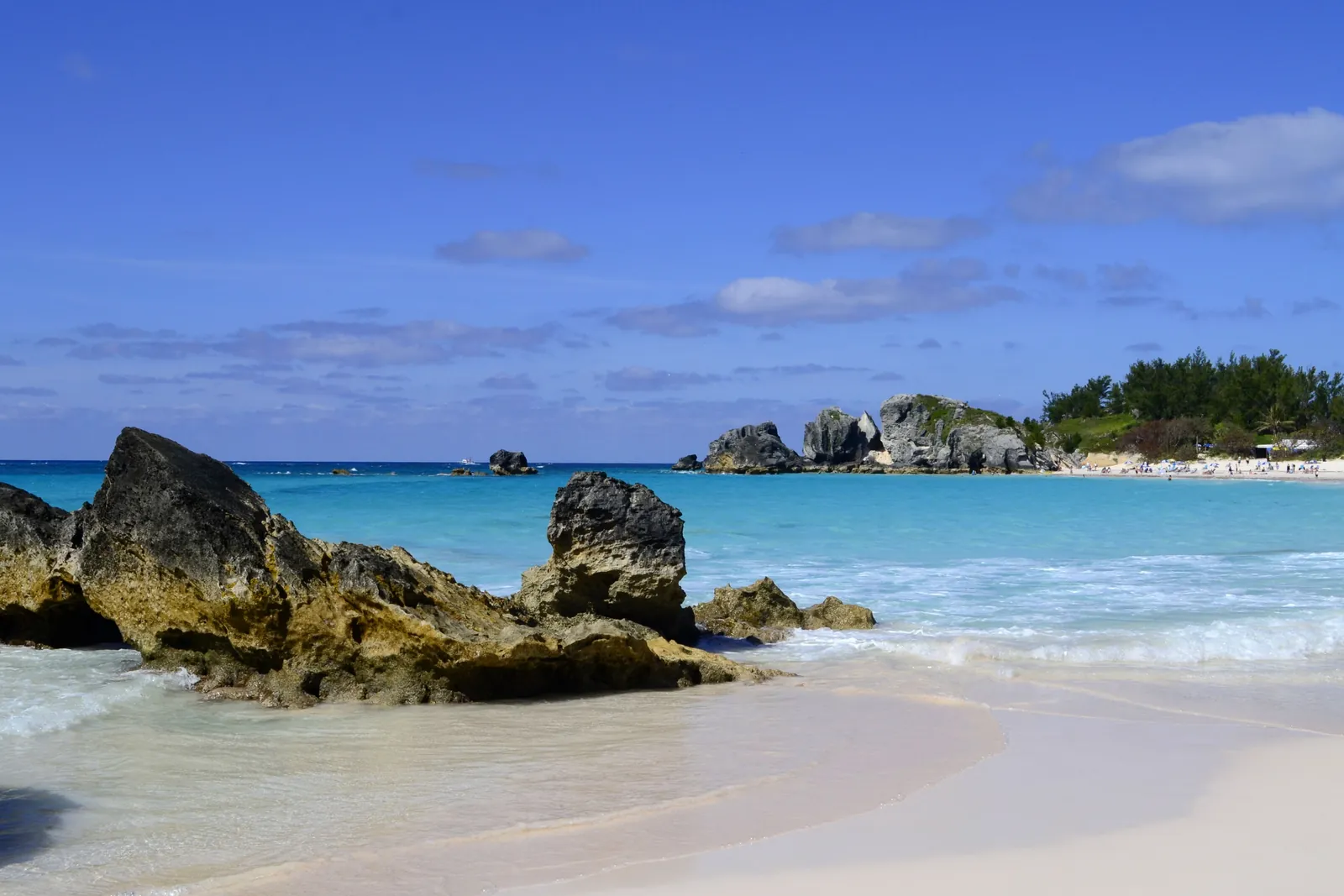
Short answer: The top places to visit in Bermuda are Horseshoe Bay Beach, the South Shore Park coves, the old town of St. George’s, the Royal Naval Dockyard and the National Museum, Hamilton, Tobacco Bay, the Crystal and Fantasy Caves, Gibbs Hill Lighthouse, the Bermuda Aquarium, Museum and Zoo, and the Bermuda Railway Trail. The island is only about 35 km (22 miles) long, so a long weekend covers most of them and five days covers them all.
Bermuda is a hook-shaped chain of islands alone in the North Atlantic, about two hours by air from the US East Coast. It is not in the Caribbean: think pink-sand beaches and turquoise coves, pastel cottages with stepped white roofs, and a very British island life of afternoon tea, cricket and Bermuda shorts.
The list is ordered the way we would recommend it for a first visit. Weather timing comes from the Bermuda Weather Service’s 1991–2020 normals, the Bermuda dollar is fixed one-to-one with the US dollar, and facts were checked in October 2026.
1. Horseshoe Bay Beach
Why it made the list: Bermuda’s most famous beach is a long curve of pink-tinged sand, colored by the crushed red shells of tiny reef organisms called foraminifera, backed by low cliffs and turquoise water. It is the picture most people have of Bermuda.
When to go: June to September for swimming, when highs reach 27–30 °C (81–86 °F) and the sea warms to 28–29 °C (82–84 °F) in August. Late May and October are good too, with cooler water.
Don’t miss: a swim in the main bay, then a walk along the rocks at the eastern end into the smaller coves of South Shore Park (see the next entry).
Getting there and how long: the beach is in Southampton, on the south shore; buses run along South Road. Give it a full beach day, or a morning before the crowds.
Practical note: Horseshoe Bay is one of the few beaches with lifeguards in summer, and it has a beach house with rentals. On days when cruise ships are in, arrive early. See our guide to beaches.
2. South Shore Park and its coves
Why it made the list: east of Horseshoe Bay, a coastal trail through South Shore Park links a string of quieter coves, Chaplin Bay, Stonehole Bay, Jobson’s Cove and Warwick Long Bay, each sheltered by rocks and reefs. All of Bermuda’s south shore beaches are public, and these feel like a private discovery.
When to go: June to September for swimming; in winter, the coastal trail is a beautiful walk and the beaches are almost empty.
Don’t miss: Jobson’s Cove, a small, almost enclosed pool of calm water, and the long sweep of Warwick Long Bay.
Getting there and how long: walk the trail from Horseshoe Bay, or take a bus along South Road. Combine it with Horseshoe Bay for a full day; Elbow Beach, farther east in Paget, is another long, popular strand.
Practical note: the south shore faces the open Atlantic, so rip currents can form in high surf; on windy days, choose a sheltered cove, and wear water shoes on the rocks. Don’t touch any Portuguese man-of-war on the sand.
3. St. George’s
Why it made the list: settled in 1612, St. George’s is one of the oldest continuously inhabited English towns in the Americas, and with its fortifications it has been a UNESCO World Heritage Site since 2000. Its narrow lanes, pastel houses and old churches are Bermuda’s history in one walkable town.
When to go: spring and autumn, when it is warm enough to sit outside but not too hot to walk the lanes and forts. The town is quieter on days without cruise visitors.
Don’t miss: King’s Square, St. Peter’s Church, the oldest Anglican church in continuous use outside the British Isles, and the haunting Unfinished Church. Fort St. Catherine overlooks the beach where the survivors of the Sea Venture shipwreck came ashore in 1609.
Getting there and how long: about 15–20 minutes by taxi from the airport, or by bus, or by ferry from Hamilton in season. Spend a full day, with a swim at Tobacco Bay.
Practical note: St. George’s lanes have steps and slopes, so wear comfortable shoes. See our Bermuda travel guide.
4. The Royal Naval Dockyard
Why it made the list: at Bermuda’s western tip, the Dockyard was Britain’s main Atlantic naval base for more than 150 years. Its massive stone buildings now hold the National Museum of Bermuda, craft markets, restaurants and the main cruise ship piers.
When to go: November to April, when far fewer cruise ships call and the museum is quiet; from late spring to autumn, go early or late on cruise days.
Don’t miss: the National Museum of Bermuda, with exhibits on shipwrecks and island history and the Commissioner’s House, built in the 1820s (US$20 for adults, according to the museum). On the way, stop at Somerset Bridge, billed as the world’s smallest drawbridge.
Getting there and how long: the ferry from Hamilton is the scenic way, and buses run the length of the island. Allow half a day to a full day.
Practical note: buy bus and ferry passes, tokens and tickets with the Shorelink app or at the Hamilton terminal, not at the airport; buses need exact change.
5. Hamilton
Why it made the list: Bermuda’s small capital, on a big harbor in the center of the island, mixes pastel colonial buildings with modern offices, and it is the hub for buses, ferries, restaurants and nightlife.
When to go: all year. In summer, the Harbour Nights street festival fills Front Street on Wednesday evenings; winter is quiet but pleasant for museums and shopping.
Don’t miss: Front Street on the harbor, the view from the tower of the Bermuda Cathedral, and Fort Hamilton’s moat garden.
Getting there and how long: about 25–30 minutes by taxi from the airport. Half a day for the sights; many visitors stay here for its restaurants.
Practical note: many restaurants add a gratuity of 17% or more to the bill, so check before you tip again. Try a fish sandwich on raisin bread and a Dark ‘n’ Stormy. Work out tips with our tip calculator.
6. Tobacco Bay
Why it made the list: a small, sheltered bay of limestone rocks and clear water just north of St. George’s, and one of the easiest places in Bermuda to snorkel straight from the beach.
When to go: June to September, when the sea is warmest; late May and October work if you don’t mind cooler water.
Don’t miss: snorkeling around the rocks, then sunset near Fort St. Catherine just along the coast.
Getting there and how long: a short walk from the center of St. George’s. A couple of hours, as part of a St. George’s day.
Practical note: don’t stand on coral, and bring water shoes for the rocks. Church Bay on the south shore is the other classic snorkeling spot. See our guides to snorkeling and diving: Bermuda has more than 300 known shipwrecks.
7. Crystal and Fantasy Caves
Why they made the list: two caves in Hamilton Parish with crystal-clear underground pools and stalactites, crossed by floating pontoon walkways. They are Bermuda’s best rainy-day sight and a surprise on a beach island.
When to go: any time of year; the caves are a good plan for the windy, changeable days of December to March.
Don’t miss: the floating walkway over the pool in Crystal Cave; add Fantasy Cave on a combination tour.
Getting there and how long: the caves are in the east, between Hamilton and St. George’s. Pair it with the Aquarium at Flatts or Spittal Pond.
Practical note: visits are by guided tour, with the first at 9 a.m. and the last at 5 p.m., according to the caves; combination tours run at set times, so check the schedule.
8. Gibbs Hill Lighthouse
Why it made the list: a cast-iron tower first lit in 1846 stands on a hill in Southampton near Horseshoe Bay. A 185-step spiral staircase leads to a gallery with 360-degree views of the south shore and the Great Sound, with Hamilton and the Dockyard in the distance.
When to go: on a clear day in any season; in spring, look out to sea for humpback whales, which pass Bermuda in March and April.
Don’t miss: the view from the top on a clear morning, before the heat and the haze build.
Getting there and how long: a short taxi ride or a walk uphill from the South Road bus stops. An hour or two; combine it with Horseshoe Bay.
Practical note: the climb costs US$2.50, according to the Bermuda Tourism Authority, and the spiral staircase isn’t suitable for wheelchairs or strollers.
9. The Bermuda Aquarium, Museum and Zoo
Why it made the list: at Flatts Village, this small, well-run attraction shows Bermuda’s reefs and wildlife up close. Its North Rock Exhibit is a 140,000-gallon reef tank, and there are sea turtles, harbor seals and Galapagos tortoises.
When to go: any time of year; it is a good choice for families and on windy days.
Don’t miss: the divers feeding the fish in the North Rock tank at 1:45 p.m., and the seal feedings.
Getting there and how long: Flatts is on the bus route between Hamilton and St. George’s. Allow two or three hours, with a walk at Spittal Pond nature reserve nearby.
Practical note: it opens daily from 9 a.m. (last admission 4 p.m.), and admission is US$10 for adults and US$5 for children aged 5–12, according to the Bermuda Zoological Society.
10. The Bermuda Railway Trail
Why it made the list: Bermuda’s railway, nicknamed “Old Rattle and Shake,” ran from 1931 to 1948. Today about 18 miles (29 km) of its route is a national park trail for walking and cycling, through shady cuttings, over bridges and along the coast, away from the narrow roads.
When to go: November to April, when it is mild and quiet; in summer, go early in the day.
Don’t miss: the western sections in Sandys and Somerset, where the old railbed runs close to the water.
Getting there and how long: the trail is split into sections you can join at many points, so walk or cycle one or two in half a day.
Practical note: the trail is not continuous and crosses busy roads in places. Visitors can’t rent cars in Bermuda, so this is the relaxed way to see the countryside. See our guides to hiking and cycling.
How to fit them into one trip
Bermuda is compact, and buses and ferries reach almost everywhere, so you can stay in one place. In three days: a south shore day at Horseshoe Bay and the South Shore Park coves, with Gibbs Hill Lighthouse; a day in St. George’s with Tobacco Bay; and a day for the Crystal Caves, the Aquarium at Flatts and an evening in Hamilton. With five days, add the Royal Naval Dockyard by ferry, a section of the Railway Trail, and a snorkel or dive trip to a shipwreck. A transportation pass for unlimited buses and ferries costs US$44 for 3 days or US$62 for 7 days.
Choose your season with our best time to visit Bermuda guide, and our AI trip planner builds the day-by-day plan for your dates.
Plan your trip
Read our Bermuda travel guide for the Bermuda Arrival Card, hotel taxes and getting around, check the sea and air temperatures for your dates in the Destination weather tool, and pack with our packing list tool: a light sweater is useful from November to April.
Frequently asked questions
What is the most beautiful place in Bermuda?
Most visitors would say Horseshoe Bay Beach, with its pink sand and turquoise water. The small coves of South Shore Park, such as Jobson’s Cove, and the view from Gibbs Hill Lighthouse are close behind.
What is the best place in Bermuda for first-time visitors?
The south shore around Horseshoe Bay for the beaches, plus a day in St. George’s for history. Both are easy to reach by bus, and they show the two sides of the island.
How many days do you need in Bermuda?
Three days covers the south shore beaches and St. George’s. Five days lets you see the whole island, including the Dockyard and the caves, and a week suits a slow beach holiday.
Can you see Bermuda without a car?
Yes, and you have to: visitors can’t rent conventional cars. Buses and ferries reach all the places on this list, and you can rent small electric minicars or scooters, or take taxis.
When is the best time to see Bermuda’s top places?
May to October for the beaches, with May and June the sweet spot. The hurricane season runs from June 1 to November 30, with most activity from mid-August to mid-October. November to April is mild and quiet, good for the towns, caves, lighthouse and trail.