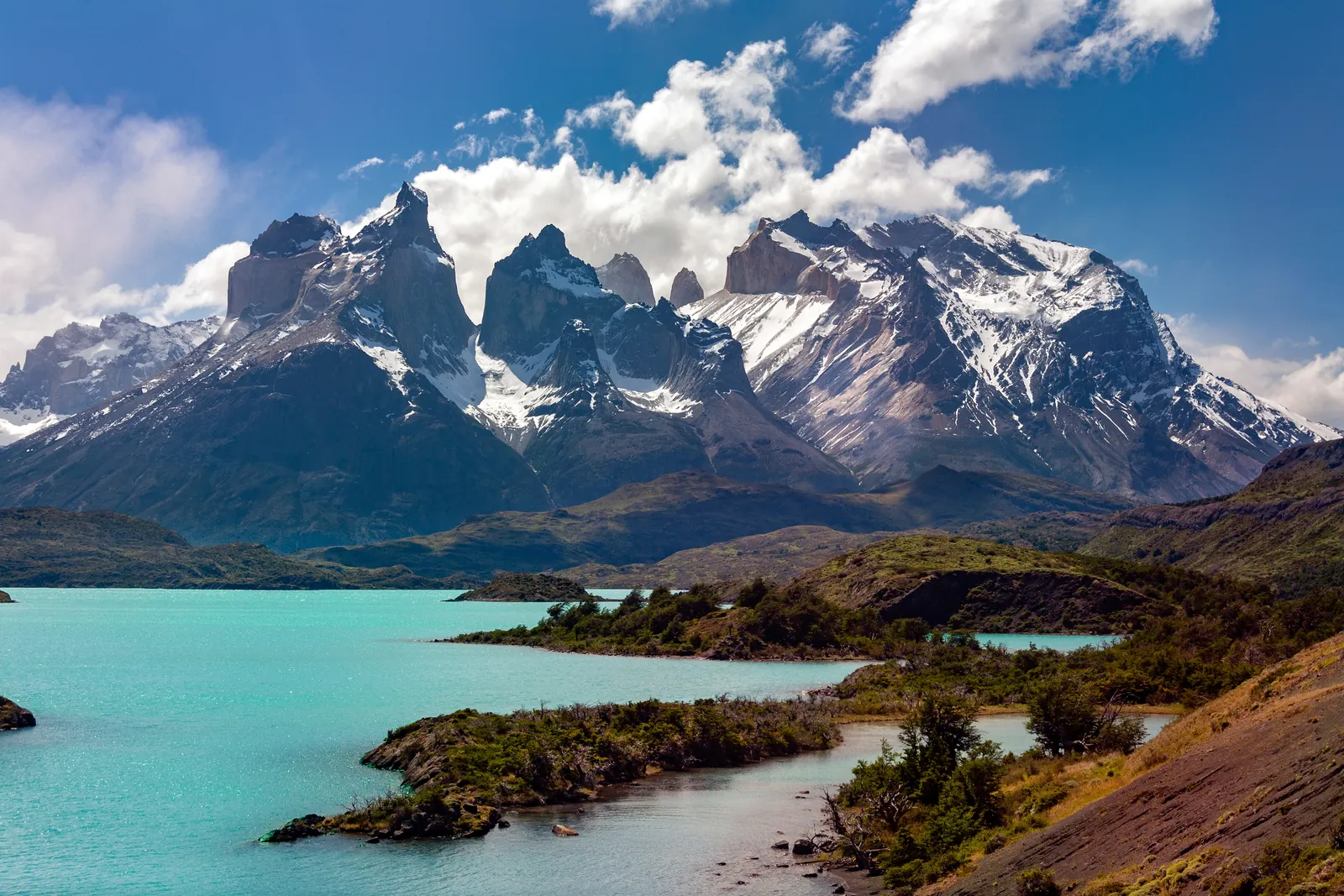
Short answer: For a first trip, the top places to visit in Chile are Torres del Paine National Park in Patagonia, the desert oasis of San Pedro de Atacama, Easter Island and its moai, the hillside port of Valparaíso and the capital, Santiago. Round out the list with Puerto Varas and the Lake District, the wooden churches of Chiloé, Pucón and Villarrica volcano, the stargazing Elqui Valley and the Marble Caves on the Carretera Austral.
Chile is about 4,300 km (2,670 miles) long, so most trips combine Santiago with two regions linked by domestic flights. The list is ordered the way we would recommend places to a first-time visitor: the “big three” of Patagonia, the Atacama and Easter Island first, then the center and the south. Practical details are as of October 2026; for entry rules, money and getting around, see our Chile travel guide. Remember that the seasons are the reverse of the Northern Hemisphere’s.
1. Torres del Paine National Park
Why it made the list: in the far south of Chilean Patagonia, the Paine massif rises straight out of the windswept steppe in granite towers and dark-capped “horns,” with glaciers spilling into lakes of turquoise and deep blue. It is one of the great mountain landscapes of the world and a UNESCO Biosphere Reserve since 1978.
Best time to go: November to March, for long days and all services; October and April are quieter, colder and cheaper. Expect strong wind in spring and summer.
Don’t miss: the hike to the Base of the Towers, and the W trek or a boat trip to the Grey Glacier if you are staying in a lodge.
Getting there and how long: fly to Punta Arenas, about three and a half hours from Santiago, or in season to Puerto Natales, the base town about two hours from the park. Allow two or three days for the highlights, four or five for the W trek.
Practical note: foreign adults pay CLP 48,500 for a multi-day pass (CLP 32,400 for one day), bought online through CONAF’s Pases Parques site. All overnight stays in refuges and campsites must be booked ahead, and they sell out months in advance for January and February. See our Torres del Paine National Park travel guide.
2. San Pedro de Atacama
Why it made the list: an adobe oasis town at about 2,400 m (7,900 ft), surrounded by one of the driest deserts on Earth and a horizon of volcanoes, San Pedro is the base for some of South America’s most otherworldly landscapes: salt flats, high lagoons, geysers and some of the clearest night skies in the world.
Best time to go: all year; spring (September to November) and fall (March to May) have the most comfortable temperatures. Summer storms can close high roads in January and February, and winter nights drop below freezing.
Don’t miss: sunset in the Valle de la Luna, the El Tatio geysers at dawn, flamingos on the Salar de Atacama, and a stargazing tour.
Getting there and how long: fly from Santiago to Calama (about two hours), then take a shuttle of about 100 km (62 miles). Stay three or four nights.
Practical note: according to CONAF’s pass site, Valle de la Luna tickets must be bought online at least a day ahead. Many tours go above 4,000 m (13,100 ft), so rest on arrival and drink plenty of water. See our San Pedro de Atacama travel guide.
3. Easter Island (Rapa Nui)
Why it made the list: about 3,700 km (2,300 miles) off the coast and one of the most remote inhabited places on Earth, Rapa Nui is famous for its moai, the giant stone figures raised on ceremonial platforms. Rapa Nui National Park has been a UNESCO World Heritage Site since 1995 and is managed by the Ma’u Henua indigenous community.
Best time to go: all year. January to March is warmest, and the Tapati festival in early February is the busiest time.
Don’t miss: the quarry of Rano Raraku, where the moai were carved, the 15 standing moai of Ahu Tongariki at sunrise, and a swim at Anakena, the island’s white-sand beach.
Getting there and how long: flights from Santiago take about five and a half hours. Stay four or five nights; three is the minimum.
Practical note: every visitor needs the free Single Entry Form, filled in online within 48 hours before the flight, a return ticket within 30 days and registered accommodation. A park ticket is compulsory, and the archaeological sites must be visited with an accredited guide. See our Easter Island travel guide.
4. Valparaíso
Why it made the list: Chile’s main port tumbles down more than 40 hills to the Pacific in a jumble of brightly painted houses, staircases, street art and old funicular elevators. Its historic quarter has been on the UNESCO World Heritage List since 2003.
Best time to go: October to April, with almost no rain; New Year’s Eve brings a huge fireworks show over the bay.
Don’t miss: a wander through Cerro Alegre and Cerro Concepción and their viewpoints, a ride on an ascensor (funicular), and Pablo Neruda’s house, La Sebastiana.
Getting there and how long: buses from Santiago run every few minutes and take about 1.5 to 2 hours. A long day trip covers the highlights; two or three nights add the evenings and Viña del Mar’s beaches.
Practical note: the hills are steep, so wear good shoes, and check opening hours before you go, as many museums close on Mondays. See our Valparaíso travel guide.
5. Santiago
Why it made the list: Chile’s capital sits in a valley at the foot of the Andes, with snowy peaks behind the skyscrapers on clear days. It has some of South America’s best museums, lively neighborhoods and wineries within an hour.
Best time to go: September to November and March to May, with highs of 20–28 °C (68–82 °F). Almost all of the year’s rain falls in winter.
Don’t miss: the view from Cerro San Cristóbal or Cerro Santa Lucía, the Pre-Columbian Art Museum and the Plaza de Armas, the Mercado Central for seafood, and a winery in the Maipo Valley.
Getting there and how long: Arturo Merino Benítez International Airport is about 17 km (11 miles) west of the center. Stay three days, five with Valparaíso and a winery.
Practical note: the Metro is fast and clean and paid with a bip! card; Line 1 runs along the main avenue past most sights. Lastarria and Providencia are pleasant bases. See our Santiago travel guide.
6. Puerto Varas and the Lake District
Why it made the list: on the shore of Lake Llanquihue, the German-founded town of Puerto Varas looks across the water to the snowy cone of Osorno volcano. It is the best base for the southern Lake District’s waterfalls, lakes, forests and volcanoes.
Best time to go: December to March, the driest months, with highs of 19–20 °C (66–68 °F). Expect rain at any time of year.
Don’t miss: the turquoise Petrohué falls in Vicente Pérez Rosales, Chile’s oldest national park, a boat on Lake Todos los Santos, and kuchen in the lakeside town of Frutillar.
Getting there and how long: fly to Puerto Montt, about two hours from Santiago, then 30 to 40 minutes by road. Stay three days, or five or six with Chiloé.
Practical note: foreign adults pay CLP 8,200 to enter the park at the Petrohué falls, with tickets sold online through Pases Parques. Pack a rain jacket in every season. See our Puerto Varas travel guide.
7. Chiloé
Why it made the list: south of Puerto Montt, the island of Chiloé has its own culture of fishing villages, stilt houses, myths and wooden churches built in a tradition started by Jesuit missionaries. In 2000, 16 of those churches were inscribed by UNESCO as the Churches of Chiloé.
Best time to go: December to March, the driest stretch in the south.
Don’t miss: a tour of the wooden churches, such as those of Castro and Chonchi, and the colorful stilt houses (palafitos) on Castro’s waterfront.
Getting there and how long: by road and a short ferry crossing from the Puerto Montt area. Allow two or three days, or a long day trip from Puerto Varas.
Practical note: the churches are working parishes, so dress modestly and check opening times locally. We do not have a Chiloé page yet; see the day trips in our Puerto Varas travel guide.
8. Pucón and Villarrica volcano
Why it made the list: on the shore of Lake Villarrica, below a smoking, snow-capped volcano, Pucón is the adventure capital of the south, with rafting, hot springs, lakes and forest trails in Villarrica National Park.
Best time to go: December to March, the warmest and driest months in the Lake District.
Don’t miss: the forests and lava fields of Villarrica National Park, whose Rucapillán entrance is about 18 km from Pucón, according to Chile’s tourism board, and an evening in one of the area’s hot springs.
Getting there and how long: fly to Temuco, or take a long-distance bus from Santiago. Stay three or four days.
Practical note: Chile’s tourism board advises checking the volcano’s alert status before you visit, and chains are mandatory on access roads in winter. Climbs to the crater are only possible when authorities allow them. We do not have a Pucón page yet; see our Chile travel guide.
9. The Elqui Valley
Why it made the list: inland from La Serena, the Elqui Valley is a semi-desert land of pisco vineyards, small villages and observatories under famously clear skies. It is the easiest place in Chile to combine wine country with stargazing.
Best time to go: all year; the dry, mild climate suits spring and fall, and skies are clearest on moonless nights.
Don’t miss: a night tour at one of the valley’s observatories, and a pisco distillery visit near Vicuña.
Getting there and how long: fly from Santiago to La Serena, then drive or take a bus inland to Vicuña. Stay two or three nights.
Practical note: book observatory tours ahead and bring warm layers, as desert nights are cold. We do not have an Elqui Valley page yet; see our Chile travel guide.
10. The Marble Caves and the Carretera Austral
Why it made the list: the Carretera Austral, a partly gravel road through northern Patagonia’s fjords, glaciers and tiny villages, is one of the world’s great road trips. Its highlight is the Marble Caves (Capillas de Mármol), swirling caverns of blue-veined marble on Lake General Carrera.
Best time to go: December to March, when days are long and roads and boats are most reliable.
Don’t miss: a boat trip from Puerto Río Tranquilo into the Marble Chapel and Cathedral formations, and the glaciers and lakes along the road.
Getting there and how long: fly to Balmaceda, near Coyhaique, then drive south. A week or more for a road trip; at least two days for the caves alone.
Practical note: the road is long and partly unpaved, with few services, so travel well prepared with spare fuel and time. Boat trips depend on wind on the lake. We do not have a Carretera Austral page yet; see our Chile travel guide.
How to fit them into one trip
Chile’s length means flying between regions, with Santiago as the hub. Pick two of the big three and give each enough time.
Ten days: Santiago and Valparaíso (three nights), San Pedro de Atacama (three), and Torres del Paine via Punta Arenas or Puerto Natales (four).
Two weeks: add Puerto Varas and the Lake District (three nights) between the desert and Patagonia, with a day on Chiloé.
Three weeks: add Easter Island (four or five nights) from Santiago, or swap the Lake District for Pucón and a drive down the Carretera Austral.
Patagonia is best from November to March, the Lake District from December to March, Santiago in spring and fall, and the Atacama and Easter Island all year. Our best time to visit Chile guide goes month by month, and our AI trip planner builds the day-by-day plan for your dates.
Plan your trip
Start with our Chile travel guide for entry rules, domestic flights and money. Use the AI trip planner to turn this list into a route, check the weather from the desert to Patagonia with the Destination weather tool, and pack for four seasons with the packing list tool.
Frequently asked questions
What is the most beautiful place in Chile?
Torres del Paine, with its granite towers above turquoise lakes, tops most lists. The Valle de la Luna at sunset in the Atacama and the Marble Caves on Lake General Carrera are close behind.
How many days do you need in Chile?
Two to three weeks for a first trip. Ten days covers Santiago and Valparaíso, the Atacama and Torres del Paine; two to three weeks adds the Lake District, Chiloé or Easter Island.
What is the best place in Chile for first-time visitors?
Santiago and Valparaíso make an easy start, and Torres del Paine is the highlight most first-timers build their trip around.
Is it worth going to Easter Island?
Yes, if you have four or five nights: the moai, the craters and the Polynesian culture are unlike anywhere else. With less time, the five-and-a-half-hour flight each way is hard to justify.
When is the best time to visit Chile?
It depends on the region: November to March for Patagonia, December to March for the Lake District, spring and fall for Santiago and the wine country, and any time for the Atacama and Easter Island.