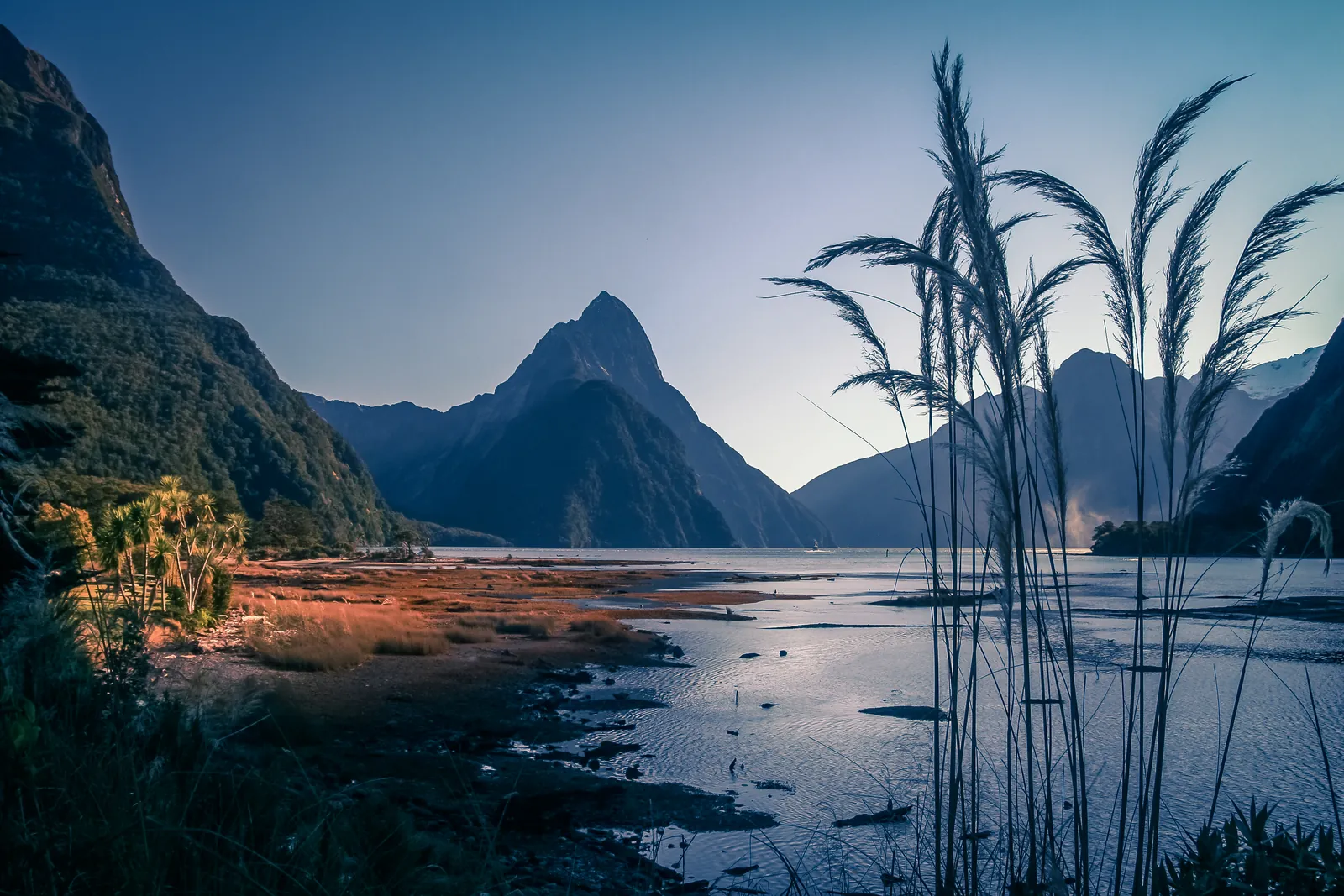
Short answer: The top places to visit in New Zealand are Milford Sound in Fiordland, Queenstown, Aoraki/Mount Cook, Rotorua, Tongariro National Park, Auckland, the Bay of Islands, Wellington, Wānaka and the Franz Josef and Fox glaciers. For a first trip, plan about two weeks or more and see both islands; February and March are the best months overall.
New Zealand rewards a road trip. In a couple of weeks you can go from subtropical bays and Māori history in the north, through the geysers and volcanoes of the central North Island, to the fjords, glaciers and alpine lakes of the South Island. This list is ordered the way we would recommend the places for a first visit, with the South Island’s big landscapes first. For each one you get why it made the list, when to go, what not to miss, how to get there and how long to stay, and a practical note.
Seasons are the reverse of the Northern Hemisphere: summer runs from December to February, and the ski season from about late June to September. Our best time to visit New Zealand guide explains them month by month.
1. Milford Sound and Fiordland
Why it made the list: Fiordland National Park, the largest in the country, is a wilderness of granite mountains, glacier-carved fjords, rainforest and waterfalls, and part of the Te Wāhipounamu – South West New Zealand World Heritage Area, listed by UNESCO in 1990. Its star is Milford Sound/Piopiotahi, where Mitre Peak rises almost straight out of the sea; the Department of Conservation (DOC) counts around 1.1 million visitors a year.
Best time to go: November to April for the Great Walks and long days; cruises run all year. Rainy days bring out hundreds of temporary waterfalls, so don’t cancel because of the forecast.
Don’t miss: a cruise on Milford Sound, and the drive itself along the Milford Road through the Eglinton Valley and the Homer Tunnel. Walkers can book the Milford, Routeburn or Kepler tracks; the 2026/27 season for the Milford Track runs from 1 November 2026 to 30 April 2027.
Getting there and how long: the lakeside town of Te Anau, at the end of the Milford Road, is the base. Spend at least two nights to allow for weather, and add quieter Doubtful Sound, reached by boat and bus from Lake Manapouri.
Practical note: the Milford Road has an avalanche season from about June to October, and drivers must carry chains from June to November. Expect sandflies near the water and pack insect repellent. See our Fiordland National Park guide.
2. Queenstown
Why it made the list: New Zealand’s best-known resort town sits on Lake Wakatipu under the jagged Remarkables, and calls itself the adventure capital, with bungy jumps, jet boats and four ski areas within reach.
Best time to go: December to March for summer hiking, biking and lake days; April for autumn color in nearby Arrowtown; late June to September for skiing.
Don’t miss: the gondola to the ridge-top viewpoint above town, a cruise on the historic steamship TSS Earnslaw, and the scenic drive to Glenorchy at the head of the lake. The old gold-mining village of Arrowtown and the Gibbston Valley wineries are short drives away.
Getting there and how long: Queenstown Airport is just outside town. Stay three or four nights; it is also the most popular base for Milford Sound.
Practical note: Queenstown is the priciest place to stay in the region, especially in summer and ski season, so book early or stay in Arrowtown. See our Queenstown travel guide.
3. Aoraki/Mount Cook National Park
Why it made the list: the high heart of the Southern Alps, with 19 peaks above 9,840 feet (3,000 m) and glaciers covering about 40% of the park, according to DOC. At its center stands Aoraki/Mount Cook, New Zealand’s highest mountain at 12,218 feet (3,724 m), sacred to Ngāi Tahu. You don’t need to be a mountaineer: easy, well-made tracks lead to glacier lakes and swing bridges.
Best time to go: November to April for walking, with long days and wildflowers; June to September for snowy scenery and the clearest night skies.
Don’t miss: the Hooker Valley Track, about 6 miles (10 km) return and three hours, to a glacier lake with icebergs below the mountain. A new 620-foot (189 m) swing bridge, the longest suspension bridge in New Zealand, opened on the track in July 2026. After dark, look up: the park lies inside the Aoraki Mackenzie International Dark Sky Reserve.
Getting there and how long: a single road, State Highway 80, runs along the turquoise shore of Lake Pukaki to Aoraki/Mount Cook Village. Stay at least one night to see the mountain at dawn or dusk; Lake Tekapo is a good stop on the way.
Practical note: the weather changes fast in the mountains; carry a warm, windproof layer even on a sunny summer walk. See our Aoraki/Mount Cook guide.
4. Rotorua
Why it made the list: New Zealand’s geothermal capital is built over one of the most active geothermal fields on Earth, with geysers, boiling mud, colorful silica terraces and hot springs all around. It is also the heartland of Te Arawa, and the best place in the country to experience Māori culture.
Best time to go: any season. December to March brings warm days for the lakes and mountain biking, and cold winter days are the most atmospheric for the geothermal parks and hot pools.
Don’t miss: a geothermal park with an erupting geyser, an evening cultural performance with a hāngī feast cooked in the earth, and the giant redwood forest on the edge of town.
Getting there and how long: drive from Auckland, or fly to Rotorua’s small airport. Two or three days covers the highlights.
Practical note: the Hobbiton movie set is within driving distance and is popular as a stop between Auckland and Rotorua; the 2.5-hour tours must be booked ahead. See our Rotorua travel guide and Taupō travel guide.
5. Tongariro National Park
Why it made the list: a high volcanic plateau crowned by three active volcanoes, Tongariro, Ngāuruhoe and Ruapehu, the North Island’s highest peak. Established in 1894, it was New Zealand’s first national park, and UNESCO later made it the first World Heritage Site listed as a cultural landscape, for the mountains’ meaning to Māori.
Best time to go: late October to April for the Tongariro Alpine Crossing, with January to March the most settled. From May to October the Crossing is a snowy alpine route for experienced or guided groups, and July to September is ski season on Ruapehu.
Don’t miss: the Tongariro Alpine Crossing, 12.5 miles (20.2 km) one way, past craters, steaming vents and the vivid Emerald Lakes. DOC suggests allowing seven to eight hours in summer.
Getting there and how long: it is within easy driving distance of Taupō, which makes a comfortable base with lakeside hotels. Allow two nights so you have a spare day if the weather is bad.
Practical note: parking at the Mangatepopo start is limited to four hours from Labour weekend to 30 April, so take a shuttle from Taupō or the park villages. Booking the Crossing is free and recommended. See our Tongariro National Park guide.
6. Auckland
Why it made the list: most international flights land in New Zealand’s largest city, which spreads between two harbors on a field of about 50 small volcanoes. It is the country’s most diverse city, and its waterfront is the starting point for island trips on the Hauraki Gulf.
Best time to go: February and March, when the weather is warm and settled and the holiday crowds have gone; December to April for beaches and sailing.
Don’t miss: a ferry to Waiheke Island’s vineyards and beaches or to Rangitoto, the city’s youngest volcano, and the view from the grassy cone of Maungawhau/Mount Eden.
Getting there and how long: Auckland Airport is south of the city, linked by the AirportLink bus. Two or three days at the start or end of the trip is plenty.
Practical note: most visitors need an NZeTA and pay the NZ$100 International Visitor Conservation and Tourism Levy before they fly, and every arriving traveler completes a free online traveler declaration. Allow at least 72 hours for the NZeTA. See our Auckland travel guide.
7. The Bay of Islands
Why it made the list: a wide, sheltered bay in Northland of forested islands and quiet coves, perfect for sailing, kayaking and dolphin cruises, in a climate warmer than most of the country. It is also where modern New Zealand began: the Treaty of Waitangi was first signed here, at Waitangi, on 6 February 1840.
Best time to go: December to March is peak summer; February and March are warm and less busy, and the bay stays mild well into autumn.
Don’t miss: the Waitangi Treaty Grounds, with its Treaty House, carved meeting house and ceremonial war canoe, and a boat trip out among the islands from Paihia.
Getting there and how long: drive north from Auckland or fly to Kerikeri. Two or three nights in Paihia or Russell.
Practical note: on Waitangi Day, 6 February, the Treaty Grounds host a free festival, but the buildings are closed, so visit on another day if you want to go inside. See our Bay of Islands travel guide.
8. Wellington
Why it made the list: the compact capital, squeezed between green hills and a deep harbor, packs in a great café and food scene, the national museum and a wildlife sanctuary minutes from downtown. It is also where the ferries leave for the South Island.
Best time to go: February and March, when the weather is usually warmest and calmest. The city is known for strong winds, especially in spring.
Don’t miss: Te Papa, the national museum, and Zealandia, a fenced valley sanctuary where rare native birds live close to the city center. Ride the red cable car up to the Botanic Garden for the view.
Getting there and how long: fly in, or drive down from Tongariro. Spend a day or two before taking the Interislander ferry, about three and a half hours across Cook Strait to Picton.
Practical note: Te Papa is free for New Zealanders, but international visitors aged 16 and over now pay NZ$35. See our Wellington travel guide.
9. Wānaka
Why it made the list: a relaxed lakeside town that many visitors prefer to busier Queenstown, with lake swims, bike rides and hikes, and the peaks of Mount Aspiring National Park on the horizon. Its most famous views are free.
Best time to go: December to March for the lake; April for golden autumn poplars; late June to September for skiing at Cardrona and Treble Cone.
Don’t miss: the climb up Roys Peak for one of the most photographed views in New Zealand, and sunrise at the lone willow known as “That Wānaka Tree.”
Getting there and how long: it is a scenic drive from Queenstown over the Crown Range, and on the road north through the Haast Pass to the glaciers. Two or three nights.
Practical note: the Roys Peak Track is a steep 10-mile (16 km) return hike of five to six hours, and it closes every year for lambing from 1 October to 10 November. See our Wānaka travel guide.
10. Franz Josef and Fox glaciers
Why it made the list: two famous glaciers descend through rainforest almost to sea level on the South Island’s West Coast, inside Westland Tai Poutini National Park. DOC notes that Franz Josef’s terminal face is less than 985 feet (300 m) above sea level, one of only three glaciers in the world this close to the coast.
Best time to go: November to April for longer days and walking; autumn and winter often bring the clearest mountain views. Rain is possible at any time.
Don’t miss: a guided heli-hike or a scenic flight with a snow landing, and an early-morning walk around Lake Matheson for mirror reflections of Aoraki/Mount Cook.
Getting there and how long: the two villages are on State Highway 6, the only road along the coast. One or two nights, ideally on the way between Wānaka and the north.
Practical note: both glaciers have retreated, so you can no longer walk up to the ice: valley tracks lead to viewpoints, and the only way onto the glaciers is by helicopter with a guide. See our Westland Tai Poutini guide.
How to fit them into one trip
With two to three weeks, start in Auckland and head to the Bay of Islands, then south through Rotorua and Taupō to Tongariro and Wellington, about a week. Take the ferry to the South Island, follow the West Coast to the glaciers, cross the Haast Pass to Wānaka and Queenstown, and finish with Fiordland and Aoraki/Mount Cook before flying home from Christchurch or Queenstown, about ten days more.
With two weeks, fly into Auckland and out of Queenstown or Christchurch, and choose a few highlights on each island: Rotorua and Tongariro in the north; Queenstown, Milford Sound and Aoraki/Mount Cook in the south. Book ferries and Great Walk huts early for summer.
Our AI trip planner builds the day-by-day plan for your dates, travelers and budget from our New Zealand guides. Check the seasons for each region in our best time to visit New Zealand guide, look up typical weather for your dates with the Destination weather tool, and pack for four seasons in a day with our packing list tool.
Frequently asked questions
What is the most beautiful place in New Zealand?
Milford Sound is the most famous, with Mitre Peak rising from the fjord. Aoraki/Mount Cook and the Hooker Valley, Lake Wakatipu at Queenstown and the Emerald Lakes on the Tongariro Alpine Crossing are equally loved.
How many days do you need in New Zealand?
About two to three weeks to see both islands without rushing. With ten days, focus on one island, usually the South Island.
What is the best place in New Zealand for first-time visitors?
Queenstown, for its mix of scenery, activities, restaurants and easy trips to Milford Sound and Wānaka. In the North Island, Rotorua gives the best introduction to geothermal landscapes and Māori culture.
Is the North Island or the South Island better?
The South Island has the biggest landscapes: fjords, glaciers and the Southern Alps. The North Island has the cities, beaches, geothermal areas, volcanoes and more Māori history. For a first trip, see both if you can.
When is the best time to visit New Zealand?
February and March, when the weather is warm and settled and the school holidays are over. December to March is best for beaches and hiking, and late June to September for skiing. See our best time to visit New Zealand guide.