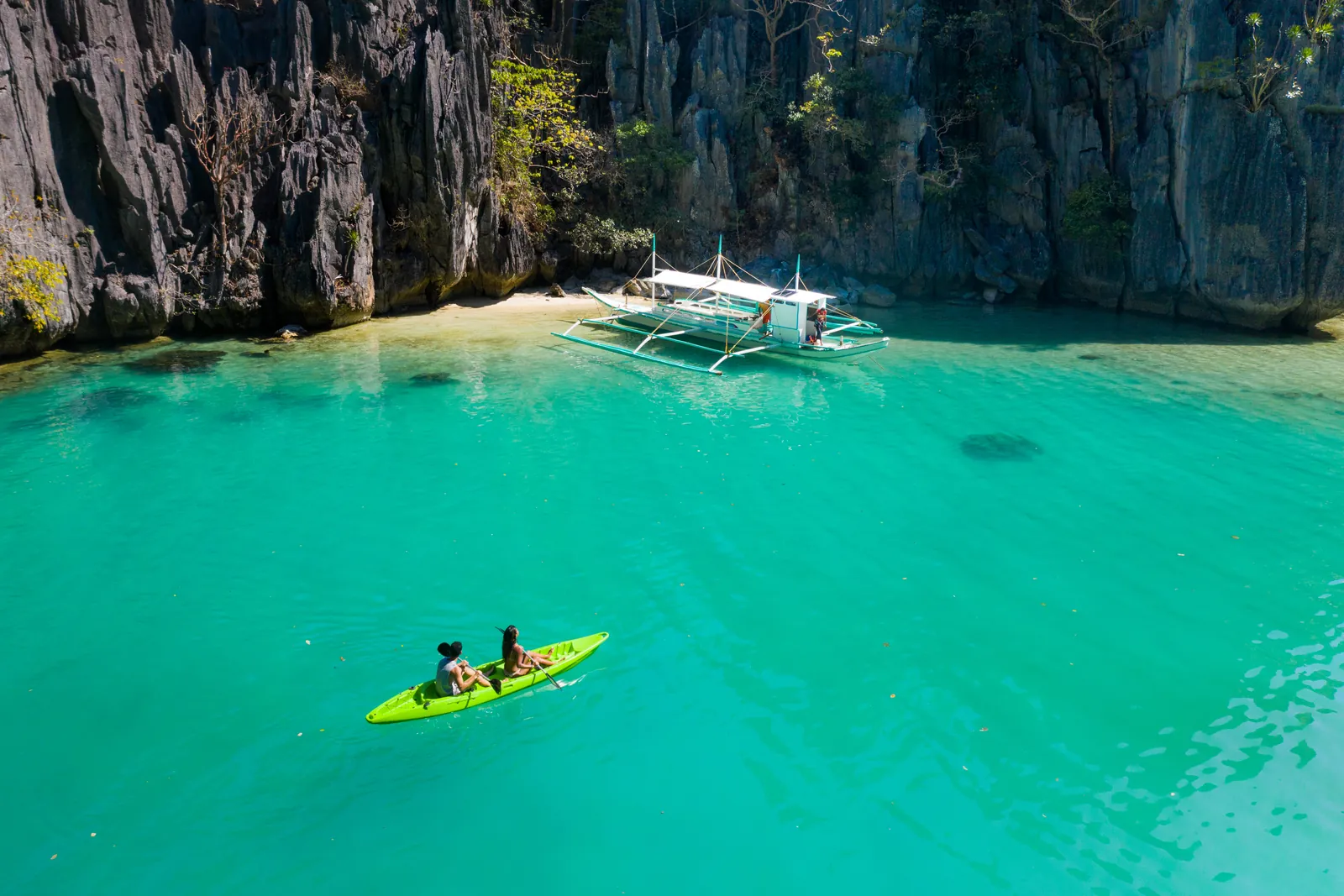
Short answer: For a first trip, the top places to visit in the Philippines are the limestone lagoons of El Nido and Coron in Palawan, the Chocolate Hills and tarsiers of Bohol, Boracay’s White Beach and the Underground River at Puerto Princesa. Round out the list with the surf island of Siargao, historic Cebu, the 2,000-year-old rice terraces of Banaue and Batad, the Spanish colonial streets of Vigan and the old walled city of Manila.
The Philippines has more than 7,600 islands, so no single trip covers them all. The list is ordered the way we would recommend places to a first-time visitor: the islands most people come for first, then the culture and the mountains of the north. Practical details are as of October 2026; for eTravel registration, visa-free stays and money, see our Philippines travel guide.
1. El Nido
Why it made the list: El Nido, at the northern tip of Palawan, is the gateway to Bacuit Bay, a scatter of limestone islands rising sheer from clear green water, with hidden lagoons, white-sand coves and coral reefs between them. It is the most spectacular island-hopping in the country.
Best time to go: December to May, when the seas are calm, with February to April the calmest and driest. From June to October, the southwest monsoon brings rain and canceled boat trips.
Don’t miss: Tour A, which takes you by kayak or swimming into the Big and Small Lagoons on Miniloc Island, and a day on Nacpan Beach, a 4 km (2.5-mile) sweep of sand about 20 km (12 miles) north of town.
Getting there and how long: fly from Manila to El Nido’s small Lio Airport, travel 5 to 6 hours by road from Puerto Princesa, or take a boat from Coron. Stay three or four days for two or three tours and a beach day.
Practical note: every visitor pays the municipal ecotourism development fee once per visit, and some lagoons charge their own fees with limits on visitor numbers. See our El Nido travel guide.
2. Coron
Why it made the list: Coron, on Busuanga Island in the Calamian group of northern Palawan, faces Coron Island, a wall of jagged limestone peaks hiding crystal-clear lakes and lagoons, managed by the indigenous Tagbanua people. Below the bay lie Japanese supply ships sunk on September 24, 1944, now among the world’s best wreck dives. It is wilder and less crowded than El Nido.
Best time to go: December to May, with February to April the calmest; the Department of Tourism names March to June as the best time for Kayangan Lake.
Don’t miss: Kayangan Lake, a 15-minute boat ride from town, where a climb of about 150 steps leads to the most photographed view in Palawan and down to clear, brackish water for swimming; and the wrecks, some shallow enough for snorkelers, such as the Skeleton Wreck.
Getting there and how long: fly to Busuanga’s Francisco B. Reyes Airport, about 30 to 40 minutes from town, take an overnight ferry from Manila, or a fast boat from El Nido. Stay three or four days, more for diving.
Practical note: each lake, lagoon and beach on Coron Island charges its own entrance fee, collected by the local community, and the DOT lists Kayangan Lake as open from 8 a.m. to 5 p.m. Take the first boat to beat the queue at the viewpoint. See our Coron travel guide.
3. Bohol
Why it made the list: Bohol, in the central Visayas, packs nature, history and beaches into one easy island: the Chocolate Hills, the tiny Philippine tarsier, old coral-stone churches, a jungle river cruise at Loboc, and the beaches and reefs of Panglao.
Best time to go: February to May, the driest months. The Chocolate Hills are greenest just after the rains and turn brown by April and May.
Don’t miss: the viewing deck at the Chocolate Hills Complex in Carmen, about 200 steps above 1,776 grassy limestone mounds (open daily 8:30 a.m. to 5:30 p.m., according to the DOT), and the Philippine Tarsier Sanctuary in Corella (daily 9 a.m. to 4 p.m.), where guides lead small groups to see tarsiers resting in the trees.
Getting there and how long: fly to Bohol-Panglao International Airport, or take a fast craft from Cebu City to Tagbilaran in about two hours. Stay three or four days.
Practical note: skip roadside “tarsier attractions” where the animals are caged or handled. In 2026 Bohol introduced new rules for dolphin and marine wildlife tours, banning feeding and touching, so choose permitted operators. See our Bohol travel guide.
4. Boracay
Why it made the list: Boracay’s 4 km (2.5-mile) White Beach, with powder-fine sand, shallow turquoise water and an evening parade of sailboats at sunset, is one of the most famous beaches in Asia.
Best time to go: November to May, when the northeast monsoon keeps White Beach calm; January to April is the driest.
Don’t miss: a one-hour sunset sail on a paraw, the traditional double-outrigger sailboat, and an island-hopping trip to Crystal Cove, Crocodile Island and Puka Shell Beach.
Getting there and how long: fly to Caticlan, 5 to 10 minutes from the jetty port, or to Kalibo, about 1.5 to 2 hours by road, then take a short boat crossing. Stay three to five days.
Practical note: since the island’s 2018 clean-up, you need a confirmed booking at an accredited hotel, and terminal and environmental fees are paid at the jetty port. Smoking and drinking on the beach itself are restricted. See our Boracay travel guide.
5. Puerto Princesa and the Underground River
Why it made the list: Palawan’s capital is the gateway to the Puerto Princesa Subterranean River National Park, a UNESCO World Heritage Site since 1999, where paddle boats glide into a vast limestone cave along a river that flows straight into the sea. The park says the river is navigable for about 4.3 km (2.7 miles).
Best time to go: December to May, with February the driest month. The river usually stays open in the rainy season, though rough seas can stop the boats at Sabang.
Don’t miss: the one-hour paddle-boat tour of the cave, past rock formations and thousands of bats and swiftlets, and an island-hopping day in Honda Bay, just north of the city.
Getting there and how long: Puerto Princesa International Airport is in the city, with flights from Manila, Cebu and Clark; Sabang, the boat wharf for the river, is about two hours away by road. Stay two or three days, then continue north to El Nido.
Practical note: the park admits no more than 900 visitors a day and runs a “no permit, no entry” policy, so book a Visitor Entry Permit in advance through the booking office in the city or an accredited agency. See our Puerto Princesa travel guide.
6. Siargao
Why it made the list: Siargao, a teardrop-shaped island facing the open Pacific off northeastern Mindanao, is the surfing capital of the Philippines, and much more: palm-lined roads through coconut groves, white sandbars, tidal rock pools, a turquoise lagoon and a relaxed café scene in General Luna.
Best time to go: about April to October for sunshine and calm lagoons, and September and October for the biggest surf. Siargao is the opposite of the west: November to February is its wettest period.
Don’t miss: Cloud 9, the reef break that put Siargao on the surfing map, watched from its wooden boardwalk and tower, and the tri-island boat trip to Naked, Daku and Guyam islands.
Getting there and how long: fly to Sayak Airport in Del Carmen from Manila, Cebu or Clark, or fly to Surigao City and take a ferry to Dapa. Stay four or five days, longer to surf.
Practical note: Cloud 9 is a powerful, shallow break for experienced surfers; beginners have gentler spots nearby. See our Siargao travel guide.
7. Cebu
Why it made the list: Cebu City is the oldest Spanish city in the Philippines, where Magellan’s expedition planted a cross in 1521, and the hub of the Visayas. It pairs history and food with some of the best day trips in the country.
Best time to go: February to May, the driest months. The Sinulog festival, on the third weekend of January, is one of the biggest in the country, and every hotel fills.
Don’t miss: the Basilica Minore del Santo Niño and Magellan’s Cross downtown, a plate of Cebu lechon (spit-roasted pig), and a day trip to Moalboal for sardine runs and turtles or to Kawasan Falls.
Getting there and how long: Mactan-Cebu International Airport is about 30 to 60 minutes from the city. One or two days for the city, four to seven with the island’s beaches and dive spots.
Practical note: Cebu is the easiest link to Bohol, two hours away by fast craft; check in at least 30 minutes before departure with an ID that matches your ticket. See our Cebu City travel guide.
8. Banaue and the Batad rice terraces
Why it made the list: in the mountains of northern Luzon, the Ifugao people have carved rice terraces into the slopes, which the Department of Tourism dates back as far as 2,000 years. The stone-walled amphitheater of Batad and the terraces of Bangaan are part of the Rice Terraces of the Philippine Cordilleras, inscribed by UNESCO in 1995.
Best time to go: the dry season, about November to April, for clear trails. The terraces change with the farming year: flooded and mirror-like around January and February, green from about April, golden at harvest; the DOT suggests August to November for Batad’s greenest terraces.
Don’t miss: the classic Banaue viewpoints in the morning light, and a walk along the terrace walls of Batad with a local guide.
Getting there and how long: overnight buses from Manila take about 9 to 10 hours. Stay two or three days, ideally one night in Batad, which is reached only on foot from the road’s end.
Practical note: Banaue and Batad each charge a visitor environmental fee, and guides are worth it on the narrow walls. See our Banaue travel guide.
9. Vigan
Why it made the list: Vigan, on the Ilocos coast of northwestern Luzon, is a UNESCO World Heritage Site (1999) and one of the best-preserved Spanish colonial towns in Asia, with cobblestone streets, ancestral houses with capiz-shell windows and horse-drawn carriages.
Best time to go: November to April, when it barely rains. From June to September, the southwest monsoon brings very heavy rain.
Don’t miss: Calle Crisologo, walked early in the morning or under its lamps in the evening, and a kalesa (horse-drawn carriage) ride to the pottery kilns.
Getting there and how long: about 8 to 10 hours by bus from Manila, 4 to 5 hours from Baguio, or fly to Laoag and drive 1.5 to 2 hours south. Stay one or two nights.
Practical note: Calle Crisologo is closed to most motor vehicles. See our Vigan travel guide.
10. Manila and Intramuros
Why it made the list: most trips start in Manila, and a day or two here adds the history the islands lack: Intramuros, the walled Spanish city founded in 1571, the National Museum around Rizal Park, Binondo’s Chinatown and famous sunsets over Manila Bay.
Best time to go: December to April, the dry season; February is usually the most pleasant month, and April is very hot.
Don’t miss: a walk or bamboo-bike tour of Intramuros and Fort Santiago, the old Spanish citadel at the mouth of the Pasig River, then a food walk through Binondo.
Getting there and how long: Ninoy Aquino International Airport (NAIA) is roughly 30 to 90 minutes from the main districts, depending on traffic. Two or three days is enough.
Practical note: Fort Santiago charges ₱75 for adults, according to the Intramuros Administration. NAIA’s terminals are not connected airside, so check yours before you fly on. See our Manila travel guide.
How to fit them into one trip
Distances between islands mean domestic flights and boats, so pick one or two regions rather than trying to see all ten, and keep a spare day before your flight home.
One week: a night in Manila, then four in El Nido and two in Coron, linked by boat; or Manila, two nights in Cebu and three in Bohol.
Ten days: Manila (two nights), Puerto Princesa for the Underground River (two), El Nido (four) and Coron (two).
Two weeks: Manila, El Nido and Coron, then a flight via Manila or Cebu to Bohol and Cebu; or swap the Visayas for Boracay or, from April to October, Siargao. Culture lovers can instead head north, any time from November to May, to Banaue, Batad and Vigan.
Timing shapes the route: Palawan, Boracay and the Visayas are best from December to May, while Siargao is best from April to October. Our best time to visit the Philippines guide goes month by month, and our AI trip planner builds the day-by-day plan for your dates.
Plan your trip
Start with our Philippines travel guide for eTravel, entry rules, flights and ferries. Use the AI trip planner to turn this list into a route, check the weather for your dates with the Destination weather tool, and work out peso prices with the Money exchange tool.
Frequently asked questions
What is the most beautiful place in the Philippines?
Most travelers would name El Nido’s Bacuit Bay or Coron’s Kayangan Lake, both in northern Palawan, where limestone cliffs rise from clear green water. Batad’s amphitheater of rice terraces is the most beautiful inland sight.
How many days do you need in the Philippines?
A week covers Manila and either Palawan (El Nido and Coron) or Cebu and Bohol. Two weeks lets you combine Palawan with the Visayas, Boracay or Siargao, with a buffer day for weather.
What is the best place in the Philippines for first-time visitors?
Palawan. El Nido and Coron deliver the island scenery most people picture, with well-organized island-hopping tours, and Puerto Princesa adds the Underground River on the same island.
Is Boracay or El Nido better?
Boracay is better for an easy beach holiday, with a long, swimmable beach, sunsets, restaurants and water sports in one place. El Nido is better for scenery and adventure, with daily boat trips to lagoons and islands.
When is the best time to visit the Philippines?
The dry season from December to May suits most of this list, with December to February the coolest. Siargao is the exception: go from about April to October.
Do I need to book the Underground River in advance?
Yes. The park admits no more than 900 visitors a day, and every visitor needs a Visitor Entry Permit booked ahead through the booking office in Puerto Princesa or an accredited agency.