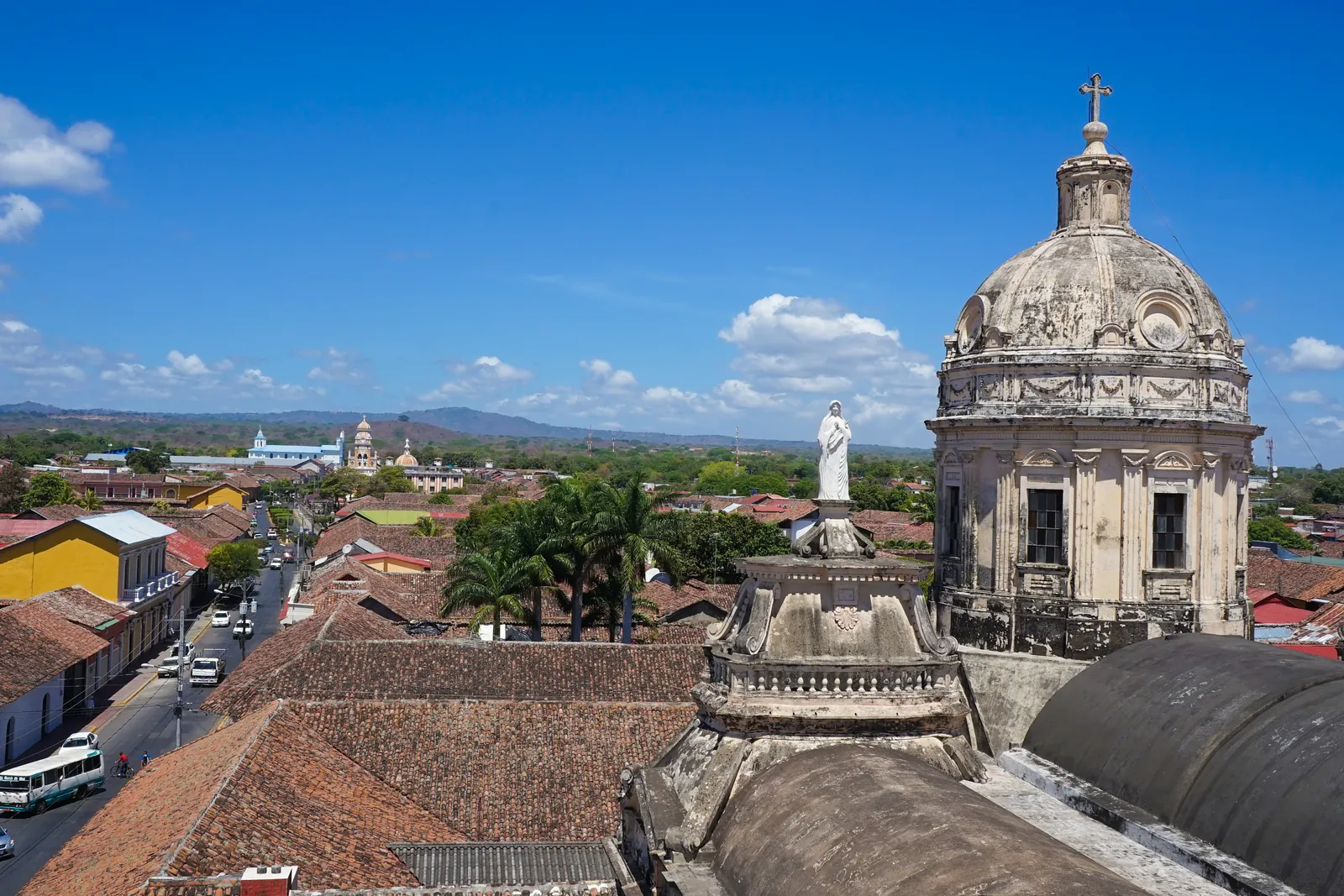
Short answer: For a first trip, the top places to visit in Nicaragua are colonial Granada and its Isletas, the smoking crater of Masaya volcano, the twin-volcano island of Ometepe, the city of León and the sandboarding slopes of Cerro Negro. Round out the list with the surf town of San Juan del Sur, the Laguna de Apoyo crater lake, Mombacho’s cloud forest, the Corn Islands and the Somoto Canyon.
Nicaragua is a land of lakes and volcanoes, and most of its highlights sit close together on the Pacific side, between Lake Nicaragua and the ocean. The list is ordered the way we would recommend places to a first-time visitor. The dry season on the Pacific side runs from about November to April, with December to February the sweet spot before the hottest weeks of March and April.
1. Granada and Las Isletas
Why it made the list: founded in 1524 on the north-west shore of Lake Nicaragua, below Mombacho volcano, Granada is one of the oldest colonial cities in the Americas and the most visited in the country. Its grid of painted houses with inner courtyards, churches and the pedestrian Calle La Calzada is made for slow walks.
Best time to go: December to February, sunny and breezy; Holy Week and the La Gritería celebrations on the evening of December 7 are lively but busy.
Don’t miss: the view over the red roofs from a church bell tower, and a boat trip among Las Isletas, the hundreds of small islands just off the city in Lake Nicaragua.
Getting there and how long: about 45 minutes to an hour by road from Managua’s international airport. Stay three nights and use Granada as a base for Masaya, Laguna de Apoyo and Mombacho.
Practical note: prices for hotels and tours are often in US dollars, while the street runs on córdobas; carry small notes of both. See our Granada travel guide.
2. Masaya Volcano National Park
Why it made the list: few places let you drive almost to the rim of an active volcano. Nicaragua’s Institute of Territorial Studies (INETER) describes Masaya’s Santiago crater as currently active, releasing about 1,087 tonnes of sulfur dioxide a day in May 2026, and the Ministry of the Environment (MARENA) counted 84,556 visitors to the park in the first half of 2026.
Best time to go: any time of year; go late in the afternoon to see the crater as the light fades.
Don’t miss: the viewpoint over the Santiago crater, and the visitor center’s displays on the volcanoes of Nicaragua.
Getting there and how long: between Managua and Granada, about 30 to 40 minutes from Granada. Allow a half day.
Practical note: the park is open every day from 8:30 a.m. to 7 p.m., according to MARENA. Stops at the crater are kept short because of the gases, so follow the rangers’ instructions. See our Granada travel guide for day trips.
3. Ometepe
Why it made the list: an island formed by two volcanoes rising out of Lake Nicaragua, Concepción and Maderas, with farms, petroglyphs, waterfalls and beaches on a freshwater lake. Concepción, 1,610 m (5,282 ft) high, has had 20 known eruptions, according to INETER, and the island is a UNESCO biosphere reserve.
Best time to go: November to February, for dry trails and cooler mornings on the volcanoes.
Don’t miss: a swim in the Ojo de Agua natural spring, and a guided hike up Maderas to its cloud-forest crater lagoon, or to the San Ramón waterfall.
Getting there and how long: by ferry or boat from San Jorge, near Rivas, to Moyogalpa, about an hour across the lake. Stay two or three nights.
Practical note: you must go with a local guide to climb Concepción or Maderas. Renting a scooter or hiring a driver is the easiest way to get around the island. See our hiking guide.
4. León
Why it made the list: a lively university city of churches, art museums and colorful streets, León has the largest cathedral in Central America, a UNESCO World Heritage Site, according to Visit Centroamérica. Nearby are the ruins of León Viejo, the original city founded in 1524 and abandoned after an earthquake and a volcanic eruption in 1610.
Best time to go: November to February; León is one of the hottest cities in the country, especially in March and April.
Don’t miss: the walk across the cathedral’s white rooftop, and the house where the poet Rubén Darío, the father of Spanish-language modernism, grew up.
Getting there and how long: about two hours by road from Managua and two and a half from Granada. Stay two nights, with a day for Cerro Negro.
Practical note: the Pacific beaches of Las Peñitas and Poneloya are about 30 minutes away, next to the Juan Venado Island Natural Reserve, 4,600 hectares of mangroves and beaches. See our city sightseeing guide.
5. Cerro Negro
Why it made the list: a young, black cinder cone near León and one of the volcanoes INETER monitors, Cerro Negro is where people sandboard: you hike up the loose volcanic gravel, then slide down the steep slope on a board, a sport Visit Centroamérica says was born in Nicaragua.
Best time to go: November to February, when it is dry and a little cooler.
Don’t miss: the run down the slope, of course, and the view from the rim over the chain of Maribios volcanoes.
Getting there and how long: about an hour by road from León, as a half-day tour.
Practical note: go with a licensed operator that provides boards, suits and goggles, and bring water and sun protection: there is no shade on the climb. See our hiking guide.
6. San Juan del Sur
Why it made the list: a small town on a horseshoe bay on the south Pacific coast, with a giant statue of Christ above the bay, surf beaches to the north and south and sunset sailing trips. It is the country’s best-known beach base.
Best time to go: November to April for dry weather; March to October for the biggest surf. Olive ridley turtles nest at the La Flor wildlife refuge, south of town, from about July to January.
Don’t miss: a surf lesson at one of the beaches north of town, and a sunset from the Christ of Mercy statue above the bay.
Getting there and how long: about 30 km (19 miles) from the Peñas Blancas border with Costa Rica and about 1.5 to 2 hours by road from Granada. Stay three nights.
Practical note: strong currents run off parts of the Pacific coast, and most beaches have no lifeguards, so swim where locals do and ask about conditions. See our San Juan del Sur travel guide.
7. Laguna de Apoyo
Why it made the list: a clear, warm lake filling an old volcanic crater between Granada and Masaya. From the Catarina viewpoint on its rim, you look over the lagoon toward Granada, Lake Nicaragua and Mombacho, according to Visit Centroamérica.
Best time to go: any time of year; the water is warm in every season, and the dry months are sunniest.
Don’t miss: a swim or kayak on the lake, and the craft villages of the Pueblos Blancos, such as Catarina and San Juan de Oriente, known for pottery.
Getting there and how long: about 30 minutes from Granada. A day trip, or a relaxing night or two by the water.
Practical note: the road down into the crater is steep; most small hotels and day-use spots arrange shuttles from Granada. See our Granada travel guide.
8. Mombacho volcano
Why it made the list: a dormant volcano only about 10 km (6 miles) from Granada, Mombacho is covered in cloud forest, with trails around its craters in a nature reserve.
Best time to go: November to February, for drier trails and clearer views; the summit is often in cloud in the afternoon.
Don’t miss: a walk on the crater trails at the top, and a zip-line canopy tour through the forest on its slopes.
Getting there and how long: a reserve truck takes visitors up the steep road from the entrance. Allow half a day from Granada.
Practical note: it is cooler and damp at the top, so bring a light layer and shoes with grip. See our hiking guide.
9. The Corn Islands
Why it made the list: two small islands in the Caribbean, Big Corn and Little Corn, with fine golden sand, healthy reefs and turquoise water, according to Visit Centroamérica, and an English-speaking Creole culture very different from the Pacific side. Little Corn has no cars.
Best time to go: February to April, the driest stretch on the Caribbean coast, which is wet much of the year.
Don’t miss: snorkeling the reefs around Little Corn, and fresh lobster and rondón, a coconut seafood stew.
Getting there and how long: by small plane from Managua to Big Corn, then a boat ride of about half an hour to Little Corn. Stay three or four nights.
Practical note: there are few ATMs on the islands, so bring enough cash, and pack light: luggage limits on the small planes are low. See our snorkeling guide.
10. Somoto Canyon
Why it made the list: in the northern highlands near the border with Honduras, the Somoto Canyon, known locally as Namancambre, is a protected area where the river runs between high rock walls. Visitors go canyoning, rappelling, climbing and birdwatching, and take boat trips, according to Visit Centroamérica.
Best time to go: December to April, the dry season in the highlands, when the river is lower and calmer.
Don’t miss: a guided canyon trip that mixes walking, swimming and jumping into deep pools, and, on the way, the cooler coffee country of Estelí and Matagalpa.
Getting there and how long: about four hours by road north of Managua, near the town of Somoto. A full day, best with a night in Estelí or Somoto.
Practical note: go only with a local guide, wear a life jacket and shoes that can get wet, and keep your phone in a dry bag. See our Nicaragua travel guide.
How to fit them into one trip
Most of the list lies in a short line along the Pacific side, so you can cover a lot with two or three bases.
One week: three nights in Granada with Las Isletas, Masaya volcano at dusk and Laguna de Apoyo, then three nights in San Juan del Sur.
Ten days: add two nights on Ometepe between Granada and the coast, and two nights in León with a sandboarding trip on Cerro Negro.
Two weeks: add the northern highlands and Somoto Canyon, or fly from Managua to the Corn Islands for three nights. Travelers continuing to Costa Rica usually cross at Peñas Blancas near San Juan del Sur.
Our best time to visit Nicaragua guide goes month by month, region by region, and our AI trip planner builds the day-by-day plan for your dates.
Plan your trip
Start with our Nicaragua travel guide for entry rules, money, ferries and shuttles. Use the AI trip planner to turn this list into a route, check what to expect on your dates with the Destination weather tool, and convert prices into córdobas with the Money exchange tool.
Frequently asked questions
What is the most beautiful place in Nicaragua?
For many visitors it is Ometepe, with its two volcanoes rising from Lake Nicaragua. The view over Laguna de Apoyo from Catarina, and Granada’s colorful streets with Mombacho behind them, are close behind.
How many days do you need in Nicaragua?
A week covers Granada, Masaya and San Juan del Sur. Ten days lets you add Ometepe and León, and two weeks adds the northern highlands or the Corn Islands.
What is the best place in Nicaragua for first-time visitors?
Granada. It is close to the airport, easy to walk, and the base for Las Isletas, Masaya volcano, Laguna de Apoyo and Mombacho.
Is Granada or León better?
Granada is prettier and more polished, with the lake and volcanoes on its doorstep. León is bigger, hotter and livelier, with a student feel, the great cathedral and Cerro Negro nearby. Most visitors enjoy both.
How do you get to Ometepe?
By ferry or smaller boat from San Jorge, near Rivas, to Moyogalpa on the island, a crossing of about an hour. San Jorge is about 1.5 hours by road from Granada and under an hour from San Juan del Sur.