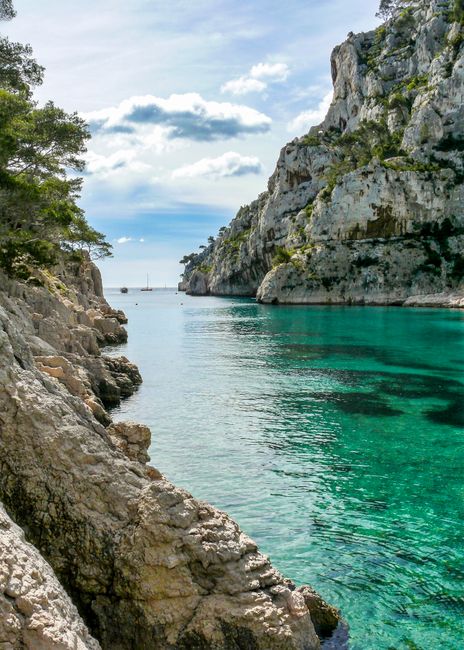
The Calanques National Park protects the white limestone cliffs and turquoise coves (calanques) that run along the coast from Marseille to Cassis and La Ciotat, together with the islands and the sea around them. There are no gates or tickets: you hike in on marked trails, see the cliffs from a boat, or paddle in by kayak. Created in 2012, it was France’s tenth national park. Two summer rules matter: from 1 June to 30 September the prefecture’s fire-risk map decides each day whether you may walk in, and on summer days the Sugiton and Pierres Tombées coves need a free online booking. Fires and smoking are banned all year.
Right now in Calanques National Park (Cassis)
- Wed18–21°C65–70°F65 mm rain
- Thu15–19°C60–67°F3 mm rain
- Fri13–18°C56–65°FClear
Tickets and tours for Calanques National Park
See all tours for Calanques National Park →
From local operators, with prices and reviews; you check availability and book on Viator, our partner. We may earn a commission at no extra cost to you. How we earn money
Why the Calanques matter
A calanque is a steep, narrow inlet cut into the limestone, with clear water at its foot. Here about 20 km of them line the coast between the southern edge of Marseille and Cassis, backed by bare white hills, pines and rosemary scrub. The park, which the national park describes as sitting at the meeting point of city and nature in the heart of the Aix-Marseille-Provence metropolis, covers land and sea: the cliffs and hills, the Frioul and Riou islands, and a large marine area rich in seagrass meadows and fish.
That closeness to a city of nearly a million people is also the challenge. The park says Sugiton saw peaks of 2,500 visitors a day before bookings were introduced, which wore away the paths and plants. Respecting the rules is what keeps the coves open.
What you’ll see
- Sugiton and the Pierres Tombées: the classic Marseille-side coves, reached on foot from the Luminy university campus.
- Sormiou and Morgiou: two larger calanques with fishermen’s huts and small beaches, reached by narrow roads that are closed to unauthorised cars in the busy season.
- Callelongue and Les Goudes: the end of the road south of Marseille, with fishing harbours and trails into the western massif.
- Port-Miou, Port-Pin and En-Vau: the three Cassis-side calanques, each with swimming spots; En-Vau, with its pebble beach between towering walls, is the most famous.
- From the sea: the Frioul islands, the Riou archipelago and the cliffs seen by boat, kayak or snorkel.
In 2026 the park’s “Automne des Calanques” programme runs until 1 November, with about fifty guided walks, boat trips, talks and shows.
Access rules and how to visit
Rules from the Calanques National Park, the Bouches-du-Rhône prefecture and the Ville de Marseille, as of October 2026:
- Entry: free, with no opening hours or tickets.
- Fire-risk map (1 June–30 September): the prefecture publishes the next day’s map at 18:00 on risque-prevention-incendie.fr/bouches-du-rhone, also shown on the park’s “Mes Calanques” app. Green means access is allowed; red means you may not enter the hills. On red days boats still run along the cliffs, but landing is strictly forbidden. Outside that period there is normally no daily map, but check the park’s news in a drought and stay off the trails on very windy, dry days.
- Sugiton and Pierres Tombées booking: in 2026 a free online booking was needed on 20–21 June, every day from 27 June to 30 August, and on 5–6 and 12–13 September. It opens three days before at 9:00, closes the day before at 18:00, covers up to five people (under-3s not counted) for the day, and is cancelled automatically if the hills close for fire risk. Look for the 2027 dates on the park’s website in late spring.
- All year in the park’s core: no fires or barbecues (fines of €135), no smoking, no camping or bivouac, including along the roads (€68 per person), no litter, no loudspeakers, no leaving the marked paths, and no motor vehicles off public roads. Dogs must be on a lead, and are banned on the Riou archipelago. Leisure drones are banned over the core of the park.
- Cars: in the busy season the roads to Sormiou, Morgiou and Callelongue are closed to unauthorised vehicles from 7:00 to 19:00. On the Cassis side, park at the free Gorguettes car park and take bus 372 or 373 (€1.70 return, according to the Cassis tourist office) or walk.
- Boats: cruises leave from Marseille’s Vieux-Port and from Cassis harbour and follow the cliffs, usually for one to three hours.
How long to allow and when to go
A cove hike takes half a day: Sugiton is about 45 minutes down from Luminy and longer back up, while the walk from Cassis to En-Vau takes a few hours there and back. A boat trip fits into a morning or afternoon. The best months are spring and autumn: October is warm, the sea is still pleasant for a swim, the fire-risk rules have ended and the crowds are gone. In summer, start at dawn. There are no toilets, water points or shops on the trails, so carry at least two litres of water each, food, sun protection and shoes with good grip on slippery limestone.
Accessibility
The trails are steep, rocky and exposed, with no shade, so the coves themselves are not accessible to wheelchair users or easy for anyone with limited mobility. The easiest way to see the Calanques is by boat from the Vieux-Port or Cassis: ask the operator about boarding before you book. The harbours at Callelongue and Les Goudes, at the end of the coast road, give a taste of the scenery without a hike.
Getting there
From central Marseille, take a city bus from Castellane to the Luminy campus for Sugiton, or follow the coast road south past Pointe Rouge to Les Goudes and Callelongue. The park’s offices are at 141 avenue du Prado in Marseille. For the Cassis side, take the regional train from Marseille to Cassis (about 20 minutes), then a bus or a 30-minute walk down to the harbour, where the trails to Port-Miou, Port-Pin and En-Vau start. Driving in summer is hard work: roads are closed and car parks fill early.
Combine it with
Pair a morning hike with an afternoon on the Vieux-Port, or end the day in Cassis with a glass of its white wine. Plan trails with our hiking guide, see the cliffs from the water with our boat trips guide, and find the best swimming spots in our beaches and snorkeling guides. Our Marseille travel guide covers the city, the islands and Cassis, and our Provence guide heads inland to Avignon’s Palais des Papes.
Calanques National Park FAQ
Is the Calanques National Park free?
Yes. There is no entry fee or gate. The only booking is a free one for the Sugiton and Pierres Tombées coves on summer days.
Are the Calanques open in summer?
It depends on the day. From 1 June to 30 September the prefecture’s fire-risk map, published at 18:00 for the next day, says whether the hills are open (green) or closed (red). On red days you can only see the Calanques from a boat, without landing.
Do I need to book the Calanque de Sugiton?
Only on the busy summer days the park sets each year (in 2026, most days from late June to mid-September). Outside those dates you can walk in freely.
Can I bring my dog to the Calanques?
Yes, on a lead, except on the Riou archipelago, where dogs are banned to protect nesting seabirds.
Can I camp or have a barbecue in the Calanques?
No. Camping, bivouacking, fires and smoking are banned all year in the core of the park, with fines of €68 for bivouacking and €135 for lighting a fire.
What is the best way to see the Calanques without hiking?
A boat trip from the Vieux-Port or Cassis, typically one to three hours along the cliffs. Boats also run on many days when the trails are closed.