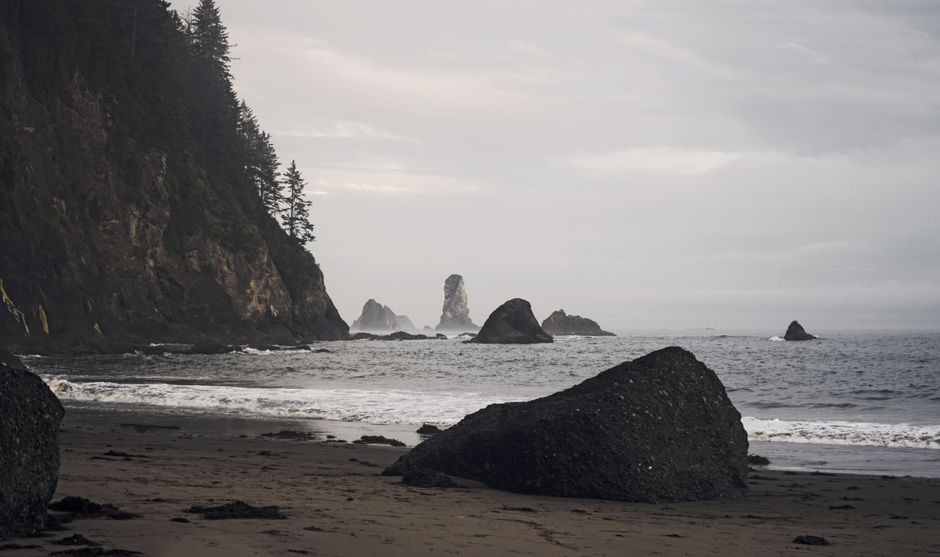
Olympic National Park covers almost a million acres of Washington’s Olympic Peninsula and holds three parks in one: glacier-capped mountains around Mount Olympus, the moss-draped temperate rain forests of the Hoh and Quinault valleys, and more than 70 miles (113 km) of wild Pacific coast with sea stacks, tide pools and beaches piled with driftwood. No road crosses the park; 95% of it is wilderness, and separate roads of 15–18 miles (24–29 km) lead in from US Highway 101, which loops around the peninsula. That means a visit is a road trip: Hurricane Ridge and Lake Crescent from Port Angeles, the Hoh Rain Forest and the beaches from Forks, Lake Quinault in the south. Give it at least two or three days, bring rain gear and check the tides before you walk the coast.
Right now in Olympic National Park (Hoh Rain Forest)
- Wed10–25°C50–76°FClear
- Thu13–23°C56–74°F1 mm rain
- Fri8–13°C46–56°F18 mm rain
- Mon 12 Oct Columbus Day
Top tours in Olympic National Park
See all tours for Olympic National Park →
From local operators, with prices and reviews; you check availability and book on Viator, our partner. We may earn a commission at no extra cost to you. How we earn money
Olympic at a glance
- Best months: July to September, the driest and warmest months, when Hurricane Ridge is snow-free and the high trails open. The rain forests are green all year and quiet in spring and fall; winter brings heavy rain on the coast and snow at Hurricane Ridge.
- Time needed: two days for Hurricane Ridge, Lake Crescent and the Hoh Rain Forest; three or four days to add the coast, Sol Duc and Lake Quinault at an easy pace.
- Getting there: Port Angeles, the main gateway, is about 2.5–3 hours from Seattle by ferry and car. Buses run from Seattle-Tacoma International Airport and the Bainbridge Island ferry to Port Angeles.
- Fees (as of October 2026): $30 per car for 7 days, cards only. No timed entry, and Olympic is not one of the parks with the $100 non-resident fee.
- Before you go: entry rules for international visitors (ESTA or visa), driving and tipping are in our United States travel guide.
Entrance fees and passes (as of October 2026)
An entrance pass is needed in the areas with entrance stations, such as Hurricane Ridge (paid at Heart O’ the Hills), the Hoh, Sol Duc, Elwha and Staircase. The park is cashless: pay by card at entrance stations and visitor centers, or buy online in advance. The coastal beaches along Highway 101, Lake Crescent and Lake Quinault have no entrance station, but your pass covers the whole park for 7 days.
| Pass | Price | What it covers |
|---|---|---|
| Private vehicle | $30 | One non-commercial vehicle (up to 15 seats) and everyone in it, 7 days |
| Motorcycle | $25 | Up to 2 motorcycles, 4 riders, 7 days |
| Per person (foot or bike) | $15 | Each person 16 or over; under-16s free; 7 days |
| Olympic annual pass | $55 | This park only, 12 months; US citizens and residents |
| America the Beautiful pass | $80 residents / $250 non-residents | All national parks and federal recreation lands for 12 months |
| Commercial van / mini-bus / motor coach | $75 / $100 / $200 | Tour vehicles with 7–15 / 16–25 / 26+ seats |
For international visitors: the $100 per-person non-resident fee that started in 2026 applies only at 11 parks (Acadia, Bryce Canyon, Everglades, Glacier, Grand Canyon, Grand Teton, Rocky Mountain, Sequoia and Kings Canyon, Yellowstone, Yosemite and Zion). Olympic is not one of them, so a car from abroad pays $30, the same as Americans. If your trip also includes Glacier or Yellowstone, the $250 non-resident America the Beautiful pass covers Olympic and saves the $100 per adult at those parks. The last 2026 fee-free days, 27 October and 11 November, are for US citizens and residents only.
Crowds, parking and reservations
Olympic has no timed entry system, but it receives more than 3 million visits a year, and Hurricane Ridge and the Hoh Rain Forest fill up on summer days, weekends and holidays. When the parking lots are full, rangers hold cars at the entrance stations and let one in as another leaves; waits of 1–2 hours are common at peak times.
- Hurricane Ridge: busiest from 10 a.m. to 2 p.m.; arrive before 10 a.m. or after 2 p.m. (after 3 p.m. on holidays). From May to 1 September a Clallam Transit shuttle runs from downtown Port Angeles (first bus 8 a.m., last bus down 5:30 p.m.); buy your park pass in advance and a bus ticket.
- Hoh Rain Forest: busiest from 10 a.m. to 5 p.m.; arrive before 8 a.m. or after 5 p.m. to avoid waits of up to 2 hours.
- Campground reservations: Kalaloch, Mora and Fairholme need reservations on Recreation.gov from mid-May to late September, the Hoh from mid-June to early September; others are first-come, first-served. Wilderness camping permits must be booked in advance on Recreation.gov; there are no trailhead permits.
Roads, closures and seasons (October 2026)
The park is open all year, 24 hours a day, but from October to May some roads, campgrounds and visitor centers close or cut their hours, and storms can close any road at short notice. Call the recorded Road and Weather line, 360-565-3131, before you set out.
- Hurricane Ridge Road: 17 miles (27 km) from Port Angeles, open in summer and early fall. In winter (generally late November to the end of March) it is usually open to uphill traffic from 9 a.m. to 4 p.m., Friday to Sunday and some holidays, weather permitting; all vehicles must be below the Heart O’ the Hills entrance by 5 p.m., and must carry tire chains above that entrance from 1 November to 1 April. The park had not yet announced the 2026–27 winter schedule in early October.
- Hurricane Ridge Day Lodge: it burned down on 7 May 2023. Temporary trailers provide restrooms and a contact station, staffed intermittently; there is no food, no gift shop and, during 2026 utility work, no drinking water on the ridge.
- Mora Road and Rialto Beach: closed beyond Mora Campground to all traffic, including walkers, for riverbank repairs from 8 July to 15 October 2026; Rialto Beach can’t be reached by road until then. Ruby Beach is a good alternative.
- Elwha Valley: the Olympic Hot Springs Road has been closed to vehicles at the Madison Falls parking area since a 2021 washout; you can walk or cycle beyond the gate.
- Quinault: the South Shore Road is closed at mile 8 by a washout, so reach Graves Creek via the North Shore Road; RVs and trailers are not allowed on Graves Creek Road.
- Staircase: the developed area, campground and Staircase Rapids Loop are open, but other trails there remained closed after a wildfire; check the park’s fire updates.
- SR 112 to Ozette: often closed or detoured after floods and landslides; check with the Washington State Department of Transportation.
Safety on the coast and in the mountains
Tides and waves: on the wilderness coast, some headlands can only be rounded at low tide, so carry a tide table and know your turnaround time; don’t get cut off below cliffs. Sneaker waves can surge far up the beach without warning, and the huge drift logs can roll and crush people in the surf; stay off logs at the water’s edge and never turn your back on the ocean. The water is cold all year, and rip currents are common, so swimming is not recommended.
Mountains and rivers: weather on Hurricane Ridge changes fast, with wind, fog and snow possible in any season; check the avalanche forecast in winter. Glacial rivers are cold and swift. Black bears and mountain goats live in the park: keep your distance, store food properly (bear canisters are required in some wilderness areas and can be borrowed from the Wilderness Information Center) and never feed wildlife. Pack the Ten Essentials, leave your itinerary with someone, and remember that phone signal is poor in most of the park. In an emergency, call 911.
Top things to see in Olympic
Hurricane Ridge
At 5,242 ft (1,598 m), 17 miles (27 km) up a winding road from Port Angeles, Hurricane Ridge is the easiest place to reach the mountains, with views across a sea of peaks to Mount Olympus and north over the Strait of Juan de Fuca to Canada. In summer, paved paths wander through meadows of wildflowers where black-tailed deer graze, the Hurricane Hill Trail climbs to a summit viewpoint, and the gravel Obstruction Point Road (mid-June to 15 October, not for RVs) leads to wilder ridge walks. In winter it is a small snow-play and ski area.
Hoh Rain Forest
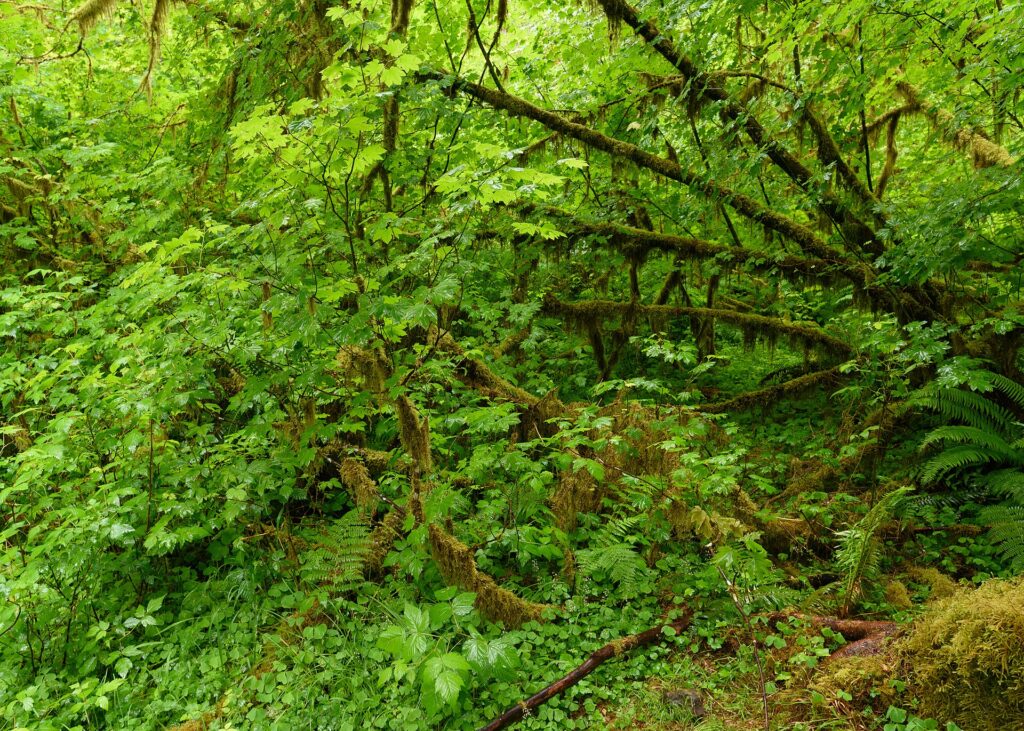
Eighteen miles (29 km) up the Hoh River from Highway 101, the Hoh is one of the finest temperate rain forests in the world, where Sitka spruce and bigleaf maples drip with mosses and ferns. The short Hall of Mosses and Spruce Nature Trail loops start at the visitor center (open daily 9 a.m. to 5:30 p.m. in summer), and the Hoh River Trail continues for days toward Mount Olympus. Look for Roosevelt elk in the valley.
Lake Crescent and Marymere Falls
A deep, glacier-carved lake of clear blue water along Highway 101 west of Port Angeles. Walk through old-growth forest to the 90-ft (27 m) Marymere Falls, climb Mount Storm King for the view, rent a kayak, or walk or bike the lakeshore Spruce Railroad Trail, open from both ends. Historic Lake Crescent Lodge sits on the south shore.
Sol Duc Valley
A 14-mile (23 km) road leads through old-growth forest to Sol Duc Hot Springs Resort, with mineral pools open in summer, and to the trailhead for Sol Duc Falls, an easy walk of under a mile (1.3 km) each way to a waterfall that splits into several channels in a mossy gorge. Salmon leap the Salmon Cascades in the fall.
Ruby Beach, Kalaloch and the coast
Along Highway 101 south of Forks, short trails lead to Ruby Beach, with its sea stacks and driftwood, and to the beaches around Kalaloch, where the Tree of Life clings to an eroding bluff. Farther north, Rialto Beach (closed by road works until 15 October 2026), Second Beach and Third Beach near La Push and the remote Ozette coast have tide pools full of sea stars and anemones; visit at low tide and look but don’t touch.
Lake Quinault and the Quinault Rain Forest
In the southwest, Lake Quinault is surrounded by rain forest, with giant trees (including record-size spruce and cedar), short nature trails and a scenic loop drive, part of which is closed by a washout on the South Shore Road. The historic Lake Quinault Lodge is in the neighboring national forest.
Nature
- Lake Crescent
- Lake Quinault
Other sights
- Marymere Falls
- Sol Duc Falls
Beaches
- Ruby Beach
Other things to do in Olympic
- Hiking: from rain forest loops to multi-day trips to the High Divide or along the wilderness coast. See our hiking guide.
- Tide pooling: best at low tides in spring and summer at Kalaloch, Second Beach and Hole-in-the-Wall near Rialto.
- Kayaking on Lake Crescent and Lake Quinault; rafting trips on the Hoh and Elwha rivers.
- Cycling the Spruce Railroad Trail and the closed upper Elwha road. See our cycling guide.
- The Elwha River: see how the river and its salmon are recovering after the removal of two dams, completed in 2014, the largest dam removal in US history.
- Ranger programs in summer at Hurricane Ridge, the Hoh, Kalaloch and Lake Crescent, listed in the park newspaper, The Bugler.
Getting there
Highway 101 loops around the park, and every area has its own entrance road. From Seattle, the quickest route is the Washington State Ferries crossing from downtown to Bainbridge Island or from Edmonds to Kingston, then the drive west via the Hood Canal Bridge. Without a car, Clallam Transit buses run from the Bainbridge Island ferry terminal to Port Angeles and serve Sequim, Forks and park stops along the north side of Highway 101, and the Dungeness Line bus runs from Seattle-Tacoma airport to Sequim and Port Angeles.
| From | Distance | Route and time |
|---|---|---|
| Seattle to Port Angeles | about 80 miles (130 km) via the ferry | Ferry to Bainbridge Island or Kingston, then SR 104 and US 101; about 2.5–3 hours |
| Port Angeles to Hurricane Ridge | 17 miles (27 km) | Hurricane Ridge Road; about 45 minutes |
| Port Angeles to Lake Crescent | about 20 miles (32 km) | US 101 west; about 30 minutes |
| Port Angeles to Forks | about 57 miles (92 km) | US 101; about 1.25 hours |
| Forks to the Hoh Rain Forest | about 31 miles (50 km) | US 101 and Upper Hoh Road (18 miles / 29 km); about 50 minutes |
| Forks to Lake Quinault | about 70 miles (113 km) | US 101 south past Ruby Beach and Kalaloch; about 1.5 hours |
Most visitors fly into Seattle-Tacoma International Airport; see our Seattle page. The Coho ferry links Port Angeles with Victoria, British Columbia, daily, so you can combine the park with Vancouver Island (take your passport). Mount Rainier National Park is about 3.5–4 hours southeast.
Around Olympic
- Port Angeles: the main gateway town on the strait, with the park’s main visitor center, hotels, restaurants and the ferry to Victoria.
- Sequim and Dungeness Spit: sunny lavender country in the rain shadow, with one of the world’s longest natural sand spits.
- Port Townsend: a Victorian seaport at the peninsula’s northeast tip, on the way from Seattle.
- Forks and La Push: the west-side base for the Hoh and the coast; La Push is the Quileute Nation’s village by First, Second and Third beaches.
- Cape Flattery: the northwesternmost point of the contiguous United States, on the Makah Reservation, reached by a short boardwalk trail; the Makah Tribe requires a recreation permit.
Nearby destinations
- Victoria85 km
- Seattle107 km
- Mount Rainier National Park178 km
- Vancouver180 km
- Tofino227 km
- Portland (Oregon)256 km
- Whistler275 km
When to go and how long to stay
The west side of the peninsula is one of the wettest places in the lower 48 states, with most rain from October to April, while Port Angeles and Sequim, in the mountains’ rain shadow, are surprisingly dry. July to September brings the best chance of sunshine, snow-free trails at Hurricane Ridge and the most visitors. Spring is lush and quiet in the rain forests; fall brings salmon runs and the first storms; winter means big waves on the coast, snow on the ridge and very few people.
| Season (Forks) | Average high | Average low | What it’s like |
|---|---|---|---|
| Spring (Mar–May) | 53–65 °F (12–18 °C) | 36–43 °F (2–6 °C) | Showery and green; high roads and trails still snowy. |
| Summer (Jun–Aug) | 68–74 °F (20–23 °C) | 47–51 °F (8–11 °C) | Driest months; morning fog on the coast; busiest time. |
| Fall (Sep–Nov) | 70–51 °F (21–11 °C) | 47–38 °F (8–3 °C) | Often clear in September, then heavy rain from October; salmon runs. |
| Winter (Dec–Feb) | 46–50 °F (8–10 °C) | 34–35 °F (1–2 °C) | Very wet and stormy on the coast; snow at Hurricane Ridge. |
Figures are NOAA 1991–2020 normals for Forks, near the Hoh and the coast, which gets about 120 inches (3,047 mm) of rain a year; Port Angeles, in the rain shadow, gets only about 26.5 inches (674 mm). Hurricane Ridge, at 5,242 ft (1,598 m), is much colder and often snowy from November to April.
Weather month by month
Olympic in two days
Day one: drive up Hurricane Ridge early, then head west to Lake Crescent for Marymere Falls and a swim or paddle, and sleep in Port Angeles or at the lake. Day two: drive to the Hoh Rain Forest for the Hall of Mosses before 10 a.m., then continue to Ruby Beach and Kalaloch for sunset.
Four days around the loop
Add Sol Duc Falls and the hot springs, a low-tide walk at Second Beach or Rialto, a night in Forks or Kalaloch, and Lake Quinault’s rain forest on the way south, then return to Seattle via Aberdeen and Olympia to close the loop.
Where to stay in and near Olympic
- Inside the park: Lake Crescent Lodge, Log Cabin Resort (closed in early October 2026), Sol Duc Hot Springs Resort (open in summer) and Kalaloch Lodge (open all year) are run by park concessioners; book months ahead for summer.
- Port Angeles and Sequim: the most hotels and restaurants, close to Hurricane Ridge and Lake Crescent.
- Forks: motels and cabins on the west side, convenient for the Hoh and the beaches.
- Lake Quinault: the historic Lake Quinault Lodge and cabins in the national forest.
- Camping: Heart O’ the Hills (105 sites, open all year, 5 miles / 8 km from Port Angeles), Hoh, Kalaloch, Mora, Fairholme, Sol Duc and others; several need summer reservations on Recreation.gov.
Room taxes: Washington room rates are quoted before tax. Lodging in the towns around the park adds Washington state and local sales tax and usually a local lodging tax; check the total when you book.
Practical tips for Olympic
- Plan by area: base yourself in Port Angeles for the north and in Forks or Kalaloch for the west; distances around the loop are long.
- Check conditions on the park’s alerts page and the Road and Weather line (360-565-3131) on the day.
- Fuel and food: stock up in Port Angeles, Forks or Amanda Park; there are few services inside the park, and none at Hurricane Ridge.
- Pets are allowed only in a few places, such as campgrounds, some beaches on a leash and the Spruce Railroad Trail; not on most trails.
- Drones are banned in the park and over the coastal wildlife refuges.
- Time zone: Pacific Time, with daylight saving time (it ends on 1 November 2026).
- Emergencies: call 911; the park’s visitor information line is 360-565-3130.
What to pack for Olympic
Waterproof jacket and pants, waterproof hiking shoes or boots, warm layers and a hat for Hurricane Ridge even in summer, and quick-dry clothes. For the coast, bring a printed tide table, sandals or shoes you don’t mind getting wet, and a headlamp. Binoculars for elk and seabirds, insect repellent and a refillable water bottle complete the kit; in winter, tire chains are required on the Hurricane Ridge Road.
Olympic travel FAQ
How much does it cost to enter Olympic National Park?
$30 per private vehicle, $25 per motorcycle or $15 per person on foot or bike, valid 7 days. There is no $100 non-resident fee at Olympic, and the park does not take cash.
Do I need a reservation to visit Olympic?
No. There is no timed entry, but Hurricane Ridge and the Hoh can hold cars at the entrance for 1–2 hours when parking is full. Some campgrounds and all wilderness camping need reservations on Recreation.gov.
Is Hurricane Ridge open in winter?
Usually on Friday to Sunday and some holidays, from about 9 a.m. to 4 p.m., weather permitting, from late November to the end of March. Tire chains are required, and there is no lodge, food or indoor warming area since the 2023 fire.
Can I visit Rialto Beach in October 2026?
Not by road until 15 October 2026: Mora Road is closed beyond Mora Campground for repairs. Visit Ruby Beach, Second Beach or Kalaloch instead.
How far is Olympic National Park from Seattle?
Port Angeles is about 2.5–3 hours from Seattle via the Bainbridge Island or Kingston ferry; the Hoh Rain Forest is about 4 hours. Buses connect Seattle-Tacoma airport and the ferry with Port Angeles.
What is the best time to visit the Hoh Rain Forest?
Any time of year; it is greenest in spring and wettest in winter. In summer, arrive before 8 a.m. or after 5 p.m. to avoid long entrance lines.
Is it safe to walk on the beaches?
Yes, with care: carry a tide table so you aren’t trapped by the incoming tide, stay off drift logs near the water, watch for sneaker waves and don’t swim in the cold surf.
Can I drive through Olympic National Park?
No road crosses the park. Highway 101 loops around it, and separate dead-end roads lead to Hurricane Ridge, Sol Duc, the Hoh, Quinault and other areas.
What is the best time to visit Olympic?
July to September for dry weather, open mountain trails and wildflowers; May, June and early October for fewer people.
Plan your trip
Partner links: TravelerCenter may earn a commission if you book, at no extra cost to you.
Sources · last reviewed 4 October 2026
Researched and last reviewed on 4 October 2026. Fees and passes, crowd and parking advice, road and area conditions, the Mora Road closure, the Hurricane Ridge winter rules and day lodge fire, campground reservations, the Hurricane Ridge shuttle, bus and ferry connections and opening hours come from Olympic National Park (National Park Service); the non-resident fee list and fee-free days from nps.gov; climate from NOAA’s 1991–2020 normals for Forks and Port Angeles. Distances and drive times, trail and waterfall details, the Staircase fire background, lodging seasons and the room-tax note are flagged for checking. For entry rules, driving and tipping, see our United States travel guide.
Also: NOAA NCEI normals 1991–2020, Forks 1 E (climate)
Data: Weather: MET Norway (CC BY 4.0) · Sea temperature: NOAA CoastWatch · Rates: ECB · Holidays: Nager.Date · Costs: World Bank ICP and price levels · © OpenStreetMap contributors (ODBL) · Wikidata (CC0)