Short answer: For a first trip, the top 10 places to visit in Norway are Oslo, Bergen, Flåm and the Nærøyfjord, the Geirangerfjord, Ålesund, Stavanger and Preikestolen, Trondheim, the Lofoten Islands, Tromsø and the North Cape. Together they give you the capital, the great western fjords, Norway’s most famous hike, its medieval heart and the Arctic north of the midnight sun and the Northern Lights.
Norway is long and mountainous, so the trick is to pick two or three regions rather than trying to see everything. This list is ordered the way we would recommend it for a first visit: the classic Oslo-to-Bergen fjord country first, then the rest of the west coast and finally the Arctic. For each place you get why it made the list, the best time to go, what not to miss, how to get there and how long to stay, plus one practical note. Prices are in Norwegian kroner (NOK), as of October 2026.
1. Oslo
Oslo sits at the head of a long, island-dotted fjord, with forest on three sides and the sea on the fourth. It is a compact, green capital where you can walk on the roof of an opera house, stand in front of Edvard Munch’s The Scream and climb aboard a polar ship that sailed to Antarctica.
Best time: late May to early September for long, light evenings and swimming in the fjord; December for Christmas lights; February and March for skiing in the forest above the city. Many attractions keep shorter hours from October to April.
Don’t miss: the MUNCH museum on the waterfront, and the museum peninsula of Bygdøy for the Fram polar ship and the Kon-Tiki raft.
Getting there and how long: Oslo’s airport is the main international gateway, and trains run from the city to Bergen, Stavanger and Trondheim. Give it two days, or three or four for a slower pace.
Practical note: the Museum of the Viking Age is closed for rebuilding and due to reopen in 2027. The Bygdøy ferries run from April to October from the City Hall pier. See our Oslo travel guide.
2. Bergen
Norway’s second city is the gateway to the western fjords: a harbor town of steep wooden houses ringed by seven mountains, with the gabled merchant houses of Bryggen lining the quay. It was a hub of the Hanseatic League for four centuries, and the old wharf is now a UNESCO World Heritage Site.
Best time: May to early September, for the longest days and the full range of fjord trips. April to June are the driest months in one of Europe’s rainiest cities, which gets about 98 inches (2,500 mm) of rain a year.
Don’t miss: the leaning alleys of Bryggen, then the Fløibanen funicular up Mount Fløyen for the view over the city and the islands.
Getting there and how long: take the scenic Bergen Railway from Oslo, or fly. Give it two days for the city, and three or four with a fjord trip.
Practical note: bring a rain jacket in any season. From Bergen, an express boat runs up the Sognefjord to Flåm from April to October, in about 5.5 hours. See our Bergen travel guide.
3. Flåm and the Nærøyfjord
Flåm is a small village at the end of the Aurlandsfjord, an arm of the Sognefjord, under mountains more than 3,300 feet (1,000 m) high. It is famous for two rides: the Flåm Railway, one of the steepest standard-gauge lines in the world, and the electric boats into the Nærøyfjord, a narrow, UNESCO-listed fjord between sheer walls.
Best time: May, June and September, for waterfalls, long days and fewer crowds than July and August. The railway runs all year, with a reduced winter timetable and snowy, quiet scenery.
Don’t miss: the Flåm Railway, about an hour and 12 miles (20 km) from the mountain station of Myrdal at 2,844 feet (867 m) down to the fjord, with a stop at the Kjosfossen waterfall, and the cruise through the Nærøyfjord to Gudvangen, about two hours.
Getting there and how long: most people come by train via Myrdal, on the Oslo–Bergen line, often on the Norway in a Nutshell tour, which runs all year. Stay a night, not just a few hours between trains.
Practical note: the Flåm Railway has free seating and sells out in summer; tickets go on sale up to 120 days ahead, from NOK 399 one way for adults. See our Flåm travel guide.
4. The Geirangerfjord
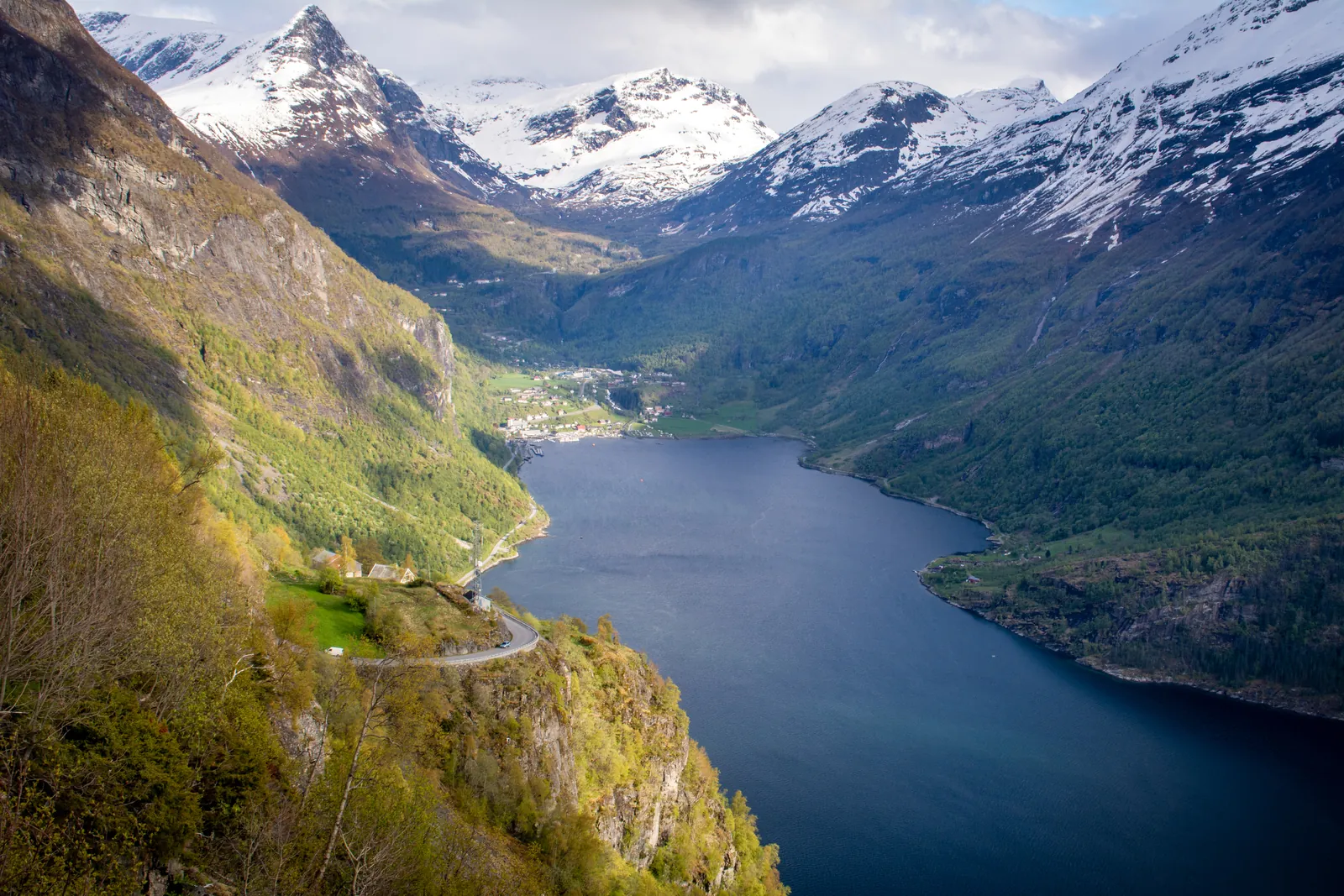
The Geirangerfjord is the picture many people have of Norway: a deep, S-shaped arm of the sea about 9 miles (15 km) long, between mountain walls more than 3,300 feet (1,000 m) high, with the Seven Sisters waterfall tumbling down the cliffs. Together with the Nærøyfjord, it has been a UNESCO World Heritage Site since 2005.
Best time: June to August, when the boats, the Dalsnibba road and the mountain passes are open. Visit Norway says Trollstigen, the hairpin road to the north, is usually open from mid-May to October or November.
Don’t miss: a fjord cruise past the Seven Sisters, and the view from Dalsnibba, about 4,900 feet (1,500 m) up, billed as Europe’s highest fjord view from a road.
Getting there and how long: drive in over the mountains, or take the boat from Ålesund. Give it at least one night, and two or three to explore properly.
Practical note: the Dalsnibba road can close for snow at short notice early and late in the season; it closed on 24 September 2026. See our Geiranger travel guide.
5. Ålesund
Ålesund is Norway’s Art Nouveau town. On the night of 23 January 1904, a fire destroyed the wooden town and left about 10,000 of its 12,000 people homeless; it was rebuilt in stone and brick between 1904 and 1907, in the Art Nouveau style of the day, which gives the center its turrets, curves and painted facades.
Best time: May to September, for long days and boat trips to Geiranger.
Don’t miss: the Art Nouveau Centre (Jugendstilsenteret), in the old Swan Pharmacy, for the story of the fire and the rebuilding, and the climb of the 418 steps up Mount Aksla for the view over the islands and the Sunnmøre Alps.
Getting there and how long: Ålesund has an airport with domestic flights. Give it one or two nights, and pair it with the Geirangerfjord.
Practical note: the Silent Fjord Cruise between Ålesund and Geiranger takes about 9 hours return, a car-free way to see the fjord. We don’t have an Ålesund guide yet; see our Geiranger travel guide.
6. Stavanger and Preikestolen
Stavanger is one of Norway’s most relaxed cities: a harbor lined with wooden warehouses and the white houses of Old Stavanger. It is also the gateway to the Lysefjord, a narrow, 26-mile (42 km) fjord walled by granite cliffs, and to Preikestolen (Pulpit Rock), a flat-topped ledge 1,982 feet (604 m) above the water.
Best time: May to September for hiking and boat trips. Preikestolen’s hiking season runs from April to October.
Don’t miss: the hike to Preikestolen, about 3.7 miles (6 km) return and around four hours, with 1,150 feet (350 m) of climbing, and the Norwegian Petroleum Museum in town.
Getting there and how long: trains run from Oslo, and Stavanger has its own airport. Give it two days for the city and a fjord cruise, three or four to add the big hikes.
Practical note: in winter, Preikestolen should only be hiked with a guide. See our Stavanger travel guide.
7. Trondheim
Trondheim was Norway’s medieval capital and its great pilgrim city. Its Nidaros Cathedral, begun in 1070 over the tomb of King Olav the Holy, is the world’s northernmost Gothic cathedral and Norway’s national shrine, and in the Middle Ages it drew pilgrims from all over Northern Europe.
Best time: June to August, for long days and the Olavsfest festival around 29 July, when the city celebrates its saint.
Don’t miss: the cathedral, and in summer the climb of 172 steps up its tower for the view over the city center; then a walk along the river past the old wharf houses.
Getting there and how long: trains run from Oslo, and Trondheim has a busy airport. One or two nights is enough, and it makes a good stop between the fjords and the north.
Practical note: guided cathedral tours in English run in high season, June to August. We don’t have a Trondheim guide yet; see our Norway travel guide.
8. The Lofoten Islands
The Lofoten Islands are a chain of jagged granite peaks rising straight out of the sea, 60 to 190 miles (100 to 300 km) north of the Arctic Circle. Red fishermen’s cabins stand on stilts in sheltered harbors, and white-sand beaches with turquoise water hide between the mountains.
Best time: June to August for hiking, kayaking and the midnight sun, which lasts from about 28 May to 14 July; late September to March for the Northern Lights over snowy peaks.
Don’t miss: the view of Reine and Hamnøy, and the hike up Reinebringen, about 1,974 steps to 1,588 feet (484 m), open from May to September.
Getting there and how long: fly to one of the island airports, or take the ferry from Bodø to Moskenes. Give it at least four days; a week lets you slow down and wait out the weather.
Practical note: camping is restricted at many popular spots, including Reine and Reinebringen from 1 May to 1 October, and campervans may not stay overnight at designated parking areas. See our Lofoten Islands travel guide.
9. Tromsø
Tromsø is a lively little city about 220 miles (350 km) north of the Arctic Circle, built on an island between snowy peaks and the sea. It is Norway’s best-known base for the Northern Lights, and for the extremes of the far north: around two months of polar night in winter and two months of midnight sun in summer.
Best time: late September to March for the Northern Lights, which may be visible from late August to early April; January to March for snow activities with some daylight; about 20 May to 22 July for the midnight sun.
Don’t miss: the Fjellheisen cable car up Mount Storsteinen, the Arctic Cathedral, completed in 1965, and a night out with an aurora guide or a day of dog sledding.
Getting there and how long: fly from Oslo, or arrive on a coastal ship from Lofoten. Give it three or four nights in winter to give the Northern Lights a fair chance, two or three in summer.
Practical note: the polar night lasts from about 27 November to 15 January, when the sun never rises and you get a few hours of blue twilight at midday. See our Tromsø travel guide.
10. The North Cape
The North Cape (Nordkapp) is the dramatic end of the road in northern Europe: a 1,007-foot (307 m) cliff plunging into the Arctic Ocean, with a wide plateau on top. In summer it is one of the best places in Norway to watch the midnight sun.
Best time: the sun stays up 24 hours a day between 14 May and 29 July. In winter, you can look for the Northern Lights instead.
Don’t miss: the midnight view from the plateau, and the fishing town of Honningsvåg, the gateway for visitors.
Getting there and how long: the North Cape is at the end of the E69 road, about 3.5 hours’ drive from Alta; the nearest airport is Honningsvåg, about 20 miles (32 km) away, and coastal ships stop at Honningsvåg. Allow one or two nights in the area.
Practical note: Arctic weather changes fast, and fog can hide the sun even in high summer, so build a spare evening into your plan. We don’t have a North Cape guide yet; see our Tromsø travel guide for the north.
How to fit them into one trip
For a first week, follow the classic route: two days in Oslo, the Bergen Railway and the Flåm Railway to Flåm for one or two nights with the Nærøyfjord boat, then two days in Bergen. With 10 days, add Stavanger and Preikestolen, or go north from Bergen to Ålesund and the Geirangerfjord. With two weeks, fly from Bergen to Bodø for three or four days in Lofoten, then continue to Tromsø. Save the North Cape for a summer trip in the far north. In winter, swap the fjords for more time in Tromsø and Lofoten for the Northern Lights.
Our AI trip planner builds the day-by-day plan for your dates. To choose between summer fjords and winter aurora, read our best time to visit Norway guide.
Plan your trip
Start with our Norway travel guide for entry, trains and costs. Check typical weather and daylight for your dates with the Destination weather tool, see Travel costs by country to set a budget, and convert kroner with the Money exchange tool.
Frequently asked questions
What is the most beautiful place in Norway?
Many travelers would choose the Geirangerfjord, with its waterfalls and cliff farms, or Reine in the Lofoten Islands. The Nærøyfjord, seen from the boat out of Flåm, and the view from Preikestolen over the Lysefjord are close behind.
What is the best place in Norway for first-time visitors?
The Oslo-to-Bergen route, with a detour to Flåm and the Nærøyfjord. It shows you the capital, the mountains, the fjords and Bergen in about a week, almost all by train and boat.
How many days do you need in Norway?
A week covers Oslo, Flåm and Bergen. Ten days lets you add Stavanger or Ålesund and Geiranger, and two weeks lets you add Lofoten and Tromsø in the north.
Where is the best place in Norway to see the Northern Lights?
Tromsø is the easiest base, with many guided trips and flights from Oslo. Lofoten and the North Cape area are good too. The season runs from about late September to March, when the nights are dark enough.
When is the best time to visit Norway?
June to August for the fjords, hiking, Lofoten and the midnight sun, when days are long and every boat runs. May and September are quieter and cheaper. For the Northern Lights, snow and dog sledding, go north between late September and March.
Can you see the fjords in winter?
Yes. The Flåm Railway and Norway in a Nutshell run all year, with a reduced winter timetable and snowy, quiet scenery. Some mountain roads, such as Trollstigen and the Dalsnibba road, close in winter, and many seasonal boats stop.