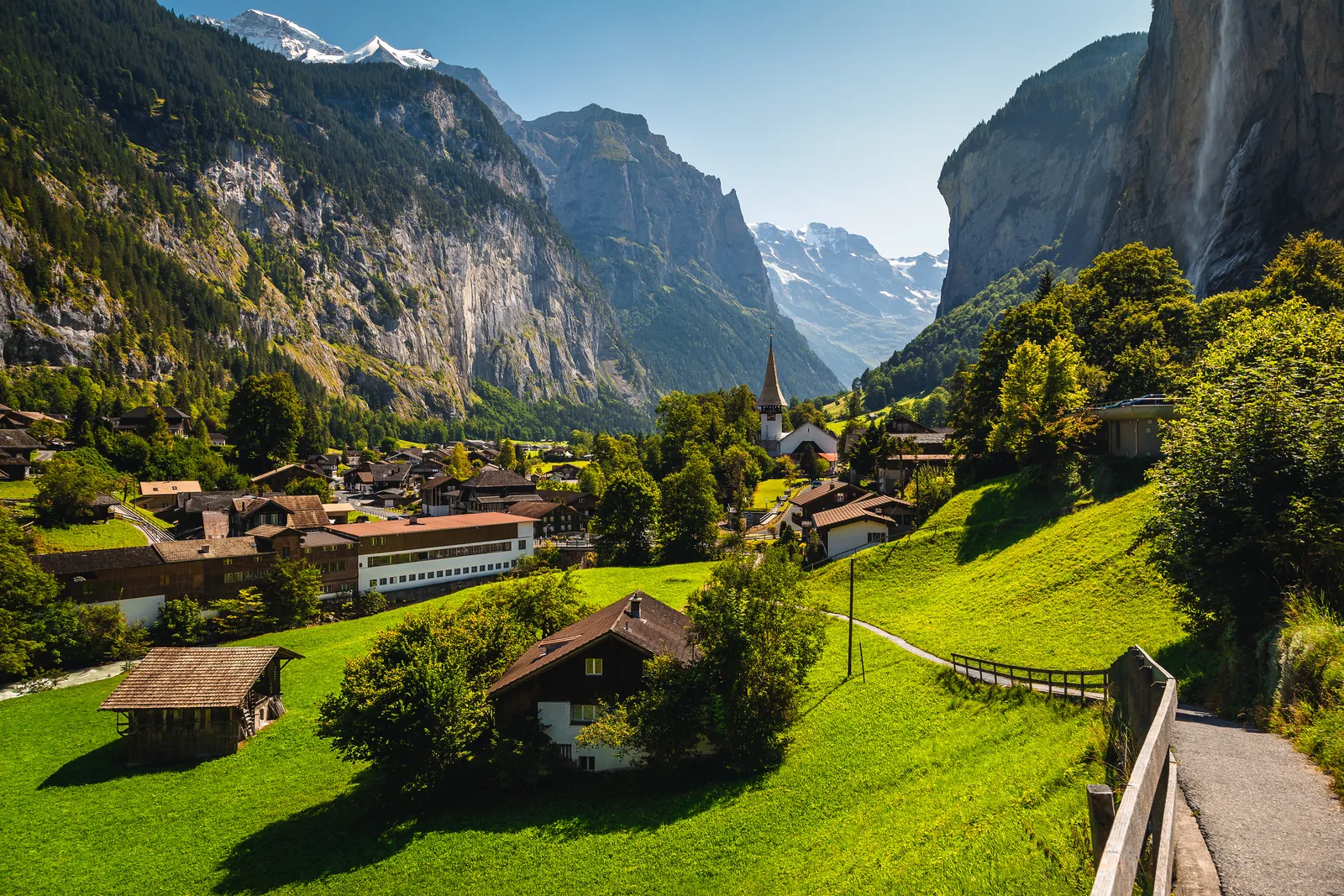
Short answer: with 7 days, take the train from Zurich to Lucerne, Interlaken and Zermatt, two nights each, and fly home from Geneva. With 10 days, ride the Glacier Express from Zermatt to St. Moritz and the Bernina Express toward Lugano, ending back in Zurich. With 14 days, start in Geneva and Montreux, take the GoldenPass Express to Interlaken and do the whole loop. Every leg works by train, bus or boat; you don’t need a car.
This guide turns the sample trips on our Switzerland travel guide into day-by-day plans, with journey times from the Swiss timetable and the best area to sleep in each stop. Mountain trips are all about the weather, so check the best time to visit Switzerland, and for the highlights see our top 10 places to visit in Switzerland. For a plan built around your dates and interests, use our AI trip planner. Everything was checked as of October 2026.
The three routes at a glance
| Route | Days | Stops (nights) | Best for |
|---|---|---|---|
| Lakes, Jungfrau and the Matterhorn | 7 | Lucerne 2, Interlaken 2, Zermatt 2 | First trip, mountain views, easy train legs |
| Add the scenic trains | 10 | Lucerne 2, Interlaken 2, Zermatt 2, St. Moritz 2, Lugano 1 | Rail fans; Alps to palm trees |
| The grand tour | 14 | Geneva 2, Montreux 1, Interlaken 3, Lucerne 2, Zermatt 2, St. Moritz 2, Lugano 1 | All four language regions, lakes and peaks |
Zurich and Geneva airports both have stations under the terminal: Zurich Airport is about 10 minutes from Zurich main station, Geneva Airport about 7 minutes from Geneva Cornavin. Flying into one and out of the other saves backtracking, and Milan Malpensa works for the Lugano end. Base yourself in two or three places rather than moving every night, and keep a spare day for the weather: the highest summits are only worth it on clear mornings.
Travel times between the main stops
Times are the fastest regular connections in the official Swiss timetable (SBB and the private railways) for October 2026. Main routes run every 30 or 60 minutes at the same minutes past each hour, and you don’t need seat reservations except on some scenic trains.
| Leg | Train | Time | Source |
|---|---|---|---|
| Zurich Airport – Lucerne | Direct InterRegio | about 1 h 10 | SBB timetable |
| Zurich – Lucerne | Direct InterRegio | about 45–50 min | SBB timetable |
| Lucerne – Interlaken Ost | Luzern–Interlaken Express, hourly | about 1 h 50 | SBB timetable |
| Interlaken Ost – Zermatt | Via Spiez and Visp (Lötschberg tunnel), 2–3 changes | about 2 h 15–2 h 30 | SBB timetable |
| Interlaken Ost – Lauterbrunnen / Grindelwald | Bernese Oberland Railway | about 20 min / about 35 min | SBB timetable |
| Zermatt – St. Moritz | Glacier Express (reservation required) | about 8 h | Glacier Express; SBB timetable |
| St. Moritz – Tirano (Italy) | Bernina Express or regional train | about 2 h 15 | SBB timetable |
| Tirano – Lugano | Bernina Express bus (seasonal) | about 3 h | Ticket sellers (approximate) |
| Lugano – Zurich / Zurich Airport | Direct InterCity / one change | about 1 h 55 / about 2 h 10 | SBB timetable |
| Lugano – Milan Centrale | Direct regional train | about 1 h 15 | SBB timetable |
| Geneva – Montreux | Direct InterRegio | about 1 h 05 | SBB timetable |
| Montreux – Interlaken Ost | GoldenPass Express, no change | about 3 h 15 | SBB timetable |
| Zermatt – Geneva Airport | Via Visp, 2 changes | about 4 h | SBB timetable |
| Bern – Interlaken Ost / Lucerne | Direct train | about 55 min / about 1 h | SBB timetable |
Zermatt is car-free: drivers leave the car in Täsch and take the shuttle train. The Glacier Express takes a seasonal break each autumn; in 2026 there is no service from 11 October to 4 December, so in those weeks the 10- and 14-day routes go from Zermatt to St. Moritz by regular trains (about 6.5 hours with changes) or drop St. Moritz.
7 days: Lucerne, Interlaken and Zermatt
The classic first trip, all by train: a lake town, the Jungfrau region and the Matterhorn. Fly into Zurich and home from Geneva. Best from June to September, when every lift and trail is open.
- Day 1, Zurich to Lucerne: Land in Zurich, and if you have energy, walk the old town on the Limmat and see Chagall’s windows in the Fraumünster. Then the train to Lucerne (about 45 minutes) and an evening stroll across the Chapel Bridge. Sleep: Lucerne old town or near the station.
- Day 2, Pilatus or Rigi: Boat across the lake to Alpnachstad and ride the world’s steepest cogwheel railway up Pilatus, or take the boat to Vitznau for Rigi, which is free with the Swiss Travel Pass. Evening on the lakefront. Sleep: same.
- Day 3, to Interlaken: The Luzern–Interlaken Express over the Brünig Pass (about 1 hour 50). Afternoon in Lauterbrunnen among the waterfalls, or the funicular up Harder Kulm for the view over both lakes. Sleep: Interlaken, or Lauterbrunnen or Grindelwald.
- Day 4, the Jungfraujoch or the Schilthorn: On a clear morning, go up to the Jungfraujoch, at 3,454 m Europe’s highest railway station, via the Eiger Express from Grindelwald (a seat reservation is strongly recommended), or take the cable cars to Mürren and the Schilthorn. Sleep: same.
- Day 5, to Zermatt: Train via Spiez, the Lötschberg tunnel and Visp (about 2 hours 15). Afternoon walk in the car-free village and up to the Matterhorn viewpoints. Sleep: Zermatt.
- Day 6, the Gornergrat: The cogwheel railway to 3,089 m for the Matterhorn and the glaciers, with a walk down past the Riffelsee lake for the mirror view; or the Matterhorn Glacier Paradise at 3,883 m. Sleep: same.
- Day 7, home: Train to Geneva Airport (about 4 hours) along the Rhône valley and Lake Geneva, or back to Zurich Airport (about 3 hours 45).
Swap it: for a calmer week, skip Zermatt and give Interlaken three nights and Lucerne three. More on each stop: Zurich, Lucerne, Interlaken and Zermatt.
10 days: add the Glacier Express, St. Moritz and Lugano
Follow the 7-day plan to Zermatt, then cross the Alps on two of the world’s famous scenic trains and finish in Italian-speaking Ticino. This route needs the Glacier Express, so it works from early December to early October; summer is best for the views and the Bernina bus.
- Days 1–2, Lucerne: Old town, the lake and Pilatus or Rigi. Sleep: Lucerne (2 nights).
- Days 3–4, Interlaken: Lauterbrunnen and the Jungfraujoch or Schilthorn. Sleep: Interlaken or Lauterbrunnen (2 nights).
- Days 5–6, Zermatt: The Gornergrat and the village. Sleep: Zermatt (2 nights).
- Day 7, Glacier Express: About 8 hours in panoramic cars over the Oberalp Pass, with lunch served at your seat. A seat reservation is compulsory (CHF 54 as of October 2026) and opens 93 days ahead. Sleep: St. Moritz (2 nights).
- Day 8, the Engadin: Walk around Lake St. Moritz, ride the funicular up Muottas Muragl for the view over the Engadin lakes (summer season), or take the cable car to Diavolezza for the glaciers of the Bernina range.
- Day 9, Bernina Express to Lugano: The morning Bernina Express over the Bernina Pass and the Brusio spiral viaduct to Tirano in Italy (about 2 hours 15), then the Bernina Express bus along Lake Como to Lugano (about 3 hours; it runs daily from about late March to late October). Sleep: Lugano (1 night).
- Day 10, home: A morning on the lakefront or up Monte San Salvatore, then the direct train to Zurich (about 1 hour 55) or to Milan (about 1 hour 15) for your flight.
Swap it: if the Bernina bus is not running, return from Tirano to St. Moritz and take the train to Zurich (about 3 hours), or stay a second night in the Engadin. Details: St. Moritz and Lugano.
14 days: the grand tour from Geneva
Two weeks lets you see French-speaking Switzerland too, ride the GoldenPass Express across the mountains, and stop in Bern. Fly into Geneva and home from Zurich or Milan.
- Days 1–2, Geneva: The Jet d’Eau and the lakefront, the old town and St. Peter’s Cathedral towers, the Red Cross Museum, and a tour of CERN or the Palais des Nations (both need planning ahead). Sleep: Geneva, near Cornavin station or the old town (2 nights).
- Day 3, Lavaux and Montreux: Train toward Montreux (about 1 hour), stopping to walk through the Lavaux vineyard terraces above the lake, a UNESCO World Heritage site. Chillon Castle at sunset. Sleep: Montreux (1 night).
- Day 4, GoldenPass Express to Interlaken: About 3 hours 15 without a change, via Gstaad and the Simmental; reservations are strongly recommended. Sleep: Interlaken or Lauterbrunnen (3 nights).
- Days 5–6, Jungfrau region: The Jungfraujoch on the clearest day, and Grindelwald First or the walk between Mürren and Gimmelwald on the other.
- Day 7, Bern and on to Lucerne: Train to Bern (about 55 minutes), the arcaded old town, the Zytglogge and the bear park, then on to Lucerne (about 1 hour). Sleep: Lucerne (2 nights).
- Day 8, Lucerne: Pilatus or Rigi and a paddle steamer on the lake.
- Day 9, to Zermatt: Train via Bern and Visp (about 3 hours 20). Sleep: Zermatt (2 nights).
- Day 10, the Matterhorn: The Gornergrat, or the Five Lakes Walk from Blauherd down to Sunnegga (about 3.5 hours), with the Matterhorn reflected in three of the lakes.
- Day 11, Glacier Express: All day to St. Moritz. Sleep: St. Moritz (2 nights).
- Day 12, the Engadin: Lakes, larch forests and a mountain lift.
- Day 13, Bernina Express and Lugano: Train to Tirano and bus to Lugano. Sleep: Lugano (1 night).
- Day 14, home: Train to Zurich Airport (about 2 hours 10) or to Milan.
Running short of nights? Make Bern a stop on the way rather than a stay, as above, and skip the Engadin day. Details: Geneva, Montreux, Bern.
Where to sleep, by stop
| Stop | Best area for a short stay | Why |
|---|---|---|
| Geneva | Near Cornavin station or the old town | Trains to the airport and Montreux; walk to the lake |
| Montreux | The lakefront promenade | Station, boats and the walk to Chillon |
| Lucerne | The old town or near the station | Boats leave from the station; everything on foot |
| Interlaken region | Interlaken (Ost station) for connections; Lauterbrunnen, Wengen, Mürren or Grindelwald for views | Interlaken is the hub; the villages are quieter and closer to the peaks |
| Zermatt | The village center or a hotel with a Matterhorn view | Car-free; electric taxis and free e-buses |
| St. Moritz | St. Moritz Dorf, or Pontresina for walkers | Station and lifts; Pontresina is on the Bernina line |
| Lugano | Near the lake or the station | A funicular links the station and the old town |
Towns charge a small visitor’s tax per night, added to your hotel bill. In return, many give you a guest card with free local transport: Geneva, Bern, Basel, Lucerne, Ticino and others do. Swiss VAT on accommodation is 3.8%, already included in the price. Costs and passes are covered in our Switzerland travel guide.
Alternatives by interest
Hikers
Use two bases for a week each, or three or four nights each: Lauterbrunnen or Grindelwald for the Jungfrau region, and Zermatt for the Matterhorn. Come from late June to September, when the high trails are clear of snow; in June, some still have snow, and September often has the most stable weather. Add Kandersteg for the Oeschinensee, or the Aletsch Arena for views over the longest glacier in the Alps.
Rail fans
Do the 10-day route, which includes the Luzern–Interlaken Express, the Glacier Express and the Bernina Express, and add the GoldenPass Express from Montreux. Reserve the scenic trains as soon as bookings open: they are covered by the Swiss Travel Pass, but the seat reservation is extra.
Winter and skiing
From mid-December to March, base yourself in Zermatt, Grindelwald or Wengen, or St. Moritz, and add the Christmas markets in Basel, Zurich or Montreux in December. The Jungfraujoch, the Gornergrat and the Glacier Express run in winter too, with fewer trains. See our St. Moritz guide for the Engadin.
Families and budget travelers
Stay longer in fewer places and pick the cheaper mountains: Rigi, Stanserhorn and Stoos are free with the Swiss Travel Pass, and the free Swiss Family Card lets children aged 6–15 travel free with a parent. Picnic from Coop and Migros, drink from the fountains, and use the free local transport cards that hotels give. Base yourself in Basel or Bern for cheaper rooms and day trips.
Tips for planning your route
- Choose the right pass. For these moving routes, the Swiss Travel Pass usually pays off: as of October 2026, 8 consecutive days cost CHF 439 and 15 days CHF 499 in second class, with up to 50% off most mountain railways. If you stay in one or two bases, the one-month Half Fare Card (CHF 150) may be cheaper. Do the maths on sbb.ch.
- Book the scenic trains early. Glacier Express reservations open 93 days ahead and summer trains fill up.
- Save a day for the weather. Check the summit webcams in the morning and go up on the clearest day; mornings are usually clearer than afternoons in summer.
- Avoid the off-seasons for the mountains. In April, May, late October and November many lifts, mountain hotels and the Glacier Express take a break.
- Send your bags ahead. SBB’s luggage service can forward suitcases between stations, so you travel light on scenic trains.
- Remember the Schengen days. Days in Switzerland count toward the same 90 days in any 180 as the rest of the Schengen area.
Switzerland itinerary FAQ
Is 7 days enough for Switzerland?
Yes for Lucerne, the Jungfrau region and Zermatt, two nights each. To add the Glacier Express, St. Moritz and Lugano, plan 10 days; for Geneva and Montreux as well, two weeks.
Should I fly into Zurich or Geneva?
Zurich for Lucerne, the Jungfrau region and the east; Geneva for Lake Geneva and an easy finish from Zermatt. Flying into one and out of the other suits the 7- and 14-day routes.
Do I need a car in Switzerland?
No. Trains, buses, boats and mountain lifts reach every stop in these plans, and Zermatt, Wengen and Mürren are car-free. A car only helps for remote valleys and high passes, many of which close from about late October to May or June.
Is the Glacier Express worth it?
For rail lovers, yes: about 8 hours over the Oberalp Pass in panoramic cars. If you prefer more time in the mountains, regular trains cover similar scenery in sections, and the Bernina Express is shorter at about 2 hours 15 from St. Moritz to Tirano.
Interlaken or Lauterbrunnen as a base?
Interlaken for connections, restaurants and the lakes; Lauterbrunnen, Wengen, Mürren or Grindelwald for mountain views and quiet evenings. All are 20 to 35 minutes apart by train.
What is the best month for a Switzerland itinerary?
June and September: long days, most lifts open and fewer crowds than July and August. For skiing and Christmas markets, mid-December to March.
How long is the train from Interlaken to Zermatt?
About 2 hours 15 to 2 hours 30, changing in Spiez and Visp, through the Lötschberg tunnel (Swiss timetable, October 2026).
Sources
Researched and last reviewed by TravelerCenter on 8 October 2026. Train times come from the official Swiss public transport timetable (SBB and private railways) for October 2026; the Glacier Express reservation price, booking window and autumn break from Glacier Express; the Bernina Express bus times and season from ticket sellers and are approximate; Swiss Travel Pass and Half Fare Card prices from SBB; airport rail links from Geneva Airport and SBB; Zermatt access from Zermatt Tourism; Jungfraujoch facts from Jungfrau Railways; seasons from MeteoSwiss and our best-time guide. Timetables, fares and rules change, so check with the operator before you travel.
Data: Natural Earth (PUBLIC DOMAIN) · © OpenStreetMap contributors (ODBL) · Wikidata (CC0)