Short answer: The top places to visit in Canada are Banff National Park, Vancouver, Niagara Falls, Quebec City, Montreal, Toronto, Jasper and the Icefields Parkway, Victoria, Ottawa and Cape Breton Island. For a first trip, pick one side of the country: the Rockies with Vancouver in the west, or the Toronto–Niagara–Ottawa–Montreal–Quebec City corridor in the east.
Canada is about 5,500 km (3,400 miles) from coast to coast, so the real choice is not which places but which region. The west has the mountains, glaciers and rainforest coast; the east has the big cities, French-speaking Quebec and Niagara, all on one rail line; and Atlantic Canada is a slower road trip of lighthouses and lobster.
The list is ordered the way we would recommend it for a first visit. Weather timing comes from Environment and Climate Change Canada’s 1981–2010 normals, prices are in Canadian dollars, and facts were checked in October 2026.
1. Banff National Park
Why it made the list: Canada’s first national park protects 6,641 km² (2,564 sq miles) of the Rocky Mountains, with the famous turquoise lakes, Lake Louise, Moraine Lake and Peyto Lake, glaciers, hot springs, elk and bears. It is the country’s most famous scenery and the one picture most visitors come for.
When to go: mid-June to September for hiking and the lakes (snow lingers on high trails until July), mid-September to early October for golden larches and fewer people, and December to April for skiing. In 2026–27, Lake Louise Ski Resort is open from November 6, 2026 to May 2, 2027.
Don’t miss: Lake Louise early in the morning, and Moraine Lake in the Valley of the Ten Peaks; add the Banff Gondola up Sulphur Mountain.
Getting there and how long: fly into Calgary; the town of Banff is about 1.5 hours away by car or airport shuttle. Give it three or four days to add Moraine Lake, Johnston Canyon and a proper hike.
Practical note: everyone who stops in the park needs a park pass, $12.25 a day for adults, and Moraine Lake Road is closed to private cars all year: you go by Parks Canada shuttle (June 1 to October 12 in 2026), public transit or a tour. See our Banff National Park travel guide and our hiking guide.
2. Vancouver
Why it made the list: Vancouver is where the rainforest meets the sea: snow-capped mountains rise straight behind a skyline of glass towers, and a seawall path wraps around the downtown peninsula and the giant cedars of Stanley Park. It is also the gateway to Whistler, Victoria and whale watching in the Salish Sea.
When to go: June to September for dry, sunny weather. July is the driest month at the airport, with about 36 mm (1.4 in) of rain; November is the wettest, with about 189 mm (7.4 in).
Don’t miss: the Stanley Park seawall by bike or on foot, Granville Island’s market, and the Museum of Anthropology.
Getting there and how long: the Canada Line SkyTrain links the airport and downtown. Stay three days, or five or more with Whistler or Victoria.
Practical note: a one-zone transit ride costs $3.50, and the ride from the airport adds a $6.50 AddFare. Hotel rooms in the city carry about 19% in taxes, so compare final prices. See our Vancouver travel guide, and for the ski resort up the Sea-to-Sky Highway, our Whistler travel guide.
3. Niagara Falls
Why it made the list: the Horseshoe Falls, where the Niagara River drops into its gorge on the border with the United States, is one of the world’s great natural sights, and the Canadian side has the best views of all three falls, with boat trips into the spray and tunnels behind the water.
When to go: June to early October for the boats, gardens and Niagara Parkway, or mid-November to early January for the free Winter Festival of Lights, which opens on November 14, 2026 and runs until January 10, 2027.
Don’t miss: a boat trip into the mist at the foot of the falls, and Journey Behind the Falls ($33 for adults). Add the wineries and Victorian streets of Niagara-on-the-Lake.
Getting there and how long: about 1.5 to 2 hours by car from Toronto, or by GO Transit train or bus from Union Station. One full day covers the falls; stay a night to see them lit up and enjoy the quiet early morning.
Practical note: the riverside walkways in Queen Victoria Park are free; the 24-hour WEGO bus pass ($16) is the easy way to get between the sights. See our Niagara Falls travel guide.
4. Quebec City
Why it made the list: founded by Samuel de Champlain in 1608 on a cliff above the St. Lawrence, Quebec City is the only walled city north of Mexico, and its old town is a UNESCO World Heritage Site. Steep lanes, stone houses and the turreted Château Frontenac make it feel like a corner of France.
When to go: June to early October for terraces and day trips, late September and early October for fall colors, or February for the Quebec Winter Carnival, from February 5 to 14, 2027.
Don’t miss: the Dufferin Terrace boardwalk below the Château Frontenac, and the car-free lanes of Quartier Petit-Champlain in the Lower Town, reached by the funicular ($7) or the Breakneck Stairs.
Getting there and how long: about three hours from Montreal by car or VIA Rail train. Two days covers Old Québec; three or four add Montmorency Falls or Île d’Orléans.
Practical note: almost everyone speaks French, and a few words are appreciated. Most purchases add 14.975% sales tax, and hotels add a 3.5% lodging tax. See our Quebec City travel guide.
5. Montreal
Why it made the list: the biggest French-speaking city in North America mixes cobbled 17th- and 18th-century streets with a modern downtown, bagel bakeries, bistros and one of the busiest festival calendars on the continent.
When to go: June to September for terraces and festivals (the Montreal International Jazz Festival starts on June 25, 2027), late September and early October for fall color on Mount Royal, or late February for Montréal en Lumière (February 18–28, 2027) if you don’t mind real cold.
Don’t miss: Old Montreal and the Notre-Dame Basilica ($16 for a daytime visit), then the walk up Mount Royal for the view.
Getting there and how long: the 747 express bus links the airport and downtown, $11.25 for a pass valid 24 hours on the whole bus and metro network. Stay three days, four or five with a festival or day trip.
Practical note: one metro or bus ride costs $3.75. Try a smoked-meat sandwich and a wood-fired bagel. See our Montreal travel guide, and for the Laurentian ski village 1.5 to 2 hours north, our Mont-Tremblant travel guide.
6. Toronto
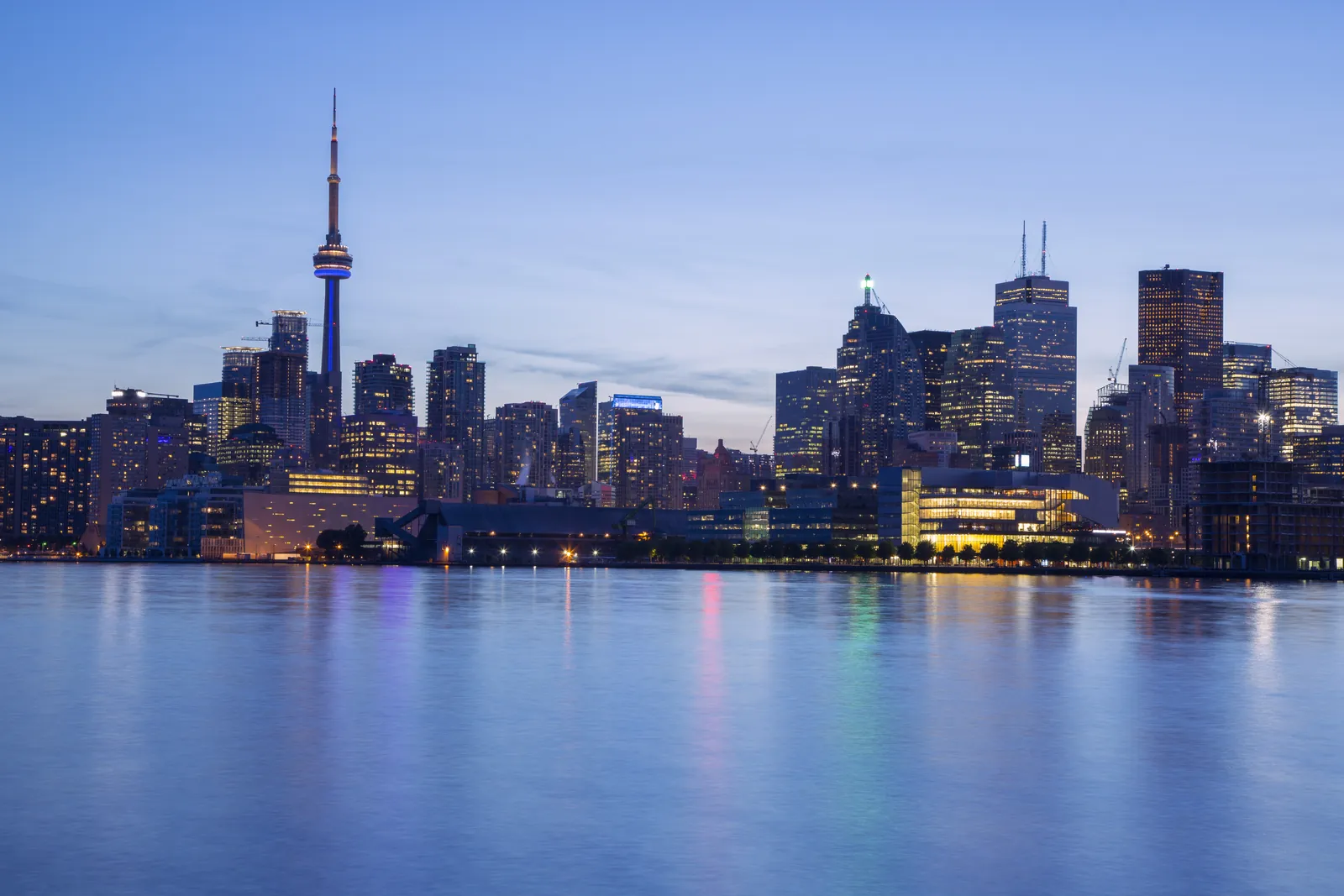
Why it made the list: Canada’s biggest city, on the shore of Lake Ontario, is a city of neighborhoods rather than monuments, and about half of its people were born outside Canada, which shows in its food. It is also the hub of the eastern rail corridor and the easiest base for Niagara Falls.
When to go: late May to June and September to mid-October, for warm days and patios without July’s humid peak.
Don’t miss: the view from the CN Tower ($47 for adults), St. Lawrence Market, and the short ferry ride to the Toronto Islands for the skyline view back across the water.
Getting there and how long: the UP Express train links Pearson Airport and Union Station in 28 minutes. Three days covers the waterfront, the main museums and a few neighborhoods.
Practical note: a TTC subway or streetcar ride is $3.30 when you tap a card. See our Toronto travel guide, and for lake country two hours north, our Muskoka travel guide.
7. Jasper and the Icefields Parkway
Why it made the list: Jasper is the largest national park in the Canadian Rockies, wilder and quieter than Banff, and one of the world’s largest dark-sky preserves. The Icefields Parkway, which links it with Lake Louise, is one of the great mountain drives, past glaciers, waterfalls and the Columbia Icefield.
When to go: late June to September for hiking, lakes and the icefield, or late September and October for golden aspens and the elk rut. Winter tires or chains are required on the Icefields Parkway from November 1 to March 31.
Don’t miss: the Columbia Icefield on the Parkway, then Maligne Lake and Athabasca Falls near Jasper.
Getting there and how long: Jasper is 232 km (144 miles) north of Lake Louise on the Parkway, or 370 km (230 miles) west of Edmonton airport; VIA Rail’s transcontinental train stops in town. Allow a full day for the drive with stops and two days in Jasper.
Practical note: a 2024 wildfire reached the town; it is open and welcoming visitors, but Maligne Canyon and the road to Mount Edith Cavell stay closed through 2026. The same park pass covers Banff and Jasper. See our Jasper National Park travel guide.
8. Victoria
Why it made the list: British Columbia’s capital, at the southern tip of Vancouver Island, has the mildest, driest climate in Canada, a harbor full of floatplanes and whale-watching boats, Canada’s oldest Chinatown and gardens that bloom almost all year.
When to go: May to September for sunshine, gardens in flower and the best whale watching; April and October for quieter streets and lower prices.
Don’t miss: Butchart Gardens ($36.75 in October), and a whale-watching trip from the Inner Harbour, in front of the Parliament Buildings and the Fairmont Empress.
Getting there and how long: BC Ferries from Tsawwassen (Vancouver) to Swartz Bay, 32 km (20 miles) north of downtown, or a floatplane right into the harbor. Two days covers the city; add more for the island’s west coast.
Practical note: the Royal BC Museum costs $32 for adults, and a bus day pass $6. For surf beaches and old-growth rainforest on the island’s west coast, see our Tofino travel guide. See our Victoria travel guide.
9. Ottawa
Why it made the list: Canada’s capital feels smaller and greener than Toronto or Montreal: Gothic-revival Parliament buildings crown a cliff above the river, the UNESCO-listed Rideau Canal runs through the center, and half a dozen national museums are within walking distance.
When to go: late May to June and September to mid-October for walking and cycling, or February for Winterlude (January 29 to February 15, 2027), when the canal becomes the Rideau Canal Skateway if the ice allows.
Don’t miss: Parliament Hill and a walk along the canal, both free, and the Canadian Museum of History across the river ($25 for adults, free on Thursdays from 5 to 7 p.m.).
Getting there and how long: VIA Rail trains come from Toronto and Montreal; it is an easy stop between them. Two or three days is enough.
Practical note: Ottawa is officially bilingual, and you will hear French as often as English. See our Ottawa travel guide.
10. Cape Breton Island
Why it made the list: the rugged northeastern end of Nova Scotia is famous for the Cabot Trail, a coastal drive that loops through Cape Breton Highlands National Park high above the Gulf of St. Lawrence and the Atlantic. Add Celtic fiddle music, lobster and moose, and it is the best of Atlantic Canada in one island.
When to go: July and August for warm weather and whale watching, or late September to mid-October for fall color and the Celtic Colours festival (October 9–17 in 2026). Many seasonal businesses close from late October to May.
Don’t miss: the Skyline Trail in the national park, and the reconstructed 18th-century French Fortress of Louisbourg.
Getting there and how long: by car over the Canso Causeway, about three hours from Halifax, or fly to Sydney. One long day drives the trail; three to five days is better.
Practical note: the national park costs $10 a day for adults, and Nova Scotia’s HST is 14%. See our Cape Breton Island travel guide, and for the start of the road trip, our Halifax travel guide and Prince Edward Island travel guide.
How to fit them into one trip
In the east, Toronto, Niagara Falls, Ottawa, Montreal and Quebec City sit along one rail corridor with frequent VIA Rail trains of three to five hours between them, so a week works without a car: Toronto (three nights, with a day at Niagara), Ottawa (one or two nights), Montreal (two nights) and Quebec City (two nights). In the west, fly into Calgary for Banff (three nights), drive the Icefields Parkway to Jasper (two nights), then fly or take the train on to Vancouver (three nights) and the ferry to Victoria (two nights): about ten days. Atlantic Canada, with Halifax, Cape Breton and Prince Edward Island, is a separate summer or fall road trip of a week or more.
Choose your season with our best time to visit Canada guide, and our AI trip planner builds the day-by-day plan for your dates.
Plan your trip
Read our Canada travel guide for the eTA, taxes and park passes, check temperatures for your dates in the Destination weather tool, convert Canadian dollars with the Money exchange tool, and work out restaurant tips with the tip calculator.
Frequently asked questions
What is the most beautiful place in Canada?
Most people would name Moraine Lake or Lake Louise in Banff National Park, with their turquoise water under glacier-covered peaks. Close behind are the Icefields Parkway, the Cabot Trail in fall color, and Quebec City’s old town under snow.
What is the best place in Canada for first-time visitors?
For mountains, Banff National Park with Vancouver. For cities, the eastern corridor of Toronto, Niagara Falls, Montreal and Quebec City, which you can travel by train. Both work well for a first week.
How many days do you need in Canada?
A week covers one region: the eastern cities by train, or Calgary and the Rockies. Allow ten days for the Rockies plus Vancouver and Victoria, and two to three weeks to see both coasts with flights in between.
Can you see the East and West of Canada in one trip?
Yes, with a domestic flight: for example, a week in Toronto, Montreal and Quebec City, then a flight west for a week in Banff, Jasper and Vancouver. Driving or taking the train across the whole country takes days, so most travelers fly.
When is the best time to visit Canada’s top places?
Late June to early October covers almost everything, with mid-September to mid-October often the sweet spot for fall colors and smaller crowds. December to March is for skiing, winter festivals and the northern lights.