Short answer: The top places to visit in Colombia are Cartagena’s walled city, Medellín, the coffee region around Salento and the Cocora Valley, Bogotá, Tayrona National Natural Park, the island of San Andrés and the Lost City trek, plus Guatapé, Villa de Leyva and the Amazon around Leticia. For a first trip, plan ten days to two weeks and combine one or two Andean cities with the Caribbean coast.
Colombia is the only South American country with coasts on both the Caribbean and the Pacific, and in one trip you can go from colonial streets and beaches to cloud forest, coffee farms and the Amazon. This list is ordered the way we would recommend the places for a first visit. For each one you get why it made the list, when to go, what not to miss, how to get there and how long to stay, and a practical note.
One thing shapes every Colombia trip: altitude, not the calendar, sets the temperature. The Caribbean coast is hot all year, Medellín and the coffee region are mild, and Bogotá is cool. Across most of the country the drier months are December to March and July to August, and the rainiest are April to May and October to November. Our best time to visit Colombia guide covers every region month by month.
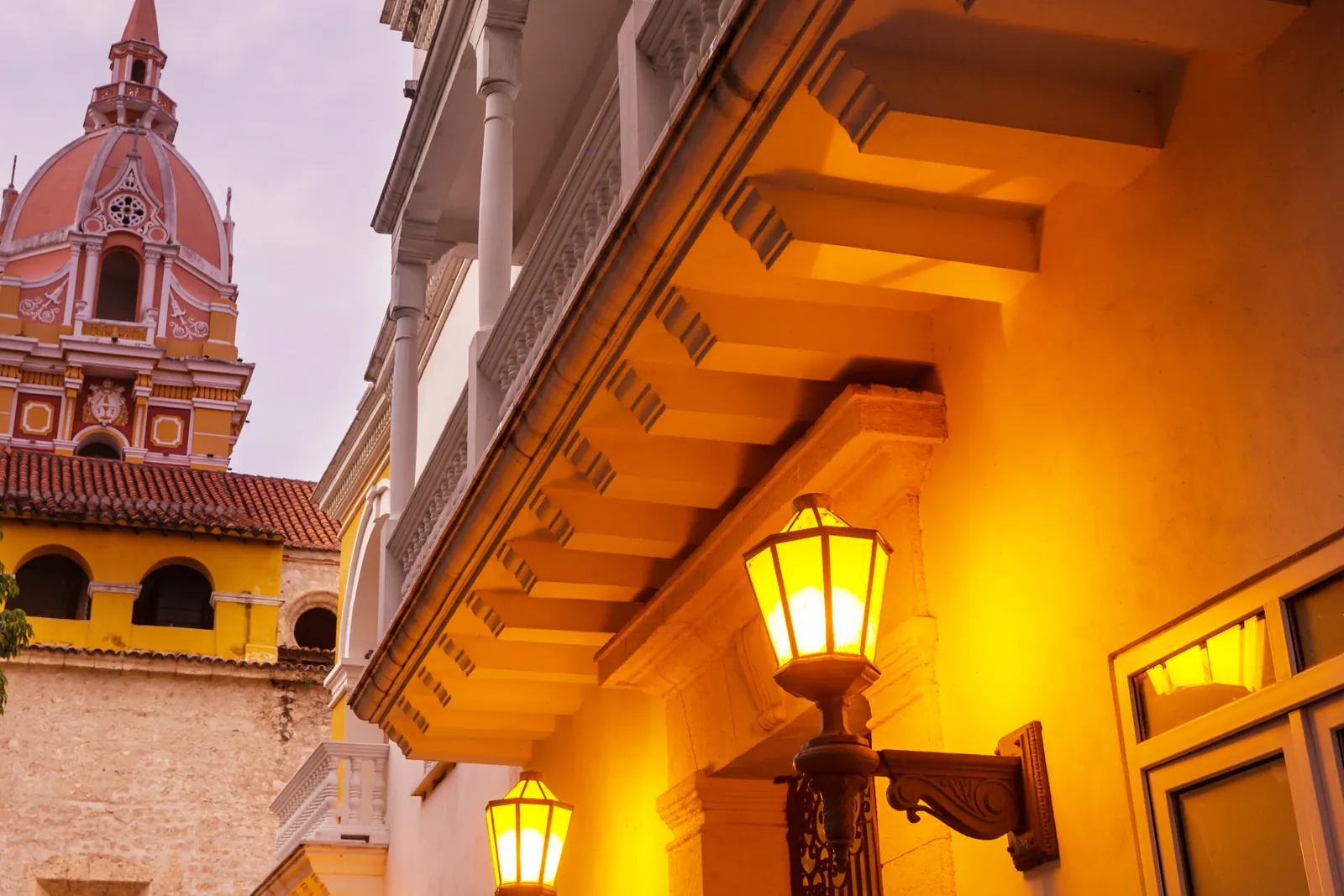
1. Cartagena
Why it made the list: Colombia’s most visited city is a Caribbean port whose historic center is enclosed by about 8 km (5 miles) of walls built in stages between 1586 and 1796. Its port, fortresses and monuments have been a UNESCO World Heritage Site since 1984.
Best time to go: December to April, the dry season: January and February average almost no rain. Highs are about 31–32 °C (88–90 °F) all year, and October is the wettest month.
Don’t miss: a slow walk through the walled city at sunset, then the street art and plazas of Getsemaní; the Castillo de San Felipe fortress; and a boat day to the Rosario Islands.
Getting there and how long: Rafael Núñez International Airport is close to the old city, with direct flights from Florida and New York, and Bogotá is about an hour and a half away by air. Stay three or four nights.
Practical note: the Rosario Islands are part of a national natural park, and the parks service has been checking that tourists carry the mandatory accident insurance; ask your boat operator whether it is included. See our Cartagena travel guide.
2. Medellín
Why it made the list: Colombia’s second city fills a green valley in the Andes and has turned itself into one of the most interesting cities in Latin America to visit, with a Metro and cable cars climbing into the hillside neighborhoods, Botero’s sculptures. ProColombia, the country’s official tourism promoter, puts its average temperature at about 19 °C (66 °F) all year.
Best time to go: December to February and July to August are drier; May and October are the wettest months. The Flower Fair (Feria de las Flores), held since 1957, fills the first weeks of August with flower parades.
Don’t miss: a Metrocable ride over the city, the Museum of Antioquia and the Botero sculptures in the plaza outside, and an evening in El Poblado or Laureles.
Getting there and how long: José María Córdova International Airport in Rionegro has nonstop flights from Florida and other US hubs. Give the city two or three days, plus a day for Guatapé.
Practical note: use ride-hailing apps or taxis called by your hotel or restaurant rather than hailing them in the street. See our Medellín travel guide.
3. Salento, the Cocora Valley and the coffee region
Why it made the list: the green hills of the coffee region (Eje Cafetero) are Colombia at its most relaxing: coffee farms, colorful towns and cool mountain air. Salento is the oldest town of the region, and next door the Cocora Valley is home to the towering wax palm, Colombia’s national tree, which also appears on the 100,000-peso note. The Coffee Cultural Landscape of Colombia became a UNESCO World Heritage Site in 2011.
Best time to go: July and August are the driest months in the coffee region, and January to February are fairly dry too. April and November are the wettest.
Don’t miss: a hike among the wax palms of the Cocora Valley, a coffee farm tour with a tasting, and the walk up Salento’s main street to the Alto de la Cruz viewpoint.
Getting there and how long: fly from Bogotá or Medellín to Armenia or Pereira; Salento is about 25 km (16 miles) from Armenia. Stay at least three nights.
Practical note: the colorful Willys jeeps (yipaos) that serve the area are the classic way to reach the Cocora Valley trailheads. See our Salento travel guide.
4. Bogotá
Why it made the list: the capital sits on a high Andean plateau at about 2,600 m (8,500 ft), with the colonial La Candelaria district, Monserrate’s hilltop sanctuary and some of the best restaurants in Latin America. Its Gold Museum holds about 34,000 gold pieces, the largest collection of its kind, according to ProColombia.
Best time to go: December to March and July to August are drier. Bogotá is cool all year, with days of about 10–19 °C (50–66 °F) and chilly nights; April and October to November bring the most rain.
Don’t miss: the Gold Museum and its golden Muisca Raft, a walk around La Candelaria and the Plaza de Bolívar, and the view over the city from Monserrate.
Getting there and how long: El Dorado International is Colombia’s main hub, with nonstop flights from many US cities. Two or three days is enough for a first visit.
Practical note: take the first day slowly because of the altitude. Bogotá is the only place in Colombia where the tap water is considered safe to drink. The Gold Museum opens Tuesday to Saturday from 9 a.m. to 6 p.m. and Sunday from 10 a.m. to 4 p.m., according to ProColombia. See our Bogotá travel guide.
5. Tayrona National Natural Park
Why it made the list: jungle-backed coves, boulder-strewn beaches and rainforest trails below the Sierra Nevada de Santa Marta make Tayrona the most beautiful stretch of Colombia’s Caribbean coast.
Best time to go: December to April, the dry season on this coast. The park counts December 1 to January 31, June 1 to July 31, Holy Week and holiday long weekends as high season.
Don’t miss: the coastal trail from Cañaveral to Arrecifes and on to Cabo San Juan.
Getting there and how long: Santa Marta is the base; the main El Zaino entrance is about 32 km (20 miles) from the city. Visit for a long day, or stay a night in or near the park.
Practical note: Tayrona closes completely three times a year so nature can recover and the Indigenous peoples can hold ceremonies. In 2026 the third closure runs from October 19 to November 2, so check the dates with the national parks service before you book. Non-resident foreigners pay COP 81,000 (low season) or COP 96,500 (high season); tickets are sold at the entrances on the day, with no advance reservations, and every visitor must also buy accident insurance. See our Tayrona National Natural Park guide and Santa Marta travel guide.
6. San Andrés
Why it made the list: a small coral island in the western Caribbean, about 750 km (465 miles) north of the Colombian mainland and part of the Seaflower Biosphere Reserve, famous for its “sea of seven colors.” It has an Afro-Caribbean Creole culture, and English is widely spoken.
Best time to go: January to April are the driest months, with March and April averaging under 30 mm (1.2 in) of rain. October and November are by far the wettest.
Don’t miss: snorkeling or diving at some of the island’s nearly 40 dive spots, and a boat trip to the Aquarium and Haynes Cay.
Getting there and how long: fly from Bogotá or Medellín. Three or four nights is a good stay, or a few days at the end of a mainland trip.
Practical note: every non-resident visitor must buy a tourist card from the archipelago’s governorship at the departure airport before flying to the island; the 2026 price was reported at COP 153,000, and stays under 24 hours are exempt. See our San Andrés travel guide.
7. The Lost City (Ciudad Perdida)
Why it made the list: a city of stone terraces, plazas and stairways built by the Tayrona people around the year 700, deep in the cloud forest of the Sierra Nevada, and reached only on foot. Covering about 13 hectares, it was their main urban center, according to ProColombia.
Best time to go: December to March, the driest months, when trails are less muddy and river crossings are lower.
Don’t miss: the climb up the stone stairway to the terraces at dawn, before other groups arrive.
Getting there and how long: the trek starts near Santa Marta and takes four to six days with a guided group.
Practical note: the Lost City can only be visited on an organized, guided trek with an authorized operator. Plan the trip from our Santa Marta travel guide.
8. Guatapé and El Peñol
Why it made the list: the best day trip from Medellín. Guatapé is a small Andean town on the shore of a reservoir whose houses are decorated with zócalos, painted panels showing local life, plants and animals. Nearby, the granite rock of El Peñol rises 220 m (720 ft), and 740 numbered steps lead to the top, according to ProColombia.
Best time to go: December to February and July to August, the drier months, for clear views from the rock.
Don’t miss: the climb up El Peñol for the view over the islands of the reservoir, and a wander around the Plaza de los Zócalos.
Getting there and how long: buses leave from Medellín’s North Terminal and take about two hours. Most people visit on a day trip; stay a night to enjoy the town once the tour groups leave.
Practical note: start the climb early, since the steps are steep and in full sun. See our Medellín travel guide.
9. Villa de Leyva
Why it made the list: a whitewashed colonial town in the hills of Boyacá with cobbled streets and a Plaza Mayor of 14,000 m², the largest in Colombia, according to ProColombia. The town has been a National Monument since 1954, and the dry valley around it is full of fossils.
Best time to go: December to March and July to August, the drier months in the Andes.
Don’t miss: the Plaza Mayor and the Church of Our Lady of the Rosary beside it, and the El Fósil museum, built around a pliosaur found by local farmers.
Getting there and how long: it is about three to four hours by road from Bogotá. Stay one or two nights.
Practical note: weekends and holiday long weekends bring crowds from Bogotá, so visit midweek if you can. There is no Villa de Leyva page on our site yet; plan it with our Bogotá travel guide.
10. The Amazon around Leticia
Why it made the list: Leticia, the capital of the Amazonas department, sits on the Amazon River where Colombia, Brazil and Peru meet, and it is the gateway to rainforest lodges, Indigenous communities and river trips. Pink river dolphins swim nearby, and the village of Puerto Nariño was certified as Colombia’s first sustainable destination by the Ministry of Commerce, Industry and Tourism.
Best time to go: any time of year; it is hot and humid in every season, and rain gear is always useful.
Don’t miss: a boat trip to look for pink dolphins and a visit to Amacayacu National Natural Park or Puerto Nariño.
Getting there and how long: most visitors fly to Leticia from Bogotá. Stay three or four nights.
Practical note: ProColombia recommends getting the yellow fever vaccine at least 15 days before you travel, and bringing non-spray insect repellent and long, light clothing. Our Colombia travel guide covers health and entry rules.
How to fit them into one trip
With ten days, a classic first trip runs from the mountains to the sea: two nights in Bogotá, two or three in Medellín with a day at Guatapé, three in Salento and the coffee region, then three in Cartagena. Distances are long and mountain roads slow, so fly between regions; domestic flights are short and frequent.
With two weeks, add Santa Marta and Tayrona after Cartagena (check the park’s closure dates), or a few days of beach and diving on San Andrés. Hikers can swap the beach days for the Lost City trek, or fly from Bogotá to Leticia for the Amazon. Villa de Leyva makes an easy add-on of one or two nights from Bogotá.
Our AI trip planner builds the day-by-day plan for your dates, travelers and budget from our Colombia guides. Check the seasons for each region in our best time to visit Colombia guide, look up typical conditions for your dates with the Destination weather tool, and pack for beaches and cool mountains in the same week with the packing list tool.
Frequently asked questions
What is the most beautiful place in Colombia?
Many visitors pick the Cocora Valley, with its giant wax palms rising from green hills, or the jungle-backed beaches of Tayrona National Natural Park.
How many days do you need in Colombia?
About ten days for a first trip that covers Bogotá, Medellín, the coffee region and Cartagena. With two weeks you can add Tayrona, San Andrés or the Lost City trek. With a week, pick one Andean city and Cartagena.
What is the best place in Colombia for first-time visitors?
Cartagena. It is easy to reach from the US, compact and walkable, and has plenty of hotels, restaurants and boat trips. Pair it with Medellín or Bogotá to see the Andes too.
What is the best month to visit Colombia?
January and February are hard to beat: they are dry on the Caribbean coast and fairly dry in the Andes, after the busy holiday weeks. July and August are also good. See our best time to visit Colombia guide for every month.
Do you need to book Tayrona National Natural Park in advance?
No. Tickets are sold at the park entrances on the day, with no advance reservations, and every visitor must also buy accident insurance. Check that your dates do not fall in one of the park’s three yearly closures.
Do you need a tourist card for San Andrés?
Yes. Every non-resident visitor buys one at the departure airport before flying to the island, unless the stay is under 24 hours. The 2026 price was reported at COP 153,000.