Short answer: The top places to visit in Morocco are Marrakech, the medina of Fez, the Sahara dunes at Merzouga, the blue town of Chefchaouen, Aït Ben Haddou and Ouarzazate, Essaouira on the Atlantic, the High Atlas around Toubkal, Meknes and the Roman ruins of Volubilis, Rabat and Casablanca. For a first trip, plan ten days to two weeks and combine the imperial cities, the desert and the coast.
Morocco is a short flight from Europe and feels like another world: walled medinas full of craftsmen, snowcapped mountains, palm-filled valleys of mud-brick kasbahs and the dunes of the Sahara. This list is ordered the way we would recommend the places for a first visit. For each one you get why it made the list, when to go, what not to miss, how to get there and how long to stay, and a practical note.
Spring (March to May) and autumn (September to November) suit most of the country. Summer is very hot inland, with Marrakech averaging 38 °C (100 °F) in July, while winter brings sunny days, cold nights and snow on the Atlas. Our best time to visit Morocco guide covers every region month by month.
1. Marrakech
Why it made the list: the “Red City” is Morocco’s most exciting introduction: a walled medina of souks, palaces and riads around the great square of Jemaa el-Fna, where storytellers, musicians and food stalls take over at dusk. The Medina of Marrakesh has been a UNESCO World Heritage Site since 1985.
Best time to go: March to May and October to November, with warm days and cool evenings. Winter days are sunny and mild, about 19 °C (66 °F) in January; July and August average about 38 °C (100 °F) in the afternoon.
Don’t miss: Jemaa el-Fna at sunset, the carved courtyards of the Bahia Palace, and the cobalt-blue Majorelle Garden.
Getting there and how long: Marrakech has an international airport with flights from across Europe, and trains run from Casablanca. Stay three nights, plus extra for day trips to the Atlas.
Practical note: Majorelle Garden tickets are sold only online, at MAD 170 for the garden for non-residents, so book before you go. The Bahia Palace costs MAD 100. In the souks, use official guides arranged by your riad rather than people who approach you in the street. See our Marrakech travel guide.
2. Fez
Why it made the list: the medina of Fez el-Bali is one of the largest and best-preserved medieval cities in the Arab world, a maze of lanes where donkeys still carry goods past mosques, madrasas and workshops. The Medina of Fez was Morocco’s first UNESCO World Heritage Site, inscribed in 1981.
Best time to go: March to May and October to November. Winters are chilly and wet, with days of about 16 °C (61 °F), and July and August average about 35 °C (95 °F).
Don’t miss: the view over the Chouara tannery’s dye pits from a terrace, the carved cedar and tile of the Bou Inania madrasa, and the Batha Museum of Islamic Arts.
Getting there and how long: trains connect Fez with Meknes, Rabat, Casablanca and, with a change at Kenitra, the high-speed Al Boraq line to Tangier. Stay two or three nights.
Practical note: hire a licensed guide for your first half-day in the medina; it saves hours of getting lost. The Batha Museum costs MAD 60 for foreign visitors and is closed on Tuesdays. See our Fez travel guide.
3. Merzouga and the Erg Chebbi dunes
Why it made the list: a night in the Sahara is the highlight of most Morocco trips. At Merzouga, the orange dunes of Erg Chebbi rise from the stony desert, and camel treks lead to tented camps where you watch the stars and wake for the sunrise.
Best time to go: October to April, with October, November, March and April the most comfortable. Winter nights fall to about 2 °C (35 °F), and from June to September afternoons reach about 40 °C (104 °F).
Don’t miss: a camel ride into the dunes at sunset, a night in a desert camp, and sunrise from the top of a dune.
Getting there and how long: it is a long drive from Fez or Marrakech, so most travelers come on a three-day desert tour or drive themselves with stops in the Ziz and Dades valleys. Spend one or two nights.
Practical note: camps range from simple tents to comfortable bivouacs with private bathrooms; check what is included. Pack a warm layer even in spring and autumn. See our Merzouga travel guide.
4. Chefchaouen
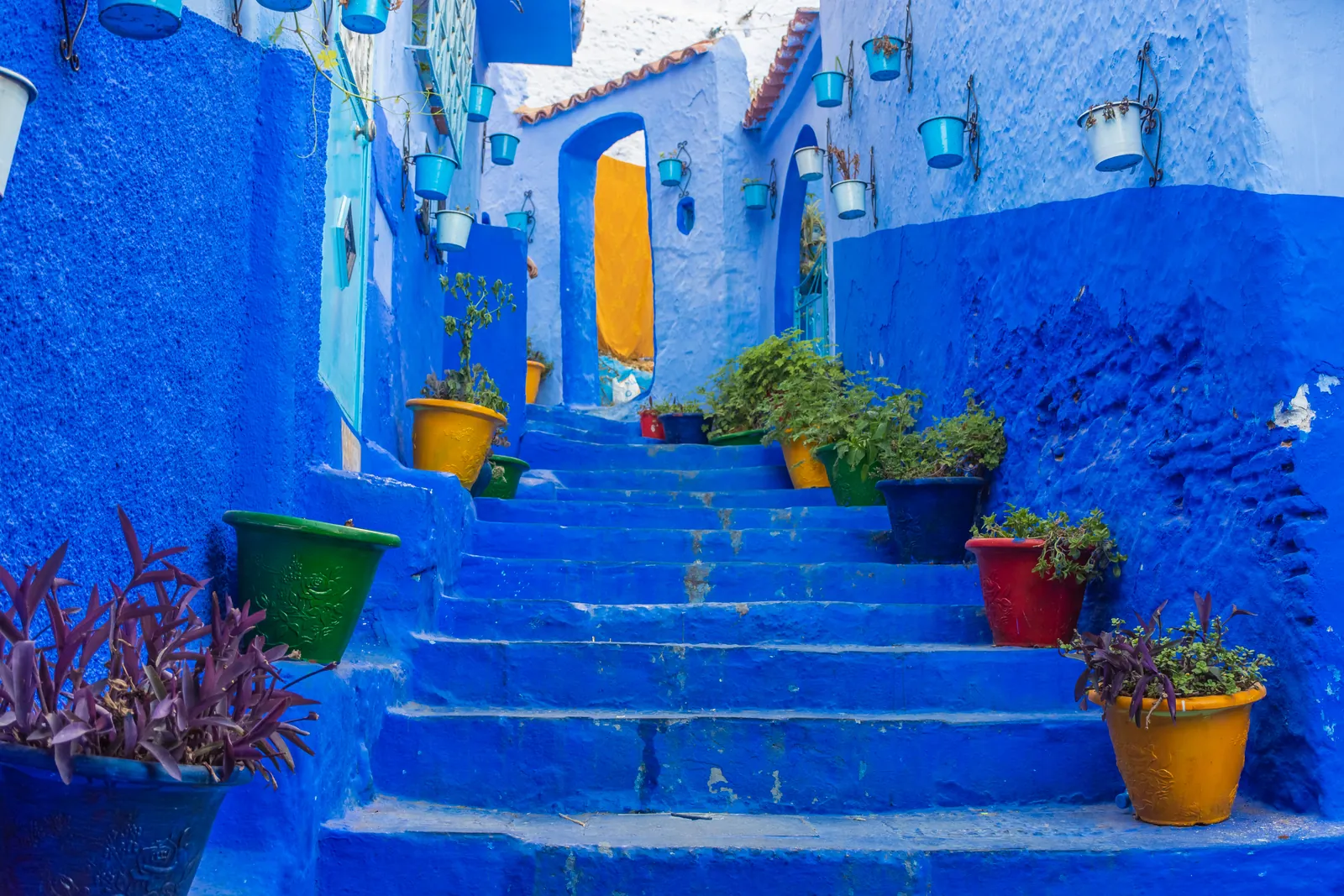
Why it made the list: the blue-washed town in the Rif mountains is one of the most photographed places in Morocco, with quiet lanes, small squares and mountain views. It is a calm contrast to the big medinas, and a good base for walks in the hills.
Best time to go: April to June and September to October. Winters in the Rif are cold and rainy; summer is warm and good for walks.
Don’t miss: an early-morning walk through the blue lanes before the day visitors arrive, the walled kasbah and its Andalusian garden on the main square, and the sunset view from the hill above town.
Getting there and how long: buses run from Fez and Tangier; there is no train. Stay two nights.
Practical note: the kasbah dates from 1471 and costs MAD 80 for foreign adults. Drugs, including cannabis, are illegal in Morocco, with severe penalties. See our Chefchaouen travel guide.
5. Aït Ben Haddou and Ouarzazate
Why it made the list: the fortified village of Aït Ben Haddou, a cluster of mud-brick houses and towers climbing a hillside, is the most famous ksar in Morocco and a UNESCO World Heritage Site since 1987. Nearby Ouarzazate is the “gateway to the desert,” home to film studios used for epics such as Gladiator and Kingdom of Heaven.
Best time to go: March to May and September to November. Summer afternoons are very hot; winter nights drop to about 2 °C (35 °F).
Don’t miss: the climb to the granary at the top of Aït Ben Haddou at sunset, and a tour of the film sets at Ouarzazate’s studios.
Getting there and how long: it is about four hours by road from Marrakech over the High Atlas by the Tizi n’Tichka pass. Spend one night, or stop on the way to or from the desert.
Practical note: mountain roads over the Atlas can be slow in bad weather and snow sometimes closes the pass in winter, so drive in daylight and allow extra time. See our Ouarzazate travel guide.
6. Essaouira
Why it made the list: a breezy, whitewashed port on the Atlantic with a walled medina, a busy fishing harbor and a long beach. Its medina, an 18th-century fortified town, has been a UNESCO World Heritage Site since 2001, and the town is the home of Gnawa music.
Best time to go: April to October for sunshine and wind sports; it stays cool, about 22 °C (72 °F) even in August, which makes it a perfect summer escape from Marrakech. The Gnaoua World Music Festival is usually held in June.
Don’t miss: the ramparts of the Skala du Port at sunset, grilled fish at the harbor, and a walk or ride along the beach.
Getting there and how long: buses run from Marrakech, about three hours away. Stay two nights.
Practical note: the Skala du Port costs MAD 60 for foreign adults. The trade winds blow hard from spring to autumn, so the beach is better for kitesurfing than sunbathing. See our Essaouira travel guide.
7. The High Atlas and Toubkal
Why it made the list: just south of Marrakech, the High Atlas rises to Toubkal, at 4,167 m (13,671 ft) the highest peak in North Africa. Berber villages, terraced valleys and walnut groves make it the best walking country in Morocco, from easy valley walks to the summit climb.
Best time to go: April to June and September to October for valley and foothill walks. Toubkal is usually free of snow from about June to September; in winter it needs mountaineering gear and a guide.
Don’t miss: a day walk between villages above Imlil, the usual starting point for Toubkal, with lunch in a village house.
Getting there and how long: Imlil is a short drive from Marrakech, so a day trip works. Climbing Toubkal usually takes two days, with a night in a mountain refuge.
Practical note: hike with a professional mountain guide. The area was hit by the September 2023 earthquake, and rebuilding in Al Haouz province has been under way since; local guides and guesthouses welcome visitors. There is no High Atlas page on our site yet; plan it from our Marrakech travel guide.
8. Meknes and Volubilis
Why it made the list: Meknes, the imperial city of Sultan Moulay Ismail, has huge walls and monumental gates, and is far calmer than Fez. Just outside it, Volubilis is the best-preserved Roman site in Morocco, founded in the 2nd century BC as a capital of Mauretania and later a Roman outpost. Both are UNESCO World Heritage Sites, Meknes since 1996 and Volubilis since 1997.
Best time to go: March to May and October to November, as for Fez. Summer at Volubilis is hot with little shade.
Don’t miss: the mosaics and triumphal arch of Volubilis, and the great Bab Mansour gate in Meknes.
Getting there and how long: Meknes is under an hour by train from Fez. Visit both on a day trip from Fez, or stay a night in Meknes.
Practical note: Volubilis costs MAD 100 for foreign adults; go early in the morning for cooler air and softer light. See our Meknes travel guide.
9. Rabat
Why it made the list: Morocco’s capital is a relaxed, green city on the Atlantic, and its mix of old medina, Kasbah of the Udayas and 20th-century boulevards has been a UNESCO World Heritage Site since 2012. It is also an easy stop on the train between Casablanca, Fez and Tangier.
Best time to go: April to June and September to October; the Atlantic keeps it mild all year.
Don’t miss: the blue-and-white lanes of the Kasbah of the Udayas above the river mouth, the Hassan Tower, and the Mohammed VI Museum of Modern and Contemporary Art.
Getting there and how long: the Al Boraq high-speed train links Rabat with Tangier in about 1 hour 20 minutes, and regular trains run to Casablanca and Fez. One or two days is enough.
Practical note: Rabat’s national museums are closed on Tuesdays; the Mohammed VI Museum costs MAD 60 for foreign visitors. See our Rabat travel guide.
10. Casablanca
Why it made the list: Morocco’s biggest city is where many trips start, and the Hassan II Mosque, built partly over the ocean with one of the tallest minarets in the world, is one of the few mosques in Morocco that non-Muslims can visit inside.
Best time to go: any time; the Atlantic keeps it mild, about 18 °C (64 °F) by day in January and 27 °C (80 °F) in August.
Don’t miss: a guided tour of the Hassan II Mosque, and a walk past the white Art Deco buildings of the city center.
Getting there and how long: Mohammed V International Airport has flights from North America and Europe, and trains link Casablanca with Rabat, Fez, Marrakech and Tangier. One day is enough for most visitors.
Practical note: guided tours of the mosque run at set times every day, with fewer on Fridays, and cost MAD 140 for foreign adults. Dress modestly, covering shoulders and knees; you carry your shoes in a bag. See our Casablanca travel guide.
How to fit them into one trip
With about two weeks, a classic loop starts in Casablanca: a day there and a day in Rabat, then the train to Fez for three nights with a day trip to Meknes and Volubilis. Add two nights in Chefchaouen if you can. From Fez, drive or take a tour south to Merzouga for a night in the dunes, then west through the Dades Valley to Ouarzazate and Aït Ben Haddou, and over the High Atlas to Marrakech for three nights. Finish with two nights in Essaouira.
With ten days, skip Chefchaouen and Rabat, and fly into Fez and out of Marrakech (or the reverse) with the desert in between. Trains do not reach the desert, the Atlas or Essaouira, so use buses, a driver or a tour for those legs; a high-speed line to Marrakech is under construction but not open as of October 2026.
Our AI trip planner builds the day-by-day plan for your dates, travelers and budget from our Morocco guides. Check the seasons for each region in our best time to visit Morocco guide, look up typical conditions with the Destination weather tool, and work out dirham prices with the Money exchange tool.
Frequently asked questions
What is the most beautiful place in Morocco?
Many travelers would say the Erg Chebbi dunes at Merzouga at sunrise, or the blue lanes of Chefchaouen. Aït Ben Haddou at sunset and the High Atlas valleys are close behind.
How many days do you need in Morocco?
About ten days to two weeks for a first trip that covers Fez, the Sahara, Aït Ben Haddou and Marrakech. With a week, focus on Marrakech, the Atlas and Essaouira, or add a fast desert tour.
What is the best place in Morocco for first-time visitors?
Marrakech. It has the most flights, hotels and riads, it is the easiest base for day trips to the Atlas and Essaouira, and it is the starting point for most desert tours.
What is the best month to visit Morocco?
April and October are hard to beat: warm, sunny days in the cities and comfortable conditions in the desert. Book early around European Easter and in October, the busiest weeks. See our best time to visit Morocco guide for every month.
Can non-Muslims visit mosques in Morocco?
Most mosques in Morocco are open only to Muslims. The big exception is the Hassan II Mosque in Casablanca, which runs guided tours for all visitors. Many historic madrasas, such as the Bou Inania in Fez, are also open to visitors.
Is a desert trip from Marrakech worth it?
Yes, but plan at least three days for Merzouga, since the drive is long each way. With less time, a shorter trip to the stony desert near Ouarzazate or Zagora gives a taste of it.