Short answer: The top places to visit in Sri Lanka are Sigiriya and the Dambulla cave temple, Kandy, Ella, Galle Fort, the ancient city of Polonnaruwa, the sacred city of Anuradhapura, Nuwara Eliya and the tea country, Yala National Park, Mirissa and Colombo. For a first trip, plan ten days to two weeks and combine the Cultural Triangle, the hill country and the south coast.
Sri Lanka packs ancient royal capitals, misty tea hills, leopards, elephants, whales and palm-fringed beaches into one compact island. This list is ordered the way we would recommend the places for a first visit, with when to go, what not to miss, how to get there and a practical note for each.
December to March is the best time for most trips, when the west and south coasts and the hill country are dry and whales are off the south coast. From May to September, head for the Cultural Triangle and the east coast, which stay dry while the southwest monsoon soaks the west and south. Our best time to visit Sri Lanka guide covers every region month by month.
1. Sigiriya and Dambulla
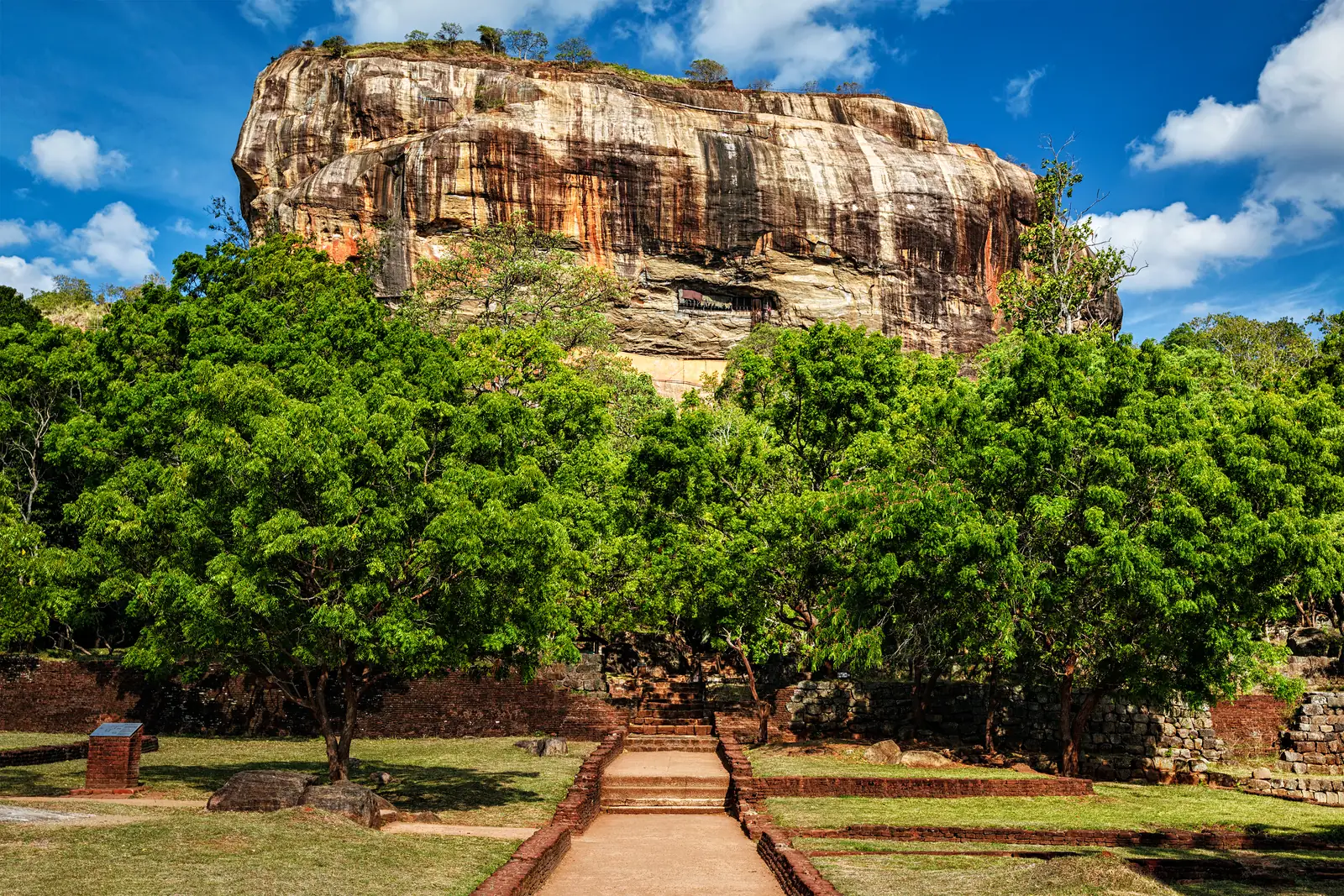
Why it made the list: Lion Rock is Sri Lanka’s most spectacular monument, a sheer column of granite rising about 180 m (590 ft) above the forest, with the ruins of a 5th-century royal palace on its summit, water gardens at its foot and painted maidens on its face. The Ancient City of Sigiriya has been a UNESCO World Heritage Site since 1982, and Dambulla’s cave temple, filled with Buddha statues and paintings, is close by.
Best time to go: January to September, with the driest weather from June to September; October to December is the rainy season here.
Don’t miss: the climb past the frescoes and the giant lion’s paws to the summit, sunrise from neighboring Pidurangala Rock, and the five painted caves of Dambulla.
Getting there and how long: Sigiriya is about four to five hours by car from Colombo or the airport and about three hours from Kandy. Stay two nights as a base for the Cultural Triangle.
Practical note: foreign visitors pay US$35 for Sigiriya, sold at the site or online through the Central Cultural Fund. Start the climb early to avoid the midday heat. See our Sigiriya travel guide.
2. Kandy
Why it made the list: the last royal capital of Sri Lanka sits in a bowl of forested hills around a lake, and on its shore stands the Temple of the Sacred Tooth Relic, the most sacred Buddhist site in the country. The Sacred City of Kandy has been a UNESCO World Heritage Site since 1988.
Best time to go: January to April, when it is mostly dry; October and November are the wettest months. The great Esala Perahera procession fills the streets in July or August (it ran from August 18 to 28 in 2026).
Don’t miss: the Temple of the Tooth, the Royal Botanic Gardens at Peradeniya, and a walk around Kandy Lake.
Getting there and how long: Kandy is three to four hours by road from Colombo or the airport. Stay one or two nights.
Practical note: the Temple of the Tooth charges foreign visitors LKR 3,000; dress modestly, covering shoulders and knees, and remove your shoes. In October 2026, trains from Colombo ran only as far as Peradeniya, about 6 km (4 miles) out, while the last section was restored. See our Kandy travel guide.
3. Ella
Why it made the list: a small hill-country town at about 1,040 m (3,400 ft), where the mountains fall away through the Ella Gap toward the southern plains. It has become one of the island’s favorite stops for its easy hikes, tea estates, waterfalls and cool evenings.
Best time to go: June to August, the driest months, with February and March good too; October to December is the wettest period.
Don’t miss: sunrise from Little Adam’s Peak, the Nine Arches Bridge curving through the jungle, and the scenic train ride through the tea country from Nanu Oya.
Getting there and how long: the train from Nanu Oya (for Nuwara Eliya) takes about 2½ hours; by road, Ella is about five hours from Kandy. Stay two nights.
Practical note: the hill-country line between Nanu Oya and Badulla reopened in June 2026 after repairs. Book reserved seats early in the high season. See our Ella travel guide.
4. Galle
Why it made the list: Galle Fort is a walled peninsula of narrow streets, colonial churches, merchants’ houses and ramparts jutting into the Indian Ocean, fortified by the Portuguese and rebuilt by the Dutch. The Old Town of Galle and its Fortifications has been a UNESCO World Heritage Site since 1988, and it is still a living town.
Best time to go: December to April, when the sea is calm and the weather mostly dry. May to September brings the southwest monsoon, with showers and rough seas.
Don’t miss: a walk around the ramparts at sunset, the old streets and churches inside the walls, and the beaches of nearby Unawatuna.
Getting there and how long: Galle is about 1½ to 2 hours from Colombo by the Southern Expressway, or 2½ to 3 hours on the coastal railway. Stay one or two nights.
Practical note: the fort’s lanes are best explored on foot early or late in the day, when it is cooler. See our Galle travel guide.
5. Polonnaruwa
Why it made the list: after Anuradhapura fell in 993, Polonnaruwa became Sri Lanka’s second capital, and its ruins include a 12th-century garden-city built under King Parakramabahu I. The Ancient City of Polonnaruwa has been a UNESCO World Heritage Site since 1982, and it is compact enough to explore by bicycle.
Best time to go: January to September, as for the rest of the Cultural Triangle, which is hot, with highs of about 33–35 °C (91–95 °F) at nearby Anuradhapura from March to September.
Don’t miss: the great Buddha statues carved from rock at the Gal Vihara, the royal palace, and the circular relic house called the Vatadage.
Getting there and how long: Polonnaruwa is an easy day trip from Sigiriya. Allow most of a day.
Practical note: foreign visitors pay US$30, sold at the site or online through the Central Cultural Fund. Rent a bicycle and start early.
6. Anuradhapura
Why it made the list: Sri Lanka’s first great capital flourished for 1,300 years around a cutting of the Buddha’s fig tree, brought here in the 3rd century BC. The Sacred City of Anuradhapura, with huge white stupas, monasteries and ancient reservoirs, has been a UNESCO World Heritage Site since 1982 and is still a major place of pilgrimage.
Best time to go: January to September. Anuradhapura reaches about 35 °C (95 °F) by day in March and April, and most rain falls from October to December. The Poson full moon in June brings pilgrims in white.
Don’t miss: the sacred Sri Maha Bodhi tree, the giant Ruwanwelisaya stupa, and the ruins of the Abhayagiri monastery.
Getting there and how long: Anuradhapura is in the north of the Cultural Triangle, a long day trip by car from Sigiriya. Stay one night if you can.
Practical note: the archaeological ticket costs foreign visitors US$30. Dress modestly, covering shoulders and knees, and remove your shoes at the sacred sites.
7. Nuwara Eliya and the tea country
Why it made the list: Sri Lanka’s highest town and classic hill station sits at about 1,890 m (6,200 ft), surrounded by some of the most famous tea estates in the world. Its red-brick post office, racecourse and old colonial hotels earned it the nickname “Little England.”
Best time to go: January to April, when it is driest and clearest; April is the busy local holiday season, and October and November are the wettest months.
Don’t miss: a tea factory tour and tasting, Lake Gregory, and an early-morning walk on the Horton Plains to World’s End.
Getting there and how long: it is about 2½ to 3 hours by road from Kandy; the nearest station, Nanu Oya, is about 8 km (5 miles) away, on the line to Ella. Stay one or two nights.
Practical note: bring a warm layer: nights are cool all year, and log fires burn in the old hotels. See our Nuwara Eliya travel guide.
8. Yala National Park
Why it made the list: the island’s most visited national park, in the dry south-east, is one of the best places in the world to see a wild leopard. Its scrub jungle, lagoons and empty beaches are also home to elephants, sloth bears, crocodiles and peacocks.
Best time to go: February to June and late October to December, when the park is open and the animals are active. The driest months bring good sightings but often closures of the main blocks; in 2026, Blocks 1 and 2 closed from mid-September to mid-October.
Don’t miss: an early-morning jeep safari in Block 1, where leopards are most often seen.
Getting there and how long: the base town, Tissamaharama, is about 2½ to 3 hours from Ella or Mirissa. Spend one night and do a morning safari.
Practical note: park permits are issued by the Department of Wildlife Conservation; most visitors book a jeep and driver through their hotel. See our Yala National Park travel guide.
9. Mirissa
Why it made the list: a crescent of golden sand on the south coast, about 35 km (22 miles) east of Galle, and the island’s whale-watching capital. Boats head out to the deep waters off Dondra Head, where blue whales, sperm whales and dolphins feed.
Best time to go: December to April, when the sea is calmer. The Sri Lanka Navy’s whale-watching season on the south coast runs from November to April; May to September brings rough seas.
Don’t miss: an early-morning whale-watching trip, sunset from Parrot Rock, and a seafood dinner on the beach.
Getting there and how long: Mirissa is about 45 minutes from Galle and 2½ to 3 hours from Colombo by the Southern Expressway; coastal trains stop here too. Stay two or three nights.
Practical note: strong currents and rip tides are common on the south coast, especially in the monsoon months, so swim only where the sea is calm. See our Mirissa travel guide.
10. Colombo
Why it made the list: Sri Lanka’s largest city and main port mixes colonial landmarks, Buddhist temples, Hindu kovils, mosques and churches with glass towers and crowded bazaars. Most visitors pass through quickly, but a day rewards those who stay.
Best time to go: December to March, when it is drier and sunny; the southwest monsoon brings heavy rain from May to September, and October and November are the wettest months.
Don’t miss: sunset on the seafront at Galle Face Green, the eclectic Gangaramaya Temple, and the market streets of Pettah.
Getting there and how long: Bandaranaike International Airport is about 35 km (22 miles) north, 30 to 45 minutes by expressway. One day is enough for most visitors.
Practical note: Colombo works well as the first or last night of your trip. See our Colombo travel guide.
How to fit them into one trip
With ten days, land at Colombo and head straight to Sigiriya for two nights, with day trips to Dambulla and Polonnaruwa. Continue to Kandy for two nights, then Nuwara Eliya for one and Ella for two, by road or on the hill-country train. Go down to Yala for a night and a morning safari, and finish with a night in Galle.
With two weeks, add Anuradhapura to the Cultural Triangle, Horton Plains from Nuwara Eliya, and three nights on the beach at Mirissa. From May to September, swap the south coast for the east coast beaches of Trincomalee and Arugam Bay.
Our AI trip planner builds the day-by-day plan for your dates, travelers and budget from our Sri Lanka guides. Check the seasons for each region in our best time to visit Sri Lanka guide, look up typical conditions with the Destination weather tool, and work out rupee prices with the Money exchange tool. For visas, trains and money, see our Sri Lanka travel guide.
Frequently asked questions
What is the most beautiful place in Sri Lanka?
Many travelers would say the hill country around Ella, with its tea estates, waterfalls and mountain views. The view from the top of Sigiriya and the ramparts of Galle Fort at sunset are close behind.
How many days do you need in Sri Lanka?
About ten days to two weeks for a first trip. A week covers Sigiriya, Kandy, Ella and the south coast at a quick pace; ten days adds Nuwara Eliya and Yala, and two weeks leaves time for Anuradhapura and the beach.
What is the best place in Sri Lanka for first-time visitors?
Sigiriya and Kandy, which together show the island’s ancient kingdoms and Buddhist heritage. Then add the hill country around Ella and finish on the south coast.
What is the best month to visit Sri Lanka?
January to March for the west, south and hill country, and June to September for the east coast and the Cultural Triangle. See our best time to visit Sri Lanka guide for every month.
When can you see whales in Sri Lanka?
Off the south coast at Mirissa from November to April, and off Trincomalee on the east coast from May to October, according to the Sri Lanka Navy’s whale-watching project.