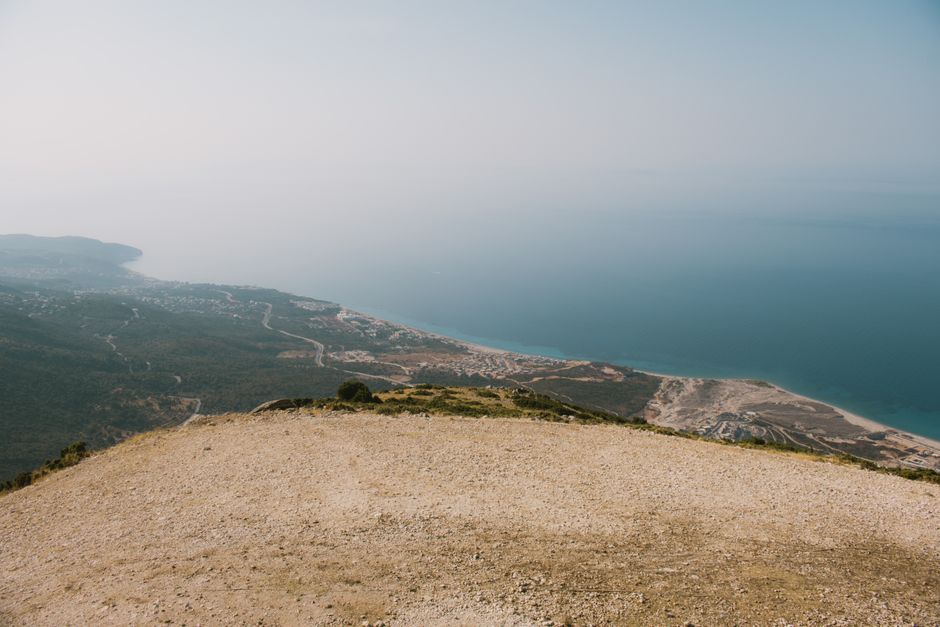
The Albanian Riviera is the wild, sunlit stretch of Ionian coast in the far south-west of Albania, where the mountains of the Llogara National Park fall straight into a sea of startling turquoise. From the pass at Llogara the road twists down to the beach villages of Dhërmi and Jale, past the hidden cove of Gjipe to the old castle town of Himarë, the Ottoman fortress at Porto Palermo and the long beach of Borsh, then on to Sarandë, the islands of Ksamil and the ancient city of Butrint by the Greek border. It is still cheaper and less built-up than most of the Mediterranean, with olive groves, citrus orchards and stone villages above the shore, though Ksamil and Sarandë now get very busy in August. Come in June or September, and give it four days to a week.
Right now in Albanian Riviera (Himarë)
- Wed19–24°C65–75°FPartly cloudy
- Thu19–21°C66–69°F18 mm rain
- Fri20–21°C68–70°F13 mm rain
Top tours in Albanian Riviera
See all tours for Albanian Riviera →
From local operators, with prices and reviews; you check availability and book on Viator, our partner. We may earn a commission at no extra cost to you. How we earn money
The Albanian Riviera at a glance
- Best months: June and September; late May and early October for quiet beaches and hiking. Mean temperatures run from about 19 °C in May to 25 °C in July and August (Hellenic National Meteorological Service, Corfu station, just across the strait), and it barely rains from June to August.
- Days needed: 3–4 for one base and a day at Butrint; a week to move down the coast from Dhërmi to Ksamil.
- Getting there: by ferry from Corfu to Sarandë, about half an hour by fast boat; by road from Tirana airport, about four to five hours to Himarë. The new Vlorë airport had not opened to commercial flights as of October 2026.
- Getting around: a hire car is easiest; buses and furgons link the villages with Vlorë and Sarandë, and boats serve the coves.
- Budget level: good value in June and September; Ksamil, Dhërmi and Sarandë are pricey in August. See our Albania guide for money and entry rules, and our Corfu guide for the Greek side of the strait.
The Riviera, village by village
- Dhërmi and Jale: the northern end, just below the Llogara Pass, with long white pebble beaches, beach clubs and summer festivals, and an old village of stone houses and churches on the hill above. Lively and stylish in summer; best for couples and friends.
- Vuno, Gjipe and Palasë: small villages and coves between Dhërmi and Himarë. Gjipe, at the mouth of a canyon, has no road access: walk down in about 20–30 minutes or arrive by boat.
- Himarë: a relaxed, family-friendly town on a bay, with a seafront promenade, nearby beaches such as Livadh and Llamani, and a castle village on the hill above. The best all-round base in the middle of the coast.
- Porto Palermo, Qeparo and Borsh: a quiet stretch with a triangular fortress on a small peninsula, a half-abandoned hill village and one of the longest beaches on the coast, backed by olive groves. Good for space and slower days.
- Lukovë and Piqeras: terraced villages and quiet coves on the road down to Sarandë.
- Sarandë: the biggest town and the ferry port for Corfu: a long, lively promenade, hotels, restaurants and nightlife, and a base for Butrint, the Blue Eye and Gjirokastër. Convenient without a car, but built-up.
- Ksamil: the southern tip, with small islands, shallow turquoise water and white sand that look like the Caribbean in photos. Beautiful but crowded and expensive in July and August; much better in June and September.
Top things to see on the Albanian Riviera
Prices and hours below are as of October 2026. Tickets are sold in lek (about 92 lek to the euro on 2 October 2026); several prices come from published reports and are flagged in our sources.
The Llogara Pass and the Llogara Tunnel
The road over the Llogara Pass, at a little over 1,000 m, is the grand entrance to the Riviera. From the north it climbs through the pine and fir forests of the Llogara National Park, with mountain restaurants serving roast lamb, then crests the ridge and drops in tight hairpins towards Dhërmi, with the whole coast and, on a clear day, Corfu laid out below. Paragliders launch from the top in summer. Since July 2024 the 6 km Llogara Tunnel, Albania’s longest, has bypassed the pass between Dukat and Palasë, cutting the crossing from about half an hour to a few minutes. Cars pay a toll at the Orikum end (cash or card; check the current rate). Take the tunnel if you are in a hurry or the weather is bad, but drive the old pass at least once, in daylight.
Butrint National Park
Butrint, about 18 km south of Sarandë and just past Ksamil, is the finest ancient site in Albania and a UNESCO World Heritage Site since 1992. The city stands on a wooded headland between a lagoon and the Vivari channel, and a loop path of about 2.5 km takes you through 2,500 years of history: the Greek theatre and sanctuary of Asclepius, Roman baths and houses, a 6th-century baptistery whose mosaic floor is usually covered with sand to protect it, a great basilica, the Lion Gate, and a Venetian tower and castle on the hilltop, now a small museum with views over the lagoon. Allow two to three hours. Frogs, turtles and egrets live in the marshy ruins.
How to visit (as of October 2026): the adult ticket is reported at 1,000 lek (about €11), with reduced tickets for 12- to 18-year-olds and students and free entry for children under 12. The park opens daily from the morning to the early evening in summer, with shorter hours in winter. Local buses run from Sarandë through Ksamil to the entrance, and a small cable ferry at the Vivari channel carries cars on towards Konispol and the Greek border. Go at opening time or late in the afternoon in summer, and take water, a hat and insect repellent.
The Blue Eye (Syri i Kaltër)
About 22 km inland from Sarandë, on the road to Gjirokastër, a karst spring wells up from more than 50 m down into a pool of almost unreal blue, ringed with deep green in a shady forest of plane trees. It is a protected natural monument and a source of drinking water, and swimming and jumping in the spring are banned; wardens enforce it. A small entrance fee (reported at 50 lek) and a parking charge are paid in cash. From the car park it is a walk of about 15–20 minutes along the river. Go early to avoid the tour buses, and combine it with Gjirokastër.
Himarë castle, Porto Palermo and the old villages
Above the modern seafront, the old town of Himarë sits within the walls of a castle on a hilltop, with ruined churches, stone houses and wide views of the coast; it is a short drive or a steep walk up. South of Himarë, the triangular fortress of Porto Palermo, built or rebuilt by the Ottoman governor Ali Pasha of Tepelena in the early 19th century, stands on a tiny peninsula in a sheltered bay; you can walk inside its dark rooms for a small fee. In the hills, the villages of Old Qeparo, Dhërmi, Vuno and Borsh (with its own castle ruin above the olive groves) are full of stone lanes and small churches, many being restored as guesthouses.
Sarandë and Lëkurësi castle
Sarandë is a modern resort, but it has a good promenade, the ruins of a 5th-century synagogue and basilica in the centre, and a lively evening scene. Drive or take a taxi up to Lëkurësi castle, an Ottoman fort on the hill above the town, for sunset over the bay and Corfu; there is a restaurant inside. Further up, the hilltop monastery of the Forty Saints (Shën Saranda), which gave the town its name, has ruins and big views.
Beaches on the Albanian Riviera
The Riviera’s beaches are mostly white pebble or fine shingle with some sand, and the water deepens quickly and stays clear. Every beach is public, but on popular ones much of the shore is rented to beach bars that charge for a pair of loungers and an umbrella, typically about €10–20 a day in summer and more on the front row in Ksamil or at smart clubs in Dhërmi. National rules keep a share of each beach free for anyone with a towel, and since 2026 local authorities set maximum lounger prices for each zone before the season; free zones may have no shade or showers. See our beaches guide.
- Dhërmi and Jale: long, bright pebble beaches with beach clubs; Jale is smaller and quieter.
- Gjipe: a sheltered cove at the mouth of a red-walled canyon, reached on foot from a car park above (about 20–30 minutes) or by boat. Bring water and shoes with grip.
- Livadh and Llamani (Himarë): easy, family-friendly bays near town.
- Borsh: several kilometres of beach, so there is always space.
- Lukovë and Krorëz: smaller coves; Krorëz is best reached by boat.
- Ksamil: sandy patches and shallow lagoons around the small islands just offshore; you can swim, paddle or take a short boat ride across. Arrive very early in August.
Bring water shoes for pebbles and sea urchins, and a snorkel mask: the rocks around Himarë, Porto Palermo and Ksamil have plenty of fish. Use licensed operators for jet skis and boats, and swim inside the buoyed areas where boats run close to shore.
Boat trips, snorkelling and hiking
- Karaburun and Sazan: from Vlorë, Radhimë or Orikum, boats visit Albania’s only marine national park, with sea caves such as Haxhi Ali’s cave, empty beaches on the Karaburun peninsula and stops at Sazan, a former military island. Full-day trips run in summer; see our boat trips guide.
- Coastal boats: from Himarë to Gjipe and the coves north of town, and from Sarandë and Ksamil to hidden beaches and the Ksamil islands.
- Snorkelling and diving: clear water and rocky reefs; dive centres in Sarandë, Himarë and Vlorë run trips to reefs and wrecks. See snorkeling and diving.
- Hiking: trails in the Llogara National Park, the walk down the Gjipe canyon, the path from Dhërmi to Gjipe along the cliffs, and the old mule tracks between the hill villages. Start early: there is little shade. See our hiking guide.
- Gjirokastër: the UNESCO-listed stone town is about an hour inland from Sarandë. Its huge castle (400 lek) holds an arms museum and views over the Drino valley.
- Corfu: a day trip across the strait by fast ferry. Take your passport or EU ID card; non-EU travellers are registered in the EU’s Entry/Exit System on arrival in Greece.
Getting there and getting around
By ferry from Corfu
The quickest way to the southern Riviera from abroad is often to fly to Corfu and take the ferry to Sarandë. Finikas Lines’ 2026 summer timetable runs from 1 June to 15 October, with frequent crossings of about half an hour between early morning and evening; Ionian Seaways also sails the route, and there are fewer boats in winter. Foot-passenger fares are roughly €10–25 one way, depending on season and boat. Albania is one hour behind Greece, so check which time your ticket shows. Coming from Albania, non-EU travellers go through the EU’s Entry/Exit System at Corfu port.
By road from Tirana
From Tirana airport, drive south on the motorway past Fier to Vlorë (about two hours), then along the Bay of Vlorë to Orikum and through the Llogara Tunnel or over the pass to Dhërmi and Himarë: about four to five hours in all. Sarandë is five hours or more by either the coast road or the faster inland road through Tepelenë and Gjirokastër. Buses run from Tirana’s South and North Bus Terminal to Vlorë, Himarë and Sarandë several times a day in summer; they are cheap but slow. The new Vlorë International Airport was built for the Riviera, but as of October 2026 it has not opened to commercial flights, according to press reports: its opening was postponed and charters moved to 2027.
On the Riviera
With a car you can stop at any cove, but the coast road is narrow and winding, and parking near the beaches in July and August is scarce and charged in cash. Without one, local buses and furgons run along the coast between Vlorë, Himarë and Sarandë, and between Sarandë, Ksamil and Butrint, more often in summer; taxis are easy in Sarandë and Ksamil, harder elsewhere. Boat taxis connect beaches near Himarë and Ksamil.
Nearby destinations
When to go and how long to stay
The Riviera has a classic Mediterranean climate: long, hot, dry summers and mild, rainy winters. June and September are ideal: warm, settled weather, a warm sea and fewer people. July and August are hot and crowded, with beach clubs, concerts and festivals in full swing and the highest prices, especially in Ksamil and Dhërmi. The sea is warm enough for most swimmers from about mid-June to early October. From November to April many hotels, beach bars and restaurants close, ferries run less often, and storms can bring heavy rain, but Sarandë stays open and the hiking is pleasant in spring.
| Season | Mean temperature | Days with rain a month | What it’s like |
|---|---|---|---|
| Spring (Mar–May) | 12–19 °C | 8–13 | Green hills and wild flowers; good for walking; sea cool until late May. |
| Summer (Jun–Aug) | 23–25 °C | 3–5 | Hot, sunny and dry; peak crowds and prices in July and August. |
| Autumn (Sep–Nov) | 22 °C falling to 14 °C | 7–15 | September is lovely, with the warmest sea; storms and rain from late October. |
| Winter (Dec–Feb) | 10–11 °C | 13–17 | Mild, wet and very quiet; many hotels closed; snow possible on the Llogara Pass. |
Figures are the Hellenic National Meteorological Service’s long-term averages (1955–2010) for its Corfu station, a few kilometres across the strait from Sarandë, used here because Albanian station normals are not published online. They are mean temperatures over day and night: afternoon highs in July and August are usually about 31 °C, and hotter in heatwaves. Almost all the rain falls between October and April. Vlorë and the northern Riviera are similar, slightly cooler in winter.
4 days on the Albanian Riviera
Day 1: drive over the Llogara Pass and settle in Himarë or Dhërmi; sunset on the beach. Day 2: walk down to Gjipe in the morning, then a lazy afternoon at Jale. Day 3: Porto Palermo and Borsh on the way south to Ksamil or Sarandë. Day 4: Butrint at opening time, then a swim off the Ksamil islands.
A week on the Albanian Riviera
Add a boat trip to Karaburun and Sazan from Vlorë or Orikum at the start, a day for the Blue Eye and Gjirokastër, and a lazy beach day at Lukovë. With more time, continue to Corfu by ferry and into Greece, or head inland to Berat.
Where to stay on the Albanian Riviera
- Couples and beach-club fans: Dhërmi or Jale.
- Families and a central base: Himarë, halfway down the coast, with easy beaches and restaurants.
- Quiet and space: Borsh, Qeparo or Lukovë.
- No car: Sarandë, with buses to Ksamil and Butrint and the ferry to Corfu.
- Turquoise water above all: Ksamil, ideally in June or September.
Albania has no national tourist tax; the small local tax on hotel stays is normally included in the room price. Many places on the Riviera are family-run guesthouses and apartments; check whether parking is included, which matters a lot in August.
Practical tips for the Albanian Riviera
- Cash: carry lek for parking, loungers, buses, the Blue Eye and small restaurants; euros are accepted in many places but with change in lek.
- Driving: take the coast road slowly, avoid driving it at night, and fill up before long stretches.
- Beat the crowds: reach Ksamil and Gjipe early, and visit Butrint at opening time.
- Fire risk: no fires or barbecues outdoors in the dry season; wildfires are a real risk on the hills.
- Respect the Blue Eye rules: no swimming in the spring.
- Time zone: Albania is one hour behind Corfu and Greece.
- Emergencies: call 112; 127 for an ambulance.
What to pack for the Albanian Riviera
For summer, pack light clothes, a sun hat, sunglasses, high-factor sunscreen and a refillable water bottle. Bring a swimsuit, a quick-dry towel, water shoes for pebbles and sea urchins, and a snorkel mask. Sturdy sandals or hiking shoes help on the paths to Gjipe and in the Llogara forest. Add a light layer for the windy Llogara Pass and boat trips, insect repellent for Butrint, and a scarf to cover shoulders in churches and monasteries. In spring and autumn, bring a rain jacket. Take your passport or EU ID card for the ferry to Corfu.
Albanian Riviera travel FAQ
Where is the Albanian Riviera?
On the Ionian coast in south-west Albania, from the Llogara Pass south of Vlorë down to Sarandë, Ksamil and Butrint near the Greek border, opposite Corfu.
What is the best base on the Albanian Riviera?
Himarë for a central, relaxed base with a car; Sarandë without a car; Dhërmi for beach clubs; Ksamil for turquoise water, ideally outside July and August.
How much does Butrint cost?
As of October 2026 the adult ticket is reported at 1,000 lek, about €11, with reduced prices for young people and students and free entry for children under 12. Check at the gate.
Can you swim in the Blue Eye?
No. The spring is a protected natural monument and a drinking-water source, and swimming and jumping are banned. A small cash entrance and parking fee apply.
Are the beaches in Ksamil free?
The beaches are public, but most of the shore is rented to beach bars that charge for loungers, often €10–15 or more a pair in summer. National rules keep some free zones, and local authorities set maximum prices each season.
How do I get from Corfu to Sarandë?
By ferry from Corfu Town, about half an hour by fast boat, with frequent sailings in summer and fewer in winter. Fares are roughly €10–25 one way.
Is the Llogara Tunnel open?
Yes. The 6 km tunnel opened in 2024 and charges a toll for cars. The old Llogara Pass road, with its famous views, is still open.
Can you fly to Vlorë?
Not yet. Vlorë International Airport had not opened to commercial flights as of October 2026, and charter flights were moved to 2027. Fly to Tirana or Corfu.
Do I need a car on the Albanian Riviera?
It helps a lot, especially for the coves and villages. Without one, base yourself in Sarandë or Himarë and use local buses, taxis and boats.
When is the sea warm enough to swim?
From about mid-June to early October for most swimmers, and warmest in August. May and late October are fresh but possible on calm, sunny days.
Can you visit Gjirokastër from the Riviera?
Yes, easily. It is about an hour’s drive from Sarandë, and the Blue Eye is on the way. The castle ticket is 400 lek; an overnight stay is even better.
Plan your trip
Partner links: TravelerCenter may earn a commission if you book, at no extra cost to you.
🇦🇱 Useful Albanian phrases for Albanian Riviera
All 38 Albanian phrases: restaurant, hotel, emergencies, romance (printable) →
Sources · last reviewed 4 October 2026
Researched and last reviewed on 4 October 2026. Ferry details come from Finikas Lines; climate from the Hellenic National Meteorological Service (Corfu station); the exchange rate from the Bank of Albania; Gjirokastër castle prices from the Regional Directorate of Cultural Heritage in Gjirokastër; entry and EES rules from the Albanian foreign ministry and the European Commission. The Butrint ticket, the Blue Eye fees and swimming ban, the beach rules and lounger prices, the Llogara Tunnel toll and the Vlorë airport delay come from published reports and are flagged for checking. Prices, timetables and rules change, so check the official sites before you travel.
Data: Weather: MET Norway (CC BY 4.0) · Sea temperature: NOAA CoastWatch · Rates: ECB · Costs: World Bank ICP and price levels · Wikidata (CC0)