Short answer: For a first trip, the top places to visit in Brazil are Rio de Janeiro, the Iguaçu Falls at Foz do Iguaçu, the colonial old town of Salvador, the Amazon rainforest from Manaus and the wildlife-rich wetlands of the Pantanal. Round out the list with the dunes and lagoons of Lençóis Maranhenses, the island paradise of Fernando de Noronha, colonial Paraty, the clear rivers of Bonito and the beaches of Florianópolis.
The list is ordered the way we would recommend places to a first-time visitor: Rio and the falls first, then culture, the great wild places and the beaches. Brazil is huge, so most trips combine domestic flights between two to four of these places. Fees are the official 2026 figures in Brazilian reais (R$).
1. Rio de Janeiro
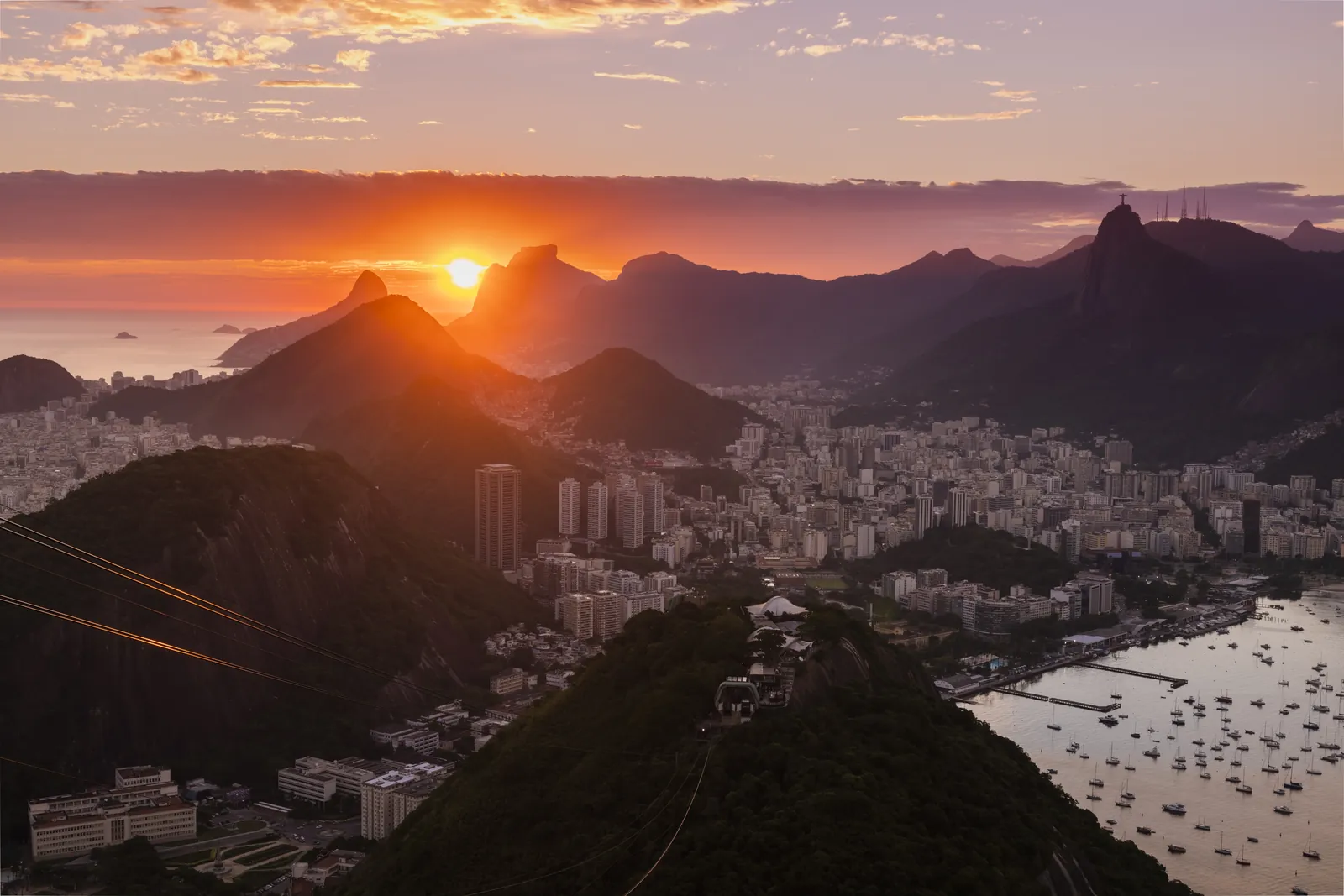
Why it made the list: few cities have a setting like Rio’s: granite peaks rising out of the rainforest, famous beaches such as Copacabana and Ipanema, and samba, football and street life everywhere. Its mountain-and-sea landscape is a UNESCO World Heritage Site.
Best time to go: September to November and March to May, when it is warm but less hot and crowded than high summer. January highs average about 30°C (86°F), and March is the wettest month. Carnival 2027’s main samba school parades are on the nights of February 7, 8 and 9.
Don’t miss: Christ the Redeemer on Corcovado, inaugurated in 1931, reached by the Corcovado train through Tijuca National Park, and the two-stage cable car up Sugarloaf Mountain for sunset.
Getting there and how long: Rio’s international airport (GIG) has flights from the US and Europe, and frequent domestic flights link it with the rest of Brazil. Stay four nights.
Practical note: the Corcovado train costs R$134 for adults of any nationality, and the Sugarloaf cable car starts at R$205; book both online. Afternoons from about 2 p.m. are usually less crowded at the statue. See our Rio de Janeiro travel guide.
2. Iguaçu Falls (Foz do Iguaçu)
Why it made the list: on the border with Argentina, the Iguaçu River plunges over about 275 waterfalls in the middle of the rainforest. Brazil’s Iguaçu National Park, a UNESCO World Heritage Site since 1986, gives the best panoramic views.
Best time to go: any time of year; the flow depends on recent rain upstream. September 2026 was the park’s busiest September on record, so expect company and arrive early.
Don’t miss: the Cataratas trail, about 1.5 km (1 mile) along the canyon to the walkway that juts out toward the Devil’s Throat, and the park’s sunrise visit, offered Wednesday to Saturday before regular opening.
Getting there and how long: Foz do Iguaçu has an airport with flights from Rio and São Paulo. Stay two nights, three to add the Argentine side.
Practical note: tickets are limited and sold online for a set date and time: R$134 for international visitors in 2026, with internal buses included. The park opens daily from 9 a.m. (8:30 a.m. at weekends) until 4 p.m., and you can stay until 5:30 p.m. For the Argentine side, see our Iguazú National Park travel guide, and for the Brazilian side our Foz do Iguaçu travel guide.
3. Salvador
Why it made the list: Brazil’s first capital is the heart of Afro-Brazilian culture, with a hilltop old town, the Pelourinho, of pastel colonial houses and gilded baroque churches, plus capoeira, drumming and some of the country’s best food.
Best time to go: September to March, the drier half of the year; May is the wettest month, with about 300 mm (12 in) of rain. Carnival 2027 runs from February 6 to 10, and Salvador’s is one of Brazil’s biggest street parties.
Don’t miss: a walk through the Pelourinho and the Church of São Francisco, whose interior is covered in gold, then the Lacerda Elevator, built in 1873, down to the lower city and the Mercado Modelo.
Getting there and how long: Salvador’s airport has flights from all major Brazilian cities. Stay three nights.
Practical note: the old town is a UNESCO World Heritage Site and is best explored by day on foot, with taxis or ride-hailing in the evening. See our Salvador travel guide.
4. The Amazon from Manaus
Why it made the list: Manaus, a city deep in the rainforest, is the easiest gateway to the Amazon. From here you can stay at a jungle lodge, canoe through flooded forest and see pink river dolphins.
Best time to go: any time, but the experience changes with the river, which usually peaks around June and is lowest around October and November. July to September is the least rainy stretch in Manaus, with about 56 to 79 mm a month.
Don’t miss: the Meeting of the Waters, where the dark Rio Negro and the sandy Solimões run side by side without mixing, and the Teatro Amazonas, the opera house opened on December 31, 1896, at the height of the rubber boom.
Getting there and how long: fly to Manaus from Rio, São Paulo or Brasília, then transfer by boat or road to a lodge. Allow four nights: one in the city and three at a lodge.
Practical note: the Teatro Amazonas runs guided visits Tuesday to Saturday from 9 a.m. to 5 p.m. and Sunday mornings (R$20). Check the CDC’s vaccine advice, which recommends yellow fever vaccination for Amazonas state. See our Manaus travel guide.
5. The Pantanal
Why it made the list: the world’s largest tropical wetland is the best place in South America to see wildlife in the open: caimans, capybaras, giant otters, hyacinth macaws and, with luck, jaguars along the rivers.
Best time to go: July to October, the dry season, when animals gather around the remaining water. At the Nhumirim station, July averages under 14 mm (half an inch) of rain, while December to March brings the floods. September is the hottest month, with highs near 36°C (97°F) at Cuiabá.
Don’t miss: a drive down the Transpantaneira, a dirt road of more than 100 wooden bridges, and a boat trip from Porto Jofre to look for jaguars on the riverbanks.
Getting there and how long: fly to Cuiabá for the northern Pantanal, or to Campo Grande for the south. Stay three or four nights at a ranch lodge.
Practical note: book a lodge with its own guides and boats; distances are long and roads rough. Parts of the Pantanal are a UNESCO World Heritage Site. See our Pantanal travel guide.
6. Lençóis Maranhenses National Park
Why it made the list: a desert of white dunes that fills with thousands of blue and green freshwater lagoons after the rains. It became a UNESCO World Heritage Site in 2024, and it looks like nowhere else on earth.
Best time to go: roughly June to September, when the lagoons are fullest and the sky clear. Nearby São Luís gets more than 400 mm (16 in) of rain in March and April but only about 3 mm in September and October, when the lagoons start to shrink.
Don’t miss: the Lagoa Azul circuit from Barreirinhas, a half-day trip by 4×4 with swims in the lagoons, and the Lagoa Bonita circuit at sunset.
Getting there and how long: fly to São Luís, then about four hours by road to Barreirinhas, the main gateway. Stay three nights.
Practical note: the park service (ICMBio) charges no entry fee, but you must visit with licensed vehicles, drivers and guides; private cars are not allowed in the park. See our Lençóis Maranhenses National Park travel guide.
7. Fernando de Noronha
Why it made the list: a small volcanic archipelago 545 km (339 miles) out in the Atlantic, with some of Brazil’s most beautiful beaches, clear water full of turtles and dolphins, and strict limits on visitors. About 70% of it is a marine national park.
Best time to go: August to December for calm, clear seas; from January to May big swells can close some swimming spots.
Don’t miss: Baía do Sancho, reached down a cliff ladder, and snorkeling in the natural pools at Atalaia, which need advance booking.
Getting there and how long: daily flights of about an hour from Recife. The island’s government suggests at least three days; four or five is better.
Practical note: every visitor pays the island’s environmental preservation fee (TPA), which rises with the length of stay (R$520.50 for five days in 2026), plus the national park ticket (R$384 for foreign visitors, valid 10 days; under-12s are exempt). Single-use plastics are banned. See our Fernando de Noronha travel guide.
8. Paraty
Why it made the list: a car-free colonial port of whitewashed churches and cobbled streets between green mountains and a bay full of islands. With nearby Ilha Grande, it is a UNESCO World Heritage Site for its culture and biodiversity.
Best time to go: April to June and September to November for mild weather without the summer crowds of December to February.
Don’t miss: a schooner trip around the bay’s islands and beaches, and a day at Trindade, with its natural rock pool by the sea.
Getting there and how long: about four to five hours by road from Rio or São Paulo, which makes it an easy add-on to a Rio trip. Stay two or three nights.
Practical note: the old town’s big uneven stones were laid to let the tide wash the streets, so wear sturdy shoes, not flip-flops. See our Paraty travel guide.
9. Bonito
Why it made the list: rivers so clear you float above fish as if in an aquarium, plus blue caves and sinkholes full of macaws. Bonito pioneered a strict, small-group model of nature tourism that keeps it pristine.
Best time to go: May to September usually brings the clearest water; December to February is when sunlight reaches the water of the Gruta do Lago Azul.
Don’t miss: a snorkel float down the Rio da Prata or the Sucuri, and the deep blue lake inside the Gruta do Lago Azul.
Getting there and how long: direct flights from São Paulo take about two hours, or drive about four hours from Campo Grande. Stay three or four nights, and combine with the southern Pantanal.
Practical note: every attraction has a daily limit and is booked through a local agency, so reserve early. Since December 2025, visitors also pay a conservation fee of R$15 per day, online, on days with attraction visits. See our Bonito travel guide.
10. Florianópolis
Why it made the list: an island city in southern Brazil with dozens of beaches, from surf breaks to calm bays, plus lagoons, dunes, hiking trails and fresh oysters. It is where Brazilians go for a beach holiday with a city’s restaurants.
Best time to go: December to March for beach weather, with highs of about 28–30°C (82–86°F); January is the wettest month. From about July to November southern right whales visit the coast to the south.
Don’t miss: the trail to Lagoinha do Leste, a wild beach between hills, and an evening at Lagoa da Conceição.
Getting there and how long: Florianópolis has an airport with flights from São Paulo and Rio. Stay three or four nights.
Practical note: traffic over the bridges is heavy in summer; stay near the beaches you want to use rather than in the city center. See our Florianópolis travel guide.
How to fit them into one trip
Distances in Brazil are continental, so plan on domestic flights and pick a few regions rather than all ten.
One week: four nights in Rio, then fly to Foz do Iguaçu for two or three nights to see the falls from both sides.
Ten days: Rio, Paraty and Iguaçu, or swap Paraty for three nights in Salvador.
Two weeks: Rio and Iguaçu, then one big nature trip: the Pantanal with Bonito (July to October), Lençóis Maranhenses (June to September) or a lodge in the Amazon, and finish on a beach in Salvador, Noronha or Florianópolis.
Timing changes the route: the Pantanal is best in the dry season from July to October, the dune lagoons from June to September, and the southern beaches from December to March. Our best time to visit Brazil guide goes month by month, and our AI trip planner builds the day-by-day plan for your dates.
Plan your trip
Start with our Brazil travel guide for visas, money and getting around. Use the AI trip planner to turn this list into a route, check rain and heat for your dates with the Destination weather tool, and convert prices with the Money exchange tool.
Frequently asked questions
What is the most beautiful place in Brazil?
Many travelers name the Iguaçu Falls, the lagoons of Lençóis Maranhenses, or Rio de Janeiro seen from Sugarloaf Mountain at sunset. Fernando de Noronha is often called the country’s most beautiful beach destination.
How many days do you need in Brazil?
At least a week for Rio and the Iguaçu Falls. Ten days to two weeks lets you add Salvador or Paraty and one nature trip, such as the Pantanal, the Amazon or Lençóis Maranhenses.
What is the best place in Brazil for first-time visitors?
Rio de Janeiro. It has international flights, the country’s most famous sights and beaches, and good connections to Iguaçu, Paraty and the rest of Brazil.
Do US citizens need a visa for Brazil?
Yes. Since April 10, 2025, citizens of the United States, Canada and Australia need a visitor visa, applied for online as an e-visa. It costs US$80.90 and allows stays of up to 90 days a year.
Is it better to see Iguaçu Falls from Brazil or Argentina?
Do both if you can. The Brazilian side gives the big panoramic views in a half day, while the Argentine side has longer trails that take you right above and beside the falls, including the Devil’s Throat, and needs a full day.