Short answer: For a first trip, the top places to visit in Costa Rica are La Fortuna and Arenal Volcano, Manuel Antonio National Park, the Monteverde cloud forest, the turtle beaches and canals of Tortuguero, and the Pacific beaches around Tamarindo. Round out the list with the Caribbean coast at Puerto Viejo and Cahuita, the wild Osa Peninsula and Corcovado, Rincón de la Vieja, San José with its volcanoes, and the sky-blue Río Celeste.
The list is ordered the way we would recommend places to a first-time visitor: the classics first, then the wilder corners for a longer trip. Park hours and fees are the official figures as of October 2026; most popular parks sell tickets only online, for a set date and time slot, through the national parks service (SINAC).
1. La Fortuna and Arenal Volcano
Why it made the list: the small town of La Fortuna sits below the near-perfect cone of Arenal Volcano, and no other base in Costa Rica packs in as much in a few days: lava-flow trails, hot springs, a jungle waterfall, hanging bridges and rafting.
Best time to go: February to April. The northern plains get more than 3,200 mm (126 in) of rain a year, in one long rainy season from May to December or January, and February to April is the relatively drier spell, when the volcano’s cone is most often clear. The hot springs work in any weather.
Don’t miss: the trails of Arenal Volcano National Park, which cross the lava flows of 1992 and pass a giant ceiba tree more than 400 years old, and an evening soak in the volcano-heated hot springs.
Getting there and how long: about three hours by road from San José or Liberia, or a short SANSA flight to La Fortuna’s airstrip. Stay two or three nights.
Practical note: the national park is open daily from 8 a.m. to 4 p.m., and foreign adults pay US$16.95 (children US$5.65). See our La Fortuna travel guide.
2. Manuel Antonio National Park
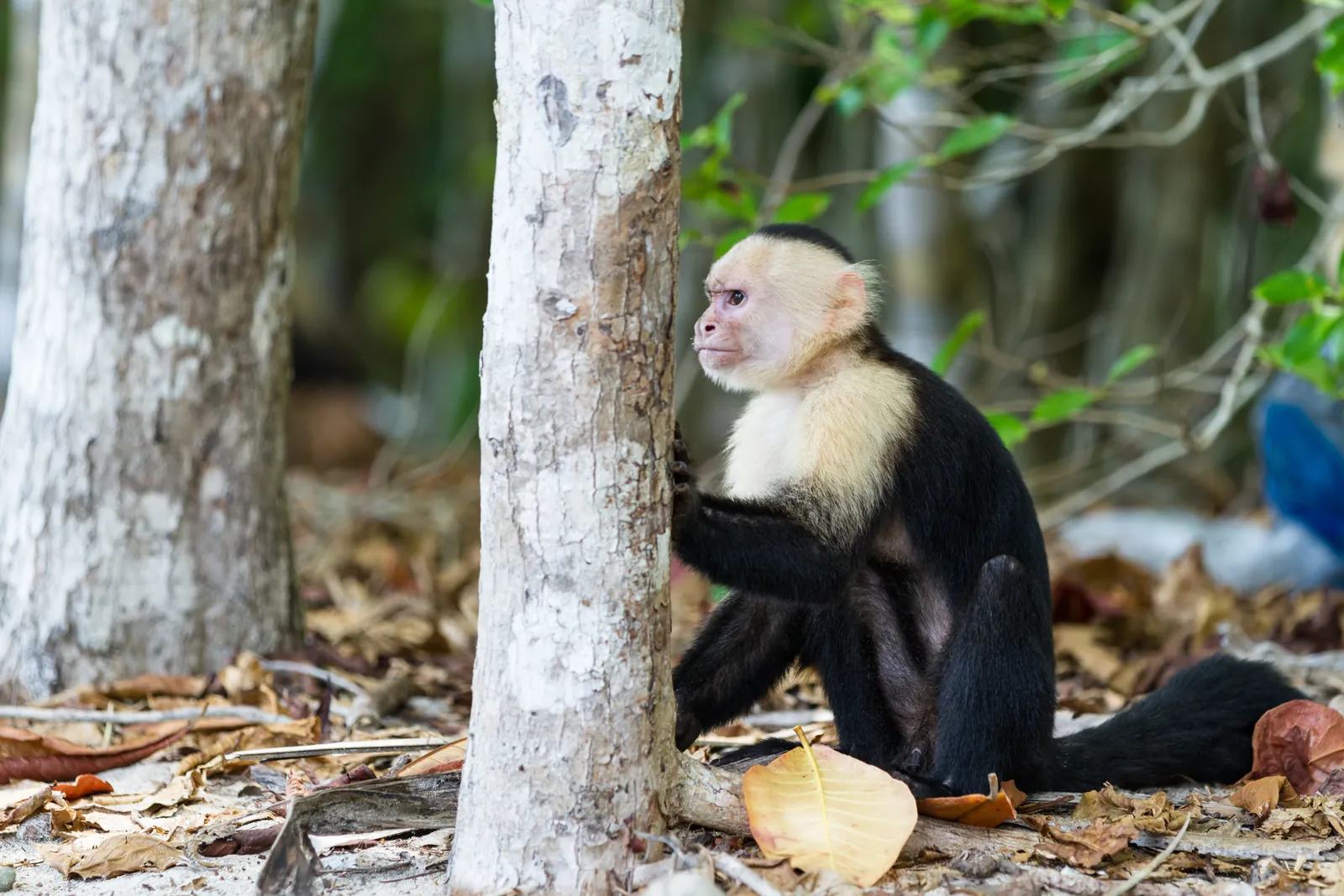
Why it made the list: Manuel Antonio is Costa Rica’s most visited protected area, and for good reason: rainforest runs straight down to white-sand coves, and sloths, white-faced capuchins and the tiny squirrel monkey (the park’s emblem) are often seen from the trails. It is small, easy to walk and ideal for families.
Best time to go: December to April, the Pacific dry season. September and October are the wettest and least visited months.
Don’t miss: a swim at Playa Manuel Antonio, and the loop around Punta Catedral, a former island now joined to the coast by a sandbar, with viewpoints over the sea.
Getting there and how long: the park is 157 km south of San José, and the main entrance is 7 km from the town of Quepos, which has a SANSA airstrip. Stay two or three nights.
Practical note: the park is closed on Tuesdays and open the other days from 7 a.m. to 3 p.m. Tickets are sold only online (foreign adults US$18.08, children 2–12 US$5.65). Feeding animals is banned. See our Manuel Antonio National Park travel guide.
3. Monteverde
Why it made the list: high on the continental divide, Monteverde and the village of Santa Elena are the base for walking through moss-draped cloud forest, where trees drip with orchids and the resplendent quetzal nests.
Best time to go: March and April for the calmest, clearest weeks and the quetzal breeding season (roughly March to June). December to February is dry but windy and misty up here.
Don’t miss: the Monteverde Cloud Forest Preserve, which protects more than 10,000 acres (4,100 ha). Go self-guided between 7:30 a.m. and 4 p.m., take the guided Natural History Walk (7:30 a.m. to 1 p.m.), or join the Night Walk at dusk.
Getting there and how long: about three and a half to four hours from San José, or about three hours from La Fortuna by the jeep-boat-jeep transfer across Lake Arenal. Stay two nights.
Practical note: the preserve sells timed entry slots and you start at its visitor center, 1 mile (1.5 km) below the entrance, where a free shuttle runs. Pack a fleece. See our Monteverde travel guide.
4. Tortuguero National Park
Why it made the list: a roadless world of canals, lagoons and rainforest on the Caribbean coast, Tortuguero is, according to SINAC, the most important nesting beach for green turtles in the Western Hemisphere.
Best time to go: July to October for nesting green turtles, which nest from June to October, with hatchlings on the beach from about August. March, April and October are the least rainy months.
Don’t miss: an early canoe or kayak trip on Caño Chiquero, where only paddles and electric motors are allowed, and a night turtle walk with a trained local guide in season.
Getting there and how long: by boat from the La Pavona dock or by small plane. Most visitors book a two-night package from San José.
Practical note: the park is open daily from 6 a.m. to noon and 1 to 4 p.m. (foreign adults US$16.95). From March 1 to October 31 the beach is closed to visitors from 6 p.m. to 6 a.m. except on guided turtle tours, and swimming in the sea and lagoons is not recommended. See our Tortuguero National Park travel guide.
5. Tamarindo and the Guanacaste beaches
Why it made the list: Guanacaste is Costa Rica’s driest, sunniest region, and Tamarindo is its liveliest beach town, with easy surf for beginners and plenty of places to eat.
Best time to go: December to April. At Liberia’s airport, each month from December to March averages only about 2 to 12 mm (0.1–0.5 in) of rain. From October to February, leatherback turtles nest on the beaches of Las Baulas National Marine Park, next to town.
Don’t miss: a surf lesson on Tamarindo’s beach, and a boat trip with a local guide into the Tamarindo estuary, a mangrove of global importance that is part of Las Baulas.
Getting there and how long: about 1 hour 15 minutes by road from Liberia’s international airport, or a SANSA flight to Tamarindo. Stay three or four nights.
Practical note: April is the hottest month, with average highs near 38°C (100°F) inland at Liberia, so plan active days for the morning. See our Tamarindo travel guide.
6. Puerto Viejo de Talamanca and Cahuita
Why it made the list: the southern Caribbean coast has a different rhythm from the rest of the country: Afro-Caribbean food and music, palm-lined beaches, and coral reefs right off the sand. Puerto Viejo is the easygoing base.
Best time to go: September and October, when the Caribbean coast is at its driest (September is the driest month at Puerto Limón) and the Pacific is at its wettest.
Don’t miss: the coastal trail through Cahuita National Park, protected since 1970 for its coral reef and among the country’s first national parks, and the beaches of the Gandoca-Manzanillo Wildlife Refuge at the end of the road, which charges no entry fee.
Getting there and how long: about four and a half to five hours by road from San José. Stay three or four nights.
Practical note: Cahuita has two entrances, both open daily from 8 a.m. to 4 p.m.: at Playa Blanca, in Cahuita village, you leave a voluntary donation, while Puerto Vargas charges foreign visitors US$5.65 and has parking. Snorkel on the reef with a certified guide. See our Puerto Viejo de Talamanca travel guide.
7. Corcovado National Park and the Osa Peninsula
Why it made the list: Corcovado, on the remote Osa Peninsula in the far south, is Costa Rica’s wildest park and one of its most biologically rich. Tapirs, three kinds of monkey and even jaguars, pumas and ocelots live here.
Best time to go: the dry season, December to April, which Costa Rica’s tourism board (ICT) recommends for Corcovado.
Don’t miss: a full day, or an overnight, at the Sirena ranger station, the park’s wildlife hotspot, and the boat ride along the coast from Drake Bay.
Getting there and how long: the two gateways are Drake Bay, usually reached by boat from Sierpe, and Puerto Jiménez, reached by road or bus from San José; SANSA flies to both. The La Leona entrance is reached from Carate beach. Allow three or four nights on the peninsula.
Practical note: you must enter Corcovado with an authorized guide, so book a guided tour through your lodge or a licensed operator rather than planning to walk in alone. We do not have a Corcovado page yet; see the parks section of our Costa Rica travel guide.
8. Rincón de la Vieja National Park
Why it made the list: an active volcano in the dry northwest, with bubbling mud pots, steaming vents, waterfalls and hot springs in dry tropical forest. It is an easy day away from the Guanacaste beaches.
Best time to go: December to April, Guanacaste’s dry season, when trails are firm.
Don’t miss: the loop trail in the Las Pailas sector past the volcanic mud pots and fumaroles, then a soak at one of the hot springs nearby.
Getting there and how long: the park is northeast of the city of Liberia, close to its international airport. A day trip from Tamarindo or a night at a lodge near the park both work well.
Practical note: buy tickets online (foreign adults US$16.95, children US$5.65). The Las Pailas sector opens Tuesday to Sunday from 8 a.m. to 3 p.m. and is closed on Mondays; the Santa María sector opens Thursday to Monday, 8 a.m. to 3:30 p.m. See the Rincón de la Vieja day trip in our Tamarindo travel guide.
9. San José and the Central Valley volcanoes
Why it made the list: most trips start and end near the capital, and a day here adds the culture the rest of the list lacks: pre-Columbian gold, a grand 19th-century theater and lively markets.
Best time to go: December to April, when there is almost no rain.
Don’t miss: the Central Bank’s Gold Museum (daily 9 a.m. to 4:30 p.m.), the National Museum in a former army barracks, and the National Theatre. For a day trip, visit Poás Volcano (daily 8 a.m. to 4 p.m., last entry 2 p.m., tickets online only) or Irazú, whose crater rim sits at 3,432 m (11,260 ft) and averages only 5–9°C (41–48°F).
Getting there and how long: Juan Santamaría International Airport (SJO) is in Alajuela, about 20 km from downtown. One or two nights is enough.
Practical note: go to the volcanoes early, before the clouds roll in, and bring a warm layer. See our San José travel guide.
10. Río Celeste and Tenorio Volcano National Park
Why it made the list: the Río Celeste is a river of startling sky-blue water that tumbles over a waterfall into a turquoise pool, deep in the rainforest of Tenorio Volcano National Park. It makes a rewarding half-day hike.
Best time to go: February to April, the relatively driest spell in the northern plains.
Don’t miss: the waterfall viewpoint, then the trail on to the spot where two clear streams meet and the river turns blue.
Getting there and how long: about one and a half to two hours by road from La Fortuna, so most people visit on a day trip from there or stop on the way to Guanacaste.
Practical note: Tenorio is one of the parks that sell tickets online for a set date and time slot, so book ahead. Swimming in the river inside the park is not allowed. See the day trips in our La Fortuna travel guide.
How to fit them into one trip
Do not try to see all ten at once: roads are winding and wildlife is best early, so pick three or four bases and give each at least two nights.
One week: San José, then La Fortuna (two nights, with a day trip to the Río Celeste), Monteverde (two nights) and Manuel Antonio (two nights), avoiding a Tuesday for the park.
Ten days: fly into Liberia, spend four nights in Tamarindo with a day at Rincón de la Vieja, then head inland to Monteverde and La Fortuna for three nights each, and fly home from San José.
Two weeks: start on the Caribbean side with two nights in Tortuguero and four in Puerto Viejo, return through San José to La Fortuna and Monteverde, and end at Manuel Antonio. With a few more days, add the Osa Peninsula and Corcovado from Manuel Antonio, or by SANSA flight from San José.
Timing changes the route: the Pacific and Guanacaste are best from December to April, while the Caribbean coast is at its best in September and October. Our best time to visit Costa Rica guide goes month by month, and our AI trip planner builds the day-by-day plan for your dates.
Plan your trip
Start with our Costa Rica travel guide for entry rules, park tickets, money and getting around. Use the AI trip planner to turn this list into a route, check what to expect on your dates with the Destination weather tool, and build a list for rain, heat and cool mountains with the packing list tool.
Frequently asked questions
What is the most beautiful place in Costa Rica?
It depends on what you love, but three places top most lists: Manuel Antonio, where rainforest meets white-sand coves; Arenal Volcano rising above La Fortuna on a clear morning; and the sky-blue Río Celeste in Tenorio Volcano National Park.
How many days do you need in Costa Rica?
Seven days is enough for a first loop of La Fortuna, Monteverde and Manuel Antonio. Ten days lets you add Guanacaste’s beaches and Rincón de la Vieja, and two weeks covers both coasts, including Tortuguero and Puerto Viejo.
What is the best place in Costa Rica for first-time visitors?
La Fortuna. It is about three hours from both international airports, has the widest choice of activities in one place (volcano trails, hot springs, a waterfall, hanging bridges and rafting), and pairs easily with Monteverde and the Pacific beaches.
Do I need to book national park tickets in advance?
For the popular parks, yes. Manuel Antonio, Poás, Irazú, Tortuguero, Rincón de la Vieja, Tenorio and several others sell tickets online through SINAC’s booking system for a set date and time slot. Tickets are personal and non-refundable.
Which is better, Costa Rica’s Pacific or Caribbean coast?
For a first trip, most visitors choose the Pacific: Manuel Antonio and Guanacaste have more places to stay and a reliable dry season from December to April. The Caribbean coast, with Tortuguero, Cahuita and Puerto Viejo, is quieter and more laid-back, and it is at its best in September and October, when the Pacific is wet.