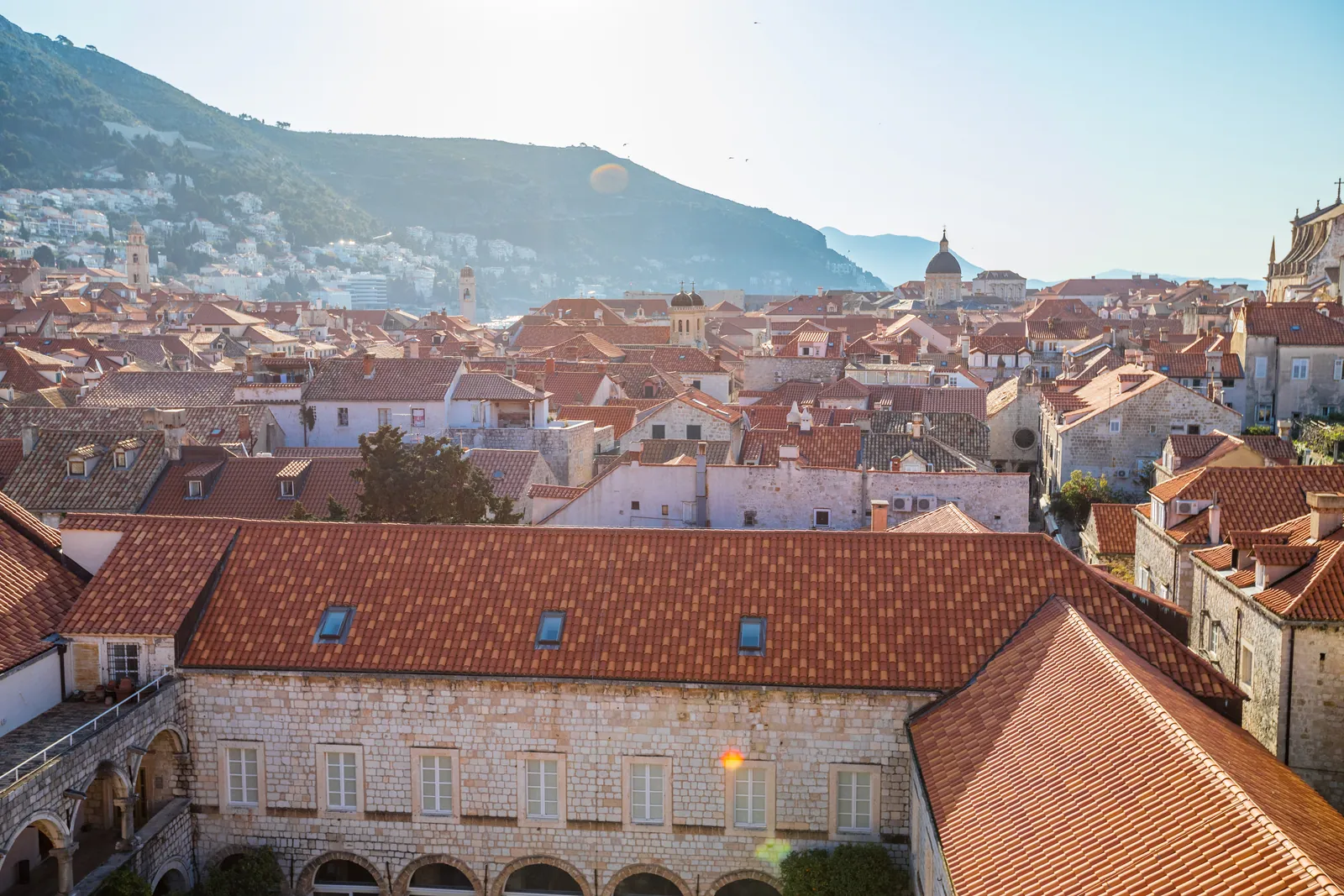
Short answer: For a first trip, the top places to visit in Croatia are Dubrovnik and its city walls, Split and Diocletian’s Palace, the waterfalls of Plitvice Lakes, the island of Hvar and the hill towns and coast of Istria. Round out the list with Krka National Park, Zadar, the capital Zagreb, the Makarska Riviera below Biokovo mountain, and the island of Krk.
The list is ordered the way we would recommend places to a first-time visitor: the Dalmatian classics first, then the north and the capital. Ticket prices are the official 2026 figures, in euros, which Croatia has used since January 1, 2023.
1. Dubrovnik
Why it made the list: Dubrovnik’s old town, a UNESCO World Heritage Site, is wrapped in some of the most complete medieval walls in Europe, with marble streets, baroque churches and the Adriatic on three sides. Walking the walls is the single most memorable thing most visitors do in Croatia.
Best time to go: late May, June and September into early October. July and August are the sunniest months, with only four or five rainy days on average, but they are also the hottest and busiest.
Don’t miss: the walk around the city walls, which run 1,940 m (about 1.2 miles) with 16 towers and reach 25 m (82 ft) high; the same ticket includes Fort Lovrijenac on its rock outside the walls. Then take the boat from the old port to the island of Lokrum, a nature reserve (€30 per person, return boat included).
Getting there and how long: Dubrovnik has its own airport, and catamarans link it with Korčula, Hvar and Split in season. Stay two or three nights.
Practical note: walk the walls first thing in the morning or late in the afternoon, when it is cooler and the cruise crowds have thinned; the walls are open every day except December 25 and you do not need a reservation. Dubrovnik charges a tourist tax of €2.65 per person per night from April to September. See our Dubrovnik travel guide.
2. Split and Diocletian’s Palace
Why it made the list: Split is a living city built inside and around the palace that the Roman emperor Diocletian built for his retirement around 305 AD. Cafés fill the old courtyards, people live in the palace walls, and the harbor is the main ferry hub for the central Dalmatian islands.
Best time to go: May, June and September. July is the driest month, with about 27 mm (1 in) of rain on average at Split, but also the most crowded.
Don’t miss: the Peristyle and the Vestibule, the Temple of Jupiter, and the Cathedral of Saint Domnius, built as Diocletian’s mausoleum, with a bell tower 57 m (187 ft) high that you can climb for views over the red roofs. Finish with a sunset walk on Marjan hill.
Getting there and how long: Split has an international airport and is the main ferry port for Hvar, Brač and Vis. Stay two nights, more if you use it as a base for island day trips.
Practical note: inside the old town, drinking in public, climbing on monuments and bathing in fountains can bring a €300 fine under the city’s public order rules. See our Split travel guide.
3. Plitvice Lakes National Park
Why it made the list: Croatia’s best-known national park is a staircase of turquoise lakes linked by waterfalls, crossed on wooden boardwalks through beech and fir forest. It is a UNESCO World Heritage Site and the country’s most famous natural sight.
Best time to go: May, June, September and October, when the waterfalls are full and the summer peak is over. In winter usually only the Lower Lakes are open; the Upper Lakes normally reopen in early April.
Don’t miss: the Lower Lakes and the Great Waterfall, then the electric boat across the main lake to the Upper Lakes. The park’s marked routes run from about 3.5 km (2–3 hours, route A) to 8 km and more (4–6 hours, routes C and H).
Getting there and how long: the park lies inland, roughly between Zagreb and Zadar, so most people stop on the drive down the coast. One full day is enough; stay nearby the night before to arrive at opening time.
Practical note: buy tickets online for a set entrance and time window: you cannot enter early, and you can be at most an hour late. A day ticket costs €40 for adults from June to September (€25 late in the day), €23 in April, May and October, and €10 in winter; the boat and panoramic train are included. Swimming is strictly prohibited. See our Plitvice Lakes travel guide.
4. Hvar
Why it made the list: Hvar is the glamorous island of the Dalmatian coast: a Venetian harbor town with a hilltop fortress, lavender fields, vineyards, and the small Pakleni Islands just offshore for swimming. Its weather station records about 2,750 hours of sunshine a year, among the most in Croatia.
Best time to go: June and September. June brings the lavender into bloom; September has warm seas and fewer people than high summer.
Don’t miss: the climb to the Fortica fortress above Hvar town at sunset, a taxi boat to the Pakleni Islands, and the Stari Grad Plain, an ancient Greek field system that is a UNESCO World Heritage Site.
Getting there and how long: about an hour by catamaran from Split to Hvar town, or by car ferry from Split to Stari Grad. Stay two or three nights.
Practical note: Hvar town is lively and busy in July and August, and it fines people who walk around town in swimwear away from the beach; Stari Grad and Jelsa are quieter bases. See our Hvar travel guide.
5. Istria
Why it made the list: the heart-shaped peninsula in the far northwest feels like a mix of Croatia and Italy: hill towns above vineyards and olive groves, the Venetian harbor of Rovinj, truffle restaurants, and the great Roman arena at Pula.
Best time to go: May, June and September for the coast; autumn for food lovers, when the white truffle season starts. Inland Istria is cooler than Dalmatia in winter.
Don’t miss: the Pula Arena, one of the largest surviving Roman amphitheaters, and the old town of Rovinj; then drive up to hilltop Motovun and Hum. In Poreč, the Euphrasian Basilica, with its 6th-century mosaics, is a UNESCO World Heritage Site.
Getting there and how long: Pula has an airport, and Istria is an easy drive from Zagreb, Ljubljana or Trieste. Stay three or four nights with a car.
Practical note: the Pula Arena costs €10 for adults (€5 for students and children) and stays open until 8 to 10 p.m. in the warm months. See our Istria travel guide.
6. Krka National Park
Why it made the list: Krka protects a river canyon with seven waterfalls and about 47 km (29 miles) of walking paths. It is smaller and closer to the coast than Plitvice, which makes it an easy half-day or day trip from Split, Šibenik or Zadar.
Best time to go: April, May, September and October, when prices are lower and the boats and shuttles still run (they operate from April 1 to October 31).
Don’t miss: the loop trail around Skradinski buk, the park’s biggest and best-known cascade, and the boat trip to Visovac, a tiny island monastery in the middle of the river (2 hours, €15).
Getting there and how long: enter at Lozovac, where a shuttle bus runs down to the falls, or at Skradin, where the boat ride upriver is included in the ticket. Allow most of a day.
Practical note: the 2026 adult ticket for all land sites is €40 from June to September (€30 after 3 p.m.), €20 in April, May and October, and €7 in winter. Swimming is allowed only at specially marked places, not at Skradinski buk. See our Krka National Park travel guide.
7. Zadar
Why it made the list: Zadar has a compact Roman and medieval old town on a peninsula, famous sunsets, and easy boat trips to the islands of the Kornati archipelago. It is less crowded than Split or Dubrovnik and well placed between Plitvice and Krka.
Best time to go: June to early September for sea and sun; September is Zadar’s wettest month on average, so plan some flexibility then.
Don’t miss: sunset on the waterfront at the Sea Organ, whose pipes play with the waves, and the Greeting to the Sun light installation next to it; then a boat day to Kornati National Park and Telašćica Nature Park.
Getting there and how long: Zadar has an airport, and fast boats link it with Pula in season. Stay two nights.
Practical note: Kornati requires a valid park ticket for each day, cheaper if bought before you enter; Telašćica charges €6 per person outside summer and €8 from June to September. See our Zadar travel guide.
8. Zagreb
Why it made the list: the capital is a relaxed Central European city of cafés, museums and parks, a world away from the coast. It is the natural start or end of a road trip and the place to go in December, when its Advent market is one of Europe’s best known.
Best time to go: May to September for café terraces, and late November to early January for Advent. Winters are cold: January averages under 1°C (34°F) at the Grič station.
Don’t miss: the Upper Town, reached by the short funicular that reopened in May 2026 after restoration, with St Mark’s Church and the Stone Gate; the Dolac market; and the cathedral, which reopened to visitors in April 2026 after earthquake repairs.
Getting there and how long: Zagreb has Croatia’s main airport and good motorway links to the coast. One or two nights is enough.
Practical note: some museums are still closed for post-earthquake work, so check before you go. See our Zagreb travel guide.
9. The Makarska Riviera and Biokovo
Why it made the list: south of Split, a string of pebble beaches backed by pine trees runs below the bare limestone wall of Biokovo mountain. It is the place for a classic beach stay with a mountain view, from Brela to Tučepi.
Best time to go: June and September for swimming. Biokovo Nature Park’s road is open from April to October.
Don’t miss: a swim at Brela’s beaches, and the drive up Biokovo to the Skywalk, a glass walkway above a cliff 1,228 m (4,029 ft) high, and on toward Sveti Jure, at 1,762 m (5,781 ft) the mountain’s highest point.
Getting there and how long: Makarska is about 60 km (37 miles) south of Split by road. Stay three or four nights for a beach break.
Practical note: Biokovo tickets are sold online only, for a time slot: €15 for adults from June to September and €10 in April, May and October. The road is single-lane and only 20 cars enter each hour, so book ahead. See our Makarska Riviera travel guide.
10. Krk
Why it made the list: Krk is the easiest Croatian island to reach, joined to the mainland by a bridge, with sandy-bottomed bays at Baška, the clifftop wine village of Vrbnik, and a walled old town. It suits families and drivers coming from Zagreb, Slovenia or Italy.
Best time to go: June to September for the sea; the Krk tourist board counts about 2,500 hours of sunshine a year.
Don’t miss: Baška’s long beach and the Glagolitic heritage around it, and a boat from Punat to the Franciscan monastery on the islet of Košljun (€6 for adults).
Getting there and how long: drive across the Krk Bridge, which has been toll-free since June 2020; Rijeka Airport is on the island itself. Stay three or four nights.
Practical note: Krk is busiest with weekend drivers in July and August; for a quieter stay pick Vrbnik or a village inland. See our Krk travel guide.
How to fit them into one trip
Croatia’s coast is long and the islands run on ferry timetables, so pick a direction, north to south or south to north, and give each base at least two nights.
One week: fly into Split, spend two nights there, two nights on Hvar, then take the catamaran to Dubrovnik for three nights. Add a day trip to Krka from Split if you can.
Ten days: fly into Zagreb, drive to Plitvice Lakes (one night), continue to Zadar (two nights), stop at Krka on the way to Split (two nights), cross to Hvar (two nights) and finish in Dubrovnik (two or three nights). Fly home from Dubrovnik.
Two weeks: start in Istria for three or four nights, add Krk or the Kvarner coast, then follow the ten-day route south. Swap in the Makarska Riviera for a few beach days between Split and Dubrovnik.
Timing changes the route: Plitvice, Krka and the coast are at their best in late spring and early autumn, many island services slow down from November to March, and Zagreb shines in December. Our best time to visit Croatia guide goes month by month, and our AI trip planner builds the day-by-day plan for your dates.
Plan your trip
Start with our Croatia travel guide for entry rules, ferries, money and driving. Use the AI trip planner to turn this list into a route, check sea and air temperatures for your dates with the Destination weather tool, and convert prices with the Money exchange tool.
Frequently asked questions
What is the most beautiful place in Croatia?
Most travelers name three: Dubrovnik’s old town seen from its walls or from Srđ hill, the waterfalls and turquoise lakes of Plitvice Lakes National Park, and the view over Hvar town and the Pakleni Islands from the Fortica fortress.
How many days do you need in Croatia?
Seven days is enough for Split, Hvar and Dubrovnik. Ten days lets you add Plitvice Lakes, Zadar and Krka on a road trip from Zagreb, and two weeks covers Istria too.
What is the best place in Croatia for first-time visitors?
Split. It has an international airport, the Roman palace and lively old town, and ferries to the islands, and it sits halfway between Plitvice Lakes and Dubrovnik, so it fits almost any route.
Do I need to book Plitvice Lakes tickets in advance?
In summer, yes. The park sells online tickets for a set entrance and time window, and you cannot enter before your time. From June to September an adult day ticket costs €40, or €25 later in the day.
Is Croatia better in June or September?
Both are excellent. June has longer days and the lavender in bloom on Hvar; September has a warm sea and fewer families on the beaches. July and August are the hottest and most crowded months.