Short answer: The top places to visit in India are Agra and the Taj Mahal, Delhi, Jaipur, Udaipur, Varanasi, the Kerala backwaters at Alappuzha, Goa, Amritsar and the Golden Temple, Leh in Ladakh, and the ruins of Hampi. For a first trip, plan two weeks: the Golden Triangle of Delhi, Agra and Jaipur, plus Varanasi or Udaipur, and save Kerala and Goa for the south.
India is less a country than a continent, from the Himalaya to the palm-fringed backwaters of Kerala and from the deserts of Rajasthan to the holy river Ganges. This list is ordered the way we would recommend the places for a first visit, with when to go, what not to miss, how to get there and a practical note for each.
October to March is the best time for most of India: dry and sunny, with days of about 20–33 °C (68–91 °F) in the Golden Triangle. April to June is very hot in the plains, the monsoon lasts from June to September, and Ladakh runs on its own calendar, best from June to September. Our best time to visit India guide covers every region month by month.
1. Agra and the Taj Mahal
Why it made the list: the Taj Mahal, the white marble mausoleum that Shah Jahan built for his wife Mumtaz Mahal, is the most famous building in India. Agra, the old Mughal capital on the Yamuna, also has the red sandstone Agra Fort and, 40 km (25 miles) away, Akbar’s abandoned city of Fatehpur Sikri, both UNESCO World Heritage Sites as well.
Best time to go: October to March. The Taj is open from 30 minutes before sunrise to 30 minutes before sunset, every day except Friday.
Don’t miss: the Taj at sunrise, the sunset view of it from the Mehtab Bagh gardens across the river, and the marble inlay of the tomb of Itimad-ud-Daulah.
Getting there and how long: the fastest trains from Delhi take about two hours to Agra Cantonment. Stay one night so you can see the Taj at dawn.
Practical note: Taj tickets for foreign visitors cost ₹1,100 at the window, ₹50 less online, plus ₹200 to enter the main mausoleum; under-15s are free. The East Gate is usually less crowded than the West Gate. See our Agra travel guide.
2. Delhi
Why it made the list: India’s capital is a city of layers, from the 12th-century Qutub Minar to the Mughal lanes of Old Delhi and the avenues of New Delhi. Three of its monuments are UNESCO World Heritage Sites: the Red Fort, Humayun’s Tomb and the Qutub Minar complex. It is also the gateway for the Golden Triangle.
Best time to go: October to March; February, March and October have the cleanest air of the cool season. New Delhi averages 20 °C (68 °F) by day in January, with cold nights and foggy mornings.
Don’t miss: the gardens and dome of Humayun’s Tomb, a walk through the spice market and lanes of Old Delhi, and the Qutub Minar in the evening light.
Getting there and how long: Indira Gandhi International Airport, India’s busiest, is linked to the center by an express metro line. Stay two or three days, at the start and end of your trip.
Practical note: the Red Fort is open from 09:30 to 16:30 and closed on Mondays. Book monument tickets online with the Archaeological Survey of India; foreign visitors pay ₹550 for the Red Fort, Qutub Minar and Humayun’s Tomb. See our Delhi travel guide.
3. Jaipur
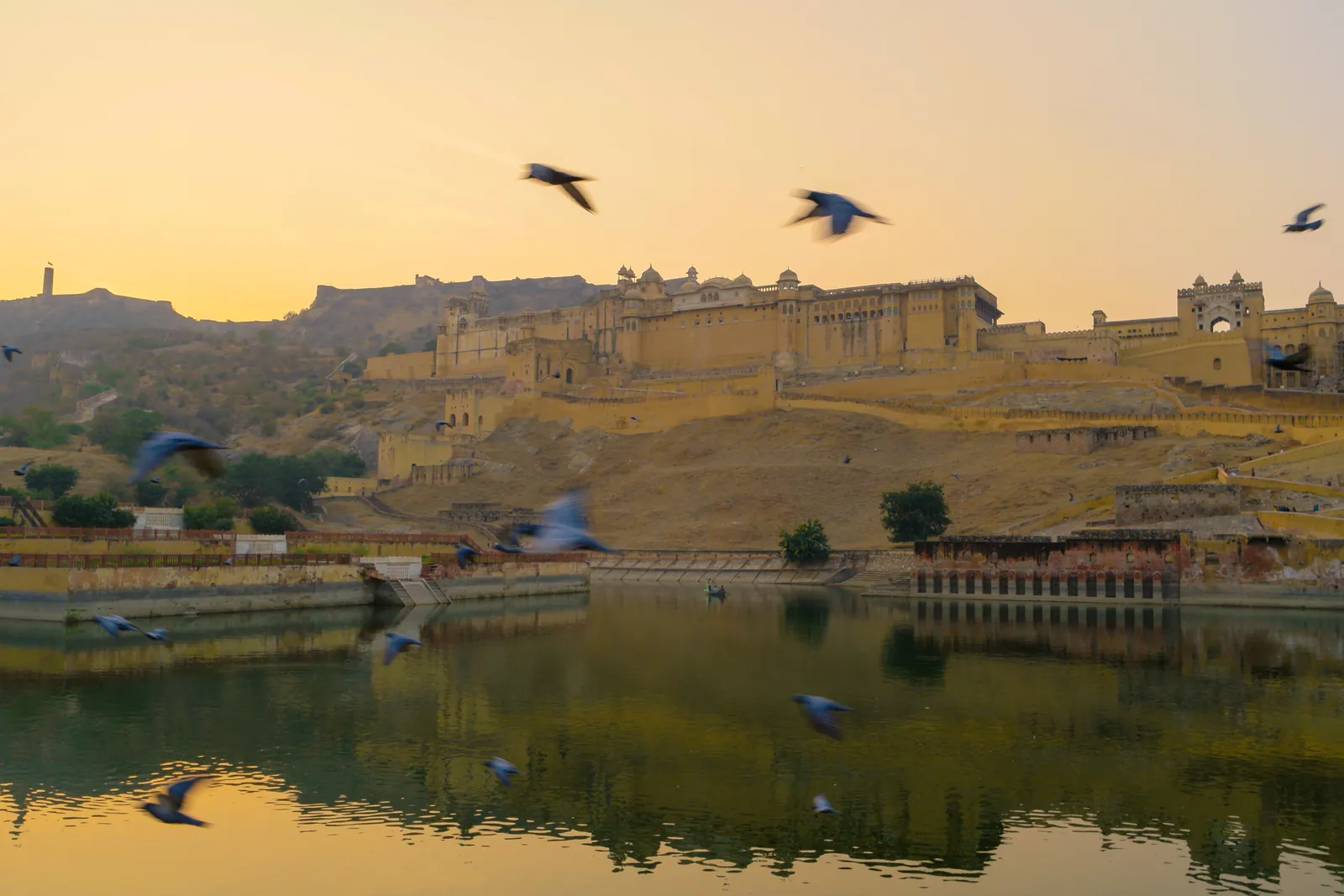
Why it made the list: the capital of Rajasthan, the “Pink City,” was founded in 1727 as one of India’s first planned cities, and its walled city has been a UNESCO World Heritage Site since 2019. The hilltop palace-fortress of Amber, the honeycomb facade of the Hawa Mahal and the giant instruments of Jantar Mantar are all close by.
Best time to go: October to March, with days of about 24–26 °C (75–79 °F) in January, the month of the Jaipur Literature Festival and kite flying. May averages 40–41 °C (104–106 °F).
Don’t miss: Amber Fort in the morning, the Hawa Mahal from a café across the street, and the courtyards of the City Palace, where the royal family still lives in part of the building.
Getting there and how long: fast trains take about 4½ hours from Delhi, and Jaipur has an international airport. Stay two or three days.
Practical note: Amber Fort opens at 09:00 and has an evening light show; the City Palace opens at 09:30. Go early to beat the heat and the tour buses. See our Jaipur travel guide.
4. Udaipur
Why it made the list: the “City of Lakes” is Rajasthan’s most romantic city, a cluster of white palaces, temples and mansions around Lake Pichola, ringed by the green Aravalli hills. It is smaller, calmer and greener than Jaipur, a place to slow down after the big cities.
Best time to go: October to March; September and October, after the monsoon, usually have the fullest lakes.
Don’t miss: the enormous City Palace, a boat on Lake Pichola at sunset, and a day trip to the hill fort of Kumbhalgarh.
Getting there and how long: Udaipur’s airport has domestic flights, and trains run from Jaipur, Delhi and Mumbai. Stay two or three nights.
Practical note: the City Palace opens at 09:30. The hill forts of Kumbhalgarh and Chittorgarh cost ₹550 online for foreign visitors. See our Udaipur travel guide.
5. Varanasi
Why it made the list: the holiest city of Hinduism, and one of the oldest continuously inhabited cities in the world, stretches along a crescent of the Ganges. According to the district administration, it has 88 ghats, the stone steps where pilgrims bathe at dawn and life unfolds all day.
Best time to go: October to March. November brings Dev Deepawali, when the ghats are lit with countless oil lamps; April to June is very hot, at about 37–39 °C (99–102 °F) in April.
Don’t miss: a boat on the Ganges at sunrise, the evening Ganga Aarti at Dashashwamedh Ghat, about 45 minutes of lamps, conch shells and chanting, and the Buddhist site of Sarnath nearby.
Getting there and how long: Varanasi has an airport about 25 km (16 miles) from the city and fast trains from Delhi. Stay two or three nights.
Practical note: foreign visitors to the Kashi Vishwanath Temple use a special helpdesk with their passport. At the cremation ghats, watch quietly from a distance and never photograph the cremations or mourners. See our Varanasi travel guide.
6. The Kerala backwaters at Alappuzha
Why it made the list: Alappuzha (Alleppey) is the gateway to Kerala’s backwaters, a web of lagoons, lakes and canals where you drift past coconut palms and paddy fields on a kettuvallam, a traditional rice barge turned floating hotel. According to Kerala Tourism, there are about 500 houseboats in Alappuzha alone.
Best time to go: November to February for dry, sunny weather. In August, the Nehru Trophy Boat Race fills the lake with long snake boats.
Don’t miss: a night on a houseboat, a canoe ride through the narrow village canals, and Kerala meals of fish curry and rice.
Getting there and how long: Alappuzha is about 85 km (53 miles) south of Cochin International Airport and 1 to 1½ hours by train from Ernakulam in Kochi. One night on a houseboat is enough for most visitors.
Practical note: houseboats are licensed by the Kerala Maritime Board; the district tourism council runs a prepaid houseboat counter. Combine the backwaters with historic Kochi and the tea hills of Munnar. See our Alappuzha travel guide.
7. Goa
Why it made the list: India’s smallest state is a strip of palm-fringed coast with a laid-back pace and a culture shaped by 450 years of Portuguese rule that ended in 1961. Whitewashed churches stand among the rice paddies, and the Churches and Convents of Old Goa are a UNESCO World Heritage Site.
Best time to go: November to March for calm seas and sunny weather; Christmas and New Year are the busiest and most expensive weeks.
Don’t miss: the baroque churches of Old Goa, a quiet beach in the south such as Palolem, and Goan food, from fish curry to Portuguese-style bread.
Getting there and how long: Goa has two airports, Dabolim and Mopa, and trains on the Konkan Railway from Mumbai and Kerala. Stay four days to a week.
Practical note: swim only between the red-and-yellow flags where lifesavers are on duty, from 7 a.m. to sunset, and never in the monsoon. See our Goa travel guide.
8. Amritsar and the Golden Temple
Why it made the list: Amritsar is the spiritual center of the Sikh faith, and its Sri Harmandir Sahib, the Golden Temple, rising from its sacred pool, is one of the most moving places in India. Its four doors are open to everyone, and its community kitchen serves free meals around the clock.
Best time to go: October to March; winter nights can be cold and foggy, and May and June are very hot. Baisakhi, on April 14, 2027, is celebrated across Punjab.
Don’t miss: the Golden Temple at dawn and after dark, when it glows over the water, a meal at the langar, the free community kitchen, and the street food of the old city.
Getting there and how long: the airport is about 13 km (8 miles) from the temple, and fast trains run from Delhi. Stay one or two nights.
Practical note: cover your head (scarves are available), remove your shoes and wash your feet before you enter. See our Amritsar travel guide.
9. Leh and Ladakh
Why it made the list: high in the far north, Leh lies at about 3,500 m (11,500 ft) in a sunny valley above the Indus, with Buddhist monasteries such as Thiksey and Hemis clinging to the ridges and mountain roads leading over high passes. It feels closer to Tibet than to the plains of India.
Best time to go: June to September, when Leh averages about 28 °C (83 °F) by day in July and stays dry while the monsoon soaks the rest of India. The roads from Srinagar and Manali open in late spring and close in autumn.
Don’t miss: the nine-story Leh Palace above the old town, the monasteries of Thiksey and Hemis, and a road trip over a high pass.
Getting there and how long: daily flights from Delhi take about an hour. Stay at least a week.
Practical note: the district administration advises at least 48 hours of rest to acclimatize before going higher, and an environmental fee of ₹400 per person is paid online. See our Leh travel guide.
10. Hampi
Why it made the list: the ruined capital of the Vijayanagara Empire lies scattered across a surreal landscape of giant granite boulders, banana plantations and rice fields on the Tungabhadra River in Karnataka. It has been a UNESCO World Heritage Site since 1986, with more than a thousand temples, palaces and bazaars.
Best time to go: October to February, with warm days and cool nights. Hampi Utsav, the main festival, is usually held between November and January.
Don’t miss: the stone chariot of the Vittala Temple, the Virupaksha Temple, and sunset over the boulders from Hemakuta Hill.
Getting there and how long: the nearest railway station is Hosapete, about 13 km (8 miles) away; Bengaluru is 6 to 7 hours by road. Stay two to four days.
Practical note: the Group of Monuments ticket costs ₹550 online for foreign visitors. Rent a bicycle or hire an auto-rickshaw to get around the spread-out site. See our Hampi travel guide.
How to fit them into one trip
With two weeks, follow the Golden Triangle: two nights in Delhi, one in Agra (with Fatehpur Sikri on the way to Jaipur), two or three in Jaipur, then on to Udaipur for two nights. Finish with a flight to Varanasi for two nights and back to Delhi. Amritsar adds two days from Delhi by fast train.
The south makes a second trip, or a third week: four days in Goa, three in Kochi, a night on a houseboat at Alappuzha and two in Munnar. Hampi fits between Goa and Bengaluru, and Ladakh is a separate summer trip, when the plains are hot and wet.
Our AI trip planner builds the day-by-day plan for your dates, travelers and budget from our India guides. Check the seasons for each region in our best time to visit India guide, look up typical conditions with the Destination weather tool, and work out rupee prices with the Money exchange tool. For e-Visas, trains and money, see our India travel guide.
Frequently asked questions
What is the most beautiful place in India?
Many travelers would say the Taj Mahal at sunrise, Udaipur’s palaces on Lake Pichola, or the Kerala backwaters from a houseboat. The Golden Temple at night and the mountains of Ladakh are close behind.
How many days do you need in India?
About two weeks for a first trip. A week covers the Golden Triangle of Delhi, Agra and Jaipur; ten days adds Varanasi or Udaipur; two weeks lets you see both.
What is the best place in India for first-time visitors?
The Golden Triangle of Delhi, Agra and Jaipur. The three cities are linked by fast trains and good roads, and they show India’s great monuments, food and markets. For a gentler start, Kerala and Goa are easier and more relaxed.
What is the best month to visit India?
November, February or March: dry, sunny and comfortable across most of the country. December and January are good too but busier, with foggy mornings in the north. See our best time to visit India guide for every month.
Is the Taj Mahal open every day?
No. It is closed every Friday. On other days it opens 30 minutes before sunrise and closes 30 minutes before sunset, and there are special night viewings around the full moon.