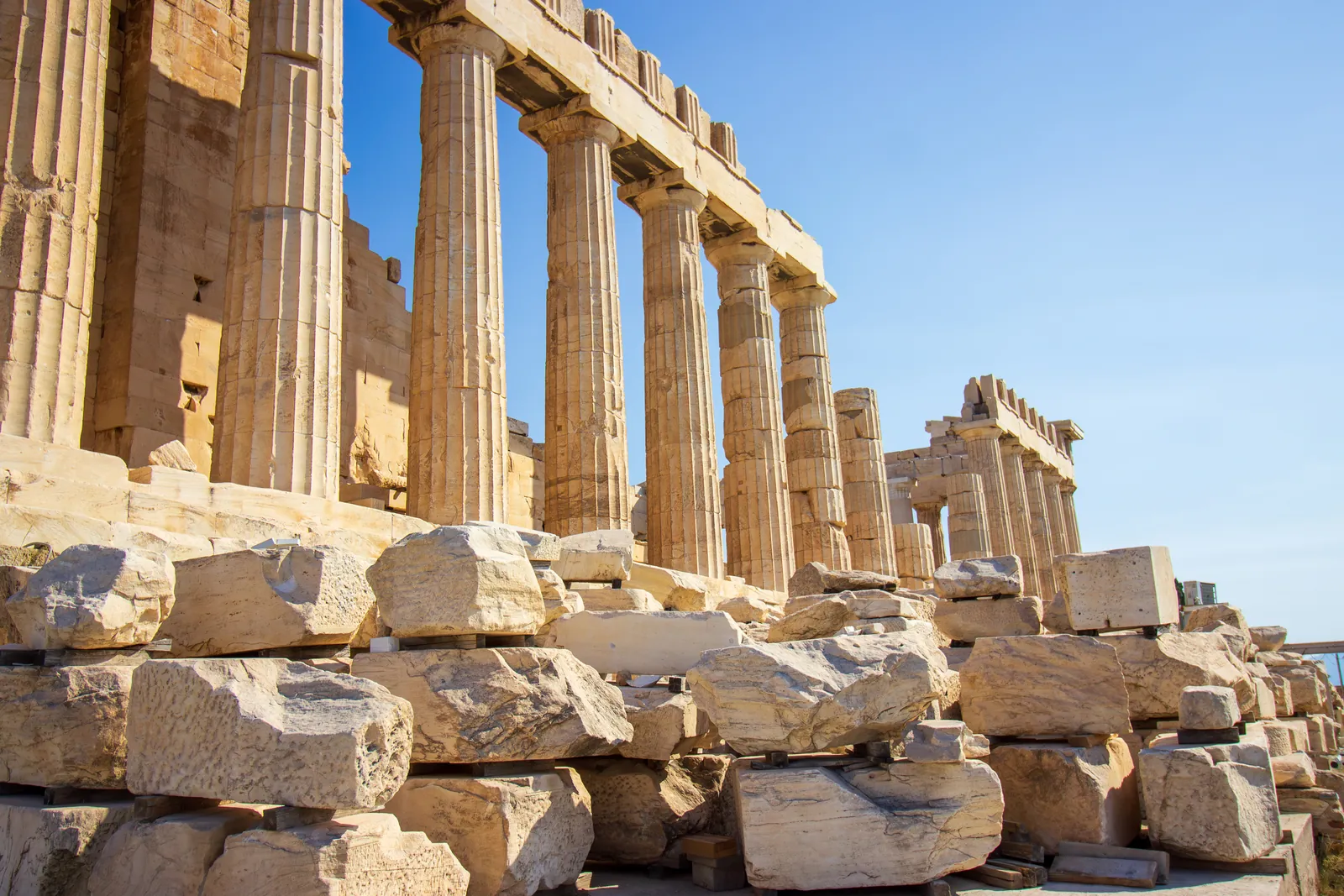
Short answer: For a first trip to Greece, put Athens and the Acropolis first, then add Santorini, Crete and the rock monasteries of Meteora. Round out the list with Mykonos and the sacred island of Delos, Naxos, Nafplio and the ancient sites of the Peloponnese, Rhodes, Corfu and Zakynthos.
Greece packs ancient ruins, volcanic islands, cliff-top monasteries, medieval towns and green Ionian islands into one country. You can’t see it all in one trip, so this list picks the ten places we would send a first-time visitor to, in the order we would recommend them.
Each section links to our full guide for that place. For entry rules, ferries and money, see our Greece travel guide.
1. Athens
Why it made the list: almost every trip to Greece starts in Athens, and the city deserves more than a night between flights. The Acropolis rises above the center, and the Ancient Agora, Plaka’s old lanes and some of the best museums in the Mediterranean are all within walking distance of it.
When to go: April to June and September to October. July and August are very hot. In recent heatwaves the Acropolis has closed in the middle of the day.
Don’t miss: the Acropolis, which opens at 8:00. A full ticket costs €30 and covers the hill and its slopes. Go at opening time and follow it with the Acropolis Museum at the foot of the hill, where the original Caryatids are on display.
Getting there and how long: Athens International Airport is linked to the center by metro line 3 and express buses. Two full days covers the highlights; add a third for Cape Sounion.
Practical note: the Acropolis ticket is good for one entry only, with no re-entry once you leave, and you can’t eat or drink on the site. Wear shoes with grip: the marble is slippery. More in our Athens travel guide.
2. Santorini
Why it made the list: Santorini is the postcard picture of Greece. It’s a ring of cliffs left by a huge volcanic eruption, lined with white villages and blue domes that look out over a flooded caldera. It is busy and not cheap, but the caldera view is one of a kind.
When to go: late May, June, September and early October. Greece’s weather service gives typical highs of about 85°F (29.7°C) in July and August. The July and August meltemi wind makes the heat bearable but can make boat trips rough.
Don’t miss: sunset in Oia, the village at the island’s northern tip, and the caldera-edge walk between Fira and Oia. Also see Akrotiri, the Bronze Age town buried by the eruption, where entry is €20.
Getting there and how long: fly from Athens or take a ferry from Piraeus. Once you’re there, the KTEL bus between Fira and Oia runs about every 30 minutes through the day. Two or three nights is enough for most people.
Practical note: Oia’s sunset spots fill up long before the sun goes down. Some cliff-foot areas have stayed fenced since the 2025 earthquakes, so follow local signs. See our Santorini travel guide.
3. Crete
Why it made the list: Greece’s largest island has the Minoan palace of Knossos, the Venetian harbor town of Chania, gorges, mountain villages and some of the best beaches and food in Greece.
When to go: May to June and September to October. Spring is best for hiking. Heraklion’s typical summer highs are around 85°F (29°C), and Chania and Heraklion stay open all year.
Don’t miss: the palace of Knossos (entry €20), with the Archaeological Museum of Heraklion to see the original frescoes. The other big one is the Samaria Gorge, a walk of about 13 km (8 miles) down from the White Mountains, plus about 2 km more to the sea at Agia Roumeli. It takes six to seven hours, and a ticket costs €10.
Getting there and how long: fly to Heraklion or Chania, or take an overnight ferry from Piraeus. Give Crete at least five days. Spend a week if you want both the east and the west.
Practical note: the gorge can open from 10 April to 31 October, and the park authority sets the exact dates each year. It also closes for bad weather; in early October 2026 it was shut after storms. Check the official ticket site the day before. See our Crete travel guide and Chania travel guide.
4. Meteora
Why it made the list: monasteries perched on top of sheer sandstone towers above the Thessaly plain. Six monasteries are still active, and it is the best mainland trip from Athens.
When to go: spring and autumn, for comfortable hiking between the rocks. October is especially good. Summer afternoons are hot.
Don’t miss: the Great Meteoron, the largest monastery, and one or two others, such as Varlaam or St Stephen. Each monastery has its own closing day. Watch the sunset from a viewpoint above the town of Kastraki.
Getting there and how long: the base is the town of Kalambaka, reached by train or bus from Athens or Thessaloniki. Stay at least one night, two if you plan to hike.
Practical note: the dress code is strict. Men need long trousers, women need a skirt and covered shoulders, and some monasteries lend wraps at the door. The Great Meteoron is closed on Tuesdays and for all of February. Rail works mean replacement buses on some sections, so check times first. See our Meteora travel guide.
5. Mykonos and Delos
Why it made the list: Mykonos has the Cyclades’ most famous nightlife and beach clubs, and its old town is a tangle of white lanes, windmills and the waterfront of Little Venice. Just offshore lies Delos, the mythical birthplace of Apollo and one of the great ancient sites of Greece.
When to go: June and September. Typical highs are about 83°F (28.5°C) in July. The island is at its busiest and priciest around mid-August.
Don’t miss: a morning on Delos, a UNESCO World Heritage site, where you’ll find the Terrace of the Lions, mosaic-floored houses and the climb up Mount Kynthos.
Getting there and how long: fly from Athens or take a ferry from Piraeus or Rafina. Boats to Delos leave from the Old Port and take about 30 minutes. Two or three nights on Mykonos is plenty.
Practical note: Delos is open from April to November and closed from December to March, and nobody stays overnight on the island. The boat ticket and the site ticket (€20) are separate, and boats can be canceled in strong wind. See our Mykonos travel guide.
6. Naxos
Why it made the list: Naxos is the Cyclades without the rush. It’s the largest island of the group, with long sandy beaches, marble mountain villages and real farming country, which is why its cheese and potatoes are famous across Greece. It suits families and slower travelers.
When to go: June and September for the beaches. Spring and October are good for walking in the hills.
Don’t miss: the Portara, a giant marble doorway from an unfinished temple of Apollo, at sunset. Then explore the mountain villages of Halki, Filoti and Apeiranthos, or hike Mount Zas, the highest peak in the Cyclades.
Getting there and how long: ferries from Piraeus, with short hops to Paros, Santorini and Mykonos, plus a small airport with flights from Athens. Spend three to four nights.
Practical note: the KTEL bus along the beach coast is frequent in summer, but the mountain villages get only a few buses a day, so rent a car for a day to explore inland. Neighboring Paros makes an easy pairing. See our Naxos travel guide.
7. Nafplio and the Peloponnese
Why it made the list: Nafplio is often called Greece’s prettiest mainland town. It was the first capital of modern Greece and has Venetian mansions, a fortress high on the hill and a little castle in the harbor. It’s also the best base for two famous ancient sites, Mycenae and Epidaurus.
When to go: spring and autumn. October is lovely here. In summer, the Athens Epidaurus Festival stages performances in the ancient theater.
Don’t miss: the Palamidi fortress above the town and the boat over to the Bourtzi castle in the harbor. Take day trips to Mycenae, with its Lion Gate, and to the theater of Epidaurus, famous for its acoustics. The Mycenae ticket also covers the museum and the Treasury of Atreus, and the Epidaurus ticket covers the theater, the site and the museum.
Getting there and how long: about two hours from Athens by car or KTEL bus. Two nights lets you see the town and both sites.
Practical note: local buses to Mycenae and Epidaurus run only a few times a day, so a rental car makes this much easier. See our Nafplio travel guide.
8. Rhodes
Why it made the list: Rhodes combines one of the best-preserved medieval towns in Europe, built by the Knights of St John, with long beaches and the white village of Lindos under its ancient acropolis.
When to go: May to June and September to October. Rhodes is one of the sunniest islands, with summer highs around 87°F (30.6°C) in August, and its swimming season runs late into autumn.
Don’t miss: the Palace of the Grand Master and the Street of the Knights in the Old Town, and the acropolis of Lindos above the village and St Paul’s Bay.
Getting there and how long: direct flights from Athens and many European cities. Ferries from Piraeus take most of a day. Stay four or five nights, and take a day trip by boat to the colorful harbor of Symi.
Practical note: the Lindos acropolis has no access for wheelchair users, and the climb is steep and exposed. Go at opening time in summer. See our Rhodes travel guide.
9. Corfu
Why it made the list: Corfu is the green Greece most people don’t picture. It has cypress-covered hills, olive groves and an old town with Venetian forts and arcades left by the French and the British. The Old Town of Corfu has been a UNESCO World Heritage site since 2007.
When to go: May to June and September. Corfu is green because it is wet. On long-term averages, November gets about 7.4 inches (187 mm) of rain, while July gets about a third of an inch (9 mm). Easter on Corfu is famous across Greece.
Don’t miss: the Old Fortress and the Liston arcade in Corfu Town, and the bays and monastery of Paleokastritsa on the west coast. Walkers can try sections of the Corfu Trail, which runs about 200 km (124 miles) down the length of the island.
Getting there and how long: flights from Athens and many European cities, plus ferries from Igoumenitsa on the mainland and from Italy. Plan four to five nights.
Practical note: at the Achilleion, Empress Sisi’s palace, only the gardens and outdoor areas are open while the building is restored. See our Corfu travel guide.
10. Zakynthos
Why it made the list: Zakynthos has some of the bluest water in the Mediterranean, with sea caves and white cliffs on the west coast and a national marine park in the south where sea turtles nest. Its most famous sight is Shipwreck Bay, one of the most photographed beaches in the world.
When to go: June and September for swimming and boat trips. Summer is the island’s busiest season.
Don’t miss: a boat trip along the cliffs past the Blue Caves, and a look at Navagio Beach from above.
Getting there and how long: flights to the island’s airport, or a KTEL bus from Athens that includes the ferry from Kyllini. Three or four nights is about right.
Practical note: because of rockfall risk, Navagio has been closed to visitors every summer since 2023. Under a 2026 ministerial decision, boats may not land or come within 50 meters of the shore, and swimming in the bay is banned until 31 October 2026. Check locally whether the clifftop viewpoint is open. See our Zakynthos travel guide.
How to fit them into one trip
The ten places fall into three groups; pick one or two:
- Classic first trip (10–12 days): Athens (2–3 days), then Naxos or Mykonos (3 days), Santorini (2–3 days) and Crete (4 days).
- Mainland and history (7–9 days): Athens, Nafplio with Mycenae and Epidaurus (2 days) and Meteora (2 days), then back to Athens.
- Ionian and Dodecanese: Corfu and Zakynthos sit on the west side of the country and Rhodes on the far east, so give each of them its own week or pair it with Athens.
Allow a travel day for each ferry or flight. To check which months suit each region, see our best time to visit Greece guide. When you’ve picked your places, our AI trip planner builds the day-by-day plan for your dates.
Plan your trip
Check typical conditions for your dates with the Destination weather tool, convert your budget into euros with the Money exchange tool, and let the TravelerCenter trip planner turn your shortlist into a plan.
Frequently asked questions
What is the most beautiful place in Greece?
Most people would say Santorini, for the view over the caldera from Oia or Imerovigli. Meteora and the sea cliffs of Zakynthos come close, and Corfu wins for green landscapes.
How many days do you need in Greece?
Ten to twelve days is ideal for a first trip. That covers Athens, two islands in the Cyclades and Crete, or Athens plus a mainland loop to Nafplio and Meteora. With a week, stick to Athens and one or two islands.
What is the best place in Greece for first-time visitors?
Athens, then Santorini or Naxos. Athens gives you the Acropolis and the best museums. Santorini gives you the iconic island views, and Naxos is the easier, more relaxed alternative, with long beaches. Crete is the best single island if you’d rather stay in one place.
When is the best time to visit Greece?
Late May, June, September and early October. Days are long and sunny, the sea is warm enough to swim from about mid-June, and there are fewer crowds than in July and August. Our best time to visit Greece guide has the month-by-month detail.
Can you visit Navagio Beach on Zakynthos?
Not on the sand. Because of rockfall risk, the beach has been closed every summer since 2023, and the 2026 rules ban landing, swimming in the bay and boats within 50 meters of the shore until 31 October 2026. Boat trips can still pass by, and you can look down on the bay from the clifftop viewpoint when it’s open.