Short answer: The top places to visit in Peru are Machu Picchu, Cusco and the Sacred Valley in the Andes; Lima for food; Lake Titicaca; Arequipa and the Colca Canyon; Paracas and the Ballestas Islands; the Nazca Lines; and the Amazon rainforest of Tambopata. For a first trip, plan about two weeks and build it around Cusco and Machu Picchu.
Peru packs Inca stonework, snowcapped volcanoes, a desert coast full of sea lions and the Amazon into one country. This list is ordered the way we would recommend the places for a first visit. For each one you get why it made the list, when to go, what not to miss, how to get there and how long to stay, and a practical note.
Two things shape any Peru itinerary: altitude and the seasons. Cusco, Puno and the Colca Canyon are high enough to make many visitors feel unwell for a day or two, and the Andes have a dry season from about May to September and a rainy season from December to March. Our best time to visit Peru guide covers the seasons month by month.
1. Machu Picchu
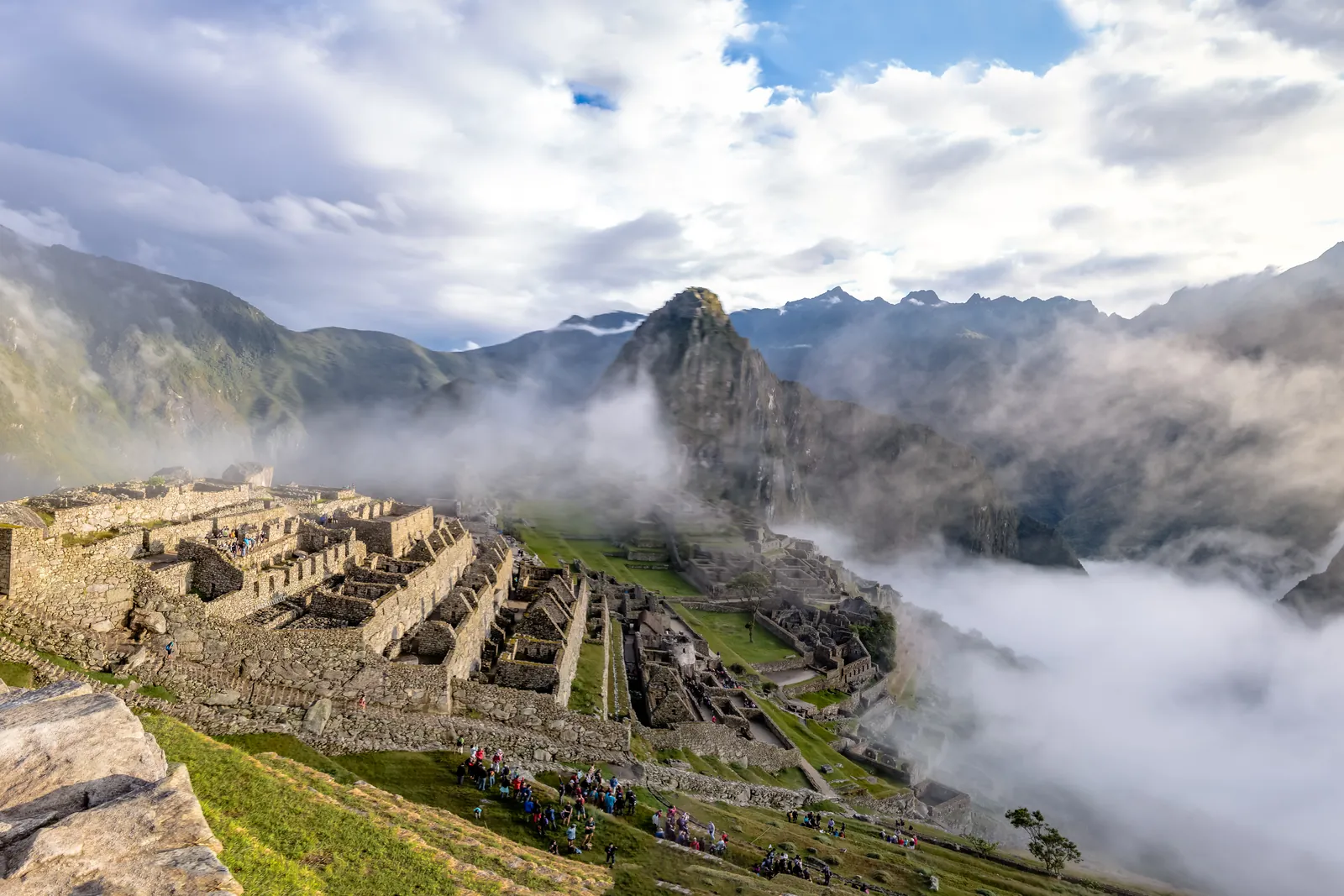
Why it made the list: the 15th-century Inca citadel on a ridge above the Urubamba River gorge is the most famous sight in South America,. UNESCO inscribed the Historic Sanctuary of Machu Picchu as a World Heritage Site in 1983, for both its culture and its nature.
Best time to go: April, May, September and October bring drier weather with fewer people. June to August is dry but the busiest time, and January to March is the wettest.
Don’t miss: the classic view over the terraces and temples with Huayna Picchu behind them, and, if you are fit and book early, one of the mountain routes for a view from above.
Getting there and how long: the only ways in are by train to Machu Picchu Pueblo (Aguas Calientes), mostly from Ollantaytambo in the Sacred Valley, or on foot along the Inca Trail. Most people spend one night in Aguas Calientes, or do a long day trip from the valley.
Practical note: entry is by timed ticket for a fixed circuit, and daily numbers are capped by the Ministry of Culture (4,500 visitors a day, rising to 5,600 on high-season dates). Tickets sell out months ahead for June to August, so buy them on the official platform before you book anything else. The Inca Trail closes every February for maintenance. Our Machu Picchu guide explains the circuits and rules.
2. Cusco
Why it made the list: the old capital of the Inca Empire is one of the most beautiful cities in South America, with Spanish churches and mansions built directly on top of perfectly fitted Inca walls. The City of Cuzco has been a UNESCO World Heritage Site since 1983, and it is the base for almost everything else in this part of Peru.
Best time to go: May to September for dry, sunny days and cold nights; April, May, September and October for fewer crowds. December to March brings afternoon storms but greener hills. The Inti Raymi sun festival fills the city in June.
Don’t miss: the Plaza de Armas, the Qorikancha sun temple under a Dominican convent, the artisans’ quarter of San Blas and the San Pedro market, then the zigzag walls of Sacsayhuamán on the hill above town.
Getting there and how long: fly from Lima or arrive by train or bus from Puno. Give Cusco two or three days, plus extra for day trips such as Rainbow Mountain.
Practical note: Cusco sits at about 11,150 feet (3,400 m). Take the first day slowly, drink water and skip heavy meals and alcohol until you feel normal. See our Cusco travel guide.
3. The Sacred Valley
Why it made the list: the green valley of the Urubamba River north of Cusco was prime farmland and a royal estate for the Incas, and its hillsides are still carved with terraces, fortresses and temples. It is also one of the nicest places in Peru to stay, with village markets and weaving cooperatives.
Best time to go: May to September, the dry season. The valley is lower and a little warmer than Cusco all year.
Don’t miss: the hilltop ruins of Pisac, the stone town and fortress of Ollantaytambo, the circular terraces of Moray and the Maras salt pans glittering on a mountainside.
Getting there and how long: it is a short drive from Cusco. Spend two or three nights, and take the train to Machu Picchu from Ollantaytambo at the end.
Practical note: because it is lower than Cusco, the valley is a gentle place to start getting used to the altitude. Several of its sites, including Pisac, Ollantaytambo and Moray, are covered by Cusco’s multi-site tourist ticket (the Boleto Turístico); the Maras salt pans charge separately. See our Sacred Valley guide.
4. Lima
Why it made the list: almost every international trip to Peru starts in the capital, and it deserves more than an overnight stop. Lima is one of the world’s great food cities, from ceviche at a neighborhood cevichería to famous tasting menus, and its historic center is a UNESCO World Heritage Site, first inscribed in 1988.
Best time to go: December to April, the coastal summer, is sunny and warm. From about June to October the city sits under gray coastal mist, though it almost never rains.
Don’t miss: a long lunch of ceviche, the colonial churches and carved wooden balconies of the historic center, and a sunset walk along the clifftop parks of Miraflores and Barranco.
Getting there and how long: Jorge Chávez International Airport is Peru’s main international gateway. Plan two days, at the start or end of the trip.
Practical note: in late September 2026, Peru’s official El Niño committee (ENFEN) issued a coastal El Niño alert, with very high air temperatures expected along the coast and more rain than normal on the northern and central coast from October to December. See our Lima travel guide.
5. Lake Titicaca and Puno
Why it made the list: Lake Titicaca, shared with Bolivia, is often called the world’s highest navigable lake, and its deep-blue water, reed beds and islands are home to Aymara- and Quechua-speaking communities. It feels completely different from anywhere else in Peru.
Best time to go: May to October for dry, sunny days, though nights drop below freezing. On the lake shore, daytime highs only reach about 57–61°F (14–16°C) all year. February brings the Fiesta de la Candelaria, Puno’s huge dance festival.
Don’t miss: a boat trip to the Uros, islands built of floating totora reeds, and to Taquile, a natural island famous for its textile art.
Getting there and how long: fly to Juliaca, take the bus from Cusco or Arequipa, or ride PeruRail’s Titicaca train from Cusco, a full-day journey across the high plain. Two nights is enough for most people.
Practical note: Puno sits at about 12,570 feet (3,830 m), higher than Cusco, so visit after you have spent some days at altitude, and pack warm layers and strong sunscreen. See our Puno travel guide.
6. Arequipa
Why it made the list: Peru’s second city sits in a green valley beneath three volcanoes, and its colonial center, built from white volcanic stone, is a UNESCO World Heritage Site since 2000. It is sunny, relaxed and one of the best places in the country to eat regional food.
Best time to go: April to November is sunny and dry; January to March brings some afternoon rain.
Don’t miss: the Santa Catalina Monastery, a walled town within the town, and a long lunch at a traditional picantería.
Getting there and how long: fly from Lima or Cusco, or take the bus from the coast or Puno. Two days in the city, plus two for the Colca Canyon.
Practical note: at about 7,660 feet (2,335 m), Arequipa is a good halfway step for acclimatizing between the coast and the higher Andes of Puno and Cusco. See our Arequipa travel guide.
7. The Colca Canyon
Why it made the list: one of the deepest canyons in the world, lined with pre-Inca terraces and small villages, and the best place in Peru to watch Andean condors. The Cruz del Cóndor viewpoint is the classic spot, where the huge birds ride the morning air currents along the canyon walls.
Best time to go: April to November, the dry months, when the road and the trails are easiest.
Don’t miss: Cruz del Cóndor early in the morning, when the condors fly, and a soak in the hot springs near Chivay.
Getting there and how long: Chivay, the main town, is about three hours by road from Arequipa, and the viewpoint about another hour beyond it. Join a two-day tour or drive yourself and stay overnight; a one-day trip is possible but very long.
Practical note: Chivay sits at about 11,950 feet (3,640 m) and the road crosses even higher passes, so the altitude matters here too. Nights are cold all year. Plan the trip from our Arequipa travel guide.
8. Paracas and the Ballestas Islands
Why it made the list: the best wildlife trip on Peru’s coast. A morning boat ride from Paracas takes you to the Ballestas Islands, rocky arches covered with seabirds, with sea lions on the rocks and a colony of Humboldt penguins.
Best time to go: December to April for warm, sunny beach weather; the boat trips run all year when the sea allows.
Don’t miss: the Ballestas boat trip, then the desert peninsula of the Paracas National Reserve, with its ocher cliffs and red beach. The reserve covers about 335,000 hectares, two-thirds of it sea.
Getting there and how long: Paracas is about 170 miles (272 km), or four hours by road, south of Lima. One or two nights is right, and it combines well with the Nazca Lines.
Practical note: the Ballestas are a protected reserve and you can only visit with an operator authorized by SERNANP, Peru’s protected-areas service; boats go out in the morning, and trips are cancelled when the sea is rough. See our Paracas guide.
9. The Nazca Lines
Why it made the list: the giant figures and lines drawn on the desert floor between Nasca and Palpa are one of the great mysteries of the ancient world, and a UNESCO World Heritage Site since 1994. From the air you can pick out the hummingbird, the monkey, the spider and dozens of straight lines running for miles.
Best time to go: any time of year; the desert is dry. Morning flights usually have the calmest air.
Don’t miss: a flight over the lines in a small plane. If you would rather stay on the ground, a roadside viewing tower gives a glimpse of a few figures.
Getting there and how long: the town of Nasca is about two hours by road beyond Ica. Most travelers visit on the way between Paracas and Arequipa, or join a day trip, and stop at the Huacachina desert oasis near Ica for sandboarding on the dunes.
Practical note: the flights are short and bumpy, so skip a big breakfast. There is no Nazca page on our site yet; plan it with our Peru travel guide.
10. The Amazon at Tambopata
Why it made the list: a few nights in a jungle lodge are the perfect contrast to the Andes. The Tambopata National Reserve near Puerto Maldonado protects about 274,690 hectares of forest, with around 600 bird species, giant otters and the clay licks where macaws gather.
Best time to go: May to October is less wet and trails are easier to walk. December to March is the rainy season, when rivers are high.
Don’t miss: a dawn visit to a macaw clay lick, and an oxbow lake by canoe to look for giant otters.
Getting there and how long: Puerto Maldonado has flights from Lima and Cusco, and the reserve begins about 30 minutes away by boat. Stay three or four nights at a lodge.
Practical note: visits inside the reserve must be with operators authorized by SERNANP, which in practice means booking through your lodge. Ask your doctor about vaccinations and malaria advice for the Amazon well before you travel. Our Peru travel guide covers health and packing.
How to fit them into one trip
With two weeks, a classic first trip runs south from Lima and climbs gradually: two days in Lima, a night or two in Paracas with the Ballestas Islands and a stop for the Nazca Lines, then three or four days in Arequipa and the Colca Canyon. From there, two days at Lake Titicaca, then five or six days for Cusco, the Sacred Valley and Machu Picchu. Going up in steps like this is the gentlest way to deal with the altitude.
Short on time? Ten days is enough for Lima, Cusco, the Sacred Valley, Machu Picchu and Lake Titicaca. Add three or four days for the Amazon, flying from Cusco to Puerto Maldonado.
Our AI trip planner builds the day-by-day plan for your dates, travelers and budget from our Peru guides. Check the seasons for each stop in our best time to visit Peru guide, look up typical conditions for your dates with the Destination weather tool, and pack for cold nights and hot days with the packing list tool.
Frequently asked questions
What is the most beautiful place in Peru?
Most visitors would say Machu Picchu, and the view over the citadel with Huayna Picchu behind it is hard to beat. Lake Titicaca’s deep-blue water and islands and the Colca Canyon with its condors are close behind.
How many days do you need in Peru?
About two weeks for a first trip that covers Lima, the south coast, Arequipa, Lake Titicaca, Cusco, the Sacred Valley and Machu Picchu. With ten days, focus on Lima, Cusco, the Sacred Valley and Machu Picchu, and add Lake Titicaca if you can.
What is the best place in Peru for first-time visitors?
Cusco. It is the base for the Sacred Valley and Machu Picchu, has plenty of hotels, restaurants and tours, and is a beautiful city in its own right.
Do you need to book Machu Picchu in advance?
Yes. Entry is by timed ticket and daily numbers are capped, so tickets for the busy months of June to August sell out months ahead. Buy them on the Ministry of Culture’s official platform, then book your train to Aguas Calientes.
What is the best month to visit Peru?
May and September are hard to beat for a trip that combines the Andes and the coast: the mountains are dry and sunny, and the crowds are smaller than in June to August. See our best time to visit Peru guide for every month.