Short answer: Andalusia (Andalucía) is the Spain of flamenco, orange trees and whitewashed villages: the Alhambra in Granada, the Mezquita in Córdoba, Seville’s Alcázar and cathedral, sunny beaches on two seas and a long tradition of tapas, sherry and fiestas. Start with Seville, Córdoba and Granada, the three great Moorish cities, then add Málaga and the Costa del Sol, Ronda and the white villages, or Cádiz and the Atlantic coast. One week covers the three cities; ten days to two weeks lets you add the coast and the mountains.
Andalusia is Spain’s southernmost region and its most populous autonomous community, home to about 8.7 million people, according to Spain’s National Statistics Institute (INE). It has eight provinces, Almería, Cádiz, Córdoba, Granada, Huelva, Jaén, Málaga and Seville, and almost a thousand kilometers of coastline on the Mediterranean and the Atlantic, with the Strait of Gibraltar between them. For nearly eight centuries, much of it was ruled by Muslim dynasties as al-Andalus, and their palaces, mosques and gardens, together with the Gothic cathedrals and Renaissance towns built after 1492, make it one of Europe’s richest regions for history. For entry rules, money, tipping and national transport, see our Spain travel guide.
Where to go in Andalusia
Most first trips link Seville, Córdoba and Granada by train or bus, with Málaga as an easy arrival point thanks to its large airport. The distances are bigger than they look on a map, so it is better to choose a few bases than to move every night. For the white villages, the national parks and the quieter beaches, a car is the easiest option.
Seville
Andalusia’s capital is the region’s most famous city: the Real Alcázar, a royal palace in the Mudéjar style with tiled courtyards and long gardens; the vast Gothic Seville Cathedral and its bell tower, the Giralda, once a minaret; and the semicircular Plaza de España, built for the 1929 Ibero-American Exposition. Wander the lanes of the Santa Cruz quarter, cross the river to Triana for tapas and flamenco, and climb the modern wooden “mushrooms” of the Setas de Sevilla at sunset. Our Seville travel guide has neighborhoods, ticket prices and airport transport.
Granada and the Sierra Nevada
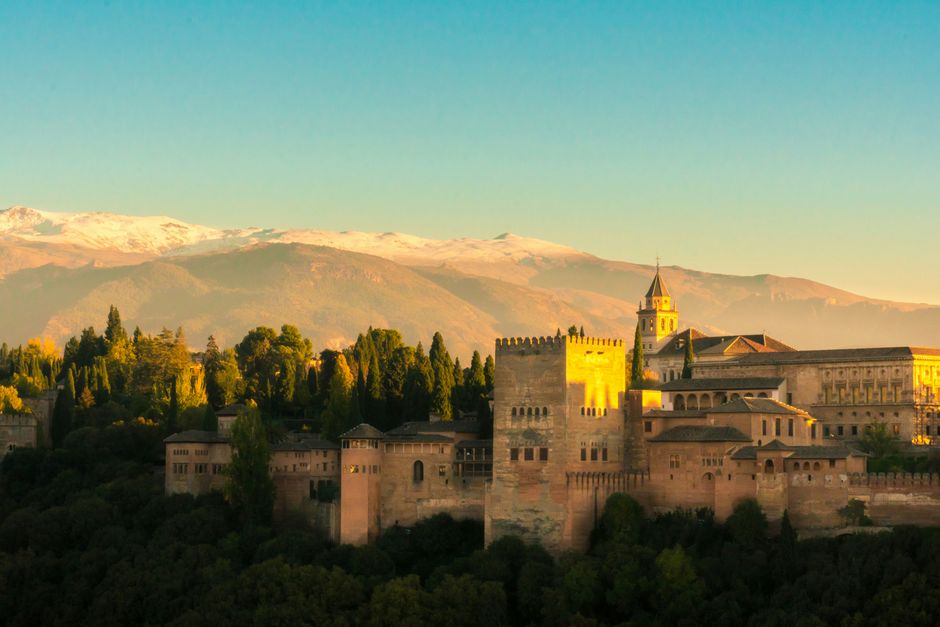
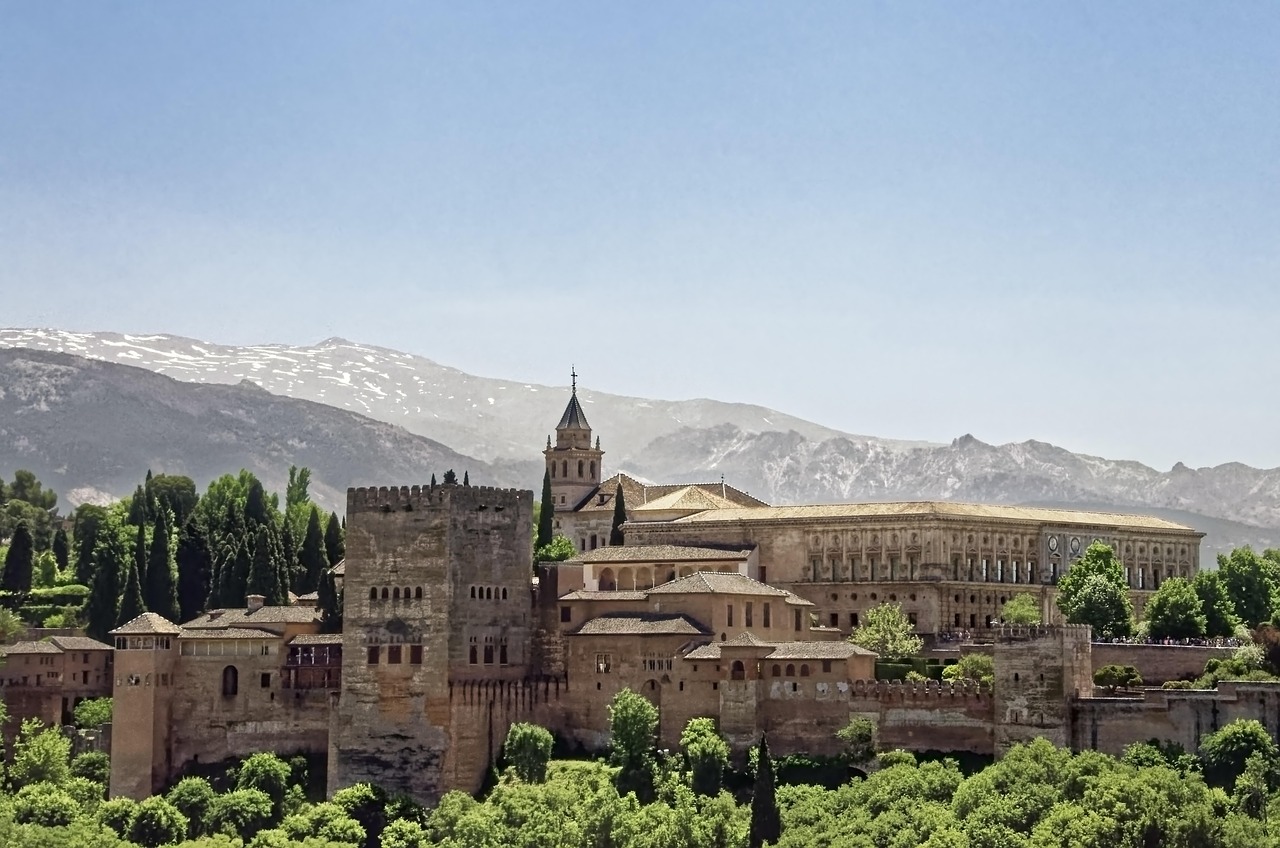
Granada sits at the foot of the snow-capped Sierra Nevada, crowned by the Alhambra, the palace-city of the Nasrid sultans and one of the most visited monuments in Spain. Across the valley, the white houses and steep lanes of the Albaicín, the old Moorish quarter, look straight at it, and the cave homes of Sacromonte are a traditional home of flamenco. Granada is also known for its free tapas with every drink. Less than an hour’s drive away, the Sierra Nevada has Spain’s southernmost ski resort and the highest peak in mainland Spain, Mulhacén, while the villages of the Alpujarras cling to its southern slopes. See our Granada travel guide.
Córdoba
Once the capital of the Caliphate of Córdoba and one of the largest cities in medieval Europe, Córdoba is smaller and quieter today, but its great sight is unforgettable: the Mosque-Cathedral (Mezquita), a forest of red-and-white striped arches with a Renaissance cathedral built in its center. Around it, the old Jewish quarter is a maze of white lanes with flower-filled patios, and outside the city are the ruins of the caliphs’ palace-city, Medina Azahara. Visit in May for the Patios festival, when residents open their flower-decked courtyards. Read our Córdoba travel guide.
Málaga and the Costa del Sol
Málaga is Andalusia’s main gateway and a lively city in its own right, the birthplace of Pablo Picasso with the Picasso Museum Málaga, a Moorish fortress, the Alcazaba, above a Roman theater, and city beaches a short walk from the old town. West of the city, the Costa del Sol is a chain of resorts, from Torremolinos and Fuengirola to stylish Marbella with its whitewashed old town and the yacht harbor of Puerto Banús. To the east, Nerja has a famous cave and the white village of Frigiliana sits in the hills behind it.
Ronda and the white villages
Inland from the Costa del Sol, the mountains are dotted with pueblos blancos, white villages perched on hilltops and cliffs. The most dramatic is Ronda, split in two by a gorge about 100 meters deep and joined by the 18th-century Puente Nuevo bridge, with one of Spain’s oldest bullrings. From there, routes lead to Grazalema in its green natural park, Zahara de la Sierra under its castle, Setenil de las Bodegas, where houses are built into the rock, and Arcos de la Frontera on its clifftop. The Caminito del Rey, a walkway along the walls of a gorge north of Málaga, is one of the region’s most popular outdoor trips.
Cádiz, Jerez and the Costa de la Luz
On the Atlantic side, the Costa de la Luz has long, wide sandy beaches, pine forests and dunes, and a breezier, more local feel than the Mediterranean coast. Cádiz, one of the oldest continuously inhabited cities in Western Europe, sits on a narrow peninsula surrounded by the sea, with a golden-domed cathedral and lookout towers. Nearby Jerez de la Frontera is the home of sherry and of the Royal Andalusian School of Equestrian Art, while El Puerto de Santa María and Sanlúcar de Barrameda are known for seafood and wine. In the far south, Tarifa, the southernmost town in mainland Europe, is a capital of kitesurfing, with Africa visible across the strait.
Almería and Cabo de Gata
Andalusia’s eastern corner is its driest and most unusual. The city of Almería has a large Moorish fortress, the Alcazaba, and the desert landscapes of Tabernas, inland, were the set for many spaghetti westerns. On the coast, the Cabo de Gata-Níjar natural park protects volcanic cliffs, wild beaches reached on foot and the white village of San José, one of the least built-up stretches of Spain’s Mediterranean coast.
Jaén and Huelva
Two provinces see fewer international visitors. Jaén is a sea of olive groves, the world’s largest olive oil-producing area, and its twin Renaissance towns, Úbeda and Baeza, are a UNESCO World Heritage Site. In the west, the province of Huelva has the Atlantic beaches of the Costa de la Luz, the Doñana National Park, one of Europe’s most important wetlands for birds, and the hill villages of the Sierra de Aracena, famous for their ham.
Top things to do in Andalusia
Visit the Alhambra
The Alhambra is Andalusia’s most famous monument, and tickets are limited. As of October 2026, the general daytime ticket, which includes the Nasrid Palaces, the Alcazaba and the Generalife gardens, costs €22.27, and a ticket for the gardens, Generalife and Alcazaba only costs €12.73; there are also night visits to the Nasrid Palaces (€12.73). Children under 12 go free but need a ticket in the same purchase. Tickets are personal: bring the ID document you booked with, and enter the Nasrid Palaces at the exact time printed on your ticket, because if you miss it, you lose that part of the visit. Buy only on the official site, tickets.alhambra-patronato.es, and book as early as you can, especially in spring and autumn. From 15 October to 31 March, the complex is open daily from 8:30 to 18:00; from 1 April to 14 October, until 20:00.
See Seville’s Alcázar and cathedral
In Seville, the Real Alcázar costs €15.50 for a general ticket as of October 2026 (under-13s free with an adult), and is open from 9:30 to 17:00 from October to March and to 19:00 from April to September. The cathedral and the Giralda cost €13 online or €14 at the ticket office; you climb the Giralda by ramps rather than stairs. Book both online, start early, and leave time in the afternoon for the shade of the María Luisa Park and the Plaza de España, which is free.
Walk through the Mezquita of Córdoba
The Mosque-Cathedral of Córdoba costs €15 for adults as of October 2026 (under-10s free), and from Monday to Saturday it opens free of charge for individual visitors from 8:30 to 9:30, in silence, except on special celebration days. The Patio de los Naranjos, the orange-tree courtyard in front of it, is free to walk through. Córdoba is an easy day trip by train from Seville, but staying a night lets you see the old town in the quiet of the evening.
Watch flamenco
Flamenco, the song, guitar and dance tradition of Andalusia, is listed by UNESCO as intangible cultural heritage, and you can see it every night of the year. Seville has the most choice, from small, intimate venues (tablaos) in Santa Cruz and Triana to the Flamenco Dance Museum; Granada’s Sacromonte caves host shows in a dramatic setting; and Jerez is known as a cradle of the art. Seville’s Bienal de Flamenco, one of the world’s biggest flamenco festivals, is held in even years; the 2026 edition ran from 9 September to 3 October. Smaller shows with fewer seats are usually more authentic than big dinner shows.
Hike the Caminito del Rey and explore the natural parks
North of Málaga, the Caminito del Rey is a 7.7 km route, including walkways bolted to the walls of the Gaitanes gorge, that takes 3 to 4 hours. Tickets are sold only on the official site, caminitodelrey.info: as of October 2026, a general ticket costs €10 and a guided visit €18. Children under 8 are not allowed, you must wear the helmet provided, and the walk is closed on Mondays and in bad weather. Elsewhere, the Sierra de Grazalema, the Sierra Nevada, Cabo de Gata and Doñana National Park offer everything from mountain hikes to birdwatching and beach walks; guided tours are the usual way to visit Doñana’s protected interior.
Go to the beach
Andalusia has beaches for every taste. The Costa del Sol, which covers more than 150 km of Mediterranean coast, has the most hotels, promenades and beach clubs, with warm water from July to October. The Costa de la Luz on the Atlantic, from Tarifa past Cádiz to the Portuguese border, has wide, natural beaches such as Bolonia, with its Roman ruins and dune, and is cooler and windier. East of Málaga, the Costa Tropical around Almuñécar has pebbly coves, and in Almería, the beaches of Cabo de Gata are the wildest of all.
Experience Holy Week and the ferias
Andalusia’s festivals are spectacular. During Holy Week (Semana Santa), brotherhoods carry huge floats with religious statues through the streets of every town, most famously in Seville and Málaga; in 2027, Holy Week runs from Palm Sunday, 21 March, to Easter Sunday, 28 March. In spring, Seville’s April Fair (Feria de Abril) fills a fairground with striped tents (casetas), flamenco dresses, horses and sevillanas dancing; Jerez has its horse fair and Córdoba its Patios festival in May; and Málaga’s fair takes over the city in August. Cádiz Carnival, famous for its satirical songs, runs from 4 to 14 February 2027. Hotels fill up and prices rise during all of these, so book early.
Discover the Renaissance towns of Úbeda and Baeza
In the province of Jaén, surrounded by olive groves, Úbeda and Baeza are two small towns full of 16th-century palaces, churches and squares, built when their noble families grew rich. They are a UNESCO World Heritage Site and much quieter than the big cities. Combine them with a visit to an olive oil mill to taste the region’s extra-virgin oil, and with Jaén’s cathedral, another Renaissance masterpiece.
When to go to Andalusia
Andalusia is one of the sunniest and hottest parts of Europe. Inland, the Guadalquivir valley around Seville and Córdoba has very hot summers, with average highs around 36 °C in July and August and heatwaves well above 40 °C. The coast is milder, thanks to the sea breeze, and the mountains are cooler: Granada, at about 700 meters, has cold, frosty winter nights, and the Sierra Nevada is snowy in winter. Most rain falls from October to April, and summers are almost completely dry. The figures below are 1991–2020 averages published by the World Meteorological Organization from Spain’s weather service (AEMET) for Seville (San Pablo airport), Málaga Airport and Granada Airport.
| Season | Seville: average high / low | Málaga: average high / low | Granada: average high / low | Good for |
|---|---|---|---|---|
| Winter (Dec–Feb) | 16–18 °C / 6–7 °C | 17–18 °C / 8–9 °C | 14–16 °C / 0–2 °C | Sightseeing without crowds, mild coast, skiing in the Sierra Nevada |
| Spring (Mar–May) | 22–28 °C / 10–15 °C | 20–25 °C / 10–15 °C | 20–27 °C / 4–10 °C | Holy Week, the April Fair, Córdoba’s patios, orange blossom, hiking |
| Summer (Jun–Aug) | 32–36 °C / 18–21 °C | 29–31 °C / 19–22 °C | 33–36 °C / 14–17 °C | Beaches and the coast; inland cities only in the early morning and evening |
| Autumn (Sep–Nov) | 31 °C falling to 20 °C / 18 °C falling to 10 °C | 28 °C falling to 20 °C / 19 °C falling to 12 °C | 30 °C falling to 18 °C / 13 °C falling to 4 °C | Warm sea in September and October, city sightseeing, harvest season |
Best overall: March to May and late September to early November, when the weather is warm and sunny but not too hot for walking around the cities. For beaches: June to October on the Mediterranean; July to September on the Atlantic, where the wind can be strong. For skiing: usually December to April in the Sierra Nevada. If you come in July or August, plan sightseeing for the morning, rest in the afternoon like the locals, and head out again after sunset.
Getting there and getting around
Airports
Málaga-Costa del Sol (AGP) is Andalusia’s busiest airport, with flights from across Europe and some long-haul routes. The C1 local train leaves from the airport and reaches Málaga’s Centro-Alameda station in 12 minutes and Fuengirola in 34 minutes, and the airport bus A runs to the city center for €4. Seville (SVQ) has flights mainly within Europe, and the EA airport bus (€6 single as of October 2026) runs into the city. Granada, Jerez and Almería have smaller airports with mostly domestic flights. Many visitors also fly into Madrid and take the high-speed train south.
Trains and buses
High-speed trains run from Madrid to Córdoba, Seville, Málaga and Granada, operated by Renfe and other companies on the same lines, and Renfe’s medium-distance and Avant trains link the Andalusian cities with one another. After a serious rail accident near Adamuz (Córdoba) in January 2026, services between Madrid and Andalusia were interrupted and have since resumed, but journey times on some routes are longer than usual, so check current timetables on renfe.com before you plan. Córdoba is the hub: it is the quickest link between Seville, Málaga and Granada.
Buses are often just as useful as trains in Andalusia, and sometimes better. Alsa runs frequent buses between Málaga and Granada, and to the Alpujarras; Damas runs from Seville and Málaga to Ronda, whose railway line is closed for works during 2026; and regional companies reach most white villages and beach towns. Local trains run along the coast from Málaga to Fuengirola, and between Seville, Jerez and Cádiz.
Driving
A car is the best way to explore the white villages, the Sierra de Grazalema, the Alpujarras, Cabo de Gata and the quieter beaches of the Costa de la Luz. Motorways and main roads are good, but village streets are often very narrow, so park at the edge of town and walk in. Avoid driving in the historic centers of Seville, Córdoba and Granada: they have restricted-access areas controlled by cameras, and several cities, including Granada and Cádiz, have introduced low-emission zones. If your hotel is inside a restricted area, ask it to register your license plate. In the cities, use public transport, taxis or your feet.
Tourist tax
Unlike Catalonia or the Balearic Islands, Andalusia has no regional tourist tax as of October 2026. Check your booking for any local charges if you travel later.
Food and drink in Andalusia
Andalusia is the home of tapas, and the best way to eat is to move from bar to bar, ordering a few small plates at each. In summer, cold soups are a must: gazpacho, made with tomato, peppers, cucumber and olive oil, and the thicker salmorejo from Córdoba, topped with egg and ham. On the coast, look for fried fish (pescaíto frito), such as fresh anchovies (boquerones) and squid, grilled sardine skewers (espetos) cooked over open fires on Málaga’s beaches, tuna from the Cádiz coast, and shrimp fritters (tortillitas de camarones). Inland, try oxtail stew (rabo de toro), spinach with chickpeas in Seville, flamenquín, a fried roll of ham and pork from Córdoba, and Granada’s tortilla del Sacromonte.
Acorn-fed Iberian ham (jamón ibérico de bellota) from the Sierra de Aracena in Huelva and from the Valle de los Pedroches in Córdoba is among Spain’s finest, and Jaén’s olive oil is on every table. To drink, Jerez, El Puerto de Santa María and Sanlúcar de Barrameda make sherry, from dry, pale fino and manzanilla to sweet Pedro Ximénez; Málaga has its sweet wines, and Montilla-Moriles near Córdoba makes its own fortified wines. In Granada and Almería, many bars still serve a free tapa with each drink. Lunch is the main meal, usually from 14:00, and dinner starts late, at 21:00 or later; breakfast is often toast with olive oil and tomato.
Plan your trip
Tell our AI trip planner how many days you have and what you enjoy, and it will build an Andalusia itinerary from our guides, for example Seville, Córdoba and Granada, or Málaga, Ronda and the Costa del Sol. Check the forecast and monthly averages for each stop with our Destination weather tool, and use the packing list: sun protection and light clothes in summer, layers for cool winter evenings and mountain trips, and comfortable shoes for cobbled streets all year. Heading north next? Our Madrid and Toledo guides are a short train ride away.
Frequently asked questions
What is the best time to visit Andalusia?
Spring (March to May) and autumn (late September to early November) are best, with warm, sunny days that are comfortable for sightseeing. Summer is very hot inland but good for the beaches; winter is mild on the coast and quiet in the cities.
How many days do you need in Andalusia?
One week is enough for Seville (three days), Córdoba (one day) and Granada (two days). With ten days to two weeks, you can add Málaga, Ronda and the white villages, Cádiz and Jerez, or a few days at the beach.
How far in advance should I book the Alhambra?
As early as you can, ideally as soon as your dates are fixed, and several weeks ahead for spring and autumn, when tickets often sell out. Buy only on the official site, tickets.alhambra-patronato.es; tickets are personal, so bring the ID you booked with, and arrive at the Nasrid Palaces on time.
Do I need a car in Andalusia?
Not for the big cities: trains and buses link Seville, Córdoba, Granada, Málaga and Cádiz well. A car is very useful for the white villages, the natural parks and the quieter beaches, but do not drive into the historic centers.
When is Holy Week in Andalusia in 2027?
Holy Week 2027 runs from Palm Sunday, 21 March, to Easter Sunday, 28 March. Processions take place across the region, with the largest in Seville and Málaga; book accommodation well ahead, as prices rise sharply.