Short answer: spring (March to May) and autumn (September to November) are the best times to visit Morocco: Marrakech, Fez and the imperial cities have warm, sunny days of about 23–33 °C (74–91 °F), and the Sahara around Merzouga is comfortable for camel treks and desert camps. The trade-off is crowds and prices around European Easter and in October. Summer is very hot inland, with Marrakech averaging 38 °C (100 °F) in July, but the Atlantic coast stays mild; winter brings sunny days, cold nights, rain in the north and snow on the Atlas.
This page explains Morocco’s very different climates, from the Atlantic coast to the mountains and the desert, what each month is like, and how Ramadan and the festivals fit in, as of October 2026. For visas, trains, monument tickets and money, see our Morocco travel guide, and plan your days with our AI trip planner.
Best time to visit Morocco at a glance
| Goal | Best months | Why |
|---|---|---|
| Best weather for cities | March to May, October and November | Marrakech highs of about 23–29 °C (74–85 °F); Fez 20–26 °C (68–79 °F) |
| Sahara and desert camps | October to April | Warm days and cool nights; June to September afternoons reach about 40 °C (104 °F) |
| Beaches | June to September | Dry, sunny weather on the Atlantic and Mediterranean coasts, with highs of 22–30 °C (72–86 °F) |
| Winter sun | November to March in Agadir and Marrakech | Agadir averages 21 °C (70 °F) in January; Marrakech about 19 °C (66 °F) |
| Hiking in the Atlas | April to June, September and October | Snow-free lower trails and mild temperatures; high summits are best in summer |
| Surfing | October to April | The main Atlantic swell season around Agadir |
| Windsurfing and kitesurfing | April to October in Essaouira | The trade-wind season |
| Festivals | May and June | The rose festival in the Dades Valley, Gnaoua in Essaouira, Mawazine in Rabat |
| Fewest crowds | January, February and early June | Between the holiday peaks; quieter still during Ramadan |
Morocco weather month by month
Weather month by month
The climate table shows average daily highs and lows and rain for each month in Marrakech, from the 1991–2020 climate normals that Morocco’s General Directorate of Meteorology (DGM) submitted to the World Meteorological Organization (WMO). Marrakech is dry, with about 220 mm (8.7 in) of rain a year, falling mostly from November to April, and March the wettest month at about 35 mm (1.4 in). Elsewhere, the picture changes fast: the Atlantic coast is mild all year, with Essaouira barely reaching 22 °C (72 °F) in August; the Mediterranean north around Tetouan gets about 650 mm (26 in) of rain, mostly in winter; the Middle Atlas town of Ifrane averages −1 °C (30 °F) on January nights; and the desert gateways of Ouarzazate and Errachidia swing from about 2 °C (35 °F) on winter nights to 39–40 °C (102–103 °F) on summer afternoons.
Morocco month by month
January
Sunny and mild by day in Marrakech, about 19 °C (66 °F), but cold at night, about 6 °C (43 °F), and near freezing in Ouarzazate and the desert. Snow covers the High Atlas. After the New Year rush, it is one of the quietest months, and desert skies are clear. The Amazigh New Year is celebrated on January 14.
February
Mild days, about 21 °C (69 °F) in Marrakech, and almond blossom in the valleys below the Atlas. In 2027, Ramadan is expected to begin around February 8 or 9: sights stay open, often with shorter hours, many restaurants outside hotels close until sunset, and evenings are lively. Morocco also turns its clocks back one hour during Ramadan.
March
Spring arrives, with Marrakech highs of about 24 °C (74 °F), though March is also its wettest month and showers are common in the north. Eid al-Fitr, ending Ramadan, is expected around March 9 or 10, 2027, with family celebrations and busy roads. Prices rise around European Easter (March 28, 2027).
April
One of the best months overall: warm and green, with highs of about 26 °C (78 °F) in Marrakech and 22 °C (72 °F) in Fez. It is good for the desert too, though spring winds can raise sandstorms. Essaouira’s windy season begins. Book riads early around Easter week.
May
Warm to hot inland, about 29 °C (85 °F) in Marrakech, and dry. The Damask rose harvest in the Dades Valley is celebrated at Kalaat M’Gouna’s rose festival, usually in May, and it is a fine month for hiking in the Atlas foothills. In 2027, Eid al-Adha is expected in mid-May.
June
Hot inland, about 34 °C (92 °F) in Marrakech, but mild on the coast. Festival month: the Gnaoua World Music Festival fills Essaouira and Mawazine brings big stages to Rabat, both usually in June. Beach season starts in Tangier and on the Mediterranean.
July
Very hot inland: Marrakech averages 38 °C (100 °F) and Errachidia, near the dunes, almost 40 °C (103 °F). The coasts are the place to be, with Agadir and Casablanca at about 26–27 °C (79–80 °F). Moroccans living abroad return home, so beaches and ferry ports are busy. Throne Day, July 30, is a national holiday.
August
The hottest month inland, with Fez and Marrakech at 35–37 °C (95–99 °F), and the busiest month at the beaches and ports. Mountain walks at altitude are pleasant, and High Atlas summits are free of snow. Casablanca averages under 1 mm of rain all month.
September
Hot at first, then pleasant, with Marrakech averaging about 33 °C (90 °F). The date harvest begins in the oases of the Draa and Ziz valleys, the sea is at its warmest, and crowds start to build again late in the month.
October
Warm days and cool nights: Marrakech averages 29 °C (83 °F) by day and 16 °C (60 °F) at night, and it is an excellent month for the desert around Merzouga and Ouarzazate. Peak season returns, and the Atlantic surf season starts in Agadir.
November
Mild days, about 23 °C (74 °F) in Marrakech, cooler nights and the first real rains in the north, where Fez’s wettest month averages about 66 mm (2.6 in). It is olive harvest time, and the Marrakech International Film Festival usually takes place in late autumn. The Green March (November 6) and Independence Day (November 18) are national holidays.
December
Mild, sunny days, about 20 °C (68 °F) in Marrakech, and cold nights; the north is wet, with Tetouan averaging about 100 mm (4.0 in). Christmas and New Year in Marrakech and the desert camps make the last two weeks some of the busiest and most expensive of the year, so book early.
Best time to visit by region
Marrakech
March to May and October to November, with warm days and cool evenings in the medina and gardens. Winter is sunny and mild by day; July and August average about 38 °C (100 °F) in the afternoon. See our Marrakech guide.
Fez and Meknes
March to May and October to November. Winters are chilly, about 16 °C (61 °F) by day and 4 °C (39 °F) at night, with rain, and July and August average about 35 °C (95 °F). See our Fez and Meknes guides.
Rabat, Casablanca and Tangier
The Atlantic cities are mild all year, best from April to June and September to October; Casablanca averages 18 °C (64 °F) in January and 27 °C (80 °F) in August. Tangier is wetter in winter and busy with summer visitors in July and August. See our Rabat, Casablanca and Tangier guides.
Chefchaouen and the Rif
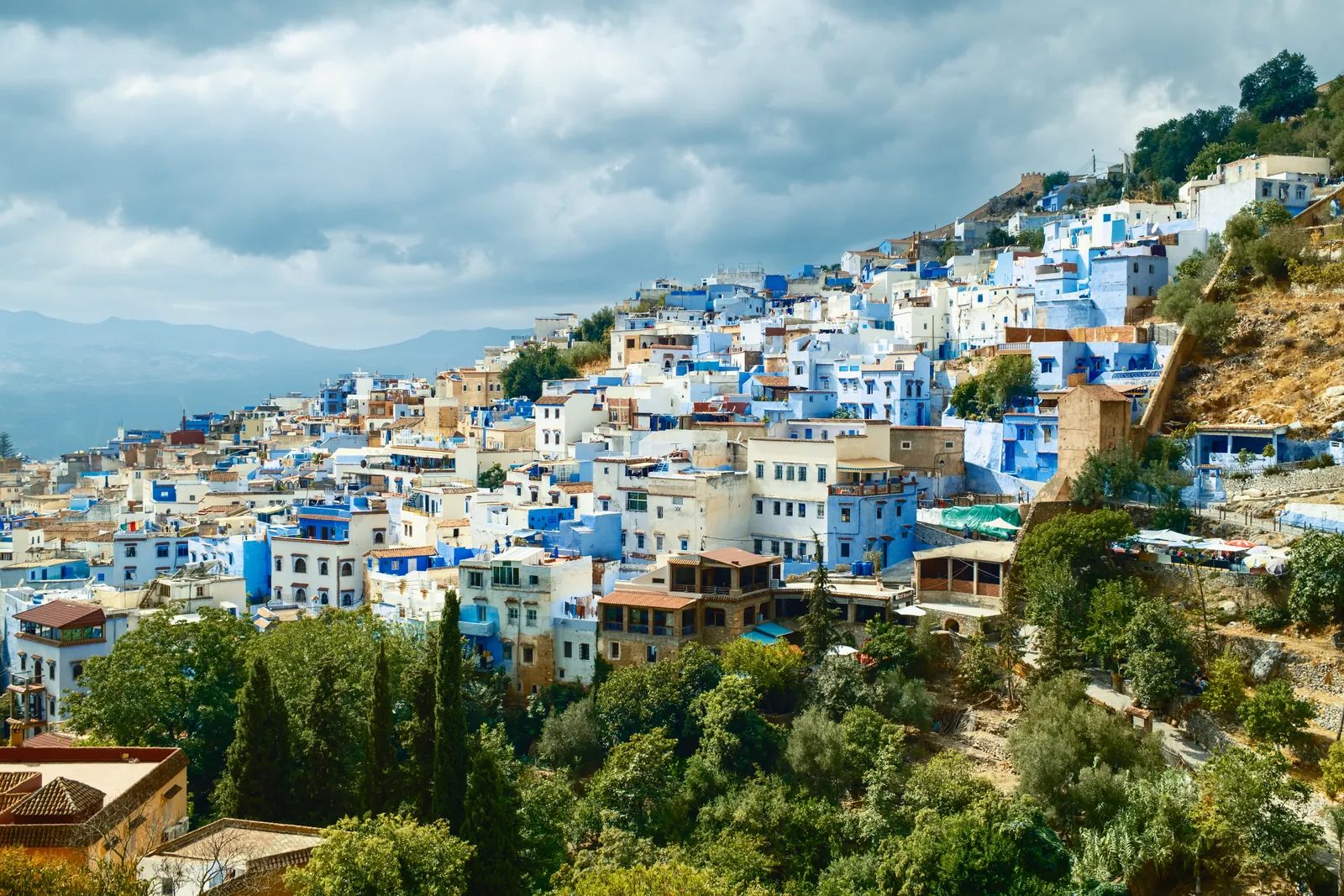
April to June and September to October. Winters in the Rif mountains are cold and rainy, while summer is warm and good for walks into the surrounding hills. See our Chefchaouen guide.
Essaouira and Agadir
Essaouira is cool and breezy all year, best from April to October for wind sports and June for the Gnaoua festival. Agadir is sunny all year: June to October for the warmest sea and winter for mild, sunny days of about 21 °C (70 °F). See our Essaouira and Agadir guides.
Ouarzazate and Merzouga
Ouarzazate is best from March to May and September to November; Merzouga and the Erg Chebbi dunes from October to April. Winter days are sunny, but nights fall to about 2 °C (35 °F), so bring warm layers for desert camps; from June to September afternoons reach about 40 °C (104 °F). See our Ouarzazate and Merzouga guides.
Best time for the desert, hiking, surfing and beaches in Morocco
Sahara trips
October to April, with October, November, March and April the most comfortable for both days and nights. In winter, nights in camp are cold; in summer, treks run only at sunrise and sunset.
Hiking in the Atlas
April to June and September to October for valley and foothill walks. Toubkal, at 4,167 m (13,671 ft), is usually snow-free from about June to September; in winter it needs mountaineering gear and a guide. See our hiking guide.
Surfing
October to April brings the biggest, most consistent Atlantic swells around Agadir and the nearby surf villages; summer waves are smaller and suit beginners. See our surfing guide.
Beaches
June to September on both coasts, when rain is almost nil; Agadir’s sheltered bay is the warmest and calmest Atlantic beach, and it stays pleasant through the winter. More in our beaches guide.
Seasons to plan around
Ramadan (expected around February 8 to March 9, 2027): sights stay open, often with shorter hours, and many restaurants outside hotels close by day; Eid al-Fitr follows. Dates move about 11 days earlier each year and depend on the sighting of the new moon. Clocks go back one hour for the month.
Summer heat inland, June to September: plan sightseeing in Marrakech, Fez and the south for early morning and evening, and switch to the coast or the mountains in the middle of the day.
Winter cold and rain, December to February: nights near or below freezing in the mountains and the desert, snow on the Atlas passes that can slow the road to Ouarzazate, and the rainy season in the north. Riads can be chilly, so ask about heating.
Peak weeks: European Easter, October and Christmas to New Year are the busiest times for Marrakech riads and desert camps; July and August are busiest on the coasts and at the ferry ports.
How long to stay
A week covers Marrakech and a desert trip; ten days adds Fez and Chefchaouen, and two weeks lets you add the coast at Essaouira. In winter, allow extra time on mountain roads. Our Morocco travel guide has sample itineraries.
Best time to visit Morocco: FAQ
What is the best month to visit Morocco?
April or October for most trips: warm, sunny days in the cities, comfortable desert nights and green or golden landscapes. Both are popular, so book riads and desert camps ahead.
Is Morocco too hot in summer?
Inland, yes for many people: Marrakech averages 38 °C (100 °F) in July and the desert is hotter. The Atlantic coast is mild, with Essaouira around 22 °C (72 °F), so summer works well for a beach-and-mountains trip.
Is winter a good time to visit Morocco?
Yes for Marrakech, Agadir and the south, with sunny days around 19–21 °C (66–70 °F) and fewer crowds outside Christmas. Nights are cold, the north is rainy, and the Atlas has snow.
When is the best time to visit the Sahara in Morocco?
October to April. October, November, March and April have the most comfortable mix of warm days and mild nights; December to February nights are near freezing.
What is the rainiest month in Morocco?
It depends on the region: November and December in the north and on the Atlantic coast, with Tetouan averaging about 100 mm (4.0 in) in December, and March in Marrakech, though only about 35 mm (1.4 in).
When is Ramadan in Morocco in 2027?
It is expected to begin around February 8 or 9, 2027 and end with Eid al-Fitr around March 9 or 10; exact dates depend on the moon sighting.
Sources · last reviewed 9 Oct 2026
Researched and last reviewed by TravelerCenter on 8 October 2026. Monthly temperatures and rain come from the WMO 1991–2020 climate normals submitted by Morocco’s General Directorate of Meteorology for Marrakech, Fès-Saïss, Casablanca-Anfa, Agadir-Inezgane, Essaouira, Tetouan, Ifrane, Ouarzazate and Errachidia, archived by NOAA NCEI. Ramadan and Eid dates for 2027 are astronomical estimates; national holiday dates, festival timing (rose festival, Gnaoua, Mawazine, the Marrakech film festival), surf and wind seasons, Toubkal conditions and crowd patterns come from our country and destination guides and general sources and are flagged for checking. Check festival dates with the organizers before you travel.
Also: DGM normals 1991–2020, Marrakech (climate)
Data: Wikidata (CC0)