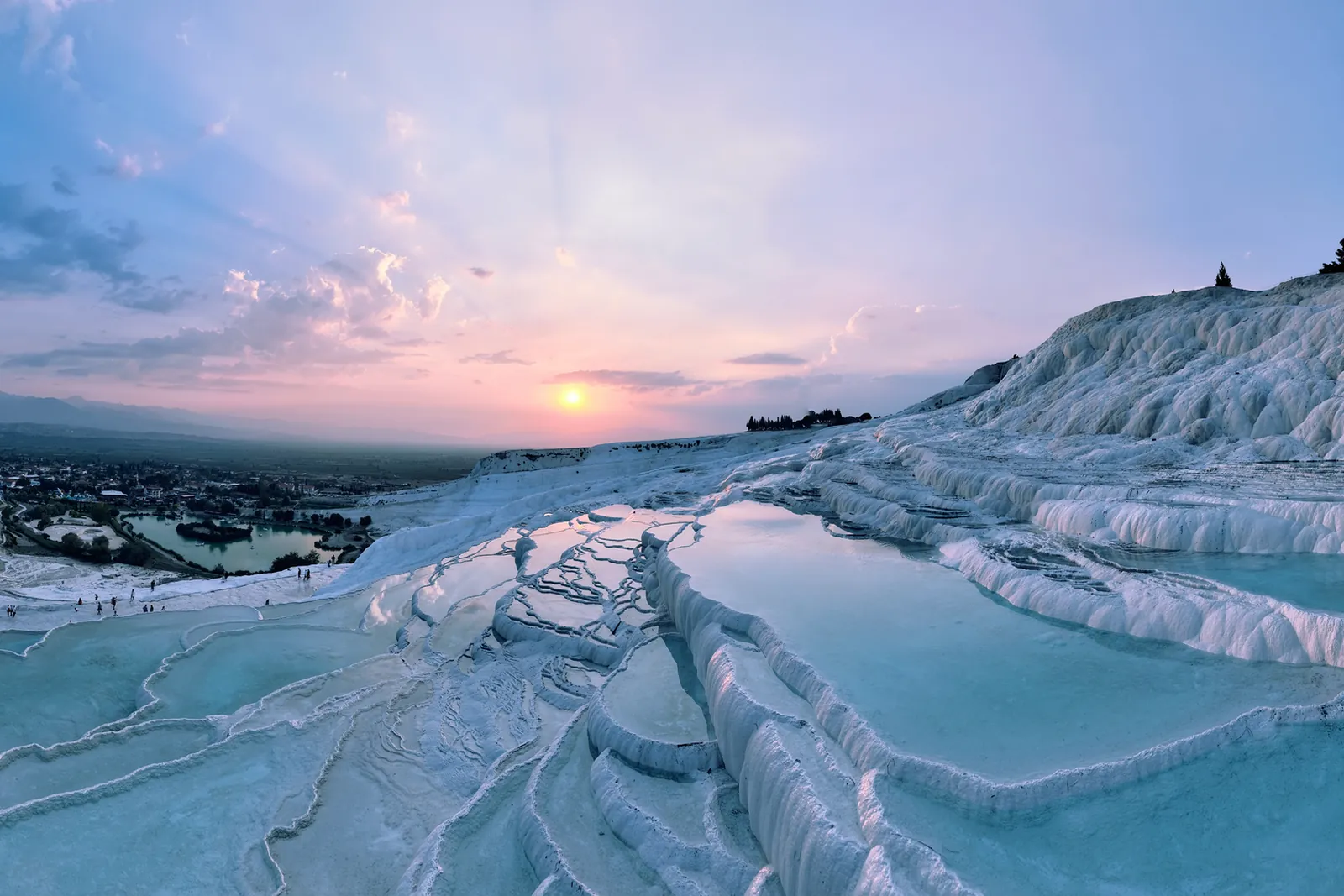
Short answer: April to June and September to October are the best time to visit Turkey (Türkiye). Spring and autumn bring warm, sunny days for Istanbul, Cappadocia, Ephesus and Pamukkale, and from late May the sea on the Aegean and Mediterranean coasts is warm enough to swim. July and August are the hottest and busiest months, with highs around 35 °C (95 °F) on the south coast and full resorts, while winter is cheap and quiet in Istanbul and snowy in Cappadocia.
This page explains Turkey’s climates region by region, what each month is like, when the sea is warmest, when balloons fly in Cappadocia and when Ramadan and the Bayram holidays fall, as of October 2026. For visas, money and getting around, see our Turkey travel guide, and plan your days with our AI trip planner.
Best time to visit Turkey at a glance
| Goal | Best months | Why |
|---|---|---|
| Best overall weather | April to June, September to October | Warm, sunny days almost everywhere, without the summer heat |
| Beaches and swimming | June to September (late May and October are good too) | Sea about 24–28 °C (75–83 °F) on the Mediterranean; almost no rain from June to September |
| Istanbul | April to early June, September to November | Mild and clear for walking; tulips in April |
| Cappadocia and balloon flights | April to June, September to October | Mild days, cool mornings and the most reliable flying weather |
| Ephesus, Pamukkale and ruins | April to May, September to October | July and August highs reach about 34–36 °C (93–96 °F) inland |
| Hiking the Lycian Way | February to May, September to November | Cooler walking weather on an exposed, shadeless coast |
| Fewest crowds and lowest prices | November to March (outside Christmas and New Year) | Resorts are quiet or closed, but city and Cappadocia hotels are cheap |
| Skiing | December to March | Uludağ above Bursa usually opens in December |
| The Black Sea and its plateaus | May to September | Mountain roads open and the warmest, least rainy weeks |
Turkey weather month by month
Weather month by month
The climate table shows average daily highs and lows and rain for each month from the 1991–2020 climate normals of the Turkish State Meteorological Service (MGM), as submitted to the World Meteorological Organization (WMO). Turkey has three main climates. The Aegean and Mediterranean coasts have hot, dry summers and mild, wet winters: Antalya averages 35 °C (95 °F) by day in July and August and gets almost no rain from June to September, but about 275 mm (10.8 in) in December. The Anatolian plateau, with Cappadocia and Ankara, is continental: Nevşehir averages only 4 °C (39 °F) by day in January, with nights below freezing, and 29 °C (85 °F) in August, with cool nights. Istanbul sits between the two, with highs of about 9 °C (49 °F) in January and 30 °C (85 °F) in August and about 640 mm (25 in) of rain a year, mostly from October to March. The Black Sea coast is mild and wet in every month. MGM’s sea records for the Turkish Mediterranean show the water at about 16–17 °C (61–62 °F) in winter, 21 °C (69 °F) in May, 28 °C (83 °F) in August and still about 25 °C (76 °F) in October.
Turkey month by month
January
The coldest month: about 9 °C (49 °F) by day in Istanbul, often grey and wet, and around 15 °C (59 °F) in Antalya, where January is one of the wettest months. Cappadocia is often under snow, beautiful for photos, but balloon flights are cancelled more often. Prices are at their lowest outside New Year, and many coastal resort hotels are closed.
February
Still winter on the plateau and in Istanbul, with skiing on Uludağ above Bursa. On the south coast, days reach about 16 °C (61 °F) and the Lycian Way’s walking season begins. Ramadan begins on February 8, 2027, according to the Presidency of Religious Affairs (Diyanet): in cities and resorts, restaurants and sights stay open as usual.
March
Spring arrives on the coasts, with highs of about 17–19 °C (63–65 °F) in İzmir and Antalya, wildflowers among the ruins and very few visitors at Ephesus. Cappadocia is still cold, at about 11 °C (52 °F) by day. The Ramazan Bayramı (Eid al-Fitr) holiday runs from March 9 to 11, 2027, when Turks travel in huge numbers and buses and flights fill up.
April
One of the best months for sightseeing: about 17 °C (63 °F) in Istanbul, when the city’s parks fill with tulips, and 21–22 °C (70–71 °F) on the Aegean and Mediterranean. It is ideal for Pamukkale, Ephesus and Lycian Way walks, though the sea is still cool, at about 18 °C (65 °F). April 23 (National Sovereignty and Children’s Day) is a public holiday.
May
Warm and green almost everywhere: about 22 °C (72 °F) in Istanbul, 21 °C (70 °F) in Cappadocia and 26 °C (80 °F) in Antalya. The sea reaches about 21 °C (69 °F), and by late May swimming is pleasant on the south coast. The Kurban Bayramı (Eid al-Adha) holiday runs from May 16 to 19, 2027, the busiest domestic travel week of the spring; May 1 and May 19 are also public holidays.
June
Early summer, and for many the best beach month: long sunny days, a sea of about 24 °C (75 °F) and resorts not yet full. Highs are about 27 °C (80 °F) in Istanbul and 32 °C (89 °F) in Antalya, while Cappadocia is warm by day and cool at night. Prices rise through the month as European school holidays approach.
July
Peak season and peak heat: about 35 °C (95 °F) in Antalya and 36 °C (96 °F) in Denizli, near Pamukkale, with heatwaves above 40 °C (104 °F) in recent summers. Resorts such as Bodrum, Fethiye and Alanya are full and at their most expensive. Visit ruins at opening time, and follow forest fire bans. July 15 is a public holiday.
August
Just as hot as July, and the sea is at its warmest, about 28 °C (83 °F). Istanbul averages 30 °C (85 °F) and is humid. It is the best month for the Black Sea coast and the green plateaus above Trabzon. August 30 (Victory Day) is a public holiday.
September
Many travelers’ favorite month: the sea is still about 27 °C (81 °F), the summer crowds thin out after the first week or two, and highs ease to about 26 °C (78 °F) in Istanbul and 25 °C (77 °F) in Cappadocia. It is excellent for combining the coast with Ephesus and Pamukkale. Rain is still rare everywhere except the Black Sea.
October
Golden autumn: about 27 °C (81 °F) by day in Antalya with the sea near 25 °C (76 °F), about 21 °C (69 °F) in Istanbul and 19 °C (66 °F) in Cappadocia, with clear mornings for balloons. The first autumn rains arrive late in the month. Republic Day, October 29, is a public holiday, with the afternoon of October 28 off; it is the wettest month in Trabzon.
November
Quiet and good value. Istanbul is mild, at about 16 °C (60 °F), with more rainy days; Antalya still reaches about 22 °C (71 °F), and the sea is around 21 °C (71 °F), but many resort hotels close for the winter. Cappadocia turns cold at night. On November 10, the country pauses for a minute’s silence at 09:05 to mark Atatürk’s death.
December
Winter returns: the wettest month in Istanbul (about 88 mm / 3.5 in) and on the south coast (about 275 mm / 10.8 in in Antalya), and the first snow in Cappadocia and on Uludağ, where the ski season usually starts. Istanbul is busy around New Year; the rest of the country is quiet and cheap.
Best time to visit by region
Istanbul and the Marmara region
April to early June and September to November, when it is mild and clear for walking between the mosques, bazaars and the Bosphorus. July and August are hot, humid and crowded; winter is grey and rainy but cheap, with short lines at Hagia Sophia. Bursa and Edirne follow the same pattern, with skiing above Bursa in winter.
Cappadocia and Central Anatolia
April to June and September to October. Summer days are hot but nights are cool at about 1,250 m (4,100 ft); winters are cold and often snowy, with more balloon cancellations. Balloons fly on roughly 220 days a year, with cancellations most common from December to March. Ankara has a similar climate. See our Cappadocia guide.
The Aegean coast: İzmir, Ephesus and Bodrum
April to June and September to October for sightseeing; June to September for beaches. İzmir averages about 34 °C (93 °F) in July, cooled by the afternoon sea breeze, and it hardly rains from June to September. Ephesus has almost no shade, so go early. See İzmir, Selçuk and Ephesus, Kuşadası, Çeşme and Bodrum.
Pamukkale
April to May and September to October. Nearby Denizli averages about 36 °C (96 °F) in July and August, and the white travertines reflect the sun, so summer visits are best at opening time or late in the day. See our Pamukkale guide.
The Turquoise Coast: Fethiye, Kaş and Marmaris
May to June and September to October for warm sea, boat trips and walking; July and August for pure beach time, with highs around 33–35 °C (91–95 °F). Winters are mild but wet. See Fethiye, Kaş and Marmaris.
Antalya and the Mediterranean resorts
April to June and September to October, with swimming from late May into October. This is the hottest stretch of coast in summer and the wettest in winter. See Antalya, Kemer, Belek, Side and Alanya.
The Black Sea
May to September, when the mountain roads and highland plateaus are open. Trabzon is mild all year, at about 27–28 °C (81–82 °F) in July and August, but rain is likely in any month and heaviest from September to November.
Best time for beaches, hiking, balloons and skiing
Beaches and boat trips
June to September, with late May and October as quieter shoulder months. The sea is warmest in August and September. See our beaches and boat trips guides.
Hiking
Culture Routes in Turkey, which maintains the 760 km Lycian Way, recommends February to May and September to November. Cappadocia’s valleys are best in spring and autumn. See our hiking guide.
Hot-air balloons
Balloons fly year-round when the wind allows, but spring, summer and autumn are the most reliable; book your flight for your first morning so you have spare days if it is cancelled. Prices are lower in winter.
Skiing
December to March on Uludağ above Bursa, with season dates set each autumn.
Seasons to plan around
Summer heat and wildfires (July and August): recent summers have brought heatwaves above 40 °C (104 °F) and forest fires around Antalya, Muğla and İzmir. Sightsee early and late, carry water and follow local fire bans; never light fires or barbecues in forests.
Ramadan and the Bayram holidays: according to Diyanet, Ramadan runs from February 8 to March 8, 2027, followed by the Ramazan Bayramı holiday from March 9 to 11; the Kurban Bayramı is from May 16 to 19, 2027. During the Bayrams, buses, flights and resort hotels fill up, and some museums and shops close on the first day.
Winter on the coast (November to March): many resort hotels, beach clubs and boat trips close, and seasonal ferries to the Greek islands run mostly from spring to autumn.
Winter on the plateau (December to March): snow and frost in Cappadocia and Ankara; balloon cancellations can last several days, and mountain roads in the east are often snowbound.
How long to stay
A week covers Istanbul and Cappadocia; ten days adds Ephesus and Pamukkale; two weeks lets you finish on the Turquoise Coast around Fethiye, Kaş and Antalya. In spring and autumn the whole route works; in summer, spend more time on the coast. Our Turkey travel guide has sample 7-, 10- and 14-day itineraries.
Best time to visit Turkey: FAQ
What is the best month to visit Turkey?
May or September. Both are warm enough for the beach on the south coast, comfortable for sightseeing in Istanbul and Cappadocia, and less crowded and cheaper than July and August.
What is the cheapest time to go to Turkey?
November to March, outside Christmas, New Year and the Bayram holidays. Istanbul and Cappadocia hotels and balloon flights are cheapest then, though many beach resorts close.
Is October a good time to visit Turkey?
Yes. October is warm and sunny on the coast, with the sea still near 25 °C (76 °F), mild in Istanbul and clear in Cappadocia, and crowds are smaller. Rain becomes more likely late in the month.
When is the sea warm enough to swim in Turkey?
From late May to October on the Mediterranean and southern Aegean. MGM’s records put the Mediterranean at about 24 °C (75 °F) in June, 28 °C (83 °F) in August and 25 °C (76 °F) in October.
What is the rainiest month in Turkey?
December on the coasts and in Istanbul; Antalya gets about 275 mm (10.8 in) that month. In Cappadocia, May is wettest, with spring showers, and on the Black Sea, October.
Is winter a good time to visit Turkey?
For Istanbul city breaks and snowy Cappadocia, yes: it is cheap and uncrowded, but cold and often wet. It is not beach season, and many coastal resorts close.
Sources · last reviewed 4 Oct 2026
Researched and last reviewed by TravelerCenter on 8 October 2026. Monthly temperatures and rain come from the Turkish State Meteorological Service’s (MGM) 1991–2020 climate normals as submitted to the WMO (archived by NOAA NCEI); sea temperatures from MGM’s long-term Mediterranean records; Ramadan and Bayram dates from the Presidency of Religious Affairs (Diyanet); Lycian Way seasons from Culture Routes in Turkey. Balloon flying days, the Istanbul tulip season, the Uludağ ski season and price patterns are general guidance flagged for checking. Check holiday and event dates before you travel.
Also: MGM normals 1991–2020, Ankara (regional station) (climate)
Data: Natural Earth (PUBLIC DOMAIN) · © OpenStreetMap contributors (ODBL) · Wikidata (CC0)