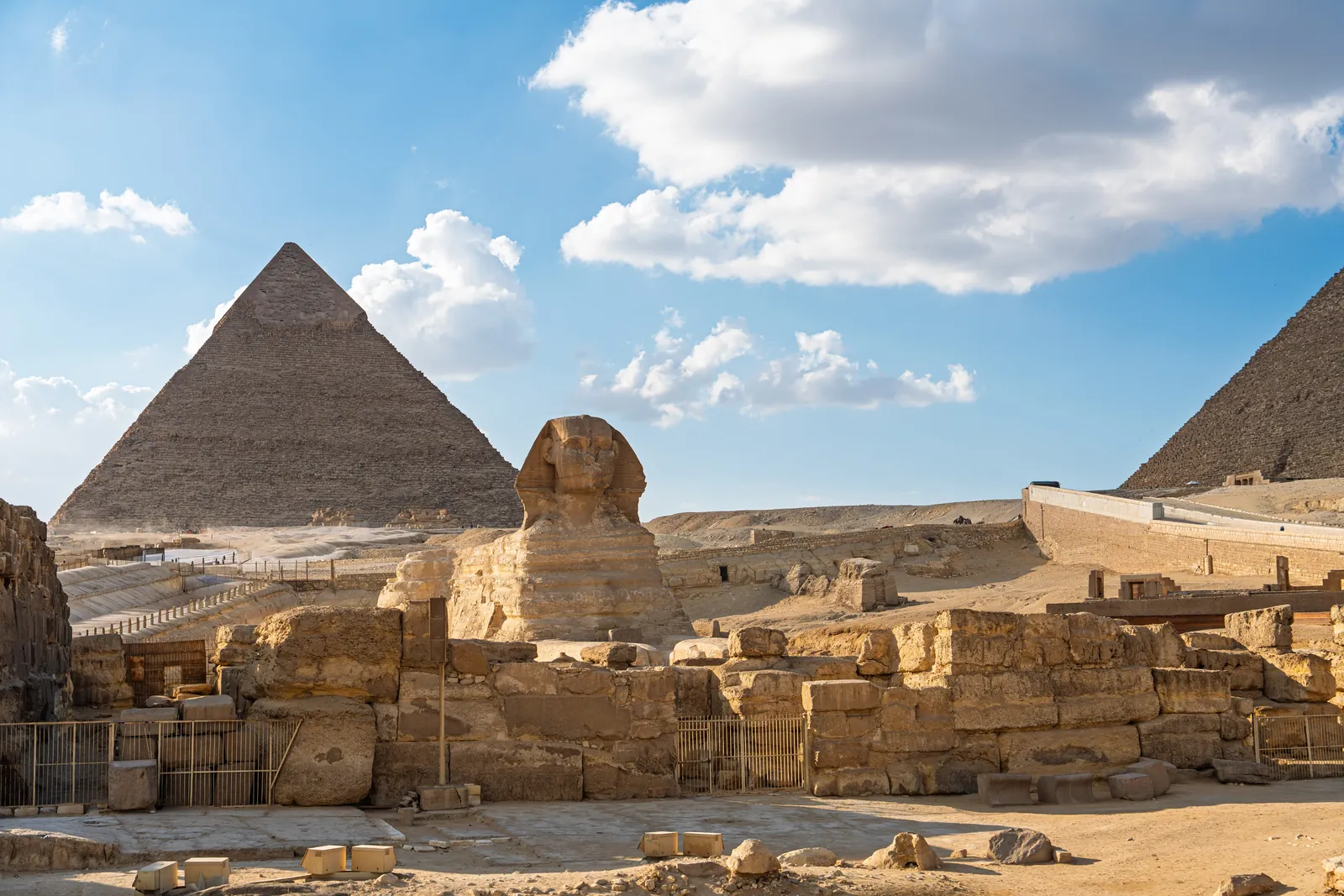
Short answer: The top places to visit in Egypt are the Pyramids of Giza with the Grand Egyptian Museum, Luxor, Cairo, Aswan, Abu Simbel, Sharm El Sheikh and Ras Mohammed, Hurghada and El Gouna, Dahab, Alexandria and Siwa Oasis. For a first trip, combine Cairo and Giza with Luxor and Aswan, linked by a Nile cruise, and finish with a few days on the Red Sea.
Egypt has been welcoming travelers for longer than almost anywhere on Earth. A first visit usually mixes three worlds: the pyramids and museums of Cairo and Giza, the temples and royal tombs along the Nile in Upper Egypt, and the warm water and coral reefs of the Red Sea. Mediterranean Alexandria and the desert oasis of Siwa add two more for a longer trip.
The list is ordered the way we would recommend it for a first visit. Weather timing comes from the Egyptian Meteorological Authority’s 1991–2020 normals, site tickets are the Ministry of Tourism and Antiquities’ foreign adult prices, converted at about EGP 52.3 to the US dollar, and facts were checked in October 2026.
1. The Pyramids of Giza and the Grand Egyptian Museum
Why it made the list: the Pyramids of Giza are the only survivor of the Seven Wonders of the Ancient World. The Great Pyramid of Khufu, built around 2560 BC, was the tallest structure on Earth for almost 4,000 years, and the Great Sphinx still guards the plateau. About 2 km (1.2 miles) away, the Grand Egyptian Museum, fully opened in late 2025, displays the complete treasures of Tutankhamun.
When to go: October to April, and at opening time in any season. In August, Cairo’s highs average about 35 °C (95 °F).
Don’t miss: the plateau and the Sphinx at 7 a.m., when the gates open, then the Tutankhamun Galleries at the museum, where more than 5,000 objects from the boy king’s tomb are on show, from the gold mask to his chariots.
Getting there and how long: Sphinx International Airport is about 30 minutes away and Cairo International 60 to 90 minutes. One busy day covers the plateau and the museum; two or three add Saqqara and Dahshur.
Practical note: the area ticket costs EGP 700 (about US$13) and is paid by card, not cash; going inside the Great Pyramid costs EGP 1,000 more. Buy Grand Egyptian Museum tickets online in advance for a timed slot. See our Giza travel guide.
2. Luxor
Why it made the list: Luxor stands on the site of ancient Thebes and is often called the world’s greatest open-air museum. The East Bank has the vast temple complex of Karnak and Luxor Temple; across the Nile, the West Bank holds the Valley of the Kings, Queen Hatshepsut’s terraced temple and the Colossi of Memnon.
When to go: October to April. From June to September, highs average above 40 °C (104 °F), so sightseeing means very early starts.
Don’t miss: Karnak’s Great Hypostyle Hall, with 134 colossal columns (EGP 600), and the painted tombs of the Valley of the Kings, which open at 6 a.m. (EGP 750 for a general ticket, usually three tombs). See Luxor Temple floodlit in the evening.
Getting there and how long: fly into Luxor, take the sleeper train from Cairo or Giza, or arrive by Nile cruise from Aswan. Give it two full days, or three or four with Dendera and Abydos.
Practical note: start the West Bank at 6 a.m., before the heat; Hatshepsut’s temple (EGP 440) is shadeless by late morning. A dawn hot-air balloon flight over the West Bank is a Luxor classic. See our Luxor travel guide.
3. Cairo
Why it made the list: the biggest city in Africa and the Arab world is loud, crowded and exhausting, and one of the most rewarding cities anywhere. Medieval Islamic Cairo, a UNESCO World Heritage Site, is the largest collection of Islamic monuments in the world, and the city’s museums hold treasures from every era of Egyptian history.
When to go: October to April; May to September is hot, with highs around 35 °C (95 °F).
Don’t miss: the Royal Mummies Hall at the National Museum of Egyptian Civilization (EGP 550), where Ramesses II and Hatshepsut rest, and a walk down Al-Muizz Street through Islamic Cairo to the Khan el-Khalili bazaar. Add the Citadel and the Mosque of Muhammad Ali for the view over the city.
Getting there and how long: fly into Cairo International. Stay three days, or four or five with Giza and Saqqara.
Practical note: the metro is the fastest way across the city, from EGP 10 a ride, and ride-hailing apps avoid haggling over taxi fares. Dress modestly in Islamic Cairo. See our Cairo travel guide.
4. Aswan
Why it made the list: Egypt’s southernmost city is the most relaxed and beautiful town on the Nile, where the river squeezes between granite boulders and golden dunes. White-sailed feluccas tack between islands, colorful Nubian villages line the west bank, and the island temple of Philae, moved block by block in the 1970s to save it from the rising waters, is just upstream.
When to go: October to April. From May to September, highs average about 39–42 °C (102–107 °F).
Don’t miss: a sunset felucca sail around Elephantine Island, and Philae (EGP 550; the motorboat to the island is paid separately).
Getting there and how long: fly into Aswan, take the train from Cairo, Giza or Luxor, or arrive by Nile cruise; Aswan is about 200 km (125 miles) south of Luxor. Stay two days, or three with Abu Simbel.
Practical note: most Nile cruises run between Luxor and Aswan in three or four nights, stopping at the temples of Edfu and Kom Ombo, the classic way to link the two. See our Aswan travel guide and our guide to boat trips.
5. Abu Simbel
Why it made the list: the two rock-cut temples of Ramesses II and Queen Nefertari, with four seated statues of the king about 20 m (66 ft) high on the facade, are among the most awe-inspiring monuments in Egypt. Like Philae, they were cut up and moved to higher ground in the 1960s to escape the waters of Lake Nasser.
When to go: October to April. On the sun festival days, February 22 and October 22, the rising sun shines along the full length of the Great Temple to light the statues in its sanctuary.
Don’t miss: the hall of the Great Temple, lined with eight more colossi of the king, then the smaller temple of Nefertari next door.
Getting there and how long: Abu Simbel is about 280 km (174 miles) south of Aswan, about 3.5 hours by road. Most visitors leave Aswan around 4 a.m., spend about two hours at the temples and are back by early afternoon; EgyptAir also flies there.
Practical note: the standard ticket costs EGP 822 (about US$16), rising to EGP 1,272 on the two sun festival days, when the site is very crowded. See our Aswan travel guide.
6. Sharm El Sheikh and Ras Mohammed
Why it made the list: at the southern tip of the Sinai Peninsula, Sharm El Sheikh is Egypt’s best-known resort for diving and winter sun. Within a short boat ride lie some of the world’s most celebrated reefs: the walls and schools of fish of Ras Mohammed National Park and the reefs of the Strait of Tiran.
When to go: March to May and October to November. Winter is sunny but cool in the evenings, and July and August are very hot.
Don’t miss: a snorkel or dive day at Ras Mohammed, and, for experienced divers, the wreck of the SS Thistlegorm.
Getting there and how long: fly into Sharm El Sheikh International. Stay five to seven days, with time for Ras Mohammed, Tiran and a trip to Dahab or Mount Sinai.
Practical note: if you fly into Sharm and stay up to 15 days only in the South Sinai resorts, you can enter with a free Sinai stamp instead of a visa; for Cairo or Luxor you need a visa. Choose licensed dive operators and carry your passport. See our Sharm El Sheikh travel guide and our guide to diving.
7. Hurghada and El Gouna
Why they made the list: Hurghada, on the African shore of the Red Sea, is Egypt’s biggest beach resort, with clear, warm water all year and some of the most affordable snorkeling and diving in the world. Just north, El Gouna is a car-light lagoon town of canals and marinas, and one of the world’s best kitesurfing spots.
When to go: March to May and September to November. Winter is sunny but cool on the water, and July and August are very hot.
Don’t miss: a boat trip to the white sand of the Giftun Islands, and a kitesurfing lesson in El Gouna.
Getting there and how long: fly into Hurghada International; El Gouna is about 20 to 30 minutes away by road. Stay four to seven days, or a week with a day trip to Luxor.
Practical note: islands and reefs are protected areas, with fees often included in boat trips; bring water shoes and reef-safe sunscreen. See our Hurghada travel guide and El Gouna travel guide, and for quieter reefs farther south, our Marsa Alam travel guide.
8. Dahab
Why it made the list: a small, laid-back town on the Gulf of Aqaba, Dahab is the counterpoint to the big resorts: low-rise hotels and cafés with floor cushions along a seafront promenade, where you can step straight onto a coral reef. Its famous Blue Hole, a deep sinkhole in the reef, makes it one of the world’s great places to dive and freedive.
When to go: March to May and October to November; winter is sunny but cool at night, and summer is very hot.
Don’t miss: snorkeling the rim of the Blue Hole, about 8 km (5 miles) north of town, and the shore reefs of the Lighthouse and the Eel Garden.
Getting there and how long: fly into Sharm El Sheikh, about 1 to 1.5 hours away by road. Stay four days to a week.
Practical note: the free Sinai stamp covers Dahab for up to 15 days. The Blue Hole’s deep arch is for technical divers only; recreational divers and snorkelers stay on the rim and the reef wall. See our Dahab travel guide and our guide to snorkeling.
9. Alexandria
Why it made the list: founded by Alexander the Great in 331 BC, Alexandria was the city of Cleopatra, the legendary Library and the Pharos lighthouse. Much of the ancient city lies under the modern one or under the sea, but its Roman catacombs, its seafront and its seafood make it a different Egypt, Mediterranean and breezy.
When to go: April to June and September to November. Summer is hot, humid and crowded with Egyptian holidaymakers, and winter brings rain and storms.
Don’t miss: the Citadel of Qaitbay, built in the 1470s with stones from the fallen lighthouse (EGP 200), and the Bibliotheca Alexandrina, the modern library near the site of the ancient one.
Getting there and how long: about 2.5 to 3 hours from Cairo by train. One or two days.
Practical note: carry a card for site tickets, and dress more conservatively than in Cairo. See our Alexandria travel guide.
10. Siwa Oasis
Why it made the list: deep in the Western Desert, Siwa is a world of its own: hundreds of thousands of date palms and olive trees, glittering salt lakes and springs, all ringed by the dunes of the Great Sand Sea. Its people are Amazigh, with their own language, and the crumbling mud-brick walls of the old fortress of Shali rise in the middle of town.
When to go: October to November and February to April. Summers are very hot, and winter nights are cold.
Don’t miss: the Temple of the Oracle, which Alexander the Great crossed the desert to consult in 331 BC (EGP 120), and a sunset 4×4 trip into the Great Sand Sea.
Getting there and how long: by bus or car from Marsa Matruh, about four hours away, with connections from Alexandria and Cairo, or the overnight sleeper train from Cairo to Marsa Matruh. Stay three or four nights; the journey takes most of a day each way.
Practical note: carry your passport, and book desert trips with a licensed operator, who arranges the permits they need. See our Siwa Oasis travel guide.
How to fit them into one trip
The classic first trip takes ten days to two weeks: three or four nights in Cairo and Giza, a flight or the sleeper train south to Luxor, a Nile cruise of three or four nights between Luxor and Aswan, a day trip to Abu Simbel, then a flight to Hurghada or Sharm El Sheikh for three or four days of beach and reef. With a week, keep Cairo, Giza, Luxor and Aswan. Alexandria is an easy add-on from Cairo, while Siwa and Dahab suit a second trip or a slower third week.
Choose your dates with our best time to visit Egypt guide, and our AI trip planner builds the day-by-day plan for your dates.
Plan your trip
Read our Egypt travel guide for the e-visa, monument tickets and trains, check the heat for your dates in the Destination weather tool, convert Egyptian pounds with the Money exchange tool, and see Travel costs by country to plan your budget.
Frequently asked questions
What is the best place in Egypt for first-time visitors?
Cairo and Giza, for the pyramids, the Sphinx and Tutankhamun’s treasures at the Grand Egyptian Museum. Add Luxor if you can: its temples and royal tombs are the other half of the classic first trip.
What is the most beautiful place in Egypt?
Many travelers would say Aswan, with its feluccas, granite islands and Nubian villages on the Nile, or the West Bank of Luxor at dawn. Underwater, Ras Mohammed and Dahab’s Blue Hole are among the most beautiful reefs in the world.
How many days do you need in Egypt?
A week covers Cairo, Giza, Luxor and Aswan. Ten days to two weeks lets you add Abu Simbel, a Nile cruise and a few days on the Red Sea.
Is a Nile cruise worth it?
For most first-time visitors, yes. Three or four nights between Luxor and Aswan covers the temples of Edfu and Kom Ombo on the way, with no packing and unpacking, and the river views are a highlight in themselves.
When is the best time to visit Egypt’s top places?
October to April for Cairo, Luxor, Aswan and Abu Simbel, when the heat is manageable. The Red Sea is best from March to May and September to November, and Alexandria from April to June and September to November.