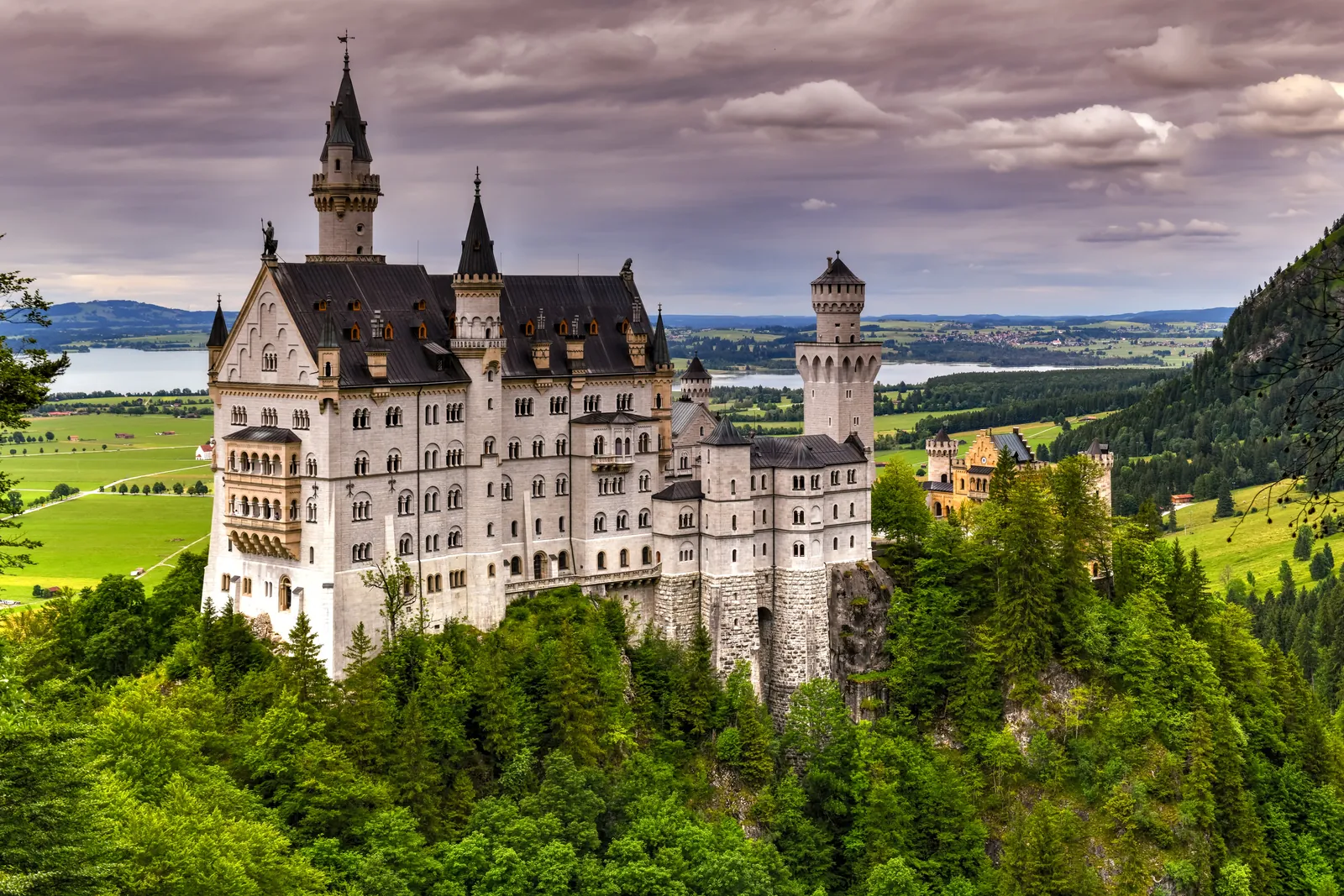
Short answer: For a first trip, the top places to visit in Germany are Berlin, Munich, Neuschwanstein Castle and the Bavarian Alps, the castles and vineyards of the Middle Rhine Valley and Cologne with its cathedral. Round out the list with Heidelberg, the medieval walls of Rothenburg ob der Tauber, the Black Forest, the port city of Hamburg and baroque Dresden with the sandstone towers of Saxon Switzerland.
The list is ordered the way we would recommend places to a first-time visitor: the two great cities and the Alps first, then the Rhine, the classic small towns, the forest and the north and east. Fast trains link most of these places in a few hours. Prices are the official 2026 figures, in euros.
1. Berlin
Why it made the list: Germany’s capital is one of Europe’s best cities for sightseeing, with history never far away. In one day you can walk through the Brandenburg Gate, climb the glass dome of the Reichstag, stand where the Wall divided the city for 28 years and see the bust of Nefertiti on Museum Island. It is green and spread out, with lakes for swimming in summer.
Best time to go: May, June and September. Summer is lively and warm; late November to December brings the Christmas markets.
Don’t miss: the Reichstag dome, free with advance registration, and Museum Island, where a one-day ticket for all its exhibitions costs €24 (under-18s free). The East Side Gallery, the longest surviving stretch of the Wall, is free.
Getting there and how long: the FEX Airport Express or the S-Bahn runs from BER airport to the center in about 30 minutes, on an ABC ticket costing €5. Give it four days, five or six with Potsdam.
Practical note: the Reichstag dome is closed from October 19 to 30, 2026, for maintenance, and the Pergamonmuseum stays closed until it reopens on July 4, 2027. See our Berlin travel guide.
2. Munich
Why it made the list: Munich is Germany at its most cheerful: a walkable city of baroque churches, royal palaces and world-class art, with beer gardens under chestnut trees. It is also the gateway to the Alps, the lakes and Neuschwanstein, all within about two hours.
Best time to go: May, June and September; beer-garden season runs from about April to October. Oktoberfest 2027 runs from September 18 to October 3.
Don’t miss: the Residenz, the former royal palace, with its Treasury and Cuvilliés Theatre (€20 for all three, under-18s free), and an afternoon in the English Garden, followed by a beer garden.
Getting there and how long: the S1 or S8 S-Bahn from the airport takes about 40 minutes. Stay three days for the city, four or five with Neuschwanstein and a lake.
Practical note: Bavaria does not allow a city tax on hotel stays, so Munich has none. Book hotels early for Oktoberfest, when prices jump. See our Munich travel guide.
3. Neuschwanstein and the Bavarian Alps
Why it made the list: along the Austrian border, the Bavarian Alps combine limestone peaks, emerald lakes and onion-domed churches with King Ludwig II’s fairy-tale castles. Neuschwanstein, Linderhof and Herrenchiemsee joined UNESCO’s World Heritage list in July 2025 as the Palaces of King Ludwig II.
Best time to go: June to early October for hiking, lakes and open passes; September for clear days and fewer crowds; mid-December to March for snow.
Don’t miss: Neuschwanstein, visited only on guided tours of about 30 minutes, and the ride up the Zugspitze, at 2,962 m (9,718 ft) Germany’s highest mountain. Further east, a boat on the Königssee takes you to the chapel of St. Bartholomä.
Getting there and how long: regional trains run from Munich to Füssen (about two hours), Garmisch-Partenkirchen and Berchtesgaden. A day trip is possible, but the region deserves four days to a week.
Practical note: Neuschwanstein tickets cost €21 for adults; under-18s go free but still need a ticket, and online booking adds €2.50 per ticket. On-site tickets are same-day only and usually sell out by late morning, so book online. See our Bavarian Alps travel guide.
4. The Middle Rhine Valley
Why it made the list: between Bingen and Koblenz, the Rhine cuts a deep, winding gorge with more than 40 castles, palaces and fortresses along 64 km, steep vineyards and half-timbered wine towns. It has been a UNESCO World Heritage Site since 2002.
Best time to go: May to mid-October, when the riverboats run their full timetable (KD’s main Middle Rhine season ran from April 25 to October 4 in 2026); September and October for the grape harvest and wine festivals.
Don’t miss: a boat trip past the Loreley rock at the river’s narrowest bend, and the Marksburg, the only hilltop castle on the Middle Rhine that was never destroyed (€12 for adults).
Getting there and how long: trains run along both banks from Koblenz and Mainz, about an hour or so from Frankfurt airport. One day covers a cruise and a castle; stay two or three nights to hike and taste Riesling.
Practical note: there are no bridges between Mainz and Koblenz, so you cross the river by ferry. In winter, boats run rarely and some castles close or shorten their hours. See our Middle Rhine Valley travel guide.
5. Cologne
Why it made the list: one of Germany’s oldest cities, founded by the Romans on the Rhine, Cologne greets you with its twin-spired Gothic cathedral the moment you step out of the main station. The old town is full of Romanesque churches and brewery taverns serving Kölsch in small glasses.
Best time to go: May to September for the riverside; late November to December 23 for the Christmas markets; February for carnival.
Don’t miss: the cathedral, begun in 1248 and completed in 1880, a UNESCO World Heritage Site, and its tower, 533 steps up to a viewing level about 100 m above the city (€8 for adults).
Getting there and how long: the S19 S-Bahn or regional trains reach the main station from Cologne Bonn Airport in about 15 minutes. Give it two days, three or four with Bonn or a Rhine trip.
Practical note: since July 1, 2026, sightseeing inside the cathedral has been ticketed, reported at €12 for adults (€6 reduced, under-14s free); services and prayer remain free. See our Cologne travel guide.
6. Heidelberg
Why it made the list: the picture-book German university town has a red sandstone castle ruin on a wooded hillside, a baroque old town between the hills and the Neckar river, and the oldest university in Germany, founded in 1386.
Best time to go: April to October for the hills and the river; late November to December for the Christmas market under the castle.
Don’t miss: the funicular up to the castle and the Great Barrel in its cellar, then the walk across the Old Bridge and up the Philosophers’ Walk for the classic view back over the town.
Getting there and how long: direct trains from Frankfurt take about 50 minutes to 1 hour 20 minutes. One full day covers the highlights; stay two or three to slow down.
Practical note: the castle ticket, €11 for adults, includes the return funicular ride from Kornmarkt, the courtyard, the Great Barrel and the German Pharmacy Museum. See our Heidelberg travel guide.
7. Rothenburg ob der Tauber
Why it made the list: this is the medieval German town of everyone’s imagination: a ring of walls and towers on a ridge above the Tauber valley, cobbled lanes of half-timbered houses and the crooked little square of the Plönlein. It is small enough to walk across in 15 minutes.
Best time to go: April to June and September to October, on weekdays. Advent brings the Reiterlesmarkt Christmas market, with big crowds.
Don’t miss: a walk along the covered walkway on the town walls, about 4 km around, and the climb of 220 steps up the town hall tower (€4, cash only).
Getting there and how long: by regional train via Steinach, on the line between Würzburg and Ansbach, with a short connection into town; by car, off the A7 motorway. Stay one night and a full day.
Practical note: the town is very busy in the middle of the day, so the secret is to stay the night and explore in the early morning and evening. The Night Watchman’s evening tour starts from the market square; check the town’s website for the 2027 schedule. See our Rothenburg ob der Tauber travel guide.
8. The Black Forest
Why it made the list: in Germany’s south-west corner, this wooded mountain range runs about 160 km toward the Swiss border, with open valleys, huge farmhouses, waterfalls and lakes, the spa town of Baden-Baden and lively Freiburg. It is the home of the cuckoo clock and the cherry cake.
Best time to go: May to October for hiking; September and October for wine festivals and golden forests; January and February for snow on the high ridges.
Don’t miss: the Triberg waterfalls, which drop 163 m in seven steps (€9 for adults in summer), and a soak in the thermal baths of Baden-Baden, part of UNESCO’s Great Spa Towns of Europe; the Caracalla baths cost €21 for two hours.
Getting there and how long: fast trains run along the Rhine to Baden-Baden, Offenburg and Freiburg. Give it three or four days, a week to hike.
Practical note: many hotels give guests the free KONUS card, valid on buses and regional trains across the region (not on ICE or IC trains), so ask before you book. See our Black Forest travel guide.
9. Hamburg
Why it made the list: Germany’s second-largest city is made by water: one of Europe’s biggest ports on the Elbe, two lakes in the middle of town and canals crossed by more than 2,000 bridges. It is rich, elegant and down to earth, with great seafood and nightlife.
Best time to go: May to September, when the waterfront and lakes come alive; December for the Christmas markets.
Don’t miss: the Plaza of the Elbphilharmonie concert hall, 37 m up, for views over the harbor, the red-brick warehouses of the Speicherstadt, a UNESCO World Heritage Site, and the Miniatur Wunderland model railway (€22 for adults).
Getting there and how long: the S1 S-Bahn runs from the airport to the main station in about 25 minutes, on an AB ticket costing €4.10. Give it two or three days.
Practical note: from October 5, 2026, a Plaza ticket costs €5, whether booked online or on the spot. Harbor ferry line 62 from the Landungsbrücken piers is a cheap harbor tour on a normal transport ticket. See our Hamburg travel guide.
10. Dresden and Saxon Switzerland
Why it made the list: Saxony’s baroque capital, rebuilt after heavy destruction in 1945, is a city of domes, palaces and river terraces on the Elbe, with world-class art and treasure collections. Less than an hour away, the sandstone towers of Saxon Switzerland make one of Germany’s most dramatic landscapes.
Best time to go: May to September for the river and the hills; late November to Christmas for the Striezelmarkt, held from November 25 to December 24, 2026.
Don’t miss: the Frauenkirche, free to enter, and the jewels of the Historic Green Vault in the Royal Palace (€18 with a timed ticket), then the walk over the Bastei Bridge above the Elbe.
Getting there and how long: direct trains from Berlin take about 1 hour 40 minutes to 2 hours. Stay two days for the Old Town, three or four with Saxon Switzerland.
Practical note: book the Historic Green Vault online, as capacity is limited; the Royal Palace museums close on Tuesdays. In Saxon Switzerland, the path over the Bastei Bridge is open, but the Neurathen rock castle beside it is closed until further notice. See our Dresden travel guide and Saxon Switzerland travel guide.
How to fit them into one trip
Germany is big, but its trains make a two-week loop easy. Pick two or three regions rather than trying to see everything.
One week, south: three nights in Munich, with a day trip to Neuschwanstein; two nights in the Bavarian Alps around Garmisch-Partenkirchen or Berchtesgaden; and a night in Rothenburg on the way north to Frankfurt.
Ten days, west and south: fly into Frankfurt, spend two nights on the Middle Rhine, two in Cologne, one in Heidelberg, one in Rothenburg and three in Munich, with a day for Neuschwanstein.
Two weeks, the classic loop: Berlin (three or four nights), Dresden (two), Munich and the Alps (four), Rothenburg (one), Heidelberg (one) and the Rhine with Cologne (three). Add Hamburg or the Black Forest if you have more time.
Germany is best in May, June and September; July and August are warmest but busiest, and Christmas markets run from late November. Our best time to visit Germany guide goes month by month, and our AI trip planner builds the day-by-day plan for your dates.
Plan your trip
Start with our Germany travel guide for trains, the Deutschlandticket, money and entry rules. Use the AI trip planner to turn this list into a route, and check the weather for your dates with the Destination weather tool.
Frequently asked questions
What is the most beautiful place in Germany?
Many travelers name Neuschwanstein Castle against the Alps, the castle-lined gorge of the Middle Rhine Valley, and the medieval walls and lanes of Rothenburg ob der Tauber.
How many days do you need in Germany?
A week covers Munich, the Alps and a stop such as Rothenburg. Ten days lets you add the Rhine, Cologne and Heidelberg, and two weeks covers Berlin and Dresden too.
What is the best place in Germany for first-time visitors?
Munich, for its old town, beer gardens and easy day trips to Neuschwanstein and the Alps, or Berlin, for its history, museums and nightlife. Many first trips combine the two by fast train.
Do I need to book Neuschwanstein tickets in advance?
Yes, especially from May to October. Tickets are for timed guided tours, and same-day tickets at the ticket center usually sell out by late morning. Adults pay €21, and under-18s need a free ticket.
When is the best time to visit Germany?
May, June and September, for warm weather, long days and fewer crowds than in July and August. Come from late November to Christmas for the Christmas markets, and in late September for Oktoberfest.