Short answer: The top places to visit in Japan are Tokyo, Kyoto, Osaka, Hiroshima with the island of Miyajima, Nara, Mount Fuji and the Fuji Five Lakes, Kanazawa, Takayama with Shirakawa-go, Sapporo and Okinawa Island. For a first trip, start with Tokyo and Kyoto, add Fuji and Hiroshima, and keep Hokkaido, the Alps or Okinawa for a longer stay or a second visit.
Japan packs giant modern cities, a thousand years of temples, a sacred volcano, snowy mountain villages and coral beaches into one country, and fast trains link most of it.
The list is ordered the way we would recommend it for a first visit. Weather timing comes from the Japan Meteorological Agency (JMA) 1991–2020 normals, and facts were checked in October 2026.
1. Tokyo
Why it made the list: Tokyo is the world’s biggest metropolitan area and still one of the easiest big cities to visit: clean, punctual and full of very different neighborhoods, from the neon of Shinjuku and the Shibuya crossing to the temple streets of Asakusa and the museums of Ueno. Most international flights land here.
When to go: late March to May and October to early December. The JMA’s normal full-bloom date for Tokyo’s cherry blossoms is March 31, and the maples color around November 28. August highs average about 31 °C (88 °F).
Don’t miss: an early morning at Sensō-ji Temple in Asakusa before the crowds, then an evening in Shinjuku or Shibuya.
Getting there and how long: Haneda Airport is about 30 minutes from the center and Narita about an hour by express train. Give Tokyo at least three full days, more if you want day trips.
Practical note: Tokyo’s accommodation tax is ¥100 or ¥200 per person per night on rooms from ¥10,000, and it changes to 3% of the room rate from April 1, 2027. See our Tokyo travel guide.
2. Kyoto
Why it made the list: Kyoto was Japan’s imperial capital for more than a thousand years and still holds the country’s greatest collection of temples, shrines, gardens and old wooden streets, with 17 places on the UNESCO World Heritage list.
When to go: early April and late November are the showpiece weeks: normal full bloom is April 4, and the hillside temples often peak in the last two weeks of November. They are also the most crowded and expensive weeks, so May, early June and early December are good quieter choices.
Don’t miss: the tunnels of red gates at Fushimi Inari, ideally at dawn, and the golden pavilion of Kinkaku-ji (open 9:00–17:00, ¥500 for adults).
Getting there and how long: about 2 hours 15 minutes from Tokyo by Nozomi shinkansen, or about 75 minutes from Kansai Airport on the Haruka express. Stay at least three nights.
Practical note: Kyoto raised its accommodation tax on March 1, 2026; it now runs from ¥200 to ¥10,000 per person per night depending on the room rate, so check it when you compare hotels. See our Kyoto travel guide.
3. Osaka
Why it made the list: Osaka is Japan’s liveliest big city, a merchant town famous for street food, neon and friendly locals. It is also the most practical base in the Kansai region: Kyoto, Nara, Kobe and Himeji are all within about an hour by train.
When to go: late March to May and October to November. Normal full bloom is April 4, the same as Kyoto, and the maples color around December 1.
Don’t miss: takoyaki and okonomiyaki along the canal in Dotonbori at night, and Osaka Castle with its moats and park.
Getting there and how long: Kansai International Airport is about 35 to 50 minutes away by train, and Shin-Osaka is about 2 hours 30 minutes from Tokyo by Nozomi. Two nights covers the city; stay longer if you use it as a base for day trips.
Practical note: JR West stopped selling the Kansai Area Pass on September 30, 2026. The Kansai Mini Pass (3 days, ¥3,000) covers rapid and local JR trains between Kyoto, Osaka, Kobe and Nara. See our Osaka travel guide.
4. Hiroshima and Miyajima
Why it made the list: Hiroshima’s Peace Memorial Park and Museum tell the story of August 6, 1945 with great dignity. Across the bay, the sacred island of Miyajima has one of Japan’s most famous views: the vermilion torii gate of Itsukushima Shrine standing in the sea.
When to go: late March to May and in November, when Miyajima’s maples turn red. The JMA’s normal full bloom in Hiroshima is April 3, and the maples color around November 22.
Don’t miss: the Peace Memorial Museum (¥200 for adults) and the A-Bomb Dome, then Itsukushima Shrine (¥300) at high tide, when the gate seems to float. On a clear day, take the Miyajima Ropeway (¥2,000 round trip) toward the summit of Mount Misen.
Getting there and how long: Hiroshima is about 1 hour 20 minutes from Shin-Osaka by shinkansen. For Miyajima, take a JR train or streetcar to Miyajimaguchi and the ferry of about 10 minutes. Spend two days, ideally with a night on the island after the day-trippers leave.
Practical note: every visitor to Miyajima pays a ¥100 visitor tax, collected with the ferry fare, and Itsukushima Shrine does not take credit cards. See our Hiroshima travel guide and Miyajima travel guide.
5. Nara
Why it made the list: Nara was Japan’s first permanent capital, from 710 to 784, and its great green park still holds the giant bronze Buddha of Todai-ji, the lantern-lined paths of Kasuga Taisha and well over a thousand wild deer. It is the easiest day trip in Kansai.
When to go: late March to May and October to early December. Normal full bloom is April 4, and the maples color around November 21.
Don’t miss: Todai-ji’s Great Buddha Hall (¥800 for adults) and a slow walk through Nara Park to Kasuga Taisha.
Getting there and how long: about 35 to 45 minutes from Kyoto and 40 minutes from Osaka-Namba by Kintetsu train, or by JR. A day is enough for the main sights; a night lets you see the park at dawn.
Practical note: the deer are wild animals. The Nara Deer Preservation Foundation counted 1,465 of them in July 2025 and asks visitors not to approach or touch them, and to take extra care with stags in the fall rutting season. See our Nara travel guide.
6. Mount Fuji and the Fuji Five Lakes
Why it made the list: at 3,776 m (12,388 ft), Mount Fuji is Japan’s highest mountain and its national symbol, and the Fuji Five Lakes at its northern foot give the closest, most famous views.
When to go: for views, late October to February. At Kawaguchiko, December to February average about 190 to 210 hours of sunshine a month, while clouds often hide the mountain from June to October. To climb, you must come in the official season: in 2026 it ran from July 1 (Yoshida and Subashiri trails) or July 10 (Fujinomiya and Gotemba) to September 10.
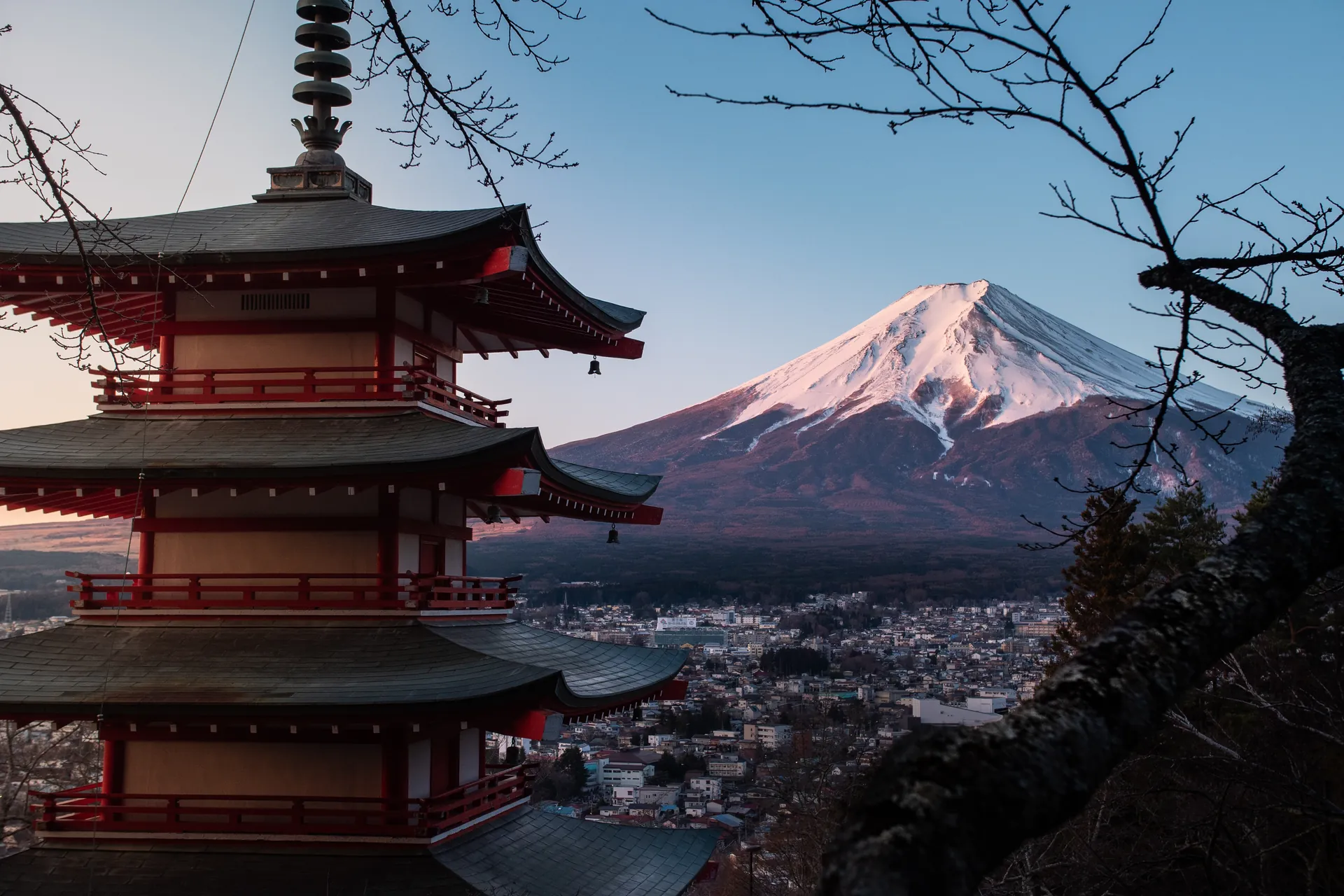
Don’t miss: Chureito Pagoda in Fujiyoshida with Fuji behind it, best at sunrise, and the quiet north shore of Lake Kawaguchi, where the mountain reflects in the water on calm mornings.
Getting there and how long: about two hours from Shinjuku by highway bus or the Fuji Excursion limited express. It works as a long day trip, but one night by the lake gives you the clear early-morning views.
Practical note: climbers pay a ¥4,000 hiking fee and must register, and the trails are closed to climbers from 2 p.m. to 3 a.m. unless they have a mountain-hut booking. If you prefer hot springs, volcanic steam vents and a lake cruise, Hakone is the classic alternative, about 80 minutes from Shinjuku by the Romancecar. See our Fuji Five Lakes travel guide.
7. Kanazawa
Why it made the list: Kanazawa is an elegant castle town on the Sea of Japan coast that escaped bombing in World War II, so it kept its geisha teahouse districts, samurai lanes and one of the three great gardens of Japan, Kenroku-en. It is also the gateway to the Japan Alps.
When to go: April to May and October to November. Normal full bloom is April 8, a few days after Tokyo.
Don’t miss: Kenroku-en (¥320 for adults), and the teahouses of Higashi Chaya. Have a seafood rice bowl at Omicho Market.
Getting there and how long: about 2.5 to 3 hours from Tokyo by the Hokuriku Shinkansen, or about 2 hours 10 minutes from Osaka via Tsuruga. Stay two nights.
Practical note: from November 1 the garden’s pine trees are tied with yukitsuri, rope cones against the snow, a classic winter photo. Kanazawa’s accommodation tax is ¥200 or ¥500 per person per night on rooms from ¥5,000. See our Kanazawa travel guide.
8. Takayama and Shirakawa-go
Why it made the list: high in the Japan Alps, Takayama keeps one of Japan’s best-preserved old merchant quarters, with dark wooden townhouses, sake breweries and morning markets. An hour away, the UNESCO-listed village of Shirakawa-go has 114 gassho-zukuri farmhouses with steep thatched roofs built to shed some of the deepest snow in Japan.
When to go: April to May and October to early November. Takayama holds its float festivals every year on April 14–15 and October 9–10. Shirakawa-go is magical under snow in January and February; its 2027 winter light-up evenings are January 11, 17, 24 and 31, by advance booking only.
Don’t miss: the old streets of Sanmachi and Takayama Jinya (¥500), the old government house, then the view over Shirakawa-go’s roofs from the observation deck.
Getting there and how long: Takayama is about 2.5 hours from Nagoya by the JR Hida limited express. Nohi Bus links Takayama and Shirakawa-go in about 50 minutes (¥2,800 one way) and runs on to Kanazawa, so the three make an easy line. Allow two nights, one of them in Takayama.
Practical note: Shirakawa-go is a living village. Visit between 8:00 and 17:00 unless you are staying, take your trash with you and stay off private land. Some buses are reservation-only, so book ahead. See our Takayama travel guide and Shirakawa-go travel guide.
9. Sapporo and Hokkaido
Why it made the list: Sapporo, the capital of Japan’s wild northern island, shows a completely different Japan: wide streets laid out in the 1870s, mountains on the edge of town, miso ramen, fresh crab and powder snow.
When to go: December to March for snow, and June to September for cool, green summers when the rest of Japan swelters; Hokkaido has no rainy-season entry in the JMA’s records. The Sapporo Snow Festival runs from February 4 to 11, 2027. Cherry blossoms arrive late here, with normal first bloom on May 1.
Don’t miss: Odori Park, the heart of the Snow Festival, and a bowl of miso ramen or a seafood rice bowl at Nijo Market. Add a day trip to Otaru.
Getting there and how long: fly from Tokyo to New Chitose Airport, then take the JR rapid train to the city in about 40 minutes. Give Hokkaido three to four days.
Practical note: since April 1, 2026, Sapporo and Hokkaido together charge an accommodation tax of ¥300 to ¥1,000 per person per night. Skiers should see our Niseko travel guide. See our Sapporo travel guide.
10. Okinawa Island
Why it made the list: Japan’s subtropical south has white-sand beaches, coral reefs and its own culture from the old Ryukyu Kingdom: different food, music and castles.
When to go: April to early May and September to November for the beach. The rainy season normally runs from May 10 to June 21, and the region averages about eight typhoon approaches a year, most in July to September.
Don’t miss: the whale sharks of the Okinawa Churaumi Aquarium on the Motobu Peninsula, and Shurijo Castle above Naha. The castle’s main hall, which burned in 2019, is scheduled to open to the public on November 23, 2026, according to the park.
Getting there and how long: about 2.5 hours by air from Tokyo to Naha. Stay four days or more, with a car for the north of the island.
Practical note: the Japan Rail Pass is not valid on Okinawa, and from February 1, 2027 the prefecture adds a 2% accommodation tax, capped at ¥2,000 per person per night. Swim inside the netted areas on official beaches. See our Okinawa Island travel guide and our guide to snorkeling.
How to fit them into one trip
Most first trips follow the same line along the shinkansen. In seven days you can do Tokyo (three nights), a night by the Fuji lakes or in Hakone, and Kyoto (three nights) with a day trip to Nara. With ten days, add Osaka and two days for Hiroshima and Miyajima, then fly home from Kansai Airport. With two weeks, add the Alps loop: from Tokyo take the shinkansen to Kanazawa, the bus to Shirakawa-go and Takayama, and the train down to Kyoto via Nagoya.
Hokkaido and Okinawa sit at opposite ends of the country, so treat each as a separate block of three to five days and fly in and out, or keep one for your next trip. Pick your season with our best time to visit Japan guide; our AI trip planner builds the day-by-day plan for your dates.
Plan your trip
Read our Japan travel guide for entry rules, rail passes and money, check your dates in the Destination weather tool, convert yen with the Money exchange tool, and let the trip planner build the route.
Frequently asked questions
What is the best place in Japan for first-time visitors?
Tokyo and Kyoto together. Tokyo shows modern Japan and is the easiest arrival point, and Kyoto shows traditional Japan, with its temples, gardens and old streets. They are about 2 hours 15 minutes apart by shinkansen.
What is the most beautiful place in Japan?
It depends on the season, but the classic answers are Mount Fuji from the Fuji Five Lakes on a clear winter morning, the floating torii gate of Miyajima at high tide, Kyoto’s temples in the November maples, and Shirakawa-go under snow.
How many days do you need in Japan?
Seven days covers Tokyo, Fuji or Hakone, and Kyoto with Nara. Ten days adds Osaka, Hiroshima and Miyajima. Two weeks lets you add the Japan Alps, Hokkaido or Okinawa without rushing.
Is the Japan Rail Pass worth it for these places?
It can be for a long loop such as Tokyo, Kyoto, Hiroshima and back. A 7-day ordinary pass costs ¥50,000 on the official site, so add up your planned fares first. It does not cover Okinawa, the Fujikyu line to Kawaguchiko, or the Nohi buses in the Alps, and regional passes are often cheaper for a single area.