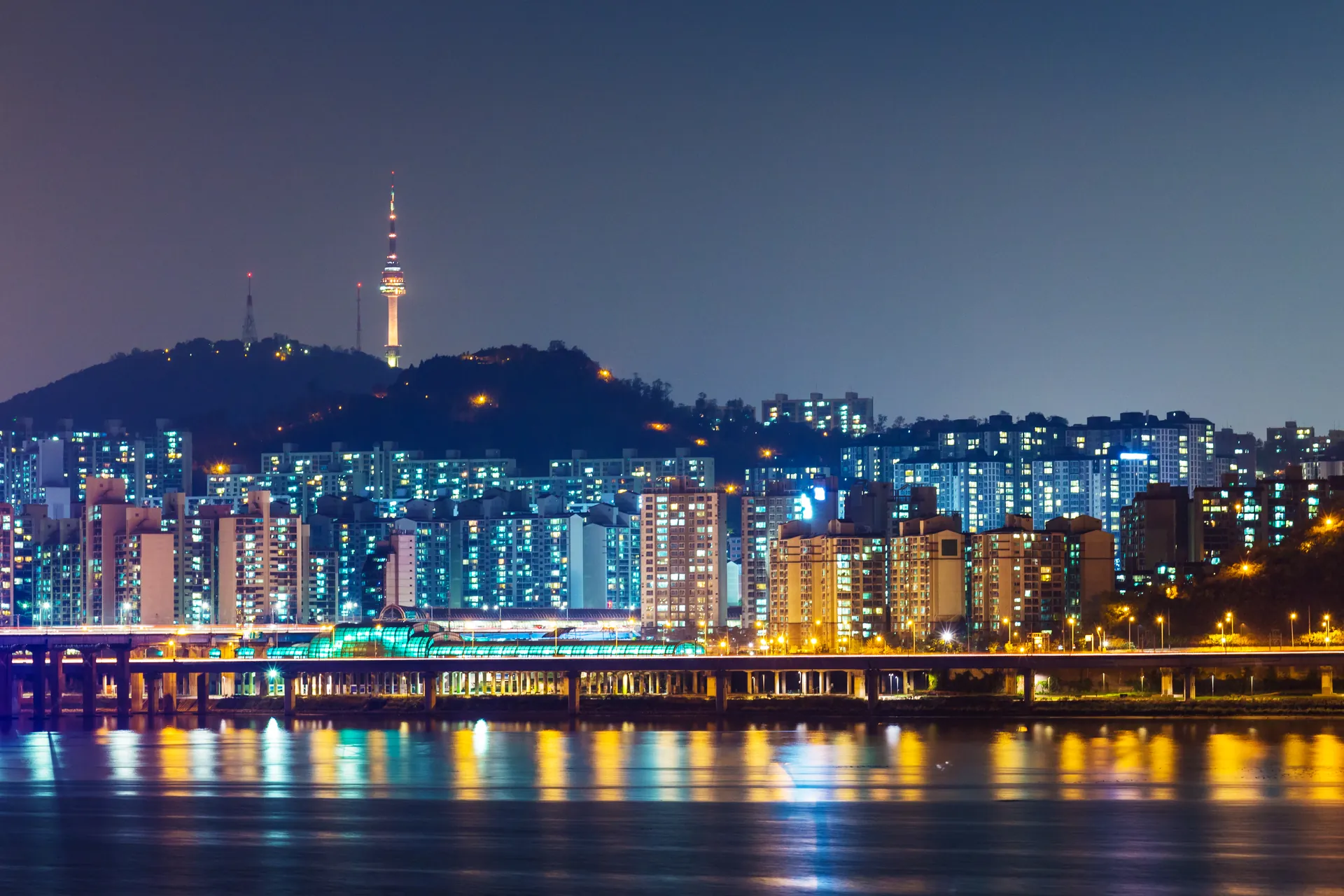
Short answer: For a first trip, the top 10 places to visit in South Korea are Seoul, Gyeongju, Busan, Jeju Island, Seoraksan National Park, Jeonju, Suwon’s Hwaseong Fortress, Gangneung, Yeosu and Incheon. Together they give you a giant modern capital, a thousand-year royal city, the seaside, a volcanic island, the best mountain scenery and the country’s food and village traditions.
South Korea is compact and easy to travel, with fast KTX trains linking most of the places on this list to Seoul in a few hours. The list is ordered the way we would recommend it for a first visit: the essential cities first, then the island, the mountains and the smaller cities that round out a longer trip. For each place you get why it made the list, the best time to go, what not to miss, how to get there and how long to stay, plus one practical note. Prices and dates are as of October 2026, and each section links to our full guide.
1. Seoul
Seoul is one of Asia’s most exciting cities: a capital of almost ten million where five royal palaces from the Joseon dynasty stand between glass towers, hanok houses line the lanes below the mountains, and markets and street-food stalls stay busy late into the night. It is also very easy to visit, with a superb subway and English signs everywhere.
Best time: April and May, and late September to early November. Cherry blossoms usually arrive in early April (the 2026 forecast for the first blossoms was 3 April), and fall colors peak in early November. Summers are hot and wet during the jangma rains, and winters cold and dry.
Don’t miss: Gyeongbokgung, the grandest palace, and Changdeokgung with its Secret Garden; then the view from Namsan and an evening in Hongdae or along the Han River parks.
Getting there and how long: most international flights land at Incheon, with fast AREX trains into the city. Give Seoul four days, plus a day trip to Suwon.
Practical note: the palaces close one day a week, Tuesday for Gyeongbokgung and Monday for Changdeokgung and Deoksugung, so plan around them. Entry is cheap: 3,000 won for Gyeongbokgung, with an integrated palace ticket for 6,000 won. See our Seoul travel guide.
2. Gyeongju
Gyeongju was the capital of the Silla kingdom for nearly a thousand years, from 57 BC to AD 935, and the whole city feels like an open-air museum: grassy royal burial mounds rise between the houses, and pagodas dot the rice fields. Its treasures make up three UNESCO World Heritage sites.
Best time: late March to May and October to mid-November. Cherry blossoms reach Gyeongju in late March, and summers are hot in the shadeless streets.
Don’t miss: Bulguksa temple and the Seokguram grotto on the mountain above it, then the illuminated pavilions of Donggung Palace and Wolji Pond after dark.
Getting there and how long: Gyeongju is on the KTX network and an easy trip from Busan. Give it two days; it is compact and easy to explore by bike.
Practical note: since May 2023, Bulguksa and Seokguram have been free to visit. Daereungwon’s tomb park is free too, while the Cheonmachong tomb and Donggung and Wolji charge 3,000 won each. See our Gyeongju travel guide.
3. Busan
South Korea’s second city and biggest port wraps around a coast of beaches, rocky headlands and harbor bays at the southeastern tip of the peninsula. It mixes big-city energy with the sea, and its winters are milder than Seoul’s.
Best time: May, June, September and October. Beach season runs from June to early September, but July and August are hot, humid and crowded, with the jangma rains and the chance of typhoons. The Busan International Film Festival runs in early October.
Don’t miss: Haedong Yonggungsa, a Buddhist temple on the rocks above the sea, the Jagalchi fish market, and the pastel hillside houses of Gamcheon Culture Village.
Getting there and how long: KTX trains run from Seoul, and Gimhae airport has domestic and regional flights. Allow three days, plus Gyeongju.
Practical note: Gamcheon is a residential neighborhood and a special management zone: visits are allowed from 9 a.m. to 6 p.m., so keep your voice down and respect the residents’ privacy. See our Busan travel guide.
4. Jeju Island
Jeju, off the south coast, is a volcanic island of black lava rock, tangerine groves and some 360 small volcanic cones, crowned by Hallasan, at 6,388 feet (1,947 m) the highest mountain in South Korea. Its volcanic landscapes, lava tubes and the crater of Seongsan Ilchulbong are a UNESCO World Natural Heritage site.
Best time: April to early June and September to November; July and August are beach season. Jeju gets the monsoon first, around 19 June, and typhoons can cancel flights and ferries for a day or two.
Don’t miss: sunrise from the crater rim of Seongsan Ilchulbong, a stretch of the Jeju Olle trails, which run 272 miles (437 km) around the island in 27 courses, and a climb of Hallasan.
Getting there and how long: Jeju is about an hour’s flight from Seoul or Busan. Give it three or four days, ideally with a rental car.
Practical note: there is no fee to climb Hallasan, but the two trails to the summit need a reservation, opened from the first working day of the previous month. See our Jeju Island travel guide.
5. Seoraksan National Park
In the northeast, Seoraksan is the country’s most spectacular mountain range: jagged granite ridges and pinnacles, valleys of clear pools and waterfalls, old temples and, in October, the finest fall colors in Korea. Daecheongbong, at 5,604 feet (1,708 m), is the third-highest peak in South Korea.
Best time: late September to early November. The colors start at the summit in early October and peak in late October; May and June bring green valleys.
Don’t miss: the Sinheungsa temple and the cable car up to Gwongeumseong from Seorak-dong, and the climb to Ulsanbawi rock if you are fit.
Getting there and how long: most visitors start at Seorak-dong near the coastal city of Sokcho. Stay two nights in Sokcho or nearby.
Practical note: the cable car sells same-day tickets on site only, 16,000 won return for adults, so arrive early on fall weekends. Many high trails close each spring and fall for the fire season (the 2023 fall closure ran from 15 November to 15 December), so check the Korea National Park Service before you hike. See our Seoraksan National Park guide.
6. Jeonju
Jeonju is South Korea’s capital of food and tradition. Its Hanok Village, with more than 700 tile-roofed houses, is the largest traditional neighborhood in the country, a maze of lanes where you can sleep on a heated floor and eat bibimbap in the city that made it famous.
Best time: late March to May and October to mid-November. Fall colors peak in early November.
Don’t miss: Gyeonggijeon, the shrine that holds the portrait of King Taejo, founder of the Joseon dynasty, and the view over the curving roofs from the hilltop pavilion of Omokdae.
Getting there and how long: KTX trains from Seoul take under two hours. One night is enough for the Hanok Village; two let you slow down.
Practical note: Gyeonggijeon costs 3,000 won for adults and is free on the last Wednesday of the month. Book a hanok guesthouse early for weekends in spring and fall. See our Jeonju travel guide.
7. Suwon’s Hwaseong Fortress
Just south of Seoul, Hwaseong is a royal fortress built from 1794 to 1796 by King Jeongjo of the Joseon dynasty to honor the remains of his father. Its walls run for about 3.6 miles (5.74 km) around the old city, with gates, watchtowers and bastions, and the fortress has been a UNESCO World Heritage Site since 1997.
Best time: spring and fall, the same as Seoul. The wall walk is exposed, so avoid the hottest summer afternoons.
Don’t miss: a walk along the top of the walls, and Hwaseong Haenggung, the temporary palace where the king stayed on his visits.
Getting there and how long: Suwon is on the Seoul subway and rail network, so it makes an easy day trip. Allow a full day.
Practical note: wear good shoes; the wall path climbs steeply over Paldalsan hill. We don’t have a Suwon guide yet; see our Seoul travel guide for the capital region.
8. Gangneung
The main city of the east coast is a laid-back seaside place of pine-backed beaches, old Confucian houses and, surprisingly, some of the best coffee in Korea. It hosted the ice events of the 2018 Winter Olympics.
Best time: July and August for the beaches; spring and fall are the most pleasant. Winter brings clear, dry days and snow in the mountains.
Don’t miss: sunrise over the East Sea at Jeongdongjin or Gyeongpo, and the cafés of Anmok’s “coffee street.”
Getting there and how long: the KTX takes under two hours from Seoul, and since December 2025 the new KTX-Eum line runs down the coast to Gyeongju and Busan in about 3 hours 50 minutes, three trains a day each way. Give it one or two nights, or pair it with Seoraksan.
Practical note: the coast line has only a few trains a day, so book ahead if you plan to ride it south. See our Gangneung travel guide.
9. Yeosu
Yeosu, on a peninsula of the south coast, sits at the edge of a sea scattered with more than 300 islands. Koreans love it for its “night sea”: the illuminated Dolsan Bridge, a cable car gliding over the harbor and seafood along the waterfront.
Best time: spring and fall. In 2026, Yeosu hosts the World Island Exhibition until 4 November.
Don’t miss: the maritime cable car at dusk, the cliff-top hermitage of Hyangiram facing the sunrise, and the camellia island of Odongdo.
Getting there and how long: about three hours from Seoul by KTX. Give it two nights, and add a day for the wetlands of Suncheon Bay next door.
Practical note: Yeosu is a favorite weekend trip for Koreans, so book Friday and Saturday nights early. See our Yeosu travel guide.
10. Incheon
Most visitors only see Incheon’s airport, but the city has more to offer. This is where Korea opened to the world in 1883: the old port has Korea’s only Chinatown, the birthplace of jajangmyeon noodles, and streets of 19th-century trading houses.
Best time: spring and fall, like Seoul. Cherry blossoms come a few days later than in the capital.
Don’t miss: the Open Port area and Chinatown, and the island beaches of Yeongjong and Muuido near the airport.
Getting there and how long: Incheon is less than an hour from Seoul by subway, and the AREX express train links the airport with Seoul Station in 43 minutes. Spend your first or last night here, or a half day on the way to a flight.
Practical note: on a long layover, the Korea Tourism Organization lists short transit tours from the airport for eligible passengers. See our Incheon travel guide.
How to fit them into one trip
For a first trip of 10 to 14 days, spend four days in Seoul with a day trip to Suwon, then take the KTX south to Gyeongju for two days and Busan for three. Fly from Busan to Jeju for three or four days and fly home from there via Seoul. With more time, add Jeonju between Seoul and the south, or go east to Gangneung and Seoraksan for the fall colors. Yeosu fits on a south-coast route between Jeonju and Busan. In a week, keep it to Seoul, Gyeongju and Busan.
Our AI trip planner builds the day-by-day plan for your dates. To pick the month, read our best time to visit South Korea guide.
Plan your trip
Start with our South Korea travel guide for entry rules, trains and costs. Check typical weather for your dates with the Destination weather tool, and save a few useful Korean phrases with our phrase cards.
Frequently asked questions
What is the most beautiful place in South Korea?
Many travelers would choose Seoraksan National Park in late October, when the granite peaks are wrapped in fall colors, or Jeju’s Seongsan Ilchulbong at sunrise. For man-made beauty, Seoul’s Changdeokgung and the temples of Gyeongju are hard to beat.
What is the best place in South Korea for first-time visitors?
Seoul. It has the palaces, markets, food and nightlife, and fast trains make it an easy base for Suwon and the start of a route south to Gyeongju and Busan.
How many days do you need in South Korea?
A week covers Seoul, Gyeongju and Busan. Ten days to two weeks lets you add Jeju and one of Jeonju, Gangneung or Seoraksan.
What is the best time to visit South Korea?
Spring (April to May) and fall (late September to November), with mild days of about 64–75°F (18–24°C), cherry blossoms in early April and fall colors from mid-October to mid-November.
Is Busan or Jeju better for a beach trip?
Busan has city beaches with a lively waterfront and is easy to reach by train. Jeju has more varied coast, volcanic scenery and quieter beaches, but you need to fly and ideally rent a car. Both are best for swimming in July and August.
Do you need a car in South Korea?
Not for the cities: trains, subways and buses are excellent. A car helps on Jeju and in the mountains around Seoraksan.