Short answer: For a first trip, the top places to visit in Mexico are Mexico City with the pyramids of Teotihuacan, the Caribbean beaches of Cancún, Tulum and the Riviera Maya, Chichén Itzá and colonial Mérida in the Yucatán, and Oaxaca for food and culture. Round out the list with San Miguel de Allende, Puerto Vallarta, Los Cabos, Guadalajara and Tequila, and the Copper Canyon railway.
Mexico is huge, so most first trips combine a city with a beach rather than trying to see everything. The list is ordered the way we would recommend places to a first-time visitor. November to April is dry almost everywhere; the rainy season runs from about June to October, and hurricane season from June 1 (May 15 on the Pacific) to November 30.
1. Mexico City
Why it made the list: one of the great cities of the world, built on the ruins of the Aztec capital. In a few days you can see the Templo Mayor beside the cathedral on the Zócalo, world-class museums, the canals of Xochimilco and leafy Roma and Condesa, and eat some of the best street food and restaurants in the Americas.
Best time to go: March to May, before the rains, when highs reach about 26–28°C (79–82°F). The city sits at about 2,300 m (7,500 ft), so it is mild all year; from June to September expect a short, heavy storm most afternoons.
Don’t miss: the National Museum of Anthropology in Chapultepec Park (Tuesday to Sunday, 9 a.m. to 6 p.m.; MXN 210 for foreign visitors), and a day trip to the pyramids of Teotihuacan (daily 8 a.m. to 5 p.m.; MXN 210).
Getting there and how long: Mexico City’s main airport (AICM) has flights from most US cities, and Metrobús Line 4 links it with the center. Give the city at least four days.
Practical note: the Frida Kahlo Museum in Coyoacán does not sell tickets at the door, so buy online in advance. At Teotihuacan, climbing the Pyramid of the Sun has been restricted since 2020, so plan to see the pyramids from the ground. See our Mexico City travel guide.
2. Cancún and Isla Mujeres
Why it made the list: Mexico’s busiest resort, with a Hotel Zone of white beaches and turquoise water between the Caribbean and a lagoon, more flights than anywhere else on the coast, and easy day trips to islands, reefs and Maya sites.
Best time to go: December to April, the dry season, with highs of about 29–30°C (84–86°F) in winter. Sargassum seaweed can arrive from about April or May to the fall, and 2026 has been a heavy year.
Don’t miss: the underwater sculptures of MUSA, seen by snorkel, dive or glass-bottom boat, and the ferry to Isla Mujeres, whose Playa Norte is one of the beaches least affected by sargassum.
Getting there and how long: Cancún International Airport (CUN) is about 20 minutes from the southern Hotel Zone, and ADO buses run from three of its four terminals. Ultramar ferries to Isla Mujeres cost MXN 290 one way from Puerto Juárez. Stay four or five nights.
Practical note: the Mexican Navy (SEMAR) publishes a daily sargassum bulletin with a forecast for each beach, worth checking from spring to fall. See our Cancún travel guide and Isla Mujeres travel guide.
3. Tulum and the Riviera Maya
Why it made the list: south of Cancún, the Riviera Maya runs past Playa del Carmen and Akumal to Tulum, where Maya ruins stand on a cliff above the sea. Inland are cenotes, the freshwater sinkholes of the Yucatán, and the jungle city of Cobá; offshore, Cozumel is one of the world’s great dive islands.
Best time to go: December to April, as for Cancún.
Don’t miss: the Tulum archaeological zone (8 a.m. to 5 p.m., last entry 3:30 p.m.), where foreign visitors pay MXN 265 in total including the Jaguar Park and national park charges, a swim in a cenote, and a day at Cobá (MXN 210).
Getting there and how long: ADO buses take about three hours from Cancún’s airport to Tulum, and the Tren Maya stops at Puerto Morelos, Playa del Carmen and Tulum. Tulum also has its own international airport. Stay four to six nights along the coast.
Practical note: go to the Tulum ruins at opening time, before the heat and the tour groups; the beaches are free. Further south, the Bacalar lagoon makes a calm extra stop. See our Tulum travel guide and Riviera Maya travel guide.
4. Mérida and Chichén Itzá
Why it made the list: Chichén Itzá, with its stepped pyramid of El Castillo, is the most famous Maya site in Mexico, and Mérida, the elegant capital of Yucatán, is the best base for it and for Uxmal, cenotes and the flamingos of Celestún.
Best time to go: November to February. April and May are the hottest months, with highs of 34–37°C (93–99°F) in Mérida. Around the spring equinox (about March 21), crowds come to see the serpent shadow on El Castillo.
Don’t miss: Chichén Itzá (daily 8 a.m. to 4 p.m.), where foreign visitors pay MXN 697 in total (INAH’s MXN 105 plus Yucatán’s MXN 592 state fee), and the Puuc-style palaces of Uxmal.
Getting there and how long: Chichén Itzá is 115 km (71 miles) from Mérida. Mérida has its own airport, and the Tren Maya links its Teya station with Cancún in about three and a half hours. Stay three or four nights.
Practical note: arrive at opening time to beat the heat and the buses from Cancún. From November to February, Celestún’s flamingo colonies are at their biggest; boats must keep at least 50 m away. See our Mérida travel guide.
5. Oaxaca
Why it made the list: Oaxaca City, in a valley of the southern mountains, is Mexico’s food and craft capital, famous for its moles, mezcal, markets and weaving villages. Its historic center and the hilltop Zapotec city of Monte Albán are together a UNESCO World Heritage Site.
Best time to go: October to April, with two big festivals: Day of the Dead (October 31 to November 2) and the Guelaguetza, Oaxaca’s festival of regional dance, on the last two Mondays of July.
Don’t miss: Monte Albán (daily 8 a.m. to 5 p.m.; MXN 210 for foreign visitors), and the Templo de Santo Domingo with its gilded baroque interior.
Getting there and how long: a short flight from Mexico City, or about six to seven hours by bus. Stay four or five nights to add Mitla and the craft villages.
Practical note: book Day of the Dead and Guelaguetza stays months ahead. See our Oaxaca travel guide.
6. San Miguel de Allende and Guanajuato
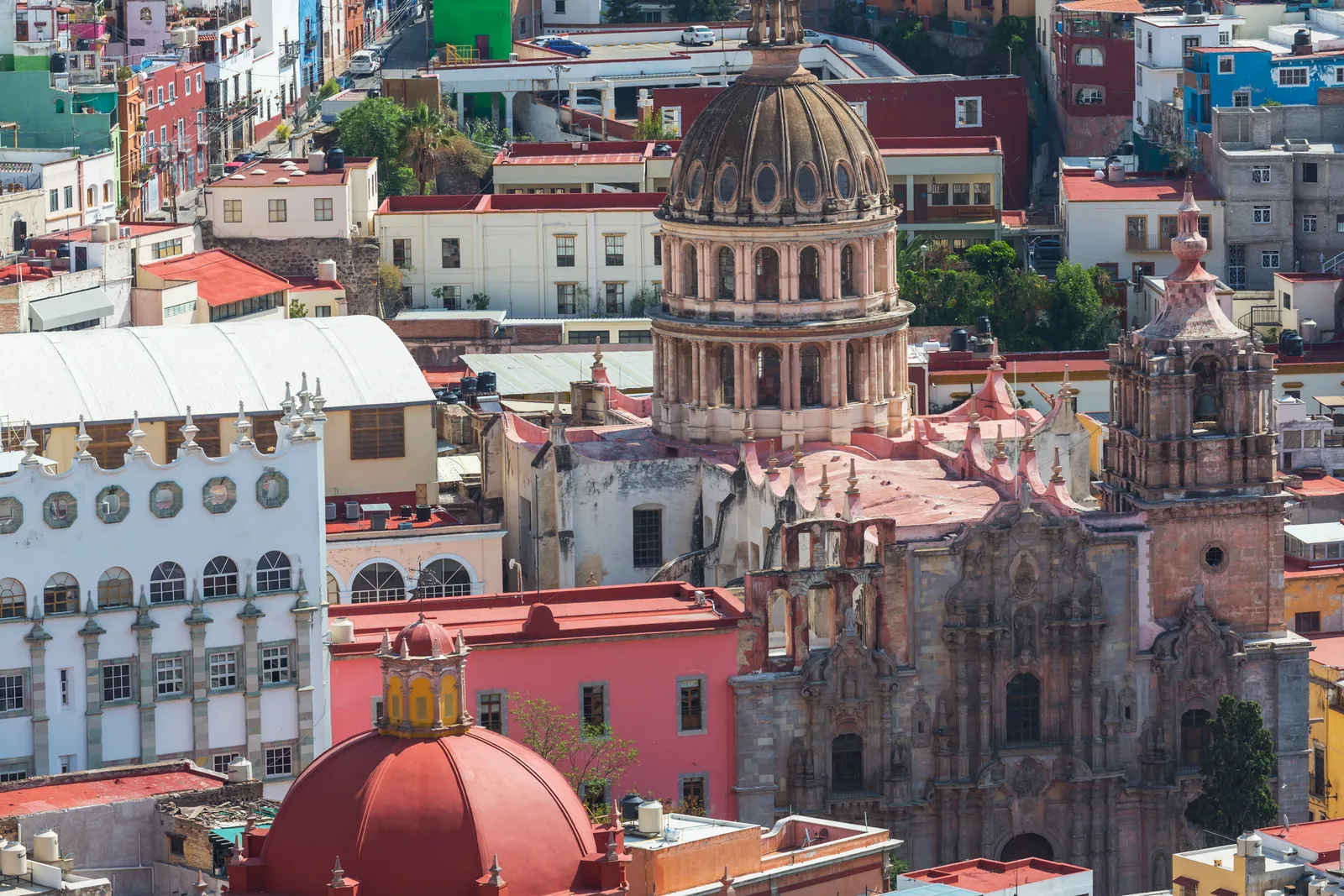
Why it made the list: San Miguel de Allende is a beautifully preserved colonial town of cobbled streets, galleries, rooftop bars and the pink neo-Gothic spires of its parish church, and nearby Guanajuato is a silver city of colorful houses, alleys and tunnels. Both are UNESCO World Heritage Sites.
Best time to go: October to April, dry and sunny, with cool nights in winter. Guanajuato’s Cervantino arts festival is held in October.
Don’t miss: the Parroquia de San Miguel Arcángel at dusk, and the pre-Hispanic hilltop site of Cañada de la Virgen outside town, reached by state-run minibuses.
Getting there and how long: about three to four hours by road from Mexico City, or about an hour and a half from León/Bajío airport. Stay three or four nights for both towns.
Practical note: at about 1,900 m (6,200 ft), San Miguel gets cold at night in winter, so pack a warm layer. See our San Miguel de Allende travel guide and Guanajuato travel guide.
7. Puerto Vallarta
Why it made the list: the best-loved resort on the Pacific combines a walkable old town and a seafront malecón with jungle-covered mountains running down to the Bay of Banderas.
Best time to go: November to April. Nearly all of Puerto Vallarta’s rain falls from June to October, and humpback whales visit the bay in winter.
Don’t miss: a boat trip to the Islas Marietas National Park (open Tuesday to Sunday; MXN 125 park fee, collected by tour operators), and the Vallarta Botanical Garden south of town.
Getting there and how long: Puerto Vallarta’s airport (PVR) is 7.5 km (4.7 miles) from town, with many flights from the US and Canada. Stay four or five nights.
Practical note: the famous hidden beach at the Marietas, Playa del Amor, opens only Wednesday to Sunday with limited access, so check with your operator. See our Puerto Vallarta travel guide.
8. Los Cabos
Why it made the list: at the tip of the Baja California peninsula, where the desert meets the sea, Cabo San Lucas and San José del Cabo offer resorts, golf, sport fishing and whale watching, with the rock arch of El Arco at Land’s End as the landmark.
Best time to go: November to April. Baja is dry, with about 360 mm (14 in) of rain a year at San José del Cabo, mostly in late summer and fall, and whales pass in winter.
Don’t miss: a boat trip to El Arco and the sea lions at Land’s End, and a day at Cabo Pulmo National Park on the East Cape, famous for its recovered reef.
Getting there and how long: Los Cabos International Airport (SJD) is 11 km from San José del Cabo, with short flights from California and Texas. Stay four or five nights.
Practical note: many beaches have strong surf. The tourism board lists swimmable beaches such as Médano, Santa María and Chileno; obey the flags. See our Los Cabos travel guide.
9. Guadalajara and Tequila
Why it made the list: Mexico’s second city is the home of mariachi, with a grand colonial center, and an hour or two away the blue-agave fields and distilleries around the town of Tequila form a UNESCO-listed landscape.
Best time to go: October to May, the dry season. In late summer, Guadalajara hosts its international mariachi festival.
Don’t miss: the Hospicio Cabañas, a UNESCO site with José Clemente Orozco’s murals, including the “Man of Fire”, and a distillery tour in Tequila.
Getting there and how long: Guadalajara’s airport is about 17 km south of the center, linked by the Macro Aeropuerto bus line. Tequila is about 60 km (37 miles) away. Stay three nights.
Practical note: the tequila trains from Guadalajara run on many weekends and sell out, so book ahead. See our Guadalajara travel guide and Tequila travel guide.
10. The Copper Canyon
Why it made the list: in the mountains of Chihuahua, the Copper Canyon is a system of canyons larger than the Grand Canyon, crossed by one of the world’s great train rides, the Chepe, which climbs about 350 km (220 miles) from the coast at Los Mochis to Creel.
Best time to go: October to November and March to April, for mild days. Winter nights on the rim are cold, and the rainy summer turns the canyon green.
Don’t miss: the stop at Divisadero for views into three canyons, and the 3 km cable car at Parque de Aventura Barrancas del Cobre (MXN 350).
Getting there and how long: the Chepe Express takes about nine hours between Los Mochis and Creel, three days a week in each direction. Allow four or five days with nights in El Fuerte, at the rim and in Creel.
Practical note: the train runs fewer days in May, June, August and September, so check the official timetable before you plan. See our Copper Canyon travel guide.
How to fit them into one trip
Distances are large, so pair regions and use domestic flights, which are cheap and frequent.
One week: four nights in Mexico City with a day at Teotihuacan, then three nights in Oaxaca. Or stay on the Caribbean: Cancún or Playa del Carmen, Tulum, and a day at Chichén Itzá.
Ten days: the Yucatán loop: Cancún or Isla Mujeres, Tulum, then Mérida for Chichén Itzá and Uxmal, using the Tren Maya and ADO buses.
Two weeks: Mexico City, San Miguel de Allende and Guanajuato, then Guadalajara and Tequila, ending on the beach at Puerto Vallarta. Or combine Mexico City and Oaxaca with a week on the Caribbean coast.
The season changes the route: November to April suits almost everywhere, while the coasts are hot, wet and in hurricane season from June to October. Our best time to visit Mexico guide goes region by region, and our AI trip planner builds the day-by-day plan for your dates.
Plan your trip
Start with our Mexico travel guide for entry rules, tourist fees, money and getting around. Use the AI trip planner to turn this list into a route, check what to expect on your dates with the Destination weather tool, and convert pesos with the Money exchange tool.
Frequently asked questions
What is the most beautiful place in Mexico?
It depends on what you love, but favorites include the Tulum ruins on their cliff above the Caribbean, the colonial streets of San Miguel de Allende and Guanajuato, and the view into the Copper Canyon from Divisadero.
How many days do you need in Mexico?
A week is enough for one region, such as Mexico City and Oaxaca, or the Caribbean coast with Chichén Itzá. Ten days to two weeks lets you combine a city, colonial towns and a beach.
What is the best place in Mexico for first-time visitors?
Mexico City for culture and food, or Cancún and the Riviera Maya for an easy beach trip with Maya ruins and cenotes nearby. Many first trips combine the two with a short flight.
Do you have to pay to visit Mexico’s Maya ruins?
Yes. Each site charges an entry fee, and some add state or park fees. Chichén Itzá costs foreign visitors MXN 697 in total, Tulum MXN 265 and Cobá MXN 210. Bring pesos or a card, as payment methods vary by site.
Which is better, Cancún or Tulum?
Cancún has more hotels, flights, nightlife and easy beaches, and it is close to the airport. Tulum is smaller and more laid-back, with Maya ruins above the sea, cenotes nearby and boutique hotels. Many visitors stay in both; they are about 130 km (80 miles) apart.