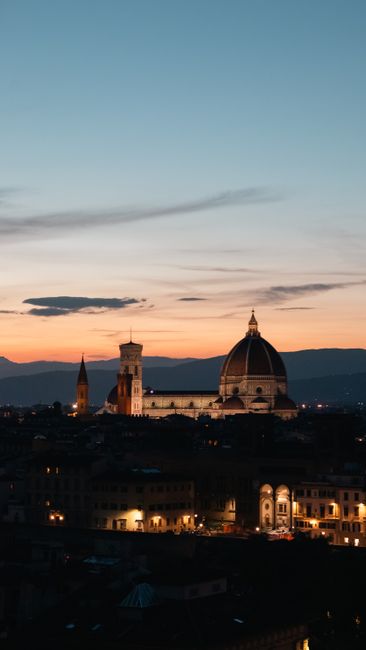
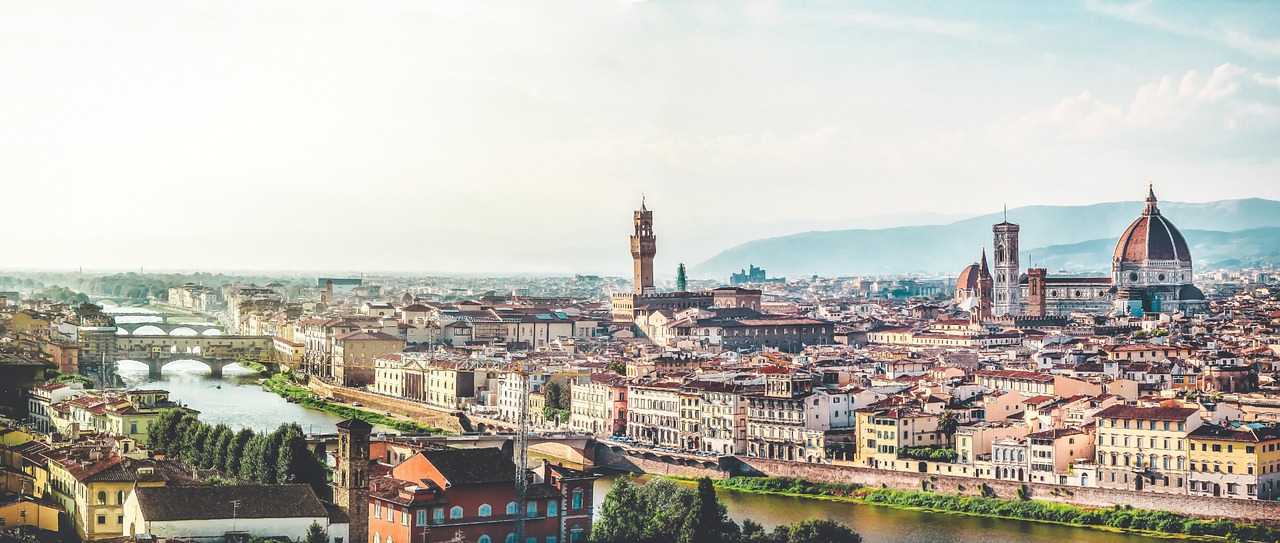
Florence is the Renaissance you can walk through: Brunelleschi’s red dome rising over terracotta roofs, Botticelli’s Venus in the Uffizi, Michelangelo’s David in the Accademia, and goldsmiths’ shops still lining the Ponte Vecchio. The centre is compact enough to cross in 20 minutes, which leaves plenty of time for the good life: a panino with lampredotto at the market, a glass of Chianti in a wine window, sunset from Piazzale Michelangelo, and day trips into the Tuscan hills. It is ideal for city sightseeing. Give it two days for the big sights, three or four to add the Oltrarno, the gardens and a day in Siena or Chianti.
Right now in Florence
- Wed12–25°C53–76°F20 mm rain
- Thu15–19°C59–67°F61 mm rain
- Fri13–20°C55–69°F1 mm rain
Top tours in Florence
See all tours for Florence →
From local operators, with prices and reviews; you check availability and book on Viator, our partner. We may earn a commission at no extra cost to you. How we earn money
Florence at a glance
- Best for: Renaissance art and architecture, food and wine, artisan shopping, and day trips through Tuscany.
- How long: 2 days for the main sights, 3–4 with the Oltrarno, Pitti Palace and a Tuscan day trip.
- Best time: April to June and September to October. July and August are very hot; winter is cool, quiet and good value.
- Book ahead: the Uffizi, the Accademia (for the David) and a time slot for Brunelleschi’s dome, which sells out first.
- Getting in: fast trains to Santa Maria Novella station from Rome (about 1 hour 35) and Milan (about 1 hour 55); the T2 tram from Florence airport.
- Before you go: entry rules, money, trains and general safety are on our Italy travel guide.
Florence’s neighbourhoods and who each one suits
Almost everything you want to see is in the historic centre, a UNESCO World Heritage Site on both banks of the Arno. Most of it lies on the north bank, between the train station and the river; the Oltrarno (“beyond the Arno”) on the south bank is quieter and more local.
Duomo and Piazza della Signoria
The monumental core: the cathedral, baptistery and bell tower, Piazza della Signoria with Palazzo Vecchio and its open-air statues, the Uffizi and the Ponte Vecchio, all within a 10-minute walk. You can’t be more central, but streets are packed by day and rooms are pricey.
San Lorenzo and Santa Maria Novella
The area between the station and the Duomo, with the Medici Chapels, the leather stalls around San Lorenzo and the Mercato Centrale food hall. Good for short stays, budget hotels and train connections, though it is busier and less charming at night.
Santa Croce and Sant’Ambrogio
East of the centre, around the great Franciscan church of Santa Croce, where Michelangelo, Galileo and Machiavelli are buried. The Sant’Ambrogio market, wine bars and restaurants make it a lively, more local base, with plenty of evening life.
Oltrarno: Santo Spirito and San Frediano
Across the river: the Pitti Palace and Boboli Gardens, artisans’ workshops, and Piazza Santo Spirito, whose steps and bars fill with locals on summer evenings. San Frediano has some of the city’s best trattorias. The favourite base for return visitors and anyone who wants a neighbourhood feel.
San Marco, Fiesole and the hills
North of the Duomo, the university area around San Marco and the Accademia is quieter and well placed. For space, views and a pool, stay in a villa in the hills, in Fiesole or around Piazzale Michelangelo, with a bus or taxi into town.
Top things to see in Florence
Prices and hours were checked on the official sites in October 2026; check again before you go, and book the big museums from April to October. Most state museums, including the Uffizi and the Accademia, close on Mondays and are free on the first Sunday of the month, with very long queues.
The Uffizi Galleries
One of the world’s great art museums, in the offices (uffizi) built for the Medici: Botticelli’s Birth of Venus and Primavera, Leonardo’s Annunciation, Michelangelo’s Doni Tondo, Raphael, Titian and Caravaggio. As of October 2026, a full ticket costs €25 bought on the day or €29 booked in advance for a timed slot, which is the safer choice from spring to autumn. Since 1 January 2026 an “Afternoon” ticket for entry from 16:00 costs €16 on the day or €20 in advance. Under-18s go free. The Uffizi is closed on Mondays. The Vasari Corridor, the raised passage that links the Uffizi across the Ponte Vecchio to the Pitti Palace, reopened at the end of 2024 and can be added with a combined ticket (from about €43). Book only on the official site, uffizi.it, and allow three hours.
The Accademia and Michelangelo’s David
Michelangelo carved the 5-metre David from a single block of marble between 1501 and 1504, and it is even more striking in person than in photos. The Galleria dell’Accademia also has his unfinished “Prisoners” struggling out of the stone and a collection of gold-ground paintings and musical instruments. As of October 2026 a full ticket costs about €20 including the booking fee, and the gallery is open Tuesday to Sunday from 8:15 to 18:50, closed on Mondays. Book a time slot; the queue without one can take hours in high season. The visit takes about an hour.
The Duomo and Brunelleschi’s dome
The cathedral of Santa Maria del Fiore, with its green, white and pink marble façade, is free to enter (visits stop on Sundays and religious holidays), but the monuments around it are covered by passes sold by the Opera di Santa Maria del Fiore on its official site, duomo.firenze.it. As of October 2026:
- Brunelleschi Pass (€30): the climb up the dome (463 steps, with a compulsory time slot chosen when you book), plus Giotto’s bell tower, the Opera del Duomo Museum, the Baptistery and the crypt of Santa Reparata.
- Giotto Pass (€20): the bell tower (414 steps), the museum, the Baptistery and Santa Reparata, without the dome.
- Ghiberti Pass (€15): the museum, the Baptistery and Santa Reparata.
Children aged 7–14 pay reduced prices, and under-7s go free. Passes are valid for three days, with one entry per monument. The dome climb is steep and narrow, with no lift, and slots sell out days or weeks ahead in high season; if you miss out, the bell tower has an equally good view that includes the dome itself. The Baptistery’s mosaic ceiling is under restoration and not visible as of October 2026. Don’t miss the museum, which holds Ghiberti’s original “Gates of Paradise” and Michelangelo’s late Pietà.
Ponte Vecchio, Palazzo Vecchio and the Pitti Palace
The Ponte Vecchio, the only Florentine bridge the retreating Germans spared in 1944, has been lined with jewellers since the 16th century. Palazzo Vecchio, the fortress-like town hall, has frescoed halls and a tower you can climb. Across the river, the Pitti Palace holds Medici treasures, Raphael paintings and the royal apartments, and behind it the terraced Boboli Gardens climb the hill. The Uffizi Galleries sell a five-day ticket covering the Uffizi, the Pitti Palace and the Boboli Gardens (€40 as of October 2026), worth it if you will visit all three.
More classic sights
- Bargello: Italy’s great museum of Renaissance sculpture, with Donatello’s bronze David.
- Medici Chapels: the family’s marble mausoleum, with Michelangelo’s tomb sculptures.
- Santa Croce and Santa Maria Novella: two great churches packed with frescoes and famous tombs.
- San Marco: a monastery museum where Fra Angelico painted a fresco in every monk’s cell.
- Piazzale Michelangelo and San Miniato al Monte: the classic sunset view over the city, and a serene Romanesque church just above it where the monks sing Gregorian chant at vespers.
Other sights
- Florence Baptistery
- Palazzo Vecchio
Churches and cathedrals
- Florence Cathedral
- Basilica of Santa Croce
Museums
- Uffizi Gallery
- Bargello Museum
Monuments
- Ponte Vecchio
The Firenze Card: is it worth it?
The city’s official museum pass costs €85 and is valid for 72 hours from first use, covering one entry to more than 75 museums, villas and gardens, including the Uffizi, the Accademia, the Pitti Palace, the Bargello and Palazzo Vecchio, with priority entry; a Restart option extends it by 48 hours. It pays off only if you visit four or five big museums in three days. Under-18s, who enter state museums free, rarely need it, and you may still need to reserve a time slot at some sites. The Duomo passes are sold separately by the Opera di Santa Maria del Fiore. Check the official list of included sites before buying.
Activities and best months
- City sightseeingThe Duomo with Brunelleschi's dome and Giotto's Bell Tower, Ponte Vecchio, Palazzo Vecchio, and the Uffizi and Pitti Palace linked by the Vasari Corridor; Feel Florence adds themed city walks and the San Lorenzo and Sant'Ambrogio markets.
- CyclingThe Arno cycle path is mainly downhill and fine for families, from Giardini del Girone past Ponte Vecchio and the Cascine park to Parco dei Renai in Signa.
Other things to do in Florence
Eating and drinking the Florentine way
Florentine food is hearty and simple: bistecca alla fiorentina, a thick T-bone steak served rare and priced by weight; ribollita and pappa al pomodoro, bread-based soups; crostini with chicken liver pâté; and lampredotto, a tripe sandwich from street kiosks that locals swear by. The Mercato Centrale has a ground-floor market and an upstairs food hall; Sant’Ambrogio market is smaller and more local. Look out for the little buchette del vino, wine windows in palace walls, a few of which still serve a glass. For dessert, gelato was born here, by tradition.
Artisans, markets and shopping
The Oltrarno is full of workshops: bookbinders, goldsmiths, frame-makers and shoemakers. Florence is famous for leather; buy from proper shops and workshops rather than the cheapest market stalls. The Officina Profumo-Farmaceutica di Santa Maria Novella, one of the world’s oldest pharmacies, is worth a look for its frescoed rooms alone.
Gardens, views and the river
Climb the Boboli Gardens and the Bardini Garden, with its wisteria tunnel in April and May, for views over the domes. Walk up to Piazzale Michelangelo for sunset, or take bus 7 up to Fiesole, an Etruscan and Roman hill town with a Roman theatre and the whole valley at your feet. In summer, riverside bars open along the Arno.
Day trips from Florence: Siena, Pisa and Chianti
Florence is the natural base for exploring Tuscany. Trains and buses reach the main towns; a car, a tour or a bike opens up the countryside.
Siena
Florence’s old rival is a perfectly preserved Gothic city built around the shell-shaped Piazza del Campo, where the Palio horse race is run on 2 July and 16 August. Don’t miss the striped cathedral with its marble floor and the Piccolomini Library. Express buses take about 1 hour 15 minutes and stop close to the centre; trains take about 1½ hours but arrive at the bottom of the hill.
Pisa and Lucca
Regional trains reach Pisa in about an hour. The Leaning Tower, the cathedral and the baptistery stand together on the lawns of the Piazza dei Miracoli; climbing the tower needs a timed ticket from the cathedral works’ official site (opapisa.it), and children may go up only from the year they turn 8. Lucca, about 1 hour 20 minutes from Florence by train and easily combined with Pisa, is ringed by Renaissance walls topped with a tree-lined path that is perfect by rented bike.
Chianti and the hill towns
The Chianti hills between Florence and Siena are made for wine tasting and slow lunches: Greve, Panzano, Radda and Castellina are the classic villages, with estates offering tours and tastings (book ahead). Without a car, join a small-group tour, or ride an e-bike through the vineyards (see our cycling guide). Further south, San Gimignano’s medieval towers, Montepulciano, Montalcino and the Val d’Orcia need an overnight stay to do them justice.
Nearby destinations
- Tuscany36 km
- San Gimignano38 km
- Siena51 km
- Lucca60 km
- Pisa69 km
- Bologna81 km
- Rimini110 km
- Cinque Terre130 km
Getting there and getting around
By train
Firenze Santa Maria Novella (SMN) is right in the centre, a 10-minute walk from the Duomo. Frecciarossa and Italo high-speed trains link it with Rome (about 1 hour 35), Bologna (about 35 minutes), Milan (about 1 hour 55) and Venice (about 2 hours 5). A few high-speed trains use Firenze Campo di Marte or Rifredi instead, so check your ticket. Regional trains for Pisa, Lucca and Siena also leave from SMN; validate paper tickets before boarding.
From the airports
- Florence airport (FLR, Peretola): the T2 tram runs from the terminal to the Unità stop next to Santa Maria Novella station in about 20 minutes, on a standard city ticket (about €1.70). Taxis charge a fixed fare to the centre.
- Pisa airport (PSA): often cheaper for flights. The PisaMover shuttle links it with Pisa Centrale, from where regional trains reach Florence in about an hour; direct coaches also run to Florence.
- Bologna airport (BLQ): another option, with a shuttle to Bologna Centrale and fast trains to Florence in about 35 minutes.
Walking, buses and trams
The centre is best on foot; streets are narrow and many are pedestrian. Small electric buses cross the centre, and buses go up to Piazzale Michelangelo and Fiesole. Buy tickets before you board (at tobacconists, machines or in the app) or tap a contactless card where readers are fitted, and validate every time.
Driving and the ZTL
Don’t drive into central Florence. Almost the whole historic centre is a ZTL restricted traffic zone watched by cameras at every gate. As of October 2026 the daytime ZTL is active Monday to Friday from 7:30 to 20:00 and on Saturdays from 7:30 to 16:00; in the warm months (2 April to 4 October in 2026) a night ZTL also applies on Thursday, Friday and Saturday nights from 23:00 to 3:00. Each unauthorised entry brings a fine, usually from about €80 plus fees, sent to your rental company and passed on to you. If your hotel is inside the zone, it may be able to register your plate for drop-off; otherwise use a car park outside the zone, such as the one at the Fortezza da Basso or by the station. Pick up a rental car on your way out to Chianti, not in the centre.
When to go and how long to stay
Florence sits in a bowl of hills, so it is hotter in summer and colder in winter than the coast. The table uses the 1961–1990 climate normals of the Italian Air Force Meteorological Service for Firenze Peretola airport: average daily highs and lows, and days with rain.
| Season | Average high / low | Rainy days per month | What it’s like | Good for |
|---|---|---|---|---|
| Winter (Dec–Feb) | 10–12 °C / 1–3 °C | 8–9 | Cool, often damp, frosty nights | Museums without queues, low prices |
| Spring (Mar–May) | 15–23 °C / 5–11 °C | About 9 | Mild, flowers in the gardens, Easter crowds | Walking, gardens, day trips |
| Summer (Jun–Aug) | 27–31 °C / 15–17 °C | 4–6 | Hot and sticky in the city; heatwaves near 40 °C | Early starts, evenings by the river, Chianti |
| Autumn (Sep–Nov) | 27 °C falling to 15 °C / 14 °C falling to 6 °C | 6 in September, 10 in November | Warm September, harvest season, wetter November | Wine, food, fewer crowds |
These are long-term averages; recent summers have been hotter, and Florence is often one of Italy’s hottest cities in July and August. Spring and autumn are the sweet spots, and the grape and olive harvests in September and October make them the best months for the countryside.
Events worth planning around
- Easter Sunday: the Scoppio del Carro, when a cart of fireworks is set off in front of the Duomo (28 March 2027).
- May and June: the Maggio Musicale Fiorentino music festival.
- June: the Calcio Storico, a bruising Renaissance football tournament in costume in Piazza Santa Croce, with the final on 24 June, the feast of San Giovanni, the city’s patron and a local holiday, ending with fireworks over the Arno.
- 7 September: the Festa della Rificolona, a children’s lantern procession.
- Autumn: grape harvest and new olive oil in the Chianti hills, and truffle fairs in the Tuscan countryside.
How long to stay: 2-, 3- and 4-day plans
2 days: Day 1, the Duomo complex with an early dome slot, the Accademia (not on a Monday) and the Mercato Centrale for lunch, then Piazza della Signoria and the Ponte Vecchio. Day 2, the Uffizi in the morning (not on a Monday), the Oltrarno and Santo Spirito in the afternoon, and sunset at Piazzale Michelangelo and San Miniato.
3 days: add the Pitti Palace and Boboli Gardens, the Bargello and Santa Croce. 4 days: add a day trip to Siena, Pisa and Lucca, or a wine day in Chianti.
Weather month by month
Where to stay in Florence and the tourist tax
- Duomo and Signoria: the most central; busy and expensive.
- Santa Maria Novella and San Lorenzo: handy for trains and good value; less charming at night.
- Santa Croce: lively, with restaurants and bars; central.
- Oltrarno: local, artisan and full of trattorias; a short walk across the river.
- The hills and Fiesole: villas with views and pools; you need buses or taxis.
Florence tourist tax (imposta di soggiorno): paid per person per night at your accommodation, for up to seven consecutive nights. As of October 2026 the rates, unchanged since February 2025, are about €3.50 in a 1-star hotel, €4.50 in a 2-star, €6 in a 3-star, €7 in a 4-star and €8 in a 5-star, and €6 in holiday rentals, B&Bs and guest houses. Young children are exempt. For a couple in a 4-star hotel that is €14 a night, usually paid at check-out.
Practical tips for Florence
- Mind Mondays: the Uffizi, the Accademia and many other state museums are closed.
- Book your dome slot first: it sells out before anything else; build the rest of your plan around it.
- Dress for the Duomo: shoulders and knees covered, and the same for Santa Croce and other churches.
- Eat and sit respectfully: picnicking on church steps and monuments can bring a fine; use the parks and the river terraces.
- Watch your pockets around the Duomo, Ponte Vecchio, the station and on crowded buses.
- Stay out of the ZTL if you have a car.
What to pack for Florence
Comfortable walking shoes with good grip for stone streets and the hundreds of steps up the dome and bell tower. In summer, pack the lightest clothes you own, a sun hat, sunglasses, sunscreen and a refillable bottle (there are free drinking fountains around town), plus a light scarf and knee-length clothes for churches. In spring and autumn bring layers and a compact umbrella; in winter, a warm coat, as the stone city holds the cold. Leave room in your bag for leather, paper and olive oil.
What to pack
- City walking shoesLisbon and Porto are steep, with polished limestone cobbles that get slippery, so grippy soles matter.
- Day packs and anti-theft bagsA small zipped or anti-theft bag makes crowded trams and viewpoints less stressful.
- Rain jacketsFrom October to April Porto and Lisbon see rain on roughly a third of days.
- Travel adapters and convertersPortugal uses Type C and F sockets at 230 V, so most visitors from outside Europe need an adapter.
- Water bottles and hydration packsRiding in the Algarve and Alentejo heat needs more water than you expect.
Florence travel FAQ
How many days do you need in Florence?
Two days covers the Uffizi, the David, the Duomo and the Ponte Vecchio. Three or four days lets you add the Oltrarno, the Pitti Palace and a day trip to Siena, Pisa or Chianti.
What is the best time to visit Florence?
April to June and September to October. July and August are very hot and crowded; November to February is cool and quiet, with the shortest queues.
How much are Uffizi tickets in 2026?
€25 bought on the day or €29 booked in advance, as of October 2026. The “Afternoon” ticket for entry from 16:00 costs €16 on the day or €20 in advance. Under-18s go free, and the gallery is closed on Mondays.
Do I need to book to see the David?
It is strongly recommended. The Accademia is open Tuesday to Sunday, and timed tickets avoid queues that can last hours in high season. A full ticket costs about €20 including the booking fee.
How do I climb Brunelleschi’s dome?
Buy the €30 Brunelleschi Pass on duomo.firenze.it and choose a time slot for the dome, which is compulsory. It is 463 steps with no lift. The pass also covers the bell tower, the museum, the Baptistery and Santa Reparata for three days.
Is Florence Cathedral free?
Yes, entering the cathedral itself is free, without a booking, though tourist visits stop on Sundays and religious holidays. The dome, bell tower, Baptistery and museum need a paid pass.
Is the Firenze Card worth it?
Only if you plan four or five major museums in three days. It costs €85 for 72 hours. If you will see just the Uffizi, the Accademia and the Duomo, individual tickets are cheaper.
Can I drive into Florence?
Not into the historic centre, which is a camera-controlled ZTL on weekdays and Saturdays (and on summer weekend nights). Fines start at about €80 plus fees. Park outside the zone and walk.
How do I get from Florence airport to the city centre?
The T2 tram runs from the terminal to Santa Maria Novella station in about 20 minutes on a standard city ticket. Taxis charge a fixed fare to the centre.
Can you do Siena and Pisa as day trips from Florence?
Yes. Siena is about 1 hour 15 minutes by express bus, and Pisa about an hour by regional train; Lucca combines well with Pisa. San Gimignano and the Val d’Orcia are better with a car or a night away.
How much is the tourist tax in Florence?
From €3.50 per person per night in a 1-star hotel to €8 in a 5-star; €7 in a 4-star and €6 in rentals and B&Bs, for up to seven nights.
Is Florence safe for tourists?
Yes. Pickpocketing in crowds around the Duomo, the Ponte Vecchio and the station is the main risk. Keep valuables zipped away and call 112 in an emergency.
Plan your trip
Partner links: TravelerCenter may earn a commission if you book, at no extra cost to you.
🇮🇹 Useful Italian phrases for Florence
All 38 Italian phrases: restaurant, hotel, emergencies, romance (printable) →
Traveler centers in Florence
Tourist information offices, visitor centers and travel agencies in Florence, from OpenStreetMap.
- Tourist information office
Tourist Info Point
- Tourist information office
Tourist Info Point
- Travel agency
Ciao Florence
- Travel agency
Italy on a budget
- Travel agency
Boston Travel
- Travel agency
Clamer
Sources · last reviewed 3 October 2026
Researched and last reviewed on 3 October 2026. Uffizi, Pitti and Boboli prices: the Uffizi Galleries (uffizi.it); Duomo passes: the Opera di Santa Maria del Fiore (duomo.firenze.it); climate: Italian Air Force Meteorological Service 1961–1990 normals for Firenze Peretola; train times: Trenitalia and Italo. The Accademia price, Firenze Card terms, ZTL hours, the tourist tax rates, the tram fare and the free first Sunday details come from secondary sources and are flagged for checking. Prices, hours and timetables change, so check the official links before you go. For entry rules, money and general safety, see our Italy travel guide.
Also: italia.it · feelflorence.it · Aeronautica Militare normals 1991–2020, Arezzo (climate)
Data: Weather: MET Norway (CC BY 4.0) · Rates: ECB · Costs: World Bank ICP and price levels · © OpenStreetMap contributors (ODBL) · Wikidata (CC0)