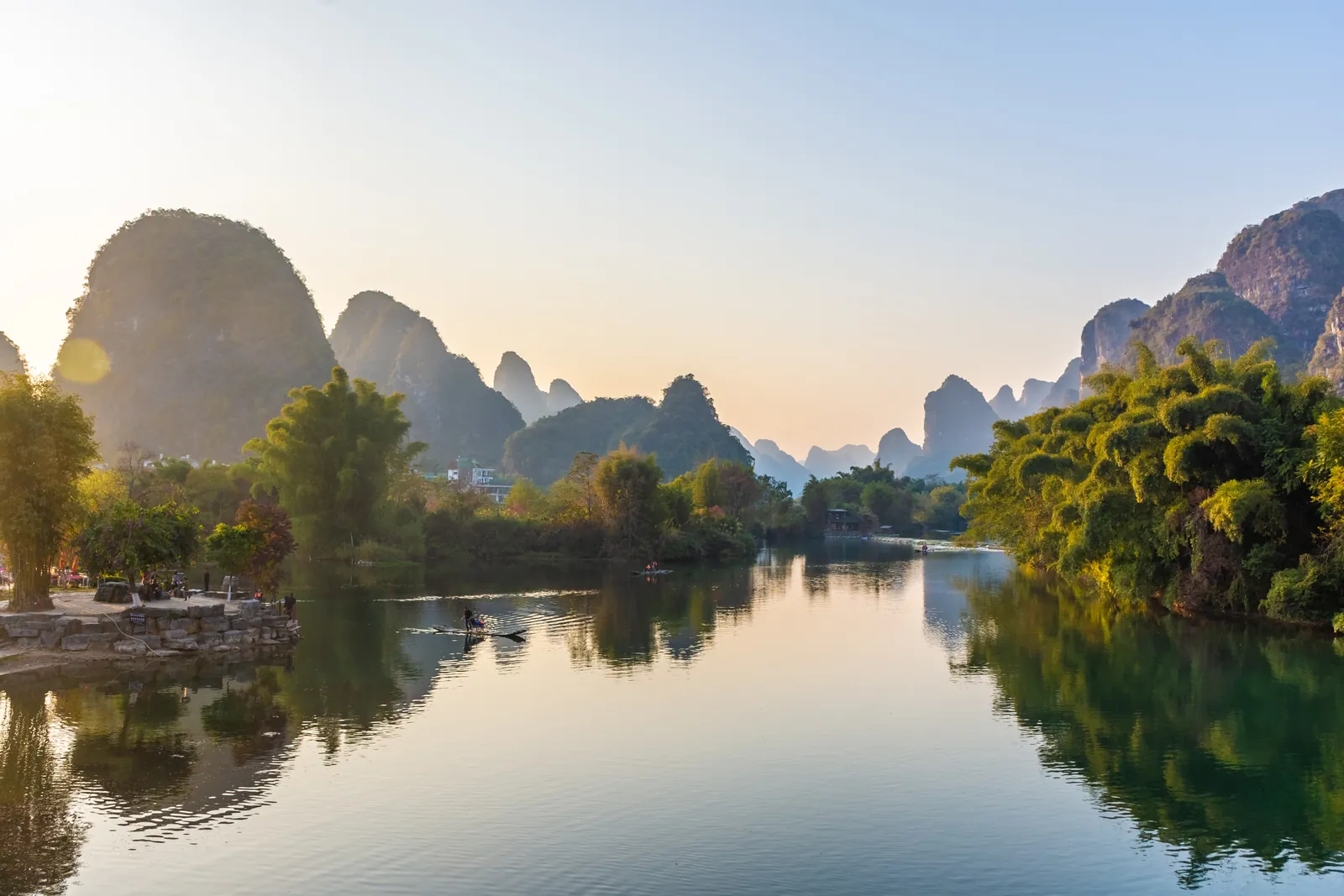
Short answer: the best time to visit China is April to May and September to October, when most of the country, from Beijing and Xi’an to Shanghai, Guilin and Zhangjiajie, has mild, mostly clear weather. The big trade-off is the national holidays: the first week of May and the National Day “Golden Week” (1–7 October) are the busiest travel weeks of the year, so aim for late April, mid-May, September or mid-to-late October. Summer is hot, wet and busy with school holidays; winter is cold in the north but the time for Harbin’s ice festival and Hainan’s beaches.
This page goes through China month by month as of October 2026: the weather in the north, east and south, the plum-rain and typhoon seasons, the public holidays that move hundreds of millions of people, and the best seasons for blossoms, autumn colors, ice festivals and beaches. For visa-free entry, payments, trains and costs, see our China travel guide, and plan your days with our AI trip planner.
Best time to visit China at a glance
| Goal | Best months | Why |
|---|---|---|
| Best weather for a first trip | April–May and September–October | Mild, clear days in Beijing, Xi’an and Shanghai, outside the summer heat and rain |
| Fewest crowds | March, mid-May to June, November | Outside the national holidays and summer school break |
| Lowest prices | November to mid-January, and March | Low season for flights and hotels, away from Chinese New Year |
| Autumn colors | Mid-October to November | Beijing’s Fragrant Hills, Jiuzhaigou, Huangshan and Zhangjiajie |
| Spring blossoms | March and April | Plum, cherry and peach blossom in Hangzhou, Wuhan and Nanjing; peonies in Luoyang |
| Ice and snow | Late December to early February | Harbin’s Ice and Snow World |
| Beaches | November to April | Sunny, dry and warm in Sanya on Hainan Island |
| Yunnan and Guilin | October to April for dry weather | Sunny, mild days; Guilin’s terraces turn golden in autumn |
| Tibet and the Silk Road | May to October | Warmer days at altitude and in the desert |
China weather month by month
Weather month by month
The climate table shows average daily highs and lows and monthly rain. The figures on this page are the China Meteorological Administration’s (CMA) 1991–2020 climate normals as submitted to the World Meteorological Organization (WMO), mainly for the Beijing, Shanghai (Baoshan), Guangzhou, Guilin and Harbin stations. China is huge, so the same month can be −12 °C (11 °F) by day in Harbin and well above 20 °C (68 °F) in Sanya. Most of the country has a monsoon climate: dry winters, and most of the year’s rain from May to September. Beijing gets about 530 mm (21 in) a year, almost a third of it in July; Shanghai about 1,240 mm (49 in); Guangzhou about 1,950 mm (77 in).
China month by month
January
Cold and very dry in the north: Beijing highs about 2 °C (36 °F) and lows about −7 °C (20 °F), and Harbin about −12 °C (11 °F) by day and −22 °C (−8 °F) at night, the peak of the ice-sculpture season. Shanghai is cold and damp, about 8 °C (47 °F), while Guangzhou is mild at about 19 °C (66 °F) and Hainan and Yunnan are sunny. Prices are low until the Spring Festival travel rush, which lasts about 40 days around Chinese New Year.
February
Chinese New Year falls on 6 February 2027, and the Lantern Festival on 20 February. Trains and flights sell out around the holiday week, and many shops and restaurants close for several days, but temple fairs and lanterns make it festive. Beijing is still cold, about 6 °C (43 °F), and the Yangtze valley damp and gray. Harbin’s ice parks stay open until the ice starts to melt; in 2026, warm weather ended the season early, on 21 February.
March
Warming: Beijing about 13 °C (56 °F), Shanghai about 14 °C (58 °F) and Guilin about 18 °C (64 °F), with rain increasing in the south. Plum and early cherry blossom appear in Nanjing, Wuhan and Hangzhou, and rapeseed fields turn yellow in the south. It is a quiet, good-value month between Chinese New Year and the spring holidays.
April
Mild and pleasant in most of the country: Beijing about 21 °C (70 °F), Shanghai about 20 °C (68 °F). Qingming falls on 5 April 2027, a short holiday. The peony festival in Luoyang runs from early April to early May, and Xishuangbanna celebrates the Water-Splashing Festival in mid-April. Northern cities can have windy, dusty days. In the south, Guangzhou’s rainy season begins, with about 194 mm (7.6 in) of rain.
May
One of the best months: Beijing about 27 °C (81 °F) and Shanghai about 25 °C (77 °F), still mostly dry in the north. The May Day holiday, usually 1–5 May, is extremely busy; book trains early or travel after it. Guangzhou is hot and wet, with about 329 mm (13.0 in) of rain, and Guilin’s rains build up.
June
Hot and humid. The plum rains (meiyu) usually arrive in the Yangtze valley in mid-June and last into July: Shanghai gets about 197 mm (7.8 in) of rain. Guangzhou and Guilin have their wettest month, with about 365 mm (14.4 in) and 449 mm (17.7 in), and the Li River runs high. The Dragon Boat Festival falls on 9 June 2027. Beijing is about 31 °C (87 °F).
July
Hot almost everywhere: Beijing about 32 °C (89 °F), Shanghai and Guilin about 33 °C (90–91 °F), with Chongqing and Wuhan among the hottest cities. Beijing gets most of its rain this month, about 170 mm (6.7 in), in heavy downpours. School holidays fill museums and sights. It is the best time for Tibet, Gansu and the northwest grasslands, and Harbin is pleasant at about 28 °C (83 °F).
August
Hot and humid, with summer school crowds. Shanghai’s wettest month by volume, about 210 mm (8.3 in), often with thunderstorms and, in some years, typhoons on the coast. Guilin starts to dry out. Plan sightseeing for mornings and evenings, or head to cooler places like Yunnan, Jiuzhaigou or the mountains.
September
The heat breaks, skies clear and crowds fall after the schools go back: Beijing about 27 °C (80 °F), Shanghai about 28 °C (82 °F). Osmanthus blooms in Hangzhou from late September. The Mid-Autumn Festival falls on 15 September 2027. Typhoons are still possible on the southern and eastern coasts. One of the best months, especially in the second half.
October
Mild and golden: Beijing about 19 °C (67 °F), Shanghai about 23 °C (73 °F), Guilin about 26 °C (79 °F). The National Day Golden Week, 1–7 October, is the busiest week of the year; after it, sights and prices return to normal and the second half of the month is excellent. Autumn colors peak in Jiuzhaigou in mid- to late October, and the rice terraces at Longji turn gold.
November
Cool and clear in the north, with Beijing about 10 °C (51 °F) and frosty nights; the Fragrant Hills’ red leaves and the ginkgos turn in late October and early November. Shanghai and Hangzhou are sunny and mild, about 18 °C (64 °F), and Guangzhou, Guilin and Yunnan are at their best. Low season prices begin, and Sanya’s dry season starts.
December
Cold and dry in the north, with Beijing highs about 4 °C (39 °F); the Great Wall and the palaces are quiet and the sky is often blue. Harbin’s Ice and Snow World usually opens in mid- to late December (on 17 December in 2025); the 2026–27 opening date had not been announced as of 8 October 2026. Guangzhou is mild and dry, about 21 °C (69 °F), and big cities have Christmas markets and lights.
Best time to visit by region
North China: Beijing, Tianjin and Pingyao
April–May and September–October, with the clearest skies in autumn. Avoid the Golden Week crowds at the Forbidden City and the Great Wall. Winter is cold but quiet, and the Great Wall can be dusted with snow. See our Beijing, Tianjin and Pingyao travel guides.
East China: Shanghai, Suzhou, Hangzhou, Nanjing and Huangshan
April–May and October–November. June and early July bring the plum rains, and July and August are hot and sticky. Spring blossom and new tea make Hangzhou lovely in March and April; Huangshan’s seas of cloud are best in spring and its colors in late October and November. See our Shanghai, Suzhou, Hangzhou, Nanjing and Huangshan travel guides.
South China: Guangzhou, Shenzhen, Guilin, Yangshuo, Xiamen and Sanya
October to December, when it is sunny, dry and warm. April to September is the rainy season, with typhoons possible from July to October. Guilin and Yangshuo are at their best in autumn; Sanya is best from November to April. See our Guangzhou, Shenzhen, Guilin, Yangshuo, Xiamen and Sanya travel guides.
Southwest China: Chengdu, Chongqing, Yunnan, Jiuzhaigou and Tibet
Chengdu and Chongqing are best in spring and autumn; Chongqing’s summer is among the hottest in China. Yunnan, with Kunming, Dali, Lijiang and Xishuangbanna, is sunny from October to May and rainy from June to September. Jiuzhaigou’s colors peak in mid- to late October. Lhasa is clear and crisp in October, with most rain from June to September; foreign visitors need a Tibet Travel Permit arranged through a licensed agency. See our Chengdu, Chongqing, Jiuzhaigou and Lhasa travel guides.
Northwest China: Xi’an and Dunhuang
April–May and late September–October. Xi’an’s September can be surprisingly wet, and winter smog is heavy on some days. Dunhuang is best in autumn, when it is clear, warm and calm; summer is hot and busy. See our Xi’an and Dunhuang travel guides.
Central China: Zhangjiajie, Wuhan, Changsha and Luoyang
Spring and autumn. Zhangjiajie is clearest from September to early November, with colors in late October and November; Luoyang is busiest during the peony festival in April; Wuhan and Changsha have long, very hot summers. See our Zhangjiajie, Wuhan, Changsha and Luoyang travel guides.
Northeast China: Harbin and Qingdao
Harbin is a winter destination, best from late December to early February for the ice festival, with January nights around −22 °C (−8 °F); summer is pleasantly mild. Qingdao, on the coast, is best in September and October, with a beach season in July and August. See our Harbin and Qingdao travel guides.
Best time for spring blossoms, autumn colors, ice festivals and beaches
Spring blossoms
March and April: plum blossom on Nanjing’s Zhongshan Mountain, cherry blossom in Wuhan and Nanjing, peach blossom on Hangzhou’s Su Causeway, and peonies in Luoyang from early April.
Autumn colors
Mid-October to November: Jiuzhaigou’s forests, Huangshan, Zhangjiajie, Beijing’s Fragrant Hills and the ginkgos of Chengdu in November.
Ice and snow
Late December to early February at Harbin’s Ice and Snow World, with ice sculptures lit up at night. Dress for −20 °C (−4 °F) or colder.
Beaches
November to April in Sanya, warm and dry; July and August on the cooler northern coast at Qingdao. See our beaches guide.
Hiking and mountains
April–May and September–October for Huangshan, Zhangjiajie, the Great Wall hikes and Tiger Leaping Gorge. See our hiking guide.
Seasons to plan around
- Chinese New Year (6 February 2027): the Spring Festival travel rush lasts about 40 days; trains and flights sell out and many businesses close for several days.
- May Day (usually 1–5 May) and National Day Golden Week (1–7 October): the busiest weeks of the year at every major sight. The State Council usually publishes the next year’s exact holiday schedule in November.
- Shorter holidays: Qingming (5 April 2027), the Dragon Boat Festival (9 June 2027) and the Mid-Autumn Festival (15 September 2027) bring busy weekends.
- Summer school holidays (July and August): museums, theme parks and mountain resorts are crowded.
- Plum rains (mid-June to July): weeks of gray, humid, showery weather in the Yangtze valley, including Shanghai, Hangzhou, Suzhou, Nanjing and Wuhan.
- Typhoons and floods (about May to November): typhoons affect the southern and eastern coasts, most often from July to October, and can stop flights, trains and ferries.
- Winter air quality and spring dust (north): heating and spring dust can raise pollution in Beijing and Xi’an on some days; check the air quality index in a weather app.
How long to stay
One week covers Beijing, Xi’an and Shanghai by high-speed train; ten days adds Suzhou and Hangzhou; two weeks adds Chengdu and Guilin. The 30-day visa-free stay, for eligible passports, covers all of these. See the sample itineraries in our China travel guide.
Best time to visit China: FAQ
What is the best month to visit China?
October, after Golden Week, and May, after the May Day holiday, are the best all-round months: mild, mostly clear and with colorful landscapes. September is a close third.
When should you avoid traveling to China?
Avoid the National Day Golden Week (1–7 October), the May Day holiday at the start of May and the weeks around Chinese New Year, when transport and sights are packed. Midsummer is hot, wet and busy with school holidays.
What is the cheapest time to visit China?
November to mid-January and March, outside the big holidays. Flights and hotels rise sharply around Chinese New Year, May Day, Golden Week and in July and August.
What is the rainiest month in China?
It depends on the region: June is wettest in Guangzhou and Guilin, June and July in the Yangtze valley (the plum rains), and July in Beijing. Winters are dry almost everywhere.
Is winter a good time to visit China?
For some trips, yes: the north is cold but clear and quiet, Harbin’s ice festival is at its best, and Hainan, Yunnan and Guangzhou are mild. Avoid the Chinese New Year week.
When is Golden Week in China?
The National Day Golden Week runs from 1 to 7 October. Trains, hotels and sights are extremely busy, so book early or travel just before or after it.
When is typhoon season in China?
Typhoons affect the southern and eastern coasts from about May to November, most often from July to October, including Hainan, Guangdong, Fujian and Shanghai.
Sources · last reviewed 9 Oct 2026
Researched and last reviewed by TravelerCenter on 8 October 2026. Monthly temperatures and rainfall are the WMO 1991–2020 climate normals submitted by the China Meteorological Administration for Beijing, Shanghai (Baoshan), Guangzhou, Guilin and Harbin; the 2026 holiday schedule comes from the State Council General Office notice; Harbin Ice and Snow World’s 2025–26 opening and closing dates from the Heilongjiang Department of Culture and Tourism and Xinhua. The 2027 holiday dates are calendar dates (the official 2027 schedule had not been published), and blossom and foliage timing, festival periods, typhoon and plum-rain seasons and seasonal price patterns are from general reference and our destination guides, flagged for checking. Check with your hotel and airline before you travel.
Also: CMA normals 1991–2020, Beijing (climate)
Data: Wikidata (CC0)