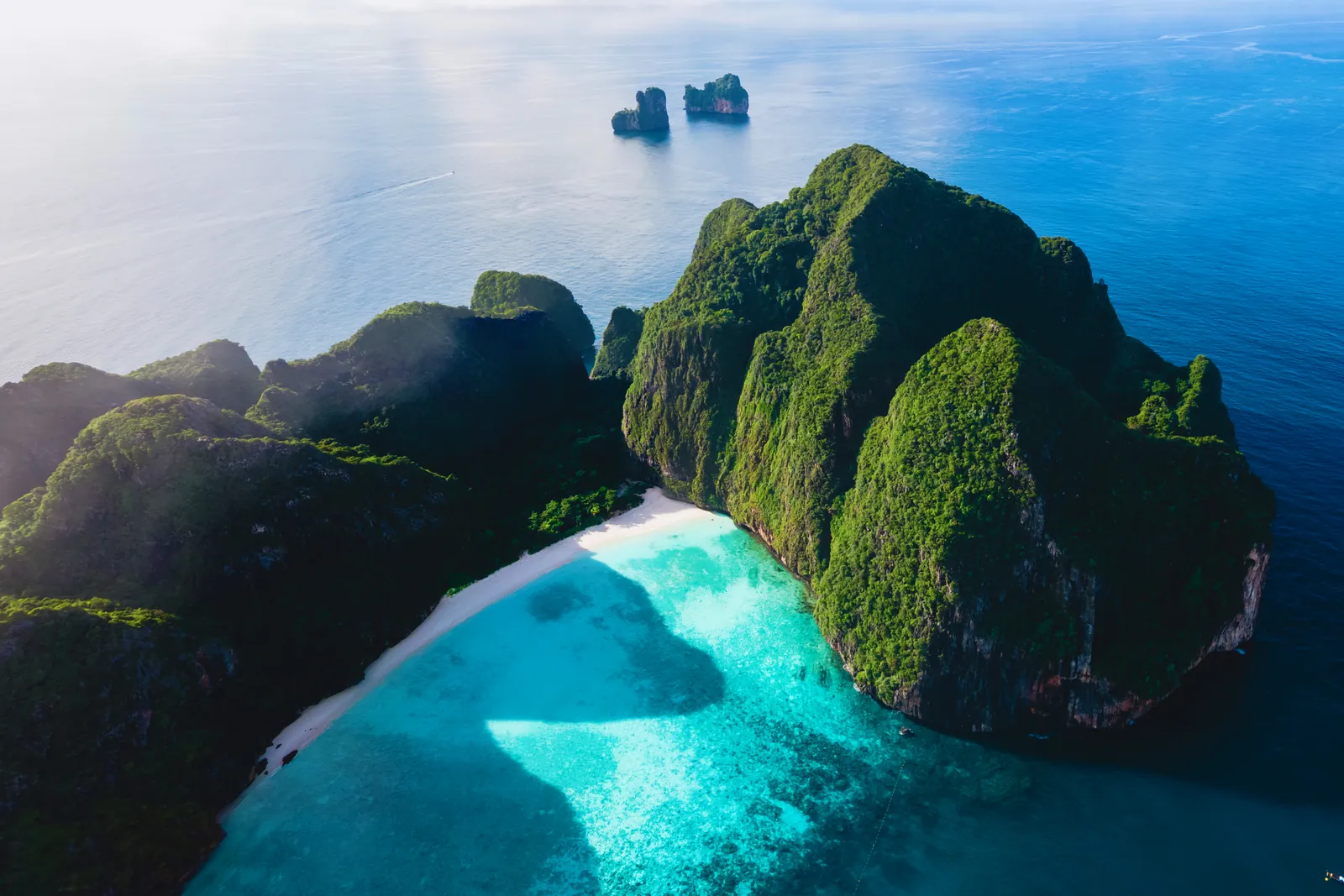
Short answer: November to February is the best time to visit most of Thailand: the cool, dry season brings sunshine and lower humidity to Bangkok, Chiang Mai and the Andaman beaches of Phuket, Krabi and Ko Phi Phi. It is also peak season, with the highest prices around Christmas, New Year and Chinese New Year. The Gulf islands (Ko Samui, Ko Pha Ngan, Ko Tao) are the exception: they are best from January to September and wettest from October to December.
This page explains Thailand’s three seasons and two monsoons, what each month is like in the north, in Bangkok and on each coast, when festivals and park closures fall, as of October 2026. For entry rules, the TDAC arrival card and getting around, see our Thailand travel guide, and plan your days with our AI trip planner.
Best time to visit Thailand at a glance
| Goal | Best months | Why |
|---|---|---|
| Best overall weather | November to February | Dry, sunny and the least humid; cool nights in the north |
| Andaman beaches (Phuket, Krabi, Phi Phi, Lanta) | November to April | Dry season and calm seas on the west coast; February is driest in Phuket |
| Gulf islands (Samui, Pha Ngan, Tao) | January to September | Sheltered from the southwest monsoon; wettest October to December |
| Chiang Mai and the north | November to January | Cool, clear and dry before the smoky-haze season from about February |
| Lowest prices | May to October (outside July and August) | Low season on the Andaman coast and inland; hotel rates fall sharply |
| Fewest crowds | May, June, September | Between the dry-season peak and the summer holidays |
| Diving and snorkeling | November to April (Andaman); June to September (Gulf) | Calm, clear water; the Similan Islands open October 15 to May 15 |
| Festivals | April and November | Songkran (April 13–15); Loy Krathong and Yi Peng (November 24 in 2026) |
| Waterfalls and green rice fields | July to October | The rainy season fills rivers and turns the north green |
Thailand weather month by month
Weather month by month
The climate table shows average daily highs and lows and rain for each month from the 1991–2020 climate normals of the Thai Meteorological Department (TMD), as submitted to the World Meteorological Organization. Thailand is hot all year, with highs of about 29–37 °C (84–98 °F) almost everywhere, so the seasons are about rain and humidity rather than temperature. From about November to February the cool, dry season covers Bangkok, the north and the Andaman coast; March to May is the hot season, peaking in April; and the southwest monsoon brings rain from about May to October. The southern Gulf coast follows a different calendar, with its heaviest rain from the northeast monsoon, from October to December. Rain in the rainy season usually falls in heavy afternoon or evening storms rather than all day.
Thailand month by month
January
Dry, sunny and comfortable almost everywhere: Bangkok averages 33 °C (91 °F) by day and 23 °C (74 °F) at night, and Chiang Mai drops to about 16 °C (60 °F) at night, colder on the mountains. Andaman beaches are at their best, and Ko Samui dries out after early-month showers. Peak season: book flights, island ferries and beach hotels early.
February
Dry and warming, with the calmest seas on the Andaman coast; it is the driest month in Phuket, with about 24 mm (0.9 in) of rain. Chinese New Year (February 6 in 2027) fills Bangkok’s Chinatown with lanterns and food, and Chiang Mai holds its Flower Festival early in the month. In the north, smoke haze from crop and forest fires can begin. Ko Samui has one of its best months.
March
The hot season begins: about 35 °C (94–96 °F) in Bangkok and Chiang Mai, and the north is often hazy. On the Andaman coast, diving is excellent and the Similan Islands are open. Beaches stay busy, but crowds ease in the cities.
April
The hottest month, with Chiang Mai averaging 37 °C (98 °F) and Bangkok 36 °C (96 °F). Songkran, the Thai New Year, is celebrated on April 13–15 with temple visits and nationwide water fights; celebrations last longer in Chiang Mai and Pattaya, and transport and hotels are very busy around the holiday. The Gulf islands are hot and calm.
May
The first monsoon storms arrive, cooling the air in Bangkok and the north and clearing the haze. The Andaman coast turns wet, with red flags on Phuket’s west-coast beaches, and the Similan and Surin islands close on May 16 until October 14. Low season begins and prices drop. Ko Samui is hot, with afternoon showers.
June
Showers most days in Bangkok and inland, usually short; the countryside turns green. Phuket’s west-coast beaches get surf rather than swimming weather, and Ko Rok off Ko Lanta closes from June 1 to September 30. The Gulf islands are mostly fine, making them the better beach choice.
July
Humid and showery in Bangkok, the north and on the Andaman coast, with good hotel deals there. Buddhist Lent begins with the full moon, and Asanha Bucha is a public holiday when alcohol sales stop for the day. Ko Samui and Ko Tao are at their best, and the summer holidays make them busy.
August
Rainy inland and on the Andaman side; Chiang Mai’s wettest month, with about 223 mm (8.8 in). Maya Bay and its neighbors on Ko Phi Phi close from August 1 to September 30, as do Ko Ha and Hin Daeng. Mother’s Day on August 12 is a national holiday. The Gulf islands stay mostly dry and busy with families.
September
The wettest month in Bangkok (about 336 mm / 13.2 in, 18 rainy days) and on the Andaman coast (about 350 mm / 13.8 in in Phuket), with occasional street flooding after downpours. Waterfalls are at their fullest in Kanchanaburi and Khao Yai. It is the quietest, cheapest month for most of the country; the Gulf islands are still a good beach choice.
October
Rain eases inland late in the month, while the Gulf’s monsoon begins, with about 295 mm (11.6 in) at Ko Samui. Maya Bay reopens on October 1 and the Similan and Surin islands on October 15. The end of Buddhist Lent brings boat races and candle festivals, and the Phuket Vegetarian Festival is held in the ninth Chinese lunar month (October 10–18 in 2026).
November
The cool, dry season returns to Bangkok, the north and, as the month goes on, the Andaman coast, and high season begins. Loy Krathong, on the full moon of the twelfth lunar month (November 24 in 2026), fills rivers with candle-lit baskets; in Chiang Mai it merges with Yi Peng’s lanterns, and Sukhothai and Ayutthaya hold traditional celebrations. On November 6, 2026, Bangkok hosts the rare Royal Barge Procession on the Chao Phraya. Ko Samui has its wettest month (about 445 mm / 17.5 in), and Ang Thong Marine National Park closes from November 1 to December 15.
December
Dry, sunny and pleasant across the north, Bangkok and the Andaman coast, with frosts possible on the northern peaks. Christmas and New Year are the busiest, most expensive weeks of the year on the beaches; book well ahead. The Gulf islands are still wet and windy early in the month, drying out toward January.
Best time to visit by region
Bangkok and the central plains
November to February: dry, with highs around 32–33 °C (90–91 °F). April is very hot, and September and October are wettest, with afternoon flooding possible. Temples and the Grand Palace are busiest in the cool season, so go at opening time. See our Bangkok guide, plus Ayutthaya and Kanchanaburi for day trips.
Chiang Mai and the north
November to January is ideal: warm, sunny days and cool nights. From about February to April, smoke from agricultural burning and forest fires often blankets the north, and fine-dust levels can be unhealthy for days. The rainy season (May to October) is green and quiet. See our guides to Chiang Mai, Chiang Rai and Pai.
Phuket, Krabi and the Andaman coast
November to April, with December to March the driest and calmest. From May to October, the southwest monsoon brings about three quarters of Phuket’s yearly rain, rough seas on west-facing beaches and fewer boat trips, but also prices a third or more lower. See Phuket, Ao Nang, Ko Phi Phi, Ko Lanta, Khao Lak and Ko Lipe.
Ko Samui, Ko Pha Ngan and Ko Tao
January to September, with February to August the most reliable. October to December brings the northeast monsoon: heavy rain, strong winds and rough seas that can cancel ferries. See Ko Samui, Ko Pha Ngan and Ko Tao.
Pattaya, Hua Hin and the Eastern Gulf
The upper Gulf is one of the driest parts of the country: Hua Hin gets only about 940 mm (37 in) of rain a year and Pattaya about 1,110 mm (44 in), with September and October the wettest months. November to April is best. Further east, Ko Samet is good from November to April, while Ko Chang is very wet from May to October.
Best time for beaches, diving, hiking and festivals
Beaches
Pick the coast by month: the Andaman coast from November to April, the Gulf islands from January to September. Hua Hin and Pattaya work most of the year. See our beaches guide.
Diving and snorkeling
November to April on the Andaman side, when the Similan and Surin islands are open (October 15 to May 15) and the water is clearest; June to September around Ko Tao and Ko Pha Ngan. See our diving and snorkeling guides.
Hiking and national parks
November to February in the north, for Doi Inthanon and the hill country; some mountain trails, like Doi Inthanon’s Kio Mae Pan, close from June 1 to October 31. Khao Yai is greenest in the rainy season but muddy and leechy. See our hiking guide.
Festivals
Songkran in mid-April, Loy Krathong and Yi Peng in November, Chinese New Year in late January or February, and the Phuket Vegetarian Festival in late September or October.
Seasons to plan around
The southwest monsoon (about May to October): rain on the Andaman coast, in Bangkok and in the north. Expect afternoon storms, rough seas and red flags on Phuket’s west coast, and some ferries and boat trips suspended. Choose the Gulf islands for beach time.
The northeast monsoon (about October to December): heavy rain and strong winds on Ko Samui, Ko Pha Ngan and Ko Tao, with occasional ferry cancellations and flooded low roads.
The smoky season in the north (about February to April): agricultural burning and forest fires can push fine-dust (PM2.5) levels high in Chiang Mai, Chiang Rai and Pai. Check air-quality readings before you go.
Annual park closures: Similan and Surin islands May 16–October 14; Maya Bay, Loh Samah Bay and Ao Loko August 1–September 30; Ko Rok June 1–September 30; Ko Ha and Hin Daeng August 1–September 30; Ang Thong November 1–December 15. Parks can also close temporarily after heavy rain.
Busy holidays: Christmas and New Year, Chinese New Year and Songkran fill flights, buses and beach hotels. On Buddhist full-moon holidays (Makha Bucha, Visakha Bucha, Asanha Bucha) alcohol sales are banned nationwide and many bars close.
How long to stay
Ten days to two weeks lets you combine Bangkok, the north and one coast; a week covers Bangkok plus Chiang Mai or a beach. Choose the coast by season: the Andaman side from November to April, the Gulf islands from January to September. Our Thailand travel guide has sample 7-, 10- and 14-day itineraries.
Best time to visit Thailand: FAQ
What is the best month to visit Thailand?
January or February: dry, sunny weather across Bangkok, the north and the Andaman coast, and Ko Samui is drying out too. The trade-off is peak-season prices, so book early.
What is the cheapest time to go to Thailand?
The rainy season, May to October, outside the July and August summer holidays. May, June and September are usually the cheapest months on the Andaman coast and in the cities.
What is the rainiest month in Thailand?
September in Bangkok and on the Andaman coast, and August in Chiang Mai. On Ko Samui, November is wettest, with about 445 mm (17.5 in).
Is the rainy season a good time to visit Thailand?
Often, yes. Rain usually comes in short, heavy storms, the countryside is green and prices are low. Head to the Gulf islands for beaches from June to September, and keep a spare day for ferries.
When is the hot season in Thailand?
March to May, peaking in April, when Bangkok averages 36 °C (96 °F) and Chiang Mai 37 °C (98 °F). Songkran’s water fights, on April 13–15, are a welcome way to cool down.
Is November a good time to visit Thailand?
Yes for Bangkok, the north and, from mid-month, the Andaman coast, and it is festival time, with Loy Krathong and Yi Peng (November 24 in 2026). Avoid the Gulf islands, which have their wettest month.
Sources · last reviewed 5 Oct 2026
Researched and last reviewed by TravelerCenter on 8 October 2026. Monthly temperatures and rain come from the Thai Meteorological Department’s 1991–2020 climate normals as submitted to the WMO (archived by NOAA NCEI); park closures from the Department of National Parks, Wildlife and Plant Conservation via the Tourism Authority of Thailand (TAT); Songkran, the Royal Barge Procession and the 2026 Vegetarian Festival dates from TAT; the Loy Krathong date from the lunar calendar rule and US Naval Observatory full-moon data. The monsoon descriptions are derived from the station data; the northern haze season, Chiang Mai Flower Festival and price patterns are general guidance flagged for checking. Check park and event dates with the organizers before you travel.
Also: TMD normals 1991–2020, Bangkok Metropolis (climate)
Data: Natural Earth (PUBLIC DOMAIN) · © OpenStreetMap contributors (ODBL) · Wikidata (CC0)