Short answer: The ten best food markets in the world for travelers are Borough Market in London, the Mercado Central in Valencia, Les Halles Paul Bocuse in Lyon, the Spice Bazaar in Istanbul, Nishiki Market in Kyoto, Gwangjang Market in Seoul, Pike Place Market in Seattle, the Mercado Municipal in São Paulo, the Queen Victoria Market in Melbourne and the Neighbourgoods Market in Cape Town. Go hungry, go early for produce, and check the opening days below, because several of them close one or two days a week.
A great food market is the fastest way into a city: in an hour you learn what grows nearby, what people cook and what they snack on, and you eat very well.
This list spans six continents. For each market you get why it made the list, what to eat, the best time of day to go, opening days and hours from the market’s own website or the local tourism authority, and a practical note. Hours change on holidays and stalls set their own times, so check the official site the week you travel. Each section links to our full guide for that city.
1. Borough Market, London, United Kingdom
Why it is on the list: Borough Market traces its story back about a thousand years to a market at the foot of London Bridge, and it has traded on its current site, next to London Bridge station, since 1756. It is still run by a charitable trust for the local community. After decades as a wholesale market, it reinvented itself in the late 1990s as a market for specialist producers, and today it is the city’s best-known place to shop and graze for good food.
What to eat: the market has three parts: Three Crown Square for the larger producers, the Green Market for specialist traders, and Borough Market Kitchen for street food. Graze on British cheeses, fresh bread, oysters, sausages and seasonal fruit, then pick a hot lunch from the street-food stalls.
When to go: Tuesday to Friday 10 a.m. to 5 p.m., Saturday 9 a.m. to 5 p.m. and Sunday 10 a.m. to 4 p.m. It is closed on Mondays, and hours change around Christmas and on bank holidays. A weekday morning is calmest; Saturday lunchtime is the busiest time of the week.
Practical note: entry is free. The Tower of London is just across the river. See our London travel guide and United Kingdom travel guide.
2. Mercado Central, Valencia, Spain
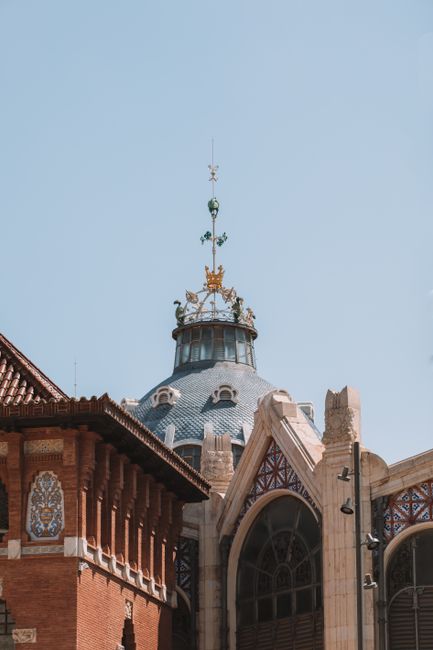
Why it is on the list: this is one of the most beautiful market halls in Europe. The modernist building opened on 23 January 1928, with domes of iron, glass and ceramic tile (the central one rises 30 meters) topped by weathervanes of a parrot and a fish. Inside, the stalls run along straight aisles under the light from the domes, and the building was designed for 959 stalls.
What to eat: Valencia’s huerta, the farmland around the city, fills the produce stalls with oranges, tomatoes and vegetables. Look for jamón and cured sausages, local cheeses, salted fish, nuts and dried fruit, then sit down at one of the counters in the section for food to eat on the spot or take away.
When to go: Monday to Saturday, 7:30 a.m. to 3 p.m.; closed on Sundays. This is a morning market, so arrive before 11 a.m., when locals do their shopping and the fish stalls are at their best.
Practical note: the market is on Plaça Ciutat de Bruges in the old town, across from the Lonja de la Seda, so you can see both in one visit. See our Valencia travel guide and Spain travel guide.
3. Les Halles de Lyon Paul Bocuse, Lyon, France
Why it is on the list: Lyon is one of France’s great food cities, and this covered market is where its chefs and home cooks buy the best of the region. Lyon’s first covered market opened in 1859; the current hall in the Part-Dieu district opened on 1 January 1971, and after a renovation the market took the name of chef Paul Bocuse, who proposed it. More than 50 independent merchants trade here.
What to eat: sit at an oyster bar with a dozen oysters and a glass of white wine, then try Lyon’s own foods: Saint-Marcellin cheese, rosette sausage, pike quenelles, Bresse chicken and a pink praline tart for dessert.
When to go: most stalls open Monday to Saturday 7:30 a.m. to 7:30 p.m. and Sunday 7:30 a.m. to 1 p.m. The restaurants serve lunch only, and the oyster bars open from 9 a.m. to 10 p.m. (to 4 p.m. on Sundays). Late morning on a weekend has the best atmosphere; arrive by 11 a.m. if you want a seat at a counter.
Practical note: it is about a five-minute walk from Part-Dieu station. Each merchant sets its own hours, and some close on Mondays. See our Les Halles Paul Bocuse guide, Lyon travel guide and France travel guide.
4. Spice Bazaar (Mısır Çarşısı), Istanbul, Turkey
Why it is on the list: the Spice Bazaar, also called the Egyptian Bazaar, has been trading for about 400 years. It was built as part of the New Mosque (Yeni Cami) complex by the Eminönü ferry docks, a project started in 1597 and completed in 1663–64. Under its vaulted roof, 113 shops sell spices, sweets and food gifts, and the streets around it are where many locals do their own shopping.
What to eat: taste Turkish delight (lokum) in many flavors, dried fruit and nuts, and Turkish tea, and smell your way through the spice stalls.
When to go: Istanbul’s governorship lists opening hours of 8 a.m. to 7:30 p.m. The bazaar closes on Republic Day (29 October) and on religious holidays. Go in the first hour after opening, before the tour groups arrive, or in the late afternoon, then catch a ferry across the Bosphorus.
Practical note: the bazaar welcomes tens of thousands of visitors a day, and shopkeepers are used to serving travelers in several languages. It is next to the Eminönü ferry piers, so it pairs well with a Bosphorus ferry ride. See our Istanbul travel guide and Turkey travel guide.
5. Nishiki Market, Kyoto, Japan
Why it is on the list: known as “Kyoto’s kitchen,” Nishiki Market is a narrow covered shopping street about 390 meters long with more than 100 shops and some 400 years of history.
What to eat: Kyoto pickles (tsukemono), fresh fish and seafood, seasonal Kyoto vegetables, soy-based foods, and Japanese sweets.
When to go: there are no market-wide hours; each shop sets its own, and most open during the day and close by early evening, with some taking a weekday off. The whole market closes from 1 to 3 January. Late morning, when the shops are open but before the lunchtime crowd, is the most pleasant time.
Practical note: the market asks visitors not to eat while walking. Eat in front of the shop where you bought the food, or inside it. The nearest stations are Shijo (Karasuma subway line) and Karasuma (Hankyu line), about three minutes’ walk away. See our Kyoto travel guide and Japan travel guide.
6. Gwangjang Market, Seoul, South Korea
Why it is on the list: founded in 1905, Gwangjang was Korea’s first permanent market, and it still sells silk, fabrics and dried goods. For travelers, though, the draw is the food street at its heart, where cooks at long counters fry, slice and serve in front of you.
What to eat: start with bindaetteok, a crisp mung bean pancake fried to order, and mayak gimbap, small seaweed rice rolls. Then try kalguksu (hand-cut noodles), kimchi mandu (dumplings), hoe (raw fish) and, for something sweet, hotteok, a filled pancake.
When to go: the general market is open 9 a.m. to 6 p.m. and the food street 9 a.m. to 11 p.m. The market closes on Sundays, but the food street opens all year round. Come for a late lunch on a weekday, or in the evening when the food street is at its liveliest.
Practical note: the market is at 88 Changgyeonggung-ro in Jongno-gu, and it is easy to reach by subway. Our phrase cards help with ordering. See our Seoul travel guide and South Korea travel guide.
7. Pike Place Market, Seattle, United States
Why it is on the list: on 17 August 1907, a handful of farmers brought their wagons to Pike Place and sold out by lunchtime. More than a century later the market covers a 9-acre historic district above the waterfront, with a working farmers market, specialty food shops, craft stalls and about 50 restaurants and eateries.
What to eat: Pacific Northwest seafood is the star: salmon, crab, oysters and chowder. Watch the fishmongers at Pike Place Fish Market toss fish across the counter, a show they have been putting on at a stall that has traded since 1930, then graze on fresh fruit, pastries and local cheese.
When to go: the market is open every day; most businesses keep 10 a.m. to 5 p.m., while produce and seafood stalls and breakfast spots open earlier and some restaurants stay open late. It closes only on Thanksgiving and Christmas Day. Come early in the morning to see the stalls set up, or on a weekday to avoid the summer and weekend crowds.
Practical note: the market is at 85 Pike Street, a short walk from downtown hotels. Our tip calculator helps at the sit-down counters. See our Seattle travel guide and United States travel guide.
8. Mercado Municipal (Mercadão), São Paulo, Brazil
Why it is on the list: opened on 25 January 1933, the Mercadão is a grand hall of more than 290 stalls in the historic center of Brazil’s biggest city. Look up: the hall is lit by 32 stained-glass panels, made up of 72 windows, by the artist Conrado Sorgenicht Filho.
What to eat: the famous dish is the mortadella sandwich, piled absurdly high with thin-sliced mortadella, which became a São Paulo classic from the 1960s. Try a pastel de bacalhau (salt-cod pastry) too, then walk the fruit stalls for Brazilian fruits you may never have seen.
When to go: Monday to Saturday 6 a.m. to 6 p.m., and Sundays and public holidays 6 a.m. to 4 p.m. Go mid-morning on a weekday, then have the sandwich for an early lunch before the line builds.
Practical note: the market is at Rua Cantareira 306 in the city center. The sandwiches are big enough to share. See our São Paulo travel guide and Brazil travel guide.
9. Queen Victoria Market, Melbourne, Australia
Why it is on the list: officially opened on 20 March 1878, the “Queen Vic” spreads over two city blocks at the edge of the Central Business District, with more than 600 small businesses. It is on Australia’s National Heritage List as a rare surviving 19th-century city produce market.
What to eat: the Meat and Fish Hall and the Dairy Produce Hall are the heart of the market, with deli counters, cheese, bread and Turkish börek. Around the halls, food stalls serve dumplings, noodles and pastries, and the fruit and vegetable sheds show off Australian produce.
When to go: Tuesday to Friday 6 a.m. to 3 p.m., Saturday 6 a.m. to 4 p.m. and Sunday 9 a.m. to 4 p.m.; specialty shopping opens at 9 a.m. The market does not trade on Mondays or Wednesdays during the day. Saturday morning is the liveliest time. In winter the market hosts a Wednesday night market, and a Christmas night market is announced on the night market’s website.
Practical note: works are under way around parts of the market, including a car park exit, so check the official site for any changes before you go. See our Melbourne travel guide and Australia travel guide.
10. Neighbourgoods Market, Cape Town, South Africa
Why it is on the list: held in the Old Biscuit Mill in Woodstock, this weekend market set off Cape Town’s market scene more than a decade ago. It is smaller and younger than the historic halls on this list, but it is a lively showcase of the city’s food, with local producers, food stalls and coffee in a converted industrial building.
What to eat: walk the stalls first, then build a lunch from fresh bread, cheese, local produce and whatever the cooks have on the grill that day, with coffee from one of the roasters at the Mill.
When to go: Saturday 9 a.m. to 3 p.m. and Sunday 10 a.m. to 4 p.m. Saturday morning is the classic visit; arrive soon after opening for the best choice and an easier time getting around.
Practical note: the Mill is at 373–375 Albert Road, Woodstock. There is no parking inside the Mill on Saturdays, but secure parking is offered across the street. Traders take cards and contactless payments, and there are ATMs on site. See our Cape Town travel guide and South Africa travel guide.
Plan your trip
Want to build a trip around food? Our free trip planner makes a day-by-day plan for your dates, travelers and budget from our guides, and you can ask it to fit a market morning into each day. Before you go, the money exchange tool helps you read the price tags, and travel costs by country shows how far your money goes in each place.
Frequently asked questions
What is the best food market in the world?
There is no single winner, but Borough Market in London, the Mercado Central in Valencia and Nishiki Market in Kyoto are on almost every food lover’s list. Choose by what you like to eat.
What is the best time of day to visit a food market?
Morning, for most of them. Produce and fish are freshest early, and the crowds are thinner. Valencia’s Mercado Central closes at 3 p.m., so it is a morning-only market. Seoul’s Gwangjang food street is the exception: it stays open until 11 p.m. and is liveliest in the evening.
Is Borough Market open on Mondays?
No. Borough Market opens Tuesday to Friday 10 a.m. to 5 p.m., Saturday 9 a.m. to 5 p.m. and Sunday 10 a.m. to 4 p.m., and closes on Mondays. Hours change around Christmas and on bank holidays.
Can you eat while walking at Nishiki Market?
The market asks visitors not to. Eat your food in front of the shop where you bought it, or inside the shop.
Which of these markets is open on Sundays?
Borough Market, Les Halles in Lyon (mornings), the Spice Bazaar in Istanbul, Pike Place Market, the Mercadão in São Paulo, the Queen Victoria Market and the Neighbourgoods Market all open on Sundays. In Seoul, Gwangjang’s food street opens all year round even though the rest of the market closes on Sundays. Valencia’s Mercado Central is closed on Sundays, and in Kyoto it depends on the shop.